Sunday Selection

It’s not often that I buy a book and start reading it straight away, mainly because I’ll be already reading one or more and also because I have a huge stack of unread books. But Bring Up the Bodies arrived in the post at just the right time, as I’d just finished reading one book and was ready for the next.
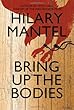
Bring Up the Bodies by Hilary Mantel is the sequel to Wolf Hall, which I read and loved in 2010.  I’ve been looking forward to reading it ever since I finished reading Wolf Hall. So, even with a large backlog of books to be read, I just had to start Bring Up the Bodies straight away. It’s like catching up with friends you haven’t seen for a while – it begins in September 1535, just a few days after Wolf Hall finished. Thomas More was executed and now Henry VIII and his retinue are staying at Wolf Hall, the home of the Seymour family. And so, the story continues. This book covers the fall of Anne Boleyn, but like Wolf Hall, it’s about the career of Thomas Cromwell, Secretary to the king, Master of the Rolls, Chancellor of Cambridge University, and deputy to the king as head of the church in England.

I’m now on page 101, a quarter of the book read, and am trying to read it as slowly as possible, soaking up the atmosphere and Hilary Mantel’s richly descriptive words. Interestingly, I’ve noticed that every now and then, she qualifies who ‘he‘ is: ‘he, Cromwell‘, removing the ambiguity found in Wolf Hall. I hadn’t realised until I read the Author’s Note that this is not the end of Thomas Cromwell or the end of Hilary Mantel’s efforts to write about him:

This book is of course not about Anne Boleyn or about Henry VIII, but about the career of Thomas Cromwell, who is still in need of attention from biographers. Meanwhile, Mr Secretary remains sleek, plump and densely inaccessible, like a choice plum in a Christmas pie; but I hope to continue my efforts to dig him out. (page 410)
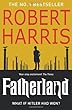
But I’ve also realised that I need to read Fatherland by Robert Harris, because this is the book we’ll be discussing at my face-to-face book group at the end of May and I hadn’t started it yet. So this morning I began to read it.

Whilst Bring Up the Bodies is most definitely historical fiction, Fatherland is more difficult to categorise. It’s set in Germany in 1964, but not the historical Germany of that date, because Hitler is approaching his 75th birthday, and Germany had won the Second World War – it’s historical fiction that never was – an alternative history. And yet many of the characters actually existed, their biographies are correct up to 1942 and Harris quotes from authentic documents in the book. The Berlin of the book is the Berlin that Albert Speer planned to build. What is definite is that this is a murder mystery, beginning with the discovery of the naked body of an old man, lying half in a lake on the outskirts of Berlin. The homicide investigator is Xavier March of the Kriminalpolizei and the victim is a member of the Nazi Party. It promises to be a thrilling page-turner.

I don’t think I’ll have any trouble reading the two books in tandem, as there’s no chance that I’ll mix up the characters or plots. :)

A Place of Greater Safety by Hilary Mantel: a Book Review

Given a choice of reading one long book or several shorter books, in the past I’ve always gone for the long book, as I like to got lost in a book, but more recently I’ve preferred shorter books. So this is the reason that Hilary Mantel’s A Place of Greater Safety has sat on my bookshelves unread for a few years. It took me over a month to read it and I did pause for a while to read other shorter books in between. And this book is certainly a book that takes you to another time and place.

It is a remarkable book about the French Revolution concentrating on three of the revolutionaries – Georges-Jacques Danton, Camille Desmoulins and Maximilian Robespierre, from their childhoods to their deaths. Along with these three main characters there is a whole host of characters and without the cast list at the beginning of the book I would have struggled to keep track of them. In fact, some of the lesser characters were just names to me and I never saw them clearly, but that didn’t surprise or deter me, given the enormity of the task of chronicling the events of the French Revolution.

But the main characters stand out and there are also vivid portraits of such people as Mirabeau (a renegade aristocrat), Lafayette (a general in the American Revolutionary War and a Commander of the French National Guard), Louis XVI and Marie Antoinette. I was also fascinated to read about Jean-Paul Marat  (he who was murdered in his bath), the Marquis de Sade and Pierre de Laclos (Les Liaisons Dangereuse) – I didn’t know anything about de Sade’s and de Laclos’s involvement in the Revolution.

My European History at school stopped at 1789, so although I remembered listing the causes of the Revolution and the events that led up to it, my knowledge of the main event, as it were, is patchy and incomplete, mainly gathered from books such as A Tale of Two Cities and TV programmes over the years. I found the first part of A Place of Greater Safety covered much of the ground that I was familiar with, but seen through the eyes of the three main characters as they grew up.

Despite Mantel’s insight into the personal lives and characters of the three main protagonists I never really sympathised with any of them – after all they were responsible for the deaths of many people, including their own friends and played a major part in the Reign of Terror. But at times I was drawn into hoping that they would escape their fate – they were all guillotined. They were all lawyers who grew up in the provinces, knew each from their youth and moved to Paris.

Camille Desmoulins is perhaps the star of the book. It was he who instigated the storming of the Bastille. He was by all accounts a charismatic character, despite his stutter. He and Danton lived close to each other, and Danton, a large, loud and ugly man who had the power of captivating his audiences, had a liaison with Lucille, Camille’s wife. Robespierre was a much cooler character and his involvement in the Terror (in which many people lost their heads) was chilling. But even he came over under Mantel’s pen as almost a likeable human being, revealing his weaknesses as well as his power. As long as he could he shielded Danton and Camille as opposition to them grew.

Unlike Wolf Hall, this book isn’t written in the first person, but it moves between the first and third person points of view, giving an almost panoramic view of the characters and their attitudes to the Revolution. It really is written in a most diverse style, moving between locations, characters and even tense. There are also passages written as script-style dialogue, passages from recorded speeches and pamphlets, ‘woven’ into Mantel’s own dialogue. She writes in her Author’s Note that this is not an impartial account and she has tried to see the world as her characters saw it, so where she could she used their own words.

The events of this book are complicated, so the need to dramatize and the need to explain must be set against each other. …

I am very conscious that a novel is a co-operative effort, a joint venture between writer and reader. I purvey my own version of events, but facts change according to your viewpoint. …

I have tried to write a novel that gives the reader scope to change opinions, change sympathies: a book that one can think and live inside. The reader may ask how to tell fact from fiction. A rough guide: anything that seems particularly unlikely is probably true. (pages ix-x)

I think, for me, that Hilary Mantel succeeded with this book. I have struggled reading other books written in the present tense, but either I’m getting more used to it, or Hilary Mantel’s style has won me over. Either way, reading this book and Wolf Hall has been a pleasure – ‘real journeys’ into other times and places.

  • Paperback: 880 pages
  • Publisher: Fourth Estate; (Reissue) edition (4 Mar 2010)
  • Language English
  • ISBN-10: 000725055X
  • ISBN-13: 978-0007250554
  • Source: my own copy
  • My Rating: 4/5

Today I’m eagerly waiting for the follow up to Wolf Hall to be delivered to my letter box: Bring Up the Bodies is published today and I’ve had an email saying it’s on its way to me.

Book Beginnings

Some books sit unread on my bookshelves for quite a long time before I read them. Then when I do pick them up I wonder why on earth I’ve left them so long – they look so good.

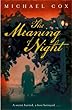
The Meaning of Night by Michael Cox is one of these many unread books of mine. I am shocked to see from my LibraryThing catalogue that I’ve had this book since August 2007, not long after I started writing this blog – no doubt I’d read about it on another book blog.

It begins:

After killing the red-haired man, I took myself off to Quinn’s for an oyster supper.

It had been surprisingly – almost laughably – easy.

The first chapter is called Exordium and a footnote explains that this means ‘an introduction to a treatise or discourse’. A second footnote tells me that ‘Quinn’s’ is a shell fishmonger and supper house at 40, Haymarket. So, not only is this a dramatic opening the first few lines tell me this is an historical murder mystery set in London, most likely to be in the Victorian period, all of which makes me want to read on.

Reading the back cover it seems that this book is following on in the tradition of Wilkie Collins and Charles Dickens, described as a ‘tale of obsession, love and revenge, played out amid London’s swirling smog’, an ‘extraordinary story of Edward Glyver, book lover, scholar and murderer.’

I think one of the reasons I haven’t read it before now is that not only is it nearly 600 pages long, my copy is printed in a small font!

Book Beginnings ButtonSee more Book Beginnings on Friday at Gilion’s blog Rose City Reader.


Daphne du Maurier: Fact and Fiction

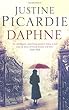
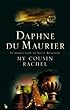
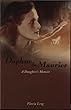
Recently I’ve had a bit of a run on books by and about Daphne du Maurier. First of all I read The Parasites, which reminded me that I’d had Justine Picardie’s novel, Daphne sitting on my bookshelves unread, so I immediately got it down. Then I just had to read My Cousin Rachel, a book I’ve had for years and never got round to reading before now. After that I read Daphne du Maurier: a Daughter’s Memoir by Flavia Leng, just because it was one of the books Justine Picardie consulted in writing her novel. I’ve previously read Margaret Forster’s biography Daphne du Maurier and Daphne du Maurier’s The ‘Rebecca’ Notebook and Other Memories, which is mainly autobiographical.

Daphne by Justine Picardie (2008) – synopsis (from the back cover):

It is 1957. As Daphne du Maurier wanders alone through her remote mansion on the Cornish coast, she is haunted by thoughts of her failing marriage and the legendary heroine of her most famous novel, Rebecca, who now seems close at hand. Seeking distraction, she becomes fascinated by Branwell, the reprobate brother of the Bronte sisters, and begins a correspondence with the enigmatic scholar Alex Symington in which truth and fiction combine. Meanwhile, in present day London, a lonely young woman struggles with her thesis on du Maurier and the Brontes and finds herself retreating from her distant husband into a fifty-year-old literary mystery.

My view: 4/5

This book merges fact and fiction so well that it’s hard to differentiate between the two. I much preferred the story of Daphne herself and her search for information about Branwell. I had to go back to Forster’s biography of Daphne to compare the accounts of her life, which matched up pretty well. I was less keen on the modern day story of a young woman, the second wife of an older man. It had too many obvious parallels with Rebecca for my liking. And if you haven’t read Rebecca, this book gives away the plot. There are also references to My Cousin Rachel, which I glossed over in case there were any spoilers there too (I don’t think there were). All in all, a very satisfying mystery about Daphne and the missing Bronte documents.

My Cousin Rachel by Daphne du Maurier (1951) – synopsis (Amazon):

Orphaned at an early age, Philip Ashley is raised by his benevolent older cousin, Ambrose. Resolutely single, Ambrose delights in Philip as his heir, a man who will love his grand home as much as he does himself. But the cosy world the two construct is shattered when Ambrose sets off on a trip to Florence. There he falls in love and marries – and there he dies suddenly. In almost no time at all, the new widow – Philip’s cousin Rachel – turns up in England. Despite himself, Philip is drawn to this beautiful, sophisticated, mysterious woman like a moth to the flame. And yet …might she have had a hand in Ambrose’s death?

My view: 4/5

I thoroughly enjoyed this book, completely taken in by the characters and loving the setting in an old mansion in Cornwall. The story is narrated by Philip, so the other characters are seen through his eyes. The tension mounts as Philip becomes obsessed with Rachel and I was never quite sure what was real and what to believe. He is not a stable character and as Rachel’s own thoughts are not revealed it’s not clear if she can be believed either, whether she is sincere or evil and manipulative.

Daphne du Maurier: a Daughter’s Memoir (1994) – synopsis (from the back cover):

In this moving and revealing memoir, Flavia Leng paints a powerful portrait of her mother, Daphne du Maurier. She presents an account of an unusual and often lonely childhood spent in London and especially Cornwall, at her mother’s beloved home, Menabilly. Family friends included Nelson and Ellen Doubleday, Gertrude Lawrence and Noel Coward. However, at the centre of this story is Daphne du Maurier herself. The book reveals a writer with a deep attachment to Cornwall, where she put down her roots and found inspiration for her novels, and who spent much of her life as a recluse, withdrawn not only from the outside world but also from members of her own family. A picture emerges of a woman who lived in a world of her own creation that was beyond the comprehension of those around her.

My view: 3.5/5

In the epilogue Flavia Leng, Daphne du Maurier younger daughter, explained that she began to write this memoir of her childhood two years before her mother died in 1989 and it was never meant for publication – it was just for the family. And that to me epitomises this memoir – it’s an account of her childhood and of her family as seen through a child’s eyes. It seems a lonely childhood, despite being the middle child. As children Flavia and her older sister Tessa didn’t get on and both she and Tessa saw that their mother lavished more affection on her beloved son, Christopher who they called Kits. But a picture emerges of Daphne, who they called Bing, as a solitary person, closeted away with her typewriter or lost in her world of ‘never, never land’, peopled by the characters she invented, with little time for her children, who were looked after by Nanny and then ‘Tod’, their governess.

Like her mother Flavia has a great love of Cornwall which shines through the book – she was never happier than when alone in Menabilly and the surrounding woodlands. It’s a sad memoir ending with Flavia feeling she had no roots left after her parents died:

I have heard it said that a person only really grows up when both parents have gone; what I do know is that life will never be quite the same again. Cornwall no longer holds the enchantment it once did. Gone is the excitement of driving down those leafy, winding roads to the lovely old houses, my beloved Menabilly, and then later Kilmarth where Bing lived out her years.

The Village by Marghanita Laski: A Book Review


Persephone edition endpapers

The Village was first published in 1952 and chronicles life in an English village immediately after the end of the Second World War. It begins with two women meeting to go on duty at the Red Cross post as they had done throughout the war. They are from different ends of the village, Wendy Trevor from up the hill where  the gentry live and Edith Wilson from Station Road where the working-class live.  Both knew that the breaking down of social barriers had just been one of those things that happened during a war. Mrs Wilson acknowledged that she would miss the camaraderie:

‘There’s a lot of us will miss it’, Edith said. ‘We’ve all of us felt at times, you know, how nice it was, like you and me being able to be together and friendly, just as if we were the same sort, if you know what I mean.’ (page19)

But the war had changed much and the social barriers were rising, but when Wendy’s daughter, Margaret, falls in love with Edith’s son, Roy, the Trevors are horrified and refuse to give their permission for the couple to marry. Margaret does not have the same attitude as her parents:

‘The trouble with you, Miss Margaret, is that you’ve got no sense of class.’ (page 113)

I thought at first that this book was not as good as Laski’s Little Boy Lost, which I loved, but as I read on I realised the simple direct style of writing contained depth and complexity and  by the end I was convinced I was living in the village, amongst these people at the end of the war. It’s not as heart-rending as Little Boy Lost, but it is absorbing reading.

The Village is not only a love story, it’s a novel exploring the issues of class and social mobility, family relationships, parental control and the position of women. Although the Trevors and the Wilsons are the main characters, it’s a novel about the whole community,with a list of all the characters at the beginning of the book, including their station in life.

Included in the mix are the Wetheralls, Ralph and his American wife, Martha. They provide an interesting perspective on the complex British class system, comparing it with the American attitudes to different groups of people. Ralph, a business man, explains to Martha because they’re in ‘trade’, the Trevors who are gentry but hard up, still look down on them – and class is still most important. Martha wants to help Margaret and can’t understand that class doesn’t go by money, until Ralph points out that it was the same in America – ‘Plenty of your old Boston families are nearly as poor as the Trevors, but they still look down their noses at everyone else.’ (page 166)

He goes even further comparing the position of the working-classes in Britain to that of negroes in the United States, not the southern states but in the ‘enlightened North‘:

‘Many’s the time I’ve sat in your mother’s apartment in New York and heard you all talking in a broadminded way about treating the negro properly, but I’ve never come in and found a black man dropped in casually for cocktails, and I wouldn’t expect it, any more that I’d expect to find the Trevors  accepting Roy Wilson as a son-in-law.

Honestly now, you wouldn’t have married a negro, would you? You’d do your best to stop your daughter from marrying a negro. Well, you take my word for it, the Trevors will feel just the same way about Margaret marrying Roy Wilson, if there’s any question of it, which I very much doubt.’ (pages 231-2)

It ‘s certainly a book I’d like to re-read.

  • Paperback: 312 pages
  • Publisher: Persephone Books Ltd; First Edition edition (22 Sep 2004)
  • Language English
  • ISBN-10: 1903155428
  • ISBN-13: 978-1903155424
  • Source: I borrowed the book from a friend, and now want my own copy!
  • My Rating: 5/5

I wrote about the beginning of The Village here.

Best new-to-me authors – January to March 2012

Kerrie at Mysteries in Paradise has started a new meme. The idea is to write a post about the best new-to-you crime fiction authors (or all) you’ve read so far this year, 2012. The books don’t necessarily need to be newly published. The meme will run at the end of June, September and December this year.

So far this year I’ve read 10 books by ‘new-to-me’ authors, but only 2 of those are crime fiction. They are:

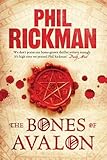
The Bones of Avalon by Phil Rickman, which I read it in January on my Kindle and didn’t have time to write about it. Phil Rickman is not a new author, of course. I had heard of him but had never read any of his books. He has written several books – 11 in the Merrily Watkins series, 6 other novels, including The Bones of Avalon, and a non-fiction book.

The Bones of Avalon set in 1560, is however, Rickman’s first historical crime fiction novel, a genre I particularly like. It has everything, mystery, murder,and witchcraft as Dr John Dee (one of my favourite historical characters – I really enjoyed Peter Ackroyd’s The House of Dr Dee) sets out to discover the whereabouts of King Arthur’s bones. His search takes him to Glastonbury and into danger. Phil Rickman writes on his websiteThis novel is actually the hardest thing I’ve ever done. I think he pulled it off very well and I hope to read some of his other books.

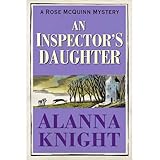
The second new-to-me crime fiction author is Alanna Knight, another well established writer whose work I haven’t come across before. There is a Kindle edition of The Inspector’s Daughter, but I found a copy in my local library.

I wrote a a Book Beginnings post about it and a short account of it earlier – see here. For more details of Alanna Knight’s many books see her website.

I rated both of these books 3.5/5 and both Alanna Knight and Phil Rickman are now on my list of authors to look out for.

The other ‘new-to-me’ authors are (with links to my posts) :