R.I.P. VII wrap-up

R.I.P. VII, hosted by Carl, has come to its end – the time has just flown by.

I chose Peril the First – ‘˜Read four books, any length, that you feel fit (the very broad definitions) of R.I.P. literature. It could be King or Conan Doyle, Penny or Poe, Chandler or Collins, Lovecraft or Leroux’¦or anyone in between.’

Mystery.
Suspense.
Thriller.
Dark Fantasy.
Gothic.
Horror.
Supernatural.
Or anything sufficiently moody that shares a kinship with the above.

I completed the challenge as many of the books I read in September and October fitted into these categories. I read:

  1. Death of a Red Heroine by Qiu Xialong
  2. Dark Matter: a Ghost Story by Michelle Paver
  3. The Sixth Lamentation by William Brodrick
  4. Maigret and the Ghost by Georges Simenon
  5. The War of the Worlds by H G Wells
  6. The Four Last Things by Andrew  Taylor
  7. The Judgement of Strangers by Andrew Taylor
  8. Fear in the Sunlight by Nicola Upson
  9. The Chalk Circle Man by Fred Vargas
  10. The House of Silk by Anthony Horowitz
  11. Hickory Dickory Dock by Agatha Christie
  12. The Expats by Chris Pavone

The ones that stand out as the scariest are The Four Last Things by Andrew Taylor and Dark Matter by Michelle Paver. Sometimes life gets in the way of blogging  so I haven’t had time to write about The War of the Worlds or The House of Silk, but those are good books too and I am aiming to write about The House of Silk – the new Sherlock Holmes Novel!

October Prompt: A Classics Challenge

This month’s prompt in Katherine’s Classics Challenge 2012 is:

Chapter Musings
Jot down some notes about the chapter you’ve just read or one that struck you the most. It can be as simple as a few words you learned, some quotes, a summary, or your thoughts and impressions.

I’ve just started to read The French Lieutenant’s Woman by John Fowles. (I have read this book years ago and seen the film.) The first chapter is very short and sets the scene in a few paragraphs. The narrator is looking back to March 1867, presumably from the twentieth century. Three characters are present, none named in this first chapter, a man and a woman walking along the Cobb, ‘ a long claw of old grey wall that flexes itself against the sea’, and a solitary figure, standing at the end of the Cobb:

It stood right at the seawardmost end, apparently leaning against an old cannon-barrel upended as a bollard. Its clothes were black. The wind moved them, but the figure stood motionless, staring, staring out to sea, more like a living memorial to the drowned, a figure from myth, than any proper fragment of the petty provincial day.

The narrator is authoritative, contrasting the Victorian Lyme of a hundred or so years earlier with that of the present day and contrasting the style of dress and manners. There are literary and historical allusions, including the verse (quoted at the beginning of the chapter) from Thomas Hardy’s poem ‘The Riddle‘, and the vocabulary is also formal and academic. There are some unfamiliar words – just what I wondered are ‘dundrearies’ that the gentleman (for that is what is implied) was wearing:

… the taller man, impeccably in a light grey, with his top hat held in his free hand, had severely reduced his dundrearies, which the arbiters of the best English fashion had declared a shade vulgar – that is, risible to the foreigner – a year or two previously.

I had to look up this word – ‘dundrearies’ were long sideburns worn with a clean-shaven chin (a bit like Bradley Wiggins, who won this year’s Tour de France, maybe?).  There is also a hint that there is more to this story than a love story, for there is also a ‘local spy’.

This first chapter promises an intriguing novel.

Crime Fiction Alphabet: U

This week’s letter in Kerrie’s Crime Fiction Alphabet is letter-u

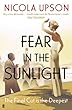
I’ve chosen Nicola Upson’s Fear in the Sunlight, the fourth novel featuring Josephine Tey, which I read on Kindle.

Summary from Fantastic Fiction:

Summer, 1936. The writer, Josephine Tey, joins her friends in the holiday village of Portmeirion to celebrate her fortieth birthday. Alfred Hitchcock and his wife, Alma Reville, are there to sign a deal to film Josephine’s novel, A Shilling for Candles, and Hitchcock has one or two tricks up his sleeve to keep the holiday party entertained – and expose their deepest fears. But things get out of hand when one of Hollywood’s leading actresses is brutally slashed to death in a cemetery near the village. The following day, as fear and suspicion take over in a setting where nothing – and no one – is quite what it seems, Chief Inspector Archie Penrose becomes increasingly unsatisfied with the way the investigation is ultimately resolved. Several years later, another horrific murder, again linked to a Hitchcock movie, drives Penrose back to the scene of the original crime to uncover the shocking truth.
My thoughts:

I have mixed thoughts about this book, good and not so good. Overall I enjoyed it but I found it confusing with so many characters, introduced very quickly in the novel, and it was difficult to distinguish who they all were, with the exception, of course, of Josephine Tey and Alfred Hitchcock. So, not well-defined characters.

However, the setting in Portmeirion is very well done and if you like lots of description that’s a bonus. I do like description, up to a point, but in this book I thought it intruded too much and held up the action. (Portmeirion is Sir Clough Williams-Ellis’s Italianate creation in the Welsh countryside. It’s also the setting for the 1960s TV series, The Prisoner, if you remember that as I do.) Set in the thirties it does give a good sense of the period between the two world wars with the shadow of the Great War still lingering and the threat of another war getting ever nearer. There is a general air of unhappiness, as Alma, Hitchcock’s wife says:

Perhaps it’s the times we have lived through, but we seem very good at destroying each other and not just through wars. We wear each other down all the time through little acts of jealousy or cruelty or greed. (location 1731)

And there are many such acts in Fear in the Sunlight as the murders pile up. I didn’t really have much idea what was going on until about halfway into the book when the writing became sharper, more focussed on the plot and characters.

I was interested in Nicola Upson’s inclusion of a discussion about writing, about mixing fact and fiction and also about the difference between a book and the film of the book. Here Josephine and Marta are talking about mixing fact and fiction, which is exactly what Nicola Upson does in her books:

‘Mix fact and fiction?’ Josephine asked, and Marta had to laugh at the disapproval in her voice. ‘How would that help restore the reputation of a much aligned man? No one would know what was true and what wasn’t.’

‘Exactly. That’s the fun of it. And a biography would only be your interpretation. At least calling it fiction is honest.’ (location 3548)

Josephine is at Portmeirion to discuss making a film of her book, A Shilling for Candles, with Alfred and Alma Hitchcock. She’s sceptical about the process of using her book as the basis for a film, but Alma tells her:

‘A film can’t just be a visual record of a book or it will never have a life of its own,’ she said.  … ‘It’s like any marriage, I suppose. The two things can coexist if they’re both good in their own right, and it doesn’t have to be one at the expense of the other.’ (locations 1612-1620)

I’ll try to remember that next time I get irritated at the way a film or TV drama alters a book.

I think that Alfred Hitchcock is really the main character and I don’t know enough about him to be able to distinguish fact from fiction in Fear in the Sunlight, nor do I know that much about the thirties either to judge whether that’s an accurate picture, but I have no doubt that Nicola Upson has done her research. Hitchcock seems to have been a complicated and difficult character, a practical joker and a manipulator:

An experiment in fear and guilt, he had called it, but an exercise in control would have been more accurate. Staging a joke, like making a film, was a way of holding on to power, and Hitchcock had discovered long ago that the manipulation involved in both helped him to forget his own anxieties and doubts. (location 1088)

As you would expect he is a master of suspense:

‘Fear of the dark is natural, we all have it, but fear in the sunlight, perhaps fear in this very restaurant, where it is so unexpected – that is interesting’. (location 3465)

  • Format: Kindle Edition (also available in paperback)
  • File Size: 821 KB
  • Print Length: 432 pages
  • Publisher: Faber and Faber Crime (3 April 2012)
  • Sold by: Amazon Media EU S.à r.l.
  • Language: English
  • ASIN: B007JVF6U2
  • Source: My own copy
  • My Rating 3/5

September’s Books

September was a good month for reading. In total I read 10 books:

I read 4 crime fiction, 4 non fiction, 1 ghost story and 1 science fiction. Two of the books were library books, 3 borrowed from a friend and 4 books were from my to-be-read books (books I’ve owned before January 2012).

It’s not been such a productive month for writing about the books I’ve read – more reading means less writing. So I’ve not previously written about the book I’ve chosen as my Pick of the Month. For more ‘Picks of the Month’ see Kerrie’s blog Mysteries in Paradise.

It is, by a short margin, The Sixth Lamentation by William Brodrick, the first Father Anselm novel.

Synopsis from Fantastic Fiction:

What should you do if the world has turned against you? When Father Anselm is asked this question by an old man at Larkwood Priory, his response, to claim sanctuary, is to have greater resonance than he could ever have imagined. For that evening the old man returns, demanding the protection of the church. His name is Eduard Schwermann and he is wanted by the police as a suspected war criminal.

With her life running out, Agnes Aubret feels it is time to unburden to her granddaughter Lucy the secrets she has been carrying for so long. Fifty years earlier, Agnes had been living in Occupied Paris, a member of a small group risking their lives to smuggle Jewish children to safety – until they were exposed by a young SS Officer: Eduard Schwermann.

As Anselm attempts to uncover Schwermann’s past, and as Lucy’s search into her grandmother’s history continues, their investigations dovetail to reveal a remarkable story.

It’s my Pick of the Month because it is historical fiction and it’s also a mystery. It looks back  to the Second World War in occupied France, telling a dramatic tale of love and betrayal, full of suspense, and interwoven stories.William Brodrick explains in his Author’s Note that the novel weaves fact and fiction, with accurate details of life in Paris during the Occupation and the subsequent war trials. He gathered facts for his novel from a variety of sources, although he has taken ‘small liberties’ with some of them.

William Brodrick has also drawn on his own personal experience. He was formerly in religious life but left before his final vows. He has degrees in philosophy and theology and after studying law he became a barrister, specialising in personal injury. The idea of smuggling Jewish children out of the Nazis’ hands was prompted by the war time experience of his own mother, Margaretha Duyker. She was part of a smuggling ring and took a child out of Amsterdam by train to Arnhem. She was caught by the Gestapo and imprisoned and eventually released. She died of motor neurone disease (the disease that Agnes is suffering from) in 1989.

I’ve read one other book by William Brodrick – The Gardens of the Dead, also a Father Anselm book. There are two more:

The Sixth Lamentation also fits into the R.I.P.VII Challenge.

Dark Matter: a Ghost Story by Michelle Paver

Dark Matter

My first book for the R.I.P. VII Challenge is a chilling book, very chilling, both in the setting in the High Arctic and in atmosphere. I was glad I wasn’t reading Dark Matter by Michelle Paver in the dead of winter, snowbound and alone, because then it would have been terrifying. The isolation of the long, dark Arctic winter is oppressive and unrelenting.

It’s a ghost story in the form of a diary – that of Jack Miller who in 1937 was part of an expedition to the High Arctic to study its biology, geology and ice dynamics and to carry out a meteorological survey. Jack’s role is as radio operator, transmitting observations three times a day to the Government forecasting system.

From the start Jack is very reluctant to go, put off by the other members of the expedition, four ex-public schoolboys. But he’s stuck in a boring job, after giving up his plans to be a scientist and realises this is the only chance he’ll ever get to change his life. Right from the start things begin to go wrong, but Jack remains enthusiastic. Later when they meet Skipper Eriksson, the part owner and captain of the ship taking them to Gruhuken, a remote uninhabited bay where they’re setting up camp, Jack begins to feel increasingly uneasy. Eriksson is reluctant to take them to Gruhuken, but he doesn’t explain why merely saying he doesn’t think it’s ‘right’ for a camp.

Not long after they have set up camp Jack feels oppressed by the isolation brought on by the thought of the men who had been there before them:

Suddenly, I felt desolate. It’s hard to describe. An oppression. A wild plummeting of the spirits. The romance of trapping peeled away, and what remained was this. Squalor. Loneliness. It’s as if the desperation of those poor men had soaked into the very timber, like the smell of blubber on the Isbjørn. (page 65)

The trappers had left behind a ruined mine, a hut ‘crouched among the boulders  in a blizzard of bones‘ and in front of the hut a ‘bear post’ for luring bears to the trappers’ gun. It all makes Jack’s spirits sink. As the ship is leaving the camp, Jack sees a man standing in front of the cabin by the bear post and is relieved when he leaves. Now the members of the expedition are alone with the huskies and Jack’s unease grows. He is disturbed by the change in the weather, the increasingly shorter days and irritated by the other members, in particular by Algie and his insensitivity and cruelty towards the dogs.

Jack’s unease turns into dread as he realises that Gruhuken may be haunted, but his rational mind explains his feeling as an echo:

An echo from the past. … it’s called ‘place memory’, a well-known idea, been around since the Victorians. If something happens in a place – something intensely emotional or violent – it imprints itself on that place; maybe by altering the atmosphere, like radio waves, or by affecting matter, so that rocks, for example, become in some way charged with what occurred. Then if a receptive person comes along, the place plays back the event, or snatches of it. … What I saw was only an echo. (pages 111-2)

As the darkness descends, Jack is left alone at the camp and his nightmare really begins. The book is well-paced, the tension mounts, and paranoia sets in … or is it real, even the dogs are scared. It really is a page-turner and a good old-fashioned ghost story. The relationships between the characters are well drawn, and especially Jack’s relationship with Isaak, one of the huskies. I was most concerned about Isaak!

Jack describes ‘dark matter‘ of the title, as that part of the universe that cannot be seen or detected, but is there. He finds this idea

‘… unsettling. Or rather, not the idea itself, that’s merely an odd notion about outer space. What I don’t like is the feeling I sometimes get that other things might exist around us, of which we know nothing.’ (pages 94-5)

I don’t like that either. It’s scary.

  • Hardcover: 256 pages
  • Publisher: Orion; First Edition edition (21 Oct 2010)
  • Language: English
  • ISBN-10: 1409123782
  • ISBN-13: 978-1409123781
  • Source: I bought the book
  • My Rating: 4/5

Crime Fiction Alphabet: Q

For the letter Q in Kerrie’s Crime Fiction Alphabet I’ve chosen Death of a Red Heroine by Qiu Xiaolong.

Death of a red heroineQX

I  ‘discovered’ Qiu Xiaolong in 2010 during a previous series of the Crime Fiction Alphabet when I wrote about his second book, A Loyal Character Dancer. Death of Red Heroine is his first book featuring Chief Inspector Chen. It won the Anthony Award for Best First Crime Novel in 2001.

Synopsis from the back cover

Shanghai in 1990. An ancient city in a Communist country: looking to the future for its survival. Chief Inspector Chen, a poet with a sound instinct for self-preservation, knows the city like few others. 

When the body of a prominent Communist Party member is found, Chen is told to keep the party authorities informed about every lead. And he must keep the young woman’s murder out of the papers at all costs. When his investigation leads him to the decadent offspring of high-ranking officials, he finds himself instantly removed from the case and reassigned to another area.

Chen has a choice: bend to the party’s wishes and sacrifice his morals, or continue his investigation and risk dismissal from his job and from the party. Or worse . . .

My thoughts:

I think this is as much historical fiction as it is crime fiction. There is so much in it about China, its culture and its history before 1990 – the Communist regime and then the Cultural Revolution in the 1960s – as well as the changes brought about in the 1990s after the massacre of Tiananmen Square. This does interfere with the progress of the murder investigation as Chen has to cope with the political ramifications and consequently there are several digressions and the pace is slow and lacking tension. As Chen is a poet as well as a policeman there are also references to Chinese literature which although interesting, don’t move the murder mystery forward. A fair amount of concentration is needed both to understand the background and work out the plot.

Chen is a reluctant policeman, he has a degree in  English literature and is a published poet and translator. However, he is a good detective and helped by Detective Yu begins to unravel the mystery. Having found a suspect it is really the motive that provides a stumbling block, that and the constant need to keep in mind the ‘interests of the Party’ that prevents a quick resolution.

I like the characterisation, Chen and Yu in particular are clearly drawn, distinctive characters, and the setting is superb. I also like the many descriptions of food (as there are in A Loyal Character Dancer), such as this dinner menu Chen lays on for a party in his new apartment:

For the main dishes, there were chunks of pork stomach on a bed of green napa, thin slices of smoked carp spread on fragile leaves of jicai, and steamed peeled shrimp with tomato sauce. There was also a plate of eels with scallions and ginger, which he had ordered from a restaurant. He had opened a can of Meiling steamed pork and added some green vegetables to make it another dish. On the side, he placed a small dish of sliced tomatoes, and another of cucumbers. When the guests arrived, a soup would be made from the juice of the canned pork and canned pickle. (page 12)

It’s a fascinating book on several levels and one I enjoyed reading. I’m a bit late catching up with reading Qiu Xiaolong’s books as there are now seven Inspector Chen books:

1. Death of a Red Heroine (2000)
2. A Loyal Character Dancer (2002)
3. When Red Is Black (2004)
4. A Case of Two Cities (2006)
5. Red Mandarin Dress (2007)
6. The Mao Case (2009)
7. Don’t Cry, Tai Lake (2012)