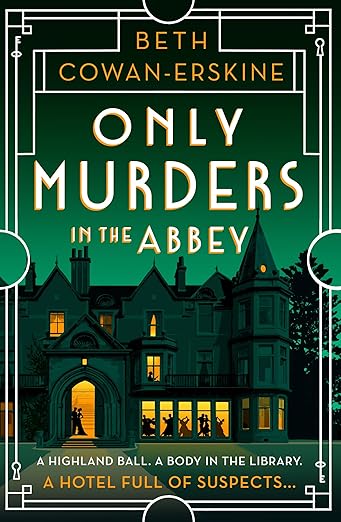
Only Murders in the Abbey by Beth Cowen-Erskine

Hodder & Stoughton/ 13 February 2025/ 363 pages/e-book |Review copy| 5*

I read the first Loch Down Murder Mystery, Loch Down Abbey in 2021 and enjoyed it very much, so I was looking forward to reading Only Murders in the Abbey, set in 1930s Scotland . And I’m glad to say that I thought it was even better than the first one.

Description from the publishers:

Mrs MacBain, thank god it’s you.’ Without another word, he grabbed her arm and pulled her into the room, locking the door behind them. Mrs MacBain turned around, clearly offended at being manhandled, but then gasped, ‘Is that blood?’

Loch Down Abbey is full of guests for a Highland Ball. Including several uninvited members of the Inverkillen clan, the Abbey’s former residents. Housekeeper Mrs MacBain thinks her biggest challenge will be finding suitable rooms for everyone and keeping the peace at cocktail hour.

Until the morning after the ball, when one of the guests is discovered inside the Abbey’s library – as dead as a doornail.

Who would have had motive to want them dead? And how did they manage to commit their crime and escape while keeping the door locked from the inside?

With an Abbey full of suspects and secrets, it is down to Mrs MacBain to catch the killer before they strike again…

The Abbey, formerly the ancestral home of the Ogilvy-Sinclair family is now an hotel, owned by several of the long-standing employees and staffed mainly by the former servants, led by Mrs Alice McBain as the Director of Operations. The manager of the hotel is The Honourable Fergus Ogilvy-Sinclair, the youngest grandson of Lady Georgina, the Dowager Countess of Inverkillen. Her eldest grandson is Lord Angus Inverkillen, the current Earl of Inverkillen.

There are so many characters in this book including family members, hotel staff and guests that I found it difficult to keep track of all of them. However the main characters are very clearly defined and there is a list of all the characters at the beginning of the book, which is a great help.

The book begins the morning after a Highland Ball as Hudson, one of the co-owners of the Abbey, is doing his rounds when he finds a dead body in the Small Library, which had been locked for the Ball. The name of the victim is not revealed. The narrative then goes back to the fortnight before the Ball, introducing the characters and their relationships and it is not until the second half of the book that the identity of the victim is revealed.

Detective Inspector Jarvis from the local constabulary is called in to investigate, but as Mrs McBain thinks he is not ‘the sharpest axe in the shed’. And it is mainly down to her to get to the bottom of the mystery – how a murder could take place in a locked room, who had the motive to commit murder and how was the opium trade in Shanghai involved. As the victim had been stabbed to death the number of suspects includes all the men at the ball who were in Highland dress which includes a sgian-dubh, (pronounced ‘skeen doo’), a small single-edged knife, worn as part of Highland dress in the sock of a kilted Scot. So, there are many suspects, making the investigation tremendously complicated and involving many red herrings, and twists and turns as several secrets and scandals are revealed.The Epilogue introduces yet another unexpected turn.

How on earth Beth Cowan-Erskine kept so many strands in play, set in a richly described location and with believable characters is totally beyond me. But she did, with immense skill making this a most enjoyable book. As she describes it it is ‘a lunatic world’ that she has created. I really hope there will be a third Lock Down Murder Mystery.

Many thanks to the publishers for a review copy via NetGalley.
Books Read in January 2025

I read 4 books in January, half the number I used to read. My reading has slowed down considerably over the last 2 years and I no longer write in much detail about them. But this year I’m hoping to get back to something more like normal and I’m aiming to write at least a paragraph or more about each of the books I’ve read each month.

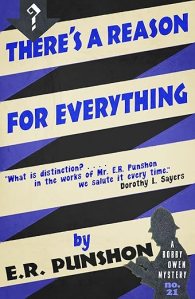
There’s a Reason for Everything (my review) by E R Punshon 4* – I began this book in December and finished reading it in early January. It was first published in 1945 and I read the e-book published by Dean Street Press. It’s the 21st in the Bobby Owen mystery series, in which Bobby has recently been promoted from Inspector to Deputy Chief Constable of Wychshire, a complicated novel with murders, a missing painting allegedly by Vermeer, dodgy fine art dealers and an abandoned country mansion called Nonpareil.

I was perplexed for quite some time until I began to see what was behind the bewildering confusion in Punshon’s narrative. I think this is a cleverly constructed plot, with ingenious puzzles to piece together before all the answers are revealed. I was quite pleased to find out at the end that I’d worked out one of the clues correctly.

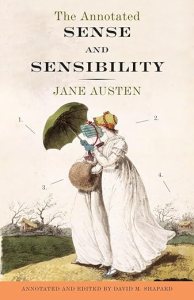
Sense and Sensibility by Jane Austen 5* – It’s about the three Dashwood sisters and their widowed mother as they leave their family estate at Norland Park after their father’s death when their half-brother John inherited the estate. This year is the 250th anniversary of Jane Austen’s birth, so this is an ideal time to reread some of her books and I’m joining Brona at This Reading Life in her Austen 2025 project to reread her books, along with the Classics Club’s Sync Read (or readalong).

I read the annotated edition, edited by David M Shapard that gives Explanations of historical context, Citations from Austen’s life, letters, and other writings, Definitions and clarifications, Literary comments and analysis, Multiple maps of England and London, An introduction, bibliography, and detailed chronology of events and More than 100 informative illustrations.

I’ll write more about this book in a later post.

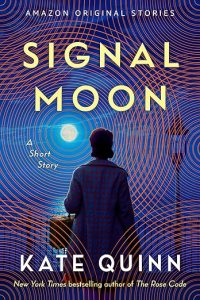
Signal Moon by Kate Quinn 5* – a short story. I’m not a big fan of short stories, often finding them too short and wanting to know more. But this one is good and it fascinated me. It’s sci-fi involving a type of time-travelling, a mix of historical fiction, links to the code breakers at Bletchley Park and WW2. I loved it. It is, of course, impossible, set in two time periods, 1943 during World War 2 and 2023, but I didn’t have to work hard to believe in it. Kate Quinn’s narrative just drew me in. In 1943, Lily Baines is a Wren working for a “Y” station, picking up signals from German intelligence that were then sent to Bletchley Park for translation. Then she picks up a signal apparently from 2023 – it’s a cry for help from Matt Jackson a young US officer. It’s about an American ship that is taking heavy fire in the North Atlantic. Together Lily and Matt have to work out how to help each other: Matt to convince her that the war she’s fighting can still be won, and Lily to help him stave off the war to come.

Kate Quinn wrote this story to feature the information about the Y stations that she had discovered whilst researching Bletchley Park and hadn’t included in The Rose Code.

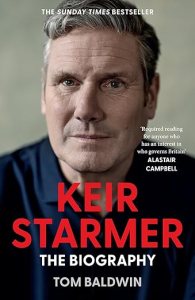
Keir Starmer: the Biography by Tom Baldwin 3.5* A Times Book of the Year; A Telegraph Book of the Year; A Daily Mail Book of the Year; A Waterstones Book of the Year

Dsecription from Amazon:

This authoritative – but not authorised – biography by Tom Baldwin provides answers by drawing deeply on many hours of interviews with Prime Minister himself, as well as unprecedented access to members of his family, his oldest friends and closest colleagues.Together, they tell an unexpectedly intimate story filled with feelings of grief and love that has driven him on more than any rigid ideology or loyalty to a particular faction.

The book tracks Starmer’s emergence from a troubled small town background and rebellious youth, through a storied legal career as a human rights barrister and the country’s chief prosecutor, to becoming an MP relatively late in life.Baldwin provides a vivid and compelling account of how this untypical politician then rose to be leader of his party in succession to Jeremy Corbyn, then transformed it with a ruthless rapidity that has enraged opponents from the left just as much as it has bewildered those on the right.

Above all, this is a book that should be read by anyone who wants to understand how someone who has too often been underestimated or dismissed as dull, now intends to change Britain.

My thoughts

This book was published in February 2024, five months before the General Election. I decided to watch the televised debates between him and Rishi Sunak, the then Prime Minister, and thought Starmer looked uncomfortable in most of them. All I knew about him was that he was the former Director of Public Prosecutions, and, as he often said in interviews, that growing up he lived in a pebble-dashed semi , that his ‘dad was a toolmaker‘ and his ‘mother was a nurse.’ So I hoped that Baldwin’s book would tell me more. Baldwin writes:

Starmer is a private man who has chosen to place himself in the white light of public scrutiny, while showing a determination that is itself exceptional to maintain a semblance of normality … often appearing uncomfortable at being a politician at all. (page xi)

He also describes him as ‘someone who is both extraordinary and very ordinary‘ (page xii). The biography is divided into five parts :

each of which begins by sketching a moment since he became a politician when this tension is most apparent. All of them also include descriptions of sometimes traumatic episodes that have wrenched him back to real life and away from the febrile – often fake – world of Westminster politics. (page xii).

In the first three parts he covers Starmer’s childhood and schooldays, his time as a student at Leeds University, where he was awarded a first-class law degree, and then at St Edmund Hall at Oxford University where he gained a postgraduate Bachelor of Civil Law degree. He then worked as a trainee barrister in London, eventually transitioning from a human rights lawyer into the country’s chief prosecutor. The fourth part describes how he became an MP, a member of the shadow cabinet and Leader of the Labour Party. The fifth part examines the leadership, before assessing what kind of prime minister he would make.

One friend said:

He’ll just turn up at the pub and be a totally normal and genuinely good bloke. But his public persona is very different, I almost don’t recognise him when I see him on TV.

And another said:

There is this enormous gap between Keir the human being and Keir the politician. At Jonny [Cooper]’s funeral, I saw the real one letting himself go – in the best way – to share his grief with his friends. But, when I watched him on TV at the party conference, he had seemed to be almost a different person, holding back and distant, almost wooden compared to the generous, humorous and empathetic man I’ve known for twenty years. (page 323)

It seems to me that he is a conscientious person who believes in working hard and playing hard. He is resilient and driven. He believes in fairness and social justice, putting the country before the party, a serious, clever man, who wants to get things done and change the country for the better.

Top 5 Tuesday: 5 authors I want to try in 2025

Who are some new authors that you want to read from in 2025

Top 5 Tuesday was created by Shanah at Bionic Book Worm, and it is now being hosted by Meeghan at Meeghan Reads. For details of all of the latest prompts for January to March, see Meeghan’s post here.

Today the topic is 5 authors I want to try in 2025. Who are some new authors that you want to read from in 2025? These books are from my TBRs.

Schindler’s List by Thomas Keneally

I was really excited to read Schindler’s List when I bought it as I’d recently watched the film, Schindler’s List for a second time and was very moved by it – it had me in tears. It was first published as Schindler’s Ark. It recreates the story of Oskar Schindler, a member of the Nazi party, who risked his life to protect Jews in Nazi-occupied Poland. He rescued more than a thousand Jews from the death camps.

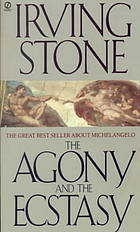
The Agony and the Ecstasy by Irving Stone is a book I’ve been longing to read for years. I’ve had it since 2007. It’s a biographical novel about Michelangelo. The copy I had was impossible to read as it was falling apart so I bought a new copy – but it’s still sitting waiting to be read. Why? Well because I have so many other books I really want to read.

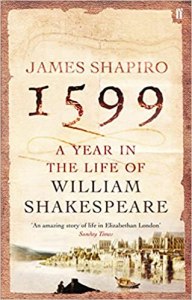
Another book I’ve had since 2007, still waiting to be read for the same reason is 1599: A Year in the Life of William Shakespeare by James Shapiro. 1599 was the year the Globe Theatre was built and that Shakespeare wrote Julius Caesar, Henry V, As You Like It and Hamlet. it’s full of detail, not just about Shakespeare, his plays and the theatre, but also about the events of his life and times!

Version 1.0.0

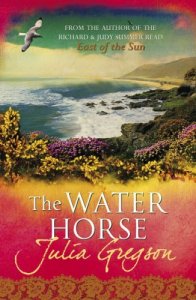
The Water Horse by Julia Gregson, a book I’ve had since 2009. It’s historical fiction based on the true story of a young Welsh woman, Jane Evans, a Welsh woman who in 1853 ran off with Welsh cattle drovers and volunteered as a nurse with Florence Nightingale in the Crimea. Catherine Carreg has grown up a tomboy, spending her days racing her ponies with Deio, the drover’s son, in a small Welsh village. But Catherine is consumed by a longing to escape the monotony of village life and, with Deio’s help, runs away to London.

Alone in the unfamiliar bustle of the city, Catherine finds a position in a rest home for sick governesses in Harley Street, run by Miss Florence Nightingale. Then, as the nation is gripped by reports of the war in the Crimea, Catherine volunteers as a nurse – and her life changes beyond all recognition.

Jeremy Hutchinson’s Case Histories by Thomas Grant – I bought this in February 2020 after watching the BBC series,The Trial of Christine Keeler, the story of the Profumo affair in 1962 as seen from her perspective. Hutchinson was Keeler’s defence barrister.

Born in 1915 into the fringes of the Bloomsbury Group, Jeremy Hutchinson went on to become the greatest criminal barrister of the 1960s, ’70s and ’80s. The cases of that period changed society for ever and Hutchinson’s role in them was second to none. In Case Histories, Jeremy Hutchinson’s most remarkable trials are examined, each one providing a fascinating look into Britain’s post-war social, political and cultural history.

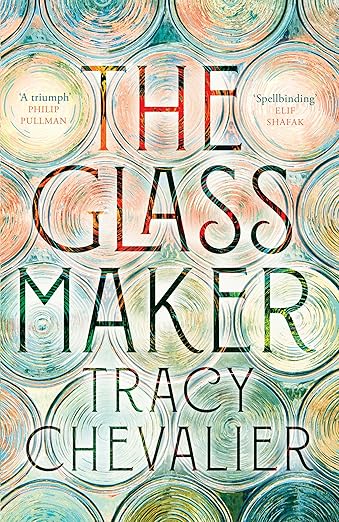
The Glassmaker: Book Beginnings on Friday & The Friday 56

Every Friday Book Beginnings on Friday is hosted by Gillion at Rose City Reader where you can share the first sentence (or so) of the book you are reading. You can also share from a book you want to highlight just because it caught your fancy.

I’m featuring The Glassmaker by Tracy Chevalier. It’s a novel that follows a family of glassmakers from the height of Renaissance-era Italy to the present day. I’ve read several of her books and I’m hoping to enjoy this one as much as the others.

If you skim a flat stone skilfully across water, it will touch down many times, in long or short intervals as it lands.

With that in mind, now replace water with time.

Also every Friday there is The Friday 56, hosted by Freda at Freda’s Voice, but she is taking a break and Anne at My Head is Full of Books has taken on hosting duties in her absence. You grab a book and turn to page 56 (or 56% of an eBook), find one or more interesting sentences (no spoilers), and post them.

‘How dare you come looking for me in Venice,’ he began in a low voice that rapidly grew louder, ‘as if I were a child who needed shepherding. You embarrassed the family name and ruined our relationship with our merchant. If the Rosso business goes under, it will be your fault.

Description:

Tracy Chevalier is a master of her own craft, and The Glassmaker is vivid, inventive, spellbinding: a virtuoso portrait of a woman, a family and a city that are as everlasting as their glass.

Venice, 1486. Across the lagoon lies Murano. Time flows differently here – like the glass the island’s maestros spend their lives learning to handle.

Women are not meant to work with glass, but Orsola Rosso flouts convention to save her family from ruin. She works in secret, knowing her creations must be perfect to be accepted by men. But perfection may take a lifetime.

Skipping like a stone through the centuries, we follow Orsola as she hones her craft through war and plague, tragedy and triumph, love and loss.

The beads she creates will adorn the necks of empresses and courtesans from Paris to Vienna – but will she ever earn the respect of those closest to her?

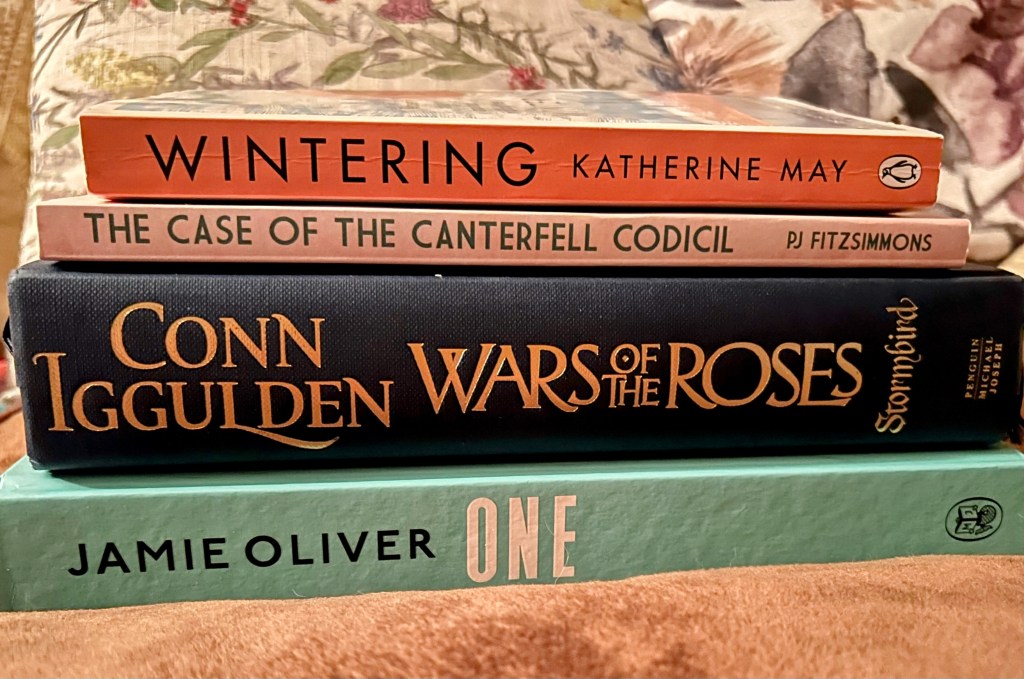
Recent Additions: Christmas Presents

I’ve always loved books and whenever anyone asked me what I’d like for my birthday or Christmas the answer was always ‘books, please’ . So l was delighted this last Christmas to receive four books!

Two of them are books that were on my wish list and the other two were complete surprises.

One: Simple One-Pan Wonders by Jamie Oliver (from my wish list)

I’ve got some of Jamie’s books, and this one looks like a good addition. In his introduction he writes ‘With a twinkle in my eye I want to position this book as one that is absolutely dedicated to the art of minimal washing up – you cook each recipe in just one pan or tray … it’s about making your life easier.’ I like the idea of minimal washing up and will be cooking quite a lot of these recipes.

It has over 120 recipes for tasty, fuss-free and satisfying dishes cooked in just one pan. What’s better: each recipe has just eight ingredients or fewer, meaning minimal prep (and washing up) and offering maximum convenience. With chapters including Veggie Delights, Celebrating Chicken, Frying Pan Pasta, Batch Cooking, Puds & Cakes, it all looks simply delicious.

Wars of the Roses: Stormbird Book One by Conn Iggulden (from my wish list)

Historical fiction has long been a great favourite of mine. I absolutely loved Sharon Penman’s The Sunne in Splendour that made me want to know more about the Wars of the Roses.So, when I found Iggulden had written a trilogy about the civil war I was keen to read it. I’ve read some of Iggulden’s other historical fiction novels and loved them, so I’m looking forward to reading this.

King Henry V – the great Lion of England – is long dead. In 1437, after years of regency, the pious and gentle Henry VI, the Lamb, comes of age and accedes to the English throne. His poor health and frailty of mind render him a weakling king -Henry depends on his closest men, Spymaster Derry Brewer and William de la Pole, Duke of Suffolk, to run his kingdom.

Yet there are those, such as the Plantagenet Richard, Duke of York, who believe England must be led by a strong king if she is to survive. With England’s territories in France under threat, and rumours of revolt at home, fears grow that Henry and his advisers will see the country slide into ruin. With a secret deal struck for Henry to marry a young French noblewoman, Margaret of Anjou, those fears become all too real.

As storm clouds gather over England, King Henry and his supporters find themselves besieged abroad and at home. Who, or what can save the kingdom before it is too late?

The Case of the Canterfell Codicil (Anty Boisjoly Mysteries Book 1) by PJ Fitzsimmons (not on my wish list). This was a complete surprise for me as I don’t know anything about this book, or the author. It’ll be good reading a new-to-me author and I do like locked room mysteries.

1920s gadabout Anty Boisjoly takes on his first case when his Oxford chum is facing the gallows, accused of the murder of his wealthy uncle.


Not one but two locked-room murders later, Boisjoly’s pitting his wits and witticisms against a subversive butler, a senile footman, a single-minded detective-inspector, an errant goat, and the eccentric conventions of the pastoral Sussex countryside to untangle a multi-layered mystery of secret bequests, ancient writs, love triangles, revenge, and a teasing twist in the final paragraph.


The Case of the Canterfell Codicil is a classic, cosy, locked-room mystery with an improbable plot inspired by Agatha Christie and prose in the style of an homage to PG Wodehouse.

Wintering: The power of rest and retreat in difficult times by Katherine May (a surprise, not on my wish list). It’s a memoir covering quite a wide range of topics, not just about winter, or rest and retreat. I’ve seen this book is one people either praise it or criticise it, so I’m keen to know what I think of it.

Wintering is a poignant and comforting meditation on the fallow periods of life, times when we must retreat to care for and repair ourselves. Katherine May thoughtfully shows us how to come through these times with the wisdom of knowing that, like the seasons, our winters and summers are the ebb and flow of life.

A moving personal narrative interwoven with lessons from literature, mythology and the natural world, May’s story offers instruction on the transformative power of rest and retreat. Illumination emerges from many sources: solstice celebrations and dormice hibernation, C.S. Lewis and Sylvia Plath, swimming in icy waters and sailing arctic seas.

Ultimately, Wintering invites us to change how we relate to our own fallow times. May models an active acceptance of sadness and finds nourishment in deep retreat, joy in the hushed beauty of winter, and encouragement in understanding life as cyclical, not linear. A secular mystic, May forms a guiding philosophy for transforming the hardships that arise before the ushering in of a new season.

Six Degrees of Separation from Orbital by Samantha Newman to Bleak House by Charles Dickens

It’s time again for Six Degrees of Separation, a monthly link-up hosted by Kate at Books Are My Favourite and Best. Each month a book is chosen as a starting point and linked to six other books to form a chain. A book doesn’t need to be connected to all the other books on the list, only to the one next to it in the chain.

This month starts with Orbital by Samantha Harvey, the 2024 Booker winner:

A team of astronauts in the International Space Station collect meteorological data, conduct scientific experiments and test the limits of the human body. But mostly they observe. Together they watch their silent blue planet, circling it sixteen times, spinning past continents and cycling through seasons, taking in glaciers and deserts, the peaks of mountains and the swells of oceans. Endless shows of spectacular beauty witnessed in a single day.

The fragility of human life fills their conversations, their fears, their dreams. So far from earth, they have never felt more part – or protective – of it. They begin to ask, what is life without earth? What is earth without humanity?

Yet although separated from the world they cannot escape its constant pull. News reaches them of the death of a mother, and with it comes thoughts of returning home. They look on as a typhoon gathers over an island and people they love, in awe of its magnificence and fearful of its destruction.

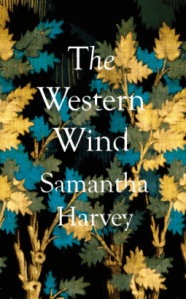
My first link is The Western Wind by Samantha Harvey. I came to the end of this book and immediately wanted to start it again. What seems at first to be a simple tale is actually a multi-layered and complex book. I really enjoyed reading it. It’s set in the late 15th century in a small village in Somerset. A man disappears, presumed drowned – but how and why did he die?

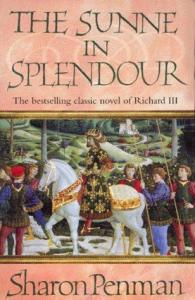
My second link is a book also set in the 15th century, The Sunne in Splendour by Sharon Penman, a fascinating novel about Richard III’s life from his childhood to his death at Bosworth Field in 1485. I think this is one of the best historical novels that I’ve read. It is full of detail, but Sharon Penman’s research sits very lightly in this book, none of it feels like a history lesson, and it all brings Richard’s world to life.

I’m staying in the 15th century for my third link, Red Rose, White Rose by Joanna Hickson, set in 15th century England during the Wars of the Roses when Cecily Neville was torn between both sides. Her father was Richard Neville, the Duke of Westmorland and a staunch Lancastrian and she married Richard Plantagenet of York and became the mother of Edward IV and Richard III. Told through the eyes of Cicely and her half-brother Cuthbert, this is the story of one of the most powerful women in England during one of its most turbulent periods.

For my fourth link I’m using the words ‘white rose‘ in the title and moving from the 15th century to the 20th with White Rose, Black Forest by Eoin Dempsey, a World War 2 novel. It’s told from the perspective of a German who opposed the Nazis and is set in the Black Forest, Germany in 1943, where Franka Gerber is living alone in an isolated cabin, having returned to her home town of Freiburg after serving a prison sentence for anti-Nazi activities.

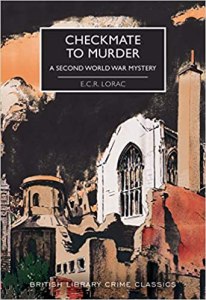
My fifth link is to another novel set in World War 2 – Checkmate to Murder by E C R Lorac, a Chief Inspector Robert Macdonald murder mystery. What I found fascinating in this book is the insight into what life was like in wartime London, complete with the London fog and the details of the blackout and although the Blitz was over there were still plenty of bangs and noise so that a gunshot wasn’t easily heard. 

For my final link I’m moving to London in the 19th century with Bleak House by Charles Dickens about the obscure case in the Court of Chancery of Jarndyce and Jarndyce. Here’s his description of fog in Chapter 1:

Fog everywhere. Fog up the river, where it flows among green aits and meadows; fog down the river, where it rolls defiled among the tiers of shipping and the waterside pollutions of a great (and dirty) city. Fog on the Essex marshes, fog on the Kentish heights. Fog creeping into the cabooses of collier-brigs; fog lying out on the yards and hovering in the rigging of great ships; fog drooping on the gunwales of barges and small boats. Fog in the eyes and throats of ancient Greenwich pensioners, wheezing by the firesides of their wards; fog in the stem and bowl of the afternoon pipe of the wrathful skipper, down in his close cabin; fog cruelly pinching the toes and fingers of his shivering little ‘prentice boy on deck. Chance people on the bridges peeping over the parapets into a nether sky of fog, with fog all round them, as if they were up in a balloon and hanging in the misty clouds.

My chain moves from the International Space Station to London in the 19th century and has travelled through the 15th century with a brief stop in the 20th century. The books are historical and crime fiction

What is in your chain, I wonder?

Next month (February 1, 2025), we’ll start with a classic – Dangerous Liaisons by Pierre Choderlos de Laclos.