New-To-Me Books

I went to Barter Books in Alnwick last week and was really delighted to find these books:

Heatwave etcFrom the bottom up they are:

  • Instructions For A Heatwave by Maggie O’Farrell – this was right at the top of a bookcase, far too high up for me to reach, but a helpful member of staff got it down for me. It’s one I’ve had on my wishlist since I read The Hand that First Held Mine, which I thought was excellent. This is her sixth book and is a portrait of a family in crisis during the heatwave in 1976.
  • The Shooting Party by Isabel Colegate – this is the book to read in October for Cornflower’s Reading Group. I read about on the morning I was going to Barter Books  was amazed to find a good hardback copy just as though I’d reserved it. The shooting party takes place in autumn 1913 – ‘Here is a whole society under the microscope, a society soon to be destroyed.’ I began reading it in the shop whilst having a cup of coffee and it promises to be really good.
  • Ordeal by Innocence by Agatha Christie – I always check which Agatha Christie books are in at Barter Books. Sometimes there aren’t any I haven’t read, but this time there were two. This one does not feature Poirot or Miss Marple, not like the TV adaptation that had Miss Marple (in the form of Geraldine McEwan), solving the mystery. In her Autobiography Agatha Christie wrote that ‘of her detective books the two that satisfy me best are Crooked House and Ordeal by Innocence.’ (An Autobiography page 538)
  • Ten Little Niggers by Agatha Christie – I was so pleased to find this book as it’s one of the best-selling books of all time and one I’ve never read, although I remember the basics of the plot from TV/film versions. I’ve beenlooking out for it for ages. The book was originally published in 1939, when the title would have given little offence in the UK, but it was different in the USA and it was first published there in 1940, a few months later, as And Then There Were None. This copy was published in 1968 in the UK and still has its original title, as the book continued to be published under this title until 1985 . I was quite startled, though, to see the cover picture showing a golliwog:

Ten Little Niggers

I’m looking forward to reading all of them – and the pleasurable problem now is deciding which one to read first – it maybe Ten Little Niggers! Again quoting from her Autobiography, Agatha Christie wrote that:

It was well received and reviewed, but the person who was really pleased with it was myself, for I knew better than any critic how difficult it had been. (page 488)
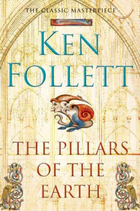
The Pillars of the Earth by Ken Follett

I’ve been working my way through some of the books I’ve owned for ages – books I really wanted to read when I bought them, but have since just sat on the bookshelves unread for a variety of reasons. I’ve had The Pillars of the Earth by Ken Follett for five years! The main reason I haven’t read it before now is its length – it has 1,076 pages!

I can’t remember now why I bought this book, possibly it was because I like historical novels and I like historic buildings and The Pillars of the Earth is set in 12th century England during the time of the civil war between Stephen and Matilda/Maud (she’s known by both names – in this book she’s called Maud, but at school we were taught her name was Matilda). It’s also the story of the building of a cathedral.

I was interested in the details of building a cathedral, the architecture and building techniques, but it is in essence a family saga. However it is so long-winded and repetitive that I began to think Follett must have written it as maybe three books and then joined them together without editing them, or maybe he was reminding himself of what he’d written earlier – it took him years to complete the book.

It’s a bit like a soap opera – terrible things happen, the characters overcome them and recover only to be knocked down again by more terrible events –  violence, power struggles and rape and pillage abound. It’s a bit simplistic with a really bad, evil character and a saintly one, a beautiful woman and a witch-type and so on. But it kept me entertained without having to think too hard and I even found myself thinking about it when I wasn’t reading, wondering what could possibly happen next. Parts of the novel came to life more than others – one being near the end of the book with the story of Thomas à Becket’s murder in Canterbury Cathedral.

There is a sequel, World Without End, set in the same place and featuring descendants of the original characters nearly 200 years after the events in The Pillars of the Earth. I’m not rushing to read it!

There was a TV version – I didn’t see it!

The Birthday Boys by Beryl Bainbridge

 I was absolutely fascinated by The Birthday Boys by Beryl Bainbridge, a novel about Captain Scott’s last Antarctic Expedition. It’s narrated by Captain Robert Falcon Scott and the other four men who died in the Antarctic having reached the South Pole – Petty Officer Edgar (Taff) Evans in June 1910; Dr Edward (Uncle Bill) Wilson, July 1910; Captain Scott: The Owner (Con), March 1911; Lt Henry Robertson (Birdie) Bowers, July 1911; and Capt Lawrence Edward (Titus) Oates, March 1912.

It’s fascinating not just as an account of the expedition, but also because it gets inside each man’s mind, it seemed to me, vividly describing the events as they progressed to the South Pole and the terrible conditions they had to endure. Beryl Bainbridge’s imagination and research combined make this a dramatic heroic story and an emotional roller-coaster set in the beautiful but deadly dangerous frozen landscape of the Antarctic.

Each character is distinctly drawn, each one revealing his thoughts, fears and hopes and the interaction between them reveals their personality clashes and friendships. The prejudices and class distinctions of the period come through strongly. The setting is superb – I could see the landscape and feel the dangers.

I finished reading this book nearly two weeks ago and apart from their final days one other episode stands out in my mind and that is the journey to the Emperor Penguin rookery at Cape Crozier undertaken by Wilson, zoologist Cherry-Garrard (Cherry) and Bowers. This section is narrated by Bowers. The journey was nearly seventy miles – Bowers described it:

I never thought the Owner would let us go, not with the Polar trek only three months off, but somehow Bill managed to talk him round. To reach the rookery where temperatures often register 100 degrees of frost, it’s necessary to scramble down cliffs exposed to blizzards sweeping ferociously across hundreds of miles of open snow plain. And all this in the dark! Exciting stuff, what? (page 133)

It took them far longer than they had anticipated and they endured dreadful conditions; at times they were ‘half delirious with exhaustion‘ and had ‘frost-bitten fingers bulging like plums.’ But Bowers thought:

It may be that the purpose of the worst journey in the world had been to collect eggs which might prove a scientific theory, but we’d unravelled a far greater mystery on the way – the missing link between God and man is brotherly love. (page 158)

Scott comes over as a sympathetic character, complicated, introspective and at times indecisive, and impatient at others. He is concerned that Amundsen will beat them to the Pole and is able to talk over his feelings with Wilson:

He understands me well enough to know that my continual harping on Amundsen’s  chances of beating us to the Pole isn’t down to self-interest, or a longing for glory, simply a desire to reach, in an endless process of addition and subtraction, a kind of mathematical peace. One hundred dogs, none of them presumably having fallen down a crevasse, must surely equal formidable odds.

It’s ironic that the same situation should be happening to me all over again. It’s barely three years since Shackleton sneaked off and nearly pipped me to the post. There again, I’d made no secret of my intentions. I’m not stupid enough to think of the Pole as mine, but I do detest underhandedness. (pages 116 – 117)

At times I had to remind myself that I was reading a novel, but then again there were passages where I had to remind myself that these events really did take place as they seemed so fantastical. Beryl Bainbridge has written a most remarkable book, full of facts seamlessly woven into the narrative, and full of emotion and feeling. It is one of the best books I’ve read this year.

Reading The Birthday Boys has made me keen to read other books about the Polar expeditions and as I wrote in this post I have South with Scott and Race to The End to look forward to reading.

Note: The Birthday Boys fits into these Reading Challenges: Historical Fiction Reading Challenge, Mount TBR Challenge and What’s In a Name Challenge (book with a celebration in the title).

Books in Synch

South with Scott, The Birthday Boys, Race to The End

Birthday Boys & SWS Race to the End 2


Beryl Bainbridge’s novel The Birthday Boys is a fictionalised version of Scott’s 1912 Antarctic expedition. Ever since I bought South with Scott by Lord Mountevans when I was at school I’ve been fascinated by race to reach the South Pole and reading The Birthday Boys made me take down South with Scott from my bookshelves to compare the two. But even so I was wanting to know more and so, when I went to the library yesterday morning I thought I’d see if there was anything else I could read about. AND THERE WAS!

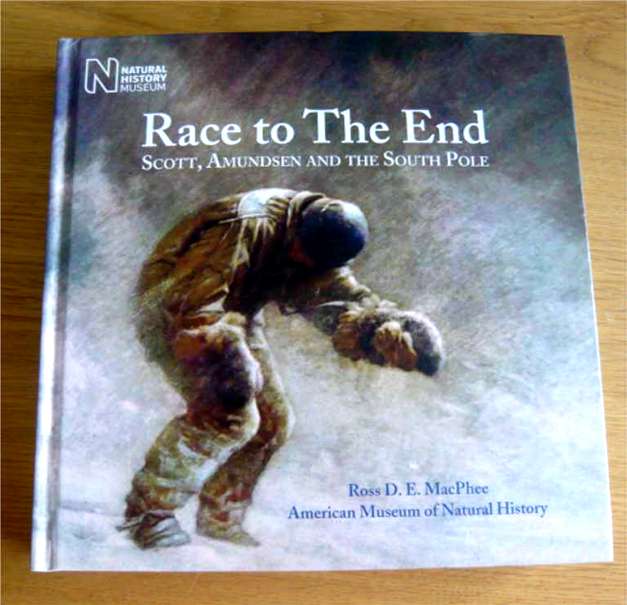
Race to The End cover

As Alex said last week when I wrote about the coincidence of finding The English Spy in the library when I had reserved Road to Referendum it really does seem as if books do call out to each other, because sitting there on the library shelves just as though it was waiting for me was this beautifully illustrated book – Race to The End: Scott, Amundsen and the South Pole by Ross D E MacPhee.

As I read The Birthday Books I was wondering how true to the facts Bainbridge had been in her novel. I’ve had time just to compare one event that is common to all three books, when Dr Wilson (Uncle Bill), Lieutenant ‘Birdie’ Bowers and Apsley Cherry-Garrard set off to Cape Crozier to recover emperor penguin eggs in the middle of the Antarctic winter – and Bainbridge’s version seems remarkable accurate, bringing the terrible hardships vividly to life. I think she must have read South with Scott. I shall write more about these books.

Birthday Boys & SWS Race to the End 1

The English Spy by Donald Smith

I’d gone to my local library to collect Road to Referendum by Iain Macwhirter, a book I’d reserved after I read about on FictionFan’s blog, and was browsing the shelves when this book, The English Spy caught my eye. Road to Referendum is about the run up to the Independence Referendum to take place in Scotland in September 2014. It also has chapters on Scottish history leading up to the present day as background.  So, it was quite a coincidence finding The English Spy as this is a novel about the build up to the political Union of England and Scotland in 1707 – the Union that Independence for Scotland would break.

My knowledge of the Act of Union in 1707 was limited to just the fact that by that union Scotland and England, together with Ireland and Wales, became the United Kingdom and I thought it was to settle the successor to Queen Anne who was childless and ill. Of course, it was much more complicated than that and The English Spy tells the story of how Daniel Defoe, at that time still known as Daniel Foe, was sent to Scotland under secret instructions from the English government to persuade the Scots to give up their independence. It’s a fascinating story of intrigue and backstabbing amongst the members of the Scottish parliament!

The narration moves between multiple viewpoints, mainly in the first person and some in the third person of various characters, some obviously historical figures and others possibly(?) fictional ones. There are Foe’s own account, letters between Isobel Rankin, his landlady in Edinburgh and her friend Nellie in Glasgow, the journal of Lord Glamis and a third person narrative of Robert Harley, the first Earl of Oxford. There are several other characters who pop in and out of the story – Lady O’Kelly and Aeneas Murray amongst others. This is a story about spies and the struggle between various factions for power and once I had got the characters sorted in my mind I was swept along with the intrigue and dangers of the times, keen to see how the Union came about.

The English Spy is a mix of fact and fiction but A Warning to the Reader at the beginning of the book clarifies that Daniel Defoe had indeed been sent to Scotland and was required to provide London with ‘clandestine reports on affairs in the north’. The Scottish Government was led by the Marquis of Queensberry who favoured union with England and the Duke of Hamilton was opposed to the union. Donald Smith warns:

Yet why did Scotland surrender its hard won and long cherished independence? The historians remain divided. What is offered here is fiction, yet as Defoe himself shows, the truths or apparent deceits of fiction may be uncomfortably closer to home.

Now, over 300 years later the question of independence for Scotland is still in question!

Dr Donald Smith is a founding member of the Scottish Storytelling Forum and of Edinburgh’s Guid Crack Club, and he is currently Director of the Scottish Storytelling Centre at The Netherbow.  He has written, directed or produced over fifty plays and is a founding director of the National Theatre of Scotland.

Now to read what Road to Referendum has to offer.

Silver: Return to Treasure Island by Andrew Motion

Silver

I first read Treasure Island as a child. It’s a book that has remained in my memory as a great adventure story, so I was interested to see that Andrew Motion (poet laureate of the UK from 1999- 2009, now professor of creative writing at the University of London and fellow of the Royal Society) had written a sequel: Silver: Return to Treasure Island. I was intrigued and when the publishers offered me a copy to read and review I immediately accepted it.

Description from the back cover:

Silver is the rip-roaring sequel to the greatest adventure ever told: Treasure Island. Almost forty years following the events of Robert Louis Stevenson’s classic, Jim Hawkins and Long John Silver have seemingly put their maritime adventures to rest. Jim has settled on the English coast with his son Jim, and Silver has returned to rural England with his daughter Natty. While their escapades may have ended, for Jim and Natty the adventure is only just beginning. One night, Natty approaches young Jim with a proposition: return to Treasure Island and find the remaining treasure that their fathers left behind. As they set sail in their fathers’ footsteps, Jim and Natty cannot imagine what awaits them. Murderous pirates, long-held grudges, noxious greed, and wily deception lurk wickedly in the high seas, and disembarking onto Treasure Island only proves more perilous. Their search for buried treasure leaves every last wit tested and ounce of courage spent. And the adventure doesn’t end there, since they still have to make their way home…

My view:

The book, narrated by young Jim Hawkins has a good beginning. I was immediately captivated by Jim’s encounter with Natty and his subsequent meeting with her father, Long John Silver, now a disintegrating body, emaciated, blind, shrunken and shrivelled but still raging with anger with a core of steel. As I had imagined a book by Motion would be, it’s beautifully written, and the scenes came to life as I read. The scenes at the beginning, on the island and in the final scenes are powerful and for me are the book’s greatest strength.

There is a lot packed into its pages, with plenty of references to Stevenson’s Treasure Island, so much so that part way through Silver I decided I had to re-read Treasure Island (so for me Silver really was a return to Treasure Island!). But this is not just a story about pirates, or the search for the silver that was left behind, it’s also a story about the island itself, about what happened to the three pirates marooned there for forty years and about the horrors of slavery and savagery.

On the whole I enjoyed Silver, but at times its pace slows, almost to a standstill and not just when the voyage on the Nightingale comes to a dead calm and the crew subside into a lethargy for several weeks, but also during some passages on the island which seemed to last an eternity – I felt I was languishing in the doldrums. There were times when I began to tire of the book, but it does pick up, with danger and death during a terrific storm.

One little touch amused me – one of the crew is a certain Mr Stevenson – ‘a Scotsman and a wisp of a fellow, whose place was generally in the crow’s nest, where he acted as our lookout.’ (page 115)

  • Paperback: 416 pages
  • Publisher: Vintage (4 April 2013)
  • Language: English
  • ISBN-10: 0099552655
  • ISBN-13: 978-0099552659
  • Source: review copy
  • My Rating: 3/5