The Wicked Day by Mary Stewart

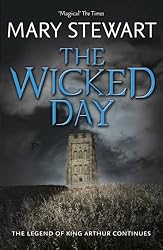
The Wicked Day is a sequel to Mary Stewart’s Merlin trilogy, telling the story of Mordred, King Arthur’s illegitimate son, who was foretold by Merlin as Arthur’s bane. It blends together fact and fiction as Mary Stewart explains in her afterword, Arthur was a real historical figure and she based her books on him using Geoffrey of Monmouth’s History of the Kings of Britain, written in the twelfth century and Sir Thomas Malory’s Le Morte d’Arthur, written in the fifteenth. Mordred, however, is probably as fictional as Lancelot.

I liked most of this book, the first part about Mordred’s early life is the best part. He grows up in the Orkneys, living with foster parents, until he is taken to the court of King Lot and his wife Queen Morgause as one of Lot’s bastard sons, unaware that Morgause, Arthur’s half-sister, is his real mother. This part of the book parallels the ending of The Last Enchantment but told from Mordred’s perspective.

All the characters from the legends are there, with the exception of Merlin – the High King Arthur, his beautiful Queen, Guinevere, his knights, Gawain and his brothers, AgravainGaheris and Gareth (Arthur’s nephews) and the sorceress, Morgause, still plotting against Arthur. Mordred is portrayed as a good person, courageous but misunderstood and controlled by his destiny:

If Merlin saw it written in the stars that you would be Arthur’s doom, then how can you escape it? There will come a day, the wicked day of destiny, when all will come to pass as he foretold. (page 240)

After a good opening third the book lost some of its appeal for me. Unlike the earlier books, The Wicked Day is narrated in the third person, which is probably why it seems less engaging to me. With the exception of the Epilogue, the passion and the magic are missing from the last part of the book which is a dry account of battles.

I wondered how Mary Stewart was going to resolve the story because in her version of it Arthur and Mordred, who is traditionally depicted as the villain, become reconciled to each other and Arthur acknowledges Mordred as his son and heir. Mordred is no villain, but not exactly a hero either. So, how come they ended up as enemies? She managed a plausible conclusion but I thought it was rather an anti-climax.

This is my third book for Carl’s Once Upon A Time VIII challenge and also qualifies for the Historical Fiction Reading challenge and the Read Scotland 2014 Challenge.

Added 17 May 2014:

Mary Stewart died in 10 May 2014 aged 97 – her obituary in The Telegraph describes her as an ‘author of romantic thrillers who wrote for love not money, and had an intuitive feel for the past.’
Books read in April

April was a good reading month – I finished reading 9 books, bringing my total for the year so far to 35:

  1. The Last Enchantment (Arthurian Saga 3) by Mary Stewart
  2. The Potter’s Hand by A N Wilson
  3. The Bell Jar by Sylvia Plath (a re-read for book group)
  4. St Bartholomew’s Man by Mary Delorme
  5. The Nine Tailors by Dorothy L Sayers (to be reviewed)
  6. The Cabinetmaker by Alan Jones
  7. Black Dogs by Ian McEwan
  8. Tantalus by Jane Jazz
  9. Burial of Ghosts by Ann Cleeves (to be reviewed)

They were all good reads, although I wouldn’t have re-read The Bell Jar if it hadn’t been my book group’s choice. I can’t say that I enjoyed that one, it is so depressing, but it is well written. All bar the first one are either library books or books I’ve acquired this year – a reaction, I suppose to finishing three months of reading only books I’ve owned before 1 January 2014!

It’s been difficult this month deciding which book to choose as my Best Book of the Month as they’ve all been enjoyable in different ways.

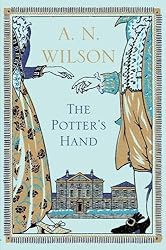
With so many good books by both established and new authors to choose from, after much thought, my all-round Best Book of the Month for April is The Potter’s Hand by A N Wilson, a remarkable novel about the Wedgwood family, their lives, loves, work, illnesses, depressions, addictions and deaths. I found it fascinating throughout, whether it was set in America during the fight for independence, or in England in Wedgwood’s factories, or his grand new house Etruria Hall, or travelling through England on the new canals.
And I should also flag up Tantalus by Jane Jazz, a love story with a difference, set in the Yorkshire moors and Tuscany. There is so much in this book that I loved €“ the characters, the story, the charged emotions and longing, the setting and the art.

Reading Challenges progress up to 30 April (for details of these challenges see my Challenges page):

  • Mount TBR Reading Challenge €“ 24 of my own unread books. My target is 48.
  • Read Scotland Challenge €“ 6 books. My target 13+.
  • What’s in a Name 7 €“ I’ve completed 5 of the 6 sections – just  a ‘book with a school subject in the title’ to read.
  • Historical Fiction Challenge €“ 6 books. My target is 25 books.
  • Colour Coded Challenge €“ 3 books. The target is to read 9 books in the different colour categories.
  • The Agatha Christie Reading Challenge €“ 2 books. This is an open-ended challenge to read all her books. So far I have read 57.
  • My Kind of Mystery Challenge €“ 10 books. My target is 31+.
  • Once Upon a Time VIII challenge – 2 books, both read this month – The Last Enchantment and Tantalus, both excellent fantasy novels.

St Bartholomew's Man by Mary Delorme

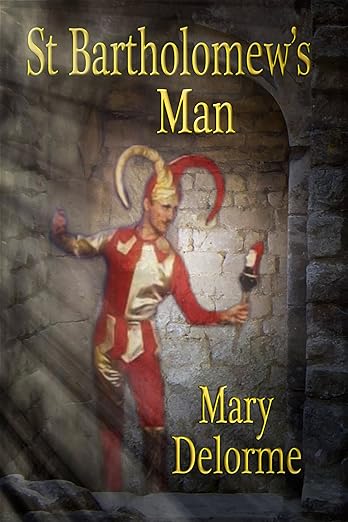
I was intrigued when I was asked if I would like to read Mary Delorme’s book St Bartholomew’s Man, about Rahere, a man who was a court jester to Henry I and who was also instrumental in the foundation of St Bartholomew’s Hospital in 1123. I was intrigued because it seemed an odd combination, that a jester and the founder of St Bartholomew’s should be one and the same person. And I wondered how that had come about.

It is historical fiction but as Mary Delorme clarifies in her Author’s Note it is based on fact with this proviso:

Almost nine hundred years lie between Rahere and myself; enough to blur historical facts, and leave room for doubt. Rahere is often described as a man of lowly origins, and a jester – something I find difficult to accept, bearing his mind his outstanding achievements and experiences. I therefore began my novel assuming that he was more highly born; not of the highest, but still an educated man. (Loc 26)

It seems to me that she has thoroughly researched her material, and managed to incorporate it seamlessly into her book. St Bartholomew’s Man follows the life of Rahere, from his childhood growing up as an orphan in a monastery, where he was one of the singing children, and he helped the monks in their healing work.

It is a book that left me knowing a lot more about the late 11th and early 12th centuries. It tells of the lives of ordinary people, of the monastic life and above all of the dangers and turbulence of life, moving through the oppressive reign of the irreligious William II (William Rufus), the more settled and peaceful reign of Henry I, followed by the violent conflict that ensued with the reign of Stephen and Matilda. I liked the historical setting and the detail both about healing and building methods. The plot kept me interested to read on to find out whether Rahere succeeded, despite all the suffering he endured and the challenges he had to overcome, in fulfilling his vow to build a hospital to care for the poor in London. The characterisation is good and I felt all the main characters came over as real people, who grew and developed throughout the book.

I enjoyed reading this book, which made me want to find out more about Rahere and St Bartholomew’s. St Bartholomew’s Hospital website outlines the history of the Hospital and St Bartholomew the Great’s website gives some information about the founding of the Priory church and Prior Rahere. Rahere’s tomb is in the church.

Then there is Rudyard Kipling’s poem Rahere, based on the legend that Rahere founded St Bartholomew’s Hospital after suffering a bout of depression and seeing a family of lepers in a London street. I also see that Rosemary Sutcliff’s children’s book The Witch’s Brat is set in the reign of Henry I and features Rahere – I’m hoping to read that one too.

My thanks to Jon Delorme for providing a copy of St Bartholomew’s Man for review, a book that entertained me and led me on to other sources of history and literature. I really want to know more about the 12th century. My knowledge is limited to schoolgirl history and Ken Follett’s The Pillars of the Earth!

The Potter's Hand by A N Wilson

Now that the TBR Triple Dog Dare has finished I am free to read anything I want. I have bought/borrowed a few books since the beginning of the year and I immediately turned to The Potter’s Hand by A N Wilson, a library book I borrowed in March and fortunately I’ve been able to renew it. I had actually read the first couple of chapters, because I just couldn’t stop myself once I’d glanced at the dramatic opening paragraph, which I wrote about in a Book Beginnings post in March, but I resisted reading any more until April!

The novel begins in 1768 and roughly follows the fortunes of the Wedgwood family until 1805, 10 years after the death of Josiah Wedgwood, an English potter and the founder of the Wedgwood company. I say roughly because the narrative moves back and forth in time and place. It is a most remarkable book, which kept me wanting to read it each time I had to stop reading – it’s a long book which took me several days to read.

As Wilson explains in an Afterword the broad outlines of the story and most of the details are true, but he has altered dates and rearranged historical events and nearly all the letters are invented. It is ‘meant to be read as fiction, even thought it is intended in part, as an act of homage to one of the great men of our history.’

For me it really did convey what it must have been like to live in that period – whilst the the American War of Independence, the French Revolution, were taking place. It was a time of great change (what time isn’t?) both social and political change as the industrial revolution got under way in England. It’s full of ideas about colonialism, the abolition of slavery, working conditions, and women’s rights. It brought about small changes as well as big ones – for example, before Josiah’s time many families ate off pewter plates or wooden platters, but with his production of creamware ‘there was hardly a respectable household in the kingdom which did not eat its dinner off well-glazed delicate plates.’

Wedgwood’s fame was international and resulted in an order to supply Catherine the Great, the Empress of Russia with an enormous dinner service – the Frog Service, decorated with illustrations of grand houses, scenes of country estates, parks and gardens and numerous other British landscapes. And his great creation towards the end of his life was the Portland Vase, a copy of the original cameo glass Roman vase. But Wedgwood was not only a master craftsman, he was also involved with his friends – philosophers, scientist and inventors – in the development of the canals and roads improving transportation as his factory grew and prospered .

It’s big on character (lots of them), the main ones being Josiah Wedgwood himself, ‘Owd Wooden Leg‘, his daughter Sukey, his nephew Tom Byerley, his childhood friend Caleb Bowers and Blue Squirrel, an American Cherokee Tom fell in love with in America. But there are plenty more who come in and out of the narrative along the way, both fictional and historical, including Voltaire, George Stubbs (who painted the Wedgwood family portrait) and Samuel Taylor Coleridge. I was particularly interested in Dr Erasmus Darwin, Charles Darwin’s grandfather, with his stammer and familiar way with his lady patients (if Wilson’s depiction is true to life) and his ideas on creation and evolution.

Overall it is the story of a remarkable family, their lives, loves, work, illnesses, depressions, addictions and deaths. I found it fascinating throughout, whether it was set in America during the fight for independence, or in England in Wedgwood’s factories, or his grand new house Etruria Hall, or travelling through England on the new canals.

Walter Scott Prize for Historical Fiction

Historical fiction is one of my favourite genres, so I was immediately interested to read that the shortlist for the £25,000 Walter Scott Prize for Historical Fiction has been announced. The Prize honours the achievements and legacy of Sir Walter Scott, the founding father of the historical novel and the winner will be announced at the Borders Book Festival in Melrose, Scotland, on 13 June.

To qualify, books must be by authors from the UK, Ireland or the Commonwealth.

The shortlist is:

  • LIFE AFTER LIFE by Kate Atkinson
  • THE LUMINARIES by Eleanor Catton
  • HARVEST by Jim Crace
  • FAIR HELEN by Andrew Greig
  • AN OFFICER AND A SPY by Robert Harris
  • THE PROMISE by Ann Weisgarber

Life After Life (which won the Costa Novel Award) is the only one of these books that I have, but I fancy reading some of the others, such as Luminaries, which won the Man Booker Prize and Fair Helen set in the Borders in the 1590s, based on a Border Ballad and legend often called €˜the Scottish Romeo and Juliet’. And I’ll certainly take at least a look at the others before June.

The Last Enchantment by Mary Stewart

Magic is the door through which mortal man may sometimes step, to find the gates in the hollow hills, and let himself through into the halls of the other world. (The Last Enchantment, page 121)

I love books that take me away to another time and place – The Last Enchantment (1979) by Mary Stewart is just such a book, magically whisking me back to the time of King Arthur and Merlin. This is not a book to read quickly, but a book to savour both for the story and for Mary Stewart’s descriptive writing.

I’ve been fascinated with the legend of King Arthur from childhood, the tales of the Sword in the Stone, the Knights of the Round Table, the Lady of the Lake, and of Merlin and so on. The Last Enchantment is the third book of the Arthurian Saga, a book of myth and legend and about the conflict between good and evil.

The narrator is Merlin and this book is set after Arthur has become the High King of Brtian, he has drawn the sword, Caliburn (Excaliber) from the stone and he is now plunged into battle against the Saxons , whilst Merlin is in a battle of a different kind, against Arthur’s half-sister, Morgause, the rose-gold witch. Merlin is now getting older and although he is losing his powers, they have not totally deserted him.

In fact this is a story of power, peopled by many richly depicted characters from Bedwyr, Arthur’s companion, who takes the place of Lancelot in this book, to Nimue (Niniane, Vivien), Merlin’s pupil who Merlin initiates into his magic powers. There is the story of Mordred’s birth (his mother Morgause had seduced Arthur), of Guinevere and her rape by King Melwas, and Merlin’s illness and recovery in the wild forest, and his incarceration in the Crystal Cave.

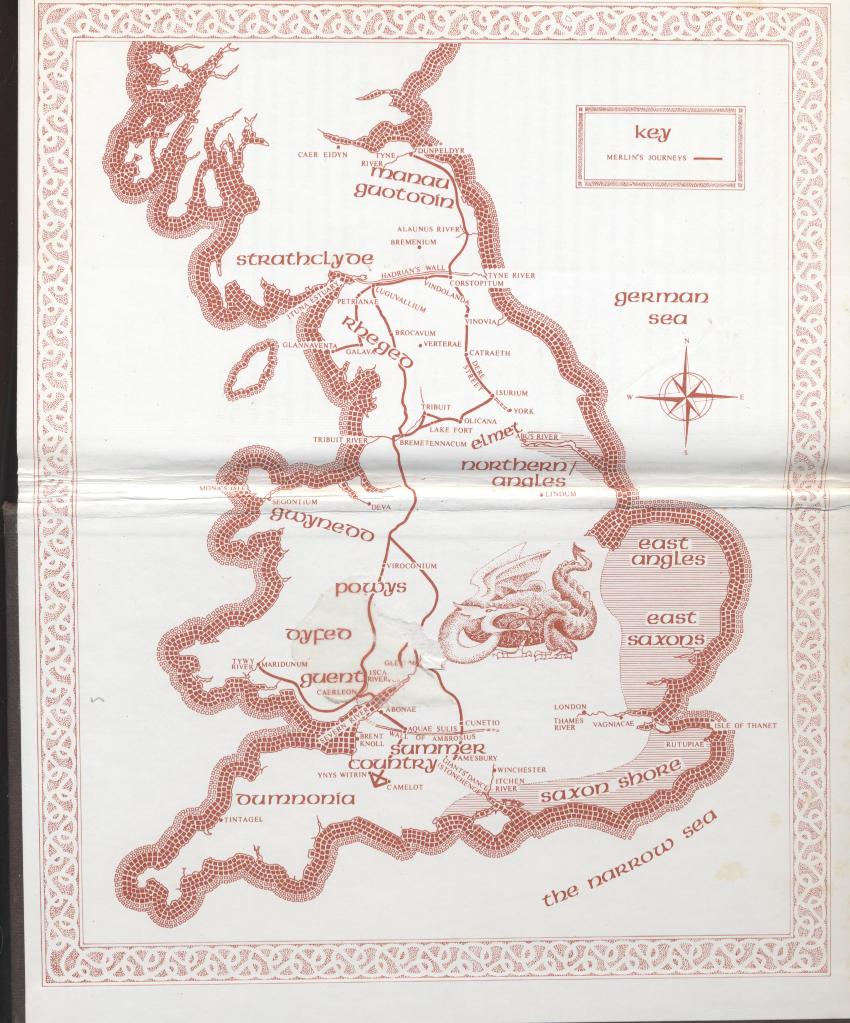
Above all, it is about Merlin and his relationship with Arthur and towards the end of the book with Niniane. As it narrated through Merlin’s eyes the battles that followed Arthur’s acsension are not the main focus of the book. He travels around the country and there is a helpful map on the endpapers of my hardback copy showing the routes he took and the places he visited.

Last Enchantment map 001

(I spent quite some time studying the map and working out what the places are called today.)

Merlin’s travels took him to numerous places including Dunpeldyr in the north-east, possibly on the site of the hill-fort on the present day Traprain Law, not far from Haddington and Dunbar, now in Scotland, then part of Northumbria; Caerleon (now the northern outskirts of Newport in South Wales); Galava (near present day Ambleside in the Lake District; and Vindolanda on the Great Wall of the Emperor Hadrian, where he visits his friend Blaise, to name but a few. It tells of how Merlin built Camelot on the hill then known as Caer Camel (caer is Welsh for fort or castle), a fictional place on a flat topped hill, not far from the sea and the Lake with its Isle of Glass.

Many years ago I read the first two books, The Crystal Cave (1970), about Merlin’s early days and The Hollow Hills (1973), in which Arthur learns who he is and becomes King.  I’d borrowed the books from the library, but never read the third book, so I was really happy when I found it in a library sale a few years ago for just 10p. I can’t think why I’ve not read it until this year, just too many other books clamouring to be read all at once, I expect.

Mary Stewart was born Mary Rainbow in January 1916 in County Durham. She currently lives in Scotland. On Goodreads I found this video of an interview with Mary Stewart in 1992 in which she talks about her writing and another interview with her in 1999, published by the University of Rochester. There are 2 other books following on from the Merlin TrilogyThe Wicked Da(1983), in which Mordred is the main character and The Prince and the Pilgrim (1995).

This historical fantasy is a perfect book not only for the Mount TBR Reading Challenge, but also the Once Upon a Time Challenge, the Historical Fiction Reading Challenge and because Mary Stewart lived in Scotland the Read Scotland 2014 Challenge too.