First Chapter, First Paragraph: The Snow Child

First chapterEvery Tuesday Diane at Bibliophile by the Sea hosts First Chapter First Paragraph Tuesday Intros to share the first paragraph sometimes two, of a book that she’s reading or planning to read soon.

This week my opening is from Eowyn Ivey’s first book, The Snow Child.

The Snow Child

It begins:

Wolverine River, Alaska, 1920

Mabel had known there would be silence. That was the point after all. No infants cooing or wailing. No neighbor children playfully hollering down the lane. No pad of small feet on wooden stairs worn smooth by generations, or clackety-clack of toys along the kitchen floor. All those sounds of her failure and regret would be left behind, and in their place would be silence.

I’ll be reading this book soon because I’ve read and loved her second book, To the Bright Edge of the World and I’ve heard that The Snow Child is also a wonderful book. These opening sentences are full of pathos and denial of Mabel’s desires and draw me in.

Blurb:

A bewitching tale of heartbreak and hope set in 1920s Alaska, Eowyn Ivey’s THE SNOW CHILD was a top ten bestseller in hardback and paperback, and went on to be a Finalist for the Pulitzer Prize.

Alaska, the 1920s. Jack and Mabel have staked everything on a fresh start in a remote homestead, but the wilderness is a stark place, and Mabel is haunted by the baby she lost many years before. When a little girl appears mysteriously on their land, each is filled with wonder, but also foreboding: is she what she seems, and can they find room in their hearts for her?

Written with the clarity and vividness of the Russian fairy tale from which it takes its inspiration, The Snow Child is an instant classic.

Would you read on? If you have read this book what did you think?

A Death in the Dales by Frances Brody

A Death in the Dales (Kate Shackleton #7)

A Death in the Dales is the 7th book in Frances Brody’s Kate Shackleton series of historical crime fiction books set in 1920s Yorkshire. Kate is an amateur detective. I’ve read the first two, Dying in the Wool and A Medal For Murder, and so I’ve jumped ahead in the series with this book. It’s not always possible to read a series in order and in this case I don’t think it matters – A Death in the Dales reads well as a standalone.

It’s 1926 and Kate Shackleton’s friend, Dr Lucian Simonson, has offered her the use of his late Aunt Freda’s cottage in Langcliffe for a short holiday with her niece Harriet, who is recovering from diphtheria. Ten years earlier Freda had witnessed the murder of the landlord of the alehouse across the street from her house. A man was found guilty of the murder and hanged – but Freda was convinced that they had convicted the wrong man.

Freda’s friend Mr Wigglesworth, the local apothecary, asks Kate to investigate the murder and gives her Freda’s papers regarding the trial. Although she had intended to have a holiday from her investigations she can’t resist looking at the papers and is convinced that Freda had wanted to her to solve the mystery and find out who had killed the pub landlord.

As well as investigating the murder, Kate also helps Harriet and her new friend, Beth to find out what has happened to Beth’s young brother who has gone missing from the farm where he was working, and then a suspicious death on the same farm.

I enjoyed reading about life in the 1920s; Frances Brody paints a very believable picture of life in a rural setting in the Dales during the post World War One years. Kate is a very likeable character and has to overcome the suspicion of strangers from the local community once she starts digging into the past. And there is the added complication of Kate and Lucian’s personal situation. All in all it’s a complicated mystery with several strands, numerous suspects and plenty of red herrings.

Frances Brody is an excellent storyteller and her books are well-plotted and complex murder mysteries in the historical setting of the 1920s and in the style of the golden age crime fiction.

The series so far is:

1. Dying in the Wool (2009)
2. A Medal For Murder (2010)
3. Murder in the Afternoon (2011)
4. A Woman Unknown (2012)
5. Murder on a Summer’s Day (2013)
6. Death of an Avid Reader (2014)
7. A Death in the Dales (2015)
8. Death at the Seaside (2016)
9. Death in the Stars (to be published in October 2017)

Reading Challenges: Mount TBR 2017 and What’s in a Name? in the category: ‘A title in which at least two words share the same first letter ‘“ alliteration!’

  • Paperback: 384 pages
  • Publisher: Piatkus (1 Oct. 2015)
  • Language: English
  • ISBN-10: 0349406561
  • ISBN-13: 978-0349406565
  • Author’s website: Frances Brody
  • Source: I bought it

At the Edge of the Orchard by Tracy Chevalier

I’ve been reading some good books this year and At the Edge of the Orchard by Tracy Chevalier is no exception, which is no surprise to me as I’ve enjoyed all of her books that I’ve read so far.

At the Edge of the OrchardThis is historical fiction, a mix of fact and fiction. Most of the places are real (and there is a helpful map at the beginning of the book) and some of the characters are historical figures. There is a lot of information about trees – apple trees, redwoods and sequoias, all of which fascinated me (especially the sequoias) and formed integral parts of the book.

It’s the story of the Goodenough family, James and his wife Sadie and their five surviving children. It begins in 1838 in Black Swamp, Ohio where James and Sadie are arguing over apples and practically everything else. James is obsessed with apples and prefers the sweet variety, the eaters , whilst Sadie loves the ‘spitters’, the bitter apples to make cider and even better, applejack. Theirs is a marriage of opposites. They had settled in the only land available – the swamp and had struggled first of all to clear the land and plant the apple seedlings and seed they had brought with them from Connecticut.

Their story alternates between James’ perspective and Sadie’s – their voices clearly distinctive and recognisable. Sadie is bitter and vindictive, picking fights wherever she can and their family life is terrible. James, although he loves his children is unable to show his feelings and Sadie moves between extremes, is unpredictable, at times loving but more often vicious and cruel to them or simply indifferent. She constantly taunts James, and their relationship going from bad to worse. Of all the children Robert is the one who shows an interest in the apple trees.

In the second part of the book the focus is on Robert, the youngest son who leaves Black Swamp after an incident that is only revealed later in the book. He went west, working where he could including a stint as a gold miner in California, until he reached the ocean ending up in San Francisco where he worked for William Lobb (a real historical figure), collecting seeds and seedlings to send to England. His story is told through the unanswered letters he sent to the family over seventeen years.

The characters are wonderful, from the dysfunctional Goodenough family, to Molly, the strong, independent and resourceful woman Robert meets during the time he worked as a gold miner. I also liked Martha, Robert’s younger sister, who shows determination and spirit despite the heart-breaking situations she has to live through.

I loved the settings, and would love to visit places described such as Calaveras Grove and South Grove to see the giant redwoods and sequoias for myself, but I doubt very much that I will ever be able to see them. In the Acknowledgements Tracy Chevalier refers to a place nearer to home that I could visit. It is in Wales – the Charles Ackers Redwood Grove which was planted in 1857 by John Naylor of Leighton Hall.

The one criticism I have is the ending. I came to the last page and thought ‘is that it?’ – I wanted to know more. I hope there will be a sequel.

My thanks to the publishers and NetGalley for my copy of this book for review.

  • Format: Kindle Edition
  • File Size: 1824 KB
  • Print Length: 305 pages
  • Publisher: HarperCollins UK,  HarperFiction The Borough Press (10 Mar. 2016)

First Chapter, First Paragraph: The Invention of Wings

First chapterEvery Tuesday Diane at Bibliophile by the Sea hosts First Chapter First Paragraph Tuesday Intros to share the first paragraph sometimes two, of a book that she’s reading or planning to read soon.

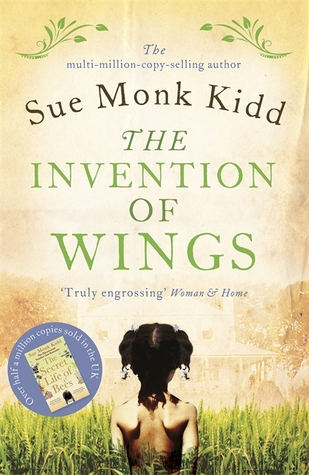
This week I’m featuring The Invention of Wings by Sue Monk Kidd, a book I’ll be reading this month for my book group.

The Invention of Wings

It begins:

There was a time in Africa the people could fly. Mauma told me this one night when I was ten years old. She said, Handful, your granny-mauma saw it for herself. She say they flew over trees and clouds. She say they flew like blackbirds. when we came here, we left the magic behind.

From the back cover:

Handful’s always been in trouble. A slave in the Grimké household like her beloved mother Charlotte, Handful knows the rules, in all their brutality, but no one can stop her pushing them to the limit. When, ten years old, she’s presented to the owner’s most difficult daughter, Sarah, as a birthday present, the sparks begin to fly …

I think I’m going to enjoy this book very much. It’s set in Charleston in the early nineteenth century and is based on the lives of sisters, Sarah and Angelina Grimké, the first female abolition agents and among the earliest American feminist thinkers.

What do you think? Would you carry on reading?

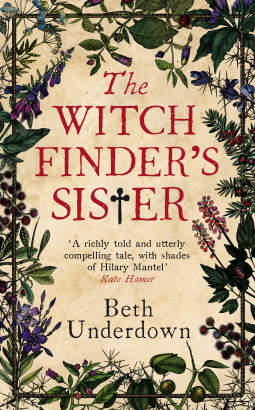
The Witchfinder’s Sister by Beth Underdown

‘The number of women my brother Matthew killed, so far as I can reckon it, is one hundred and six…’

1645. When Alice Hopkins’ husband dies in a tragic accident, she returns to the small Essex town of Manningtree, where her brother Matthew still lives.

But home is no longer a place of safety. Matthew has changed, and there are rumours spreading through the town: whispers of witchcraft, and of a great book, in which he is gathering women’s names.

To what lengths will Matthew’s obsession drive him?
And what choice will Alice make, when she finds herself at the very heart of his plan?

Based on the true story of the man known as the Witchfinder General, this exquisitely rendered novel transports you to a time and place almost unimaginable, where survival might mean betraying those closest to you, and danger lurks outside every door.

My thoughts:

When I read the description of The Witchfinder’s Sister by Beth Underdown I was immediately drawn to the story based on the life of the 1640s witchfinder Matthew Hopkins. As well as a good story it is a fascinating look at life in England during the Civil War, set in 1645, a time of great change and conflict in politics, religion and philosophical ideas, coinciding with a growth in the belief in witchcraft.

I enjoyed it immensely. It’s historical fiction that combines fact and fiction, told through the eyes of Matthew’s sister, Alice, a fictional character. Beth Underdown has researched and used the historical sources so well. What is so chilling about this book is that the events it describes really did happen.

There is a glossary at the end of the book describing, among other terms, the methods used to investigate women accused of being witches, such as ‘searching‘ where their bodies were inspected for ‘teats’, ‘swimming‘, an ordeal by water in which women were bound and lowered into a pond or river; they were innocent if they sank, and ‘watching‘ in which a suspected woman would be tied to a stool in the middle of a room, kept awake and observed for hours. Women were treated in this way if they were accused of causing harm to their neighbours for such things as the death of a neighbour’s horse or for the unexplained deaths of children. For the superstitious every sudden death, or accident, every miscarriage or illness, was considered to be caused by witchcraft.

There is a pervading sense of fear and terror as Alice discovers what Matthew is doing, intensified when he forces her to help with his investigations, travelling throughout Essex. She tries to stop him, but fearful of him accusing her mother-in-law, Bridget, she has to go along with him. She also discovers family secrets about their parents and Matthew’s birth. The witch hunts escalated as grief-stricken and angry women accused other women and their names were added to Matthew’s list. After his investigations the women were then sent to prisons to await their trials.

It is clear that the women accused were vulnerable, often widows living isolated lives, some suffering with what we would consider to be a mental illness, with no male family members to keep them safe from persecution. Matthew’s own mother showed signs of mental illness, subject to many strange habits and obsessive compulsive behaviour. But Matthew is unable to accept the facts and grows ever more fanatical.

It all hangs together as a piece of fiction, with clearly described and defined characters, making their feelings and actions perfectly believable – even Matthew comes across as a well-rounded character – and set against the background of a country in the midst of civil war. It makes harrowing reading and I found it deeply moving.

I grew very fond of Alice and her maid Grace but was appalled by the final twist at the end of the book.

Beth Underdown lectures in Creative Writing at the University of Manchester. The Witchfinder’s Sister is her first novel.

My thanks to the publishers and NeGalley for my copy of this book. It is to be published on 2 March 2017.

  • Format: Kindle Edition
  • File Size: 6546 KB
  • Print Length: 361 pages
  • Page Numbers Source ISBN: 0241978033
  • Publisher: Penguin (2 Mar. 2017)

The Good People by Hannah Kent

A heart-wrenching and beautiful novel.

I loved The Good People by Hannah Kent. It’s an intensely moving and beautifully written tale of Irish rural life in the early 19th century.

The Good People

Blurb:

County Kerry, Ireland, 1825.

Nóra bereft after the sudden death of her beloved husband, finds herself alone and caring for her young grandson Micheál. Micheál cannot speak and cannot walk and Nóra is desperate to know what is wrong with him. What happened to the healthy, happy grandson she met when her daughter was still alive?

MARY arrives in the valley to help Nóra just as the whispers are spreading: the stories of unexplained misfortunes, of illnesses, and the rumours that Micheál is a changeling child who is bringing bad luck to the valley.

NANCE’s knowledge keeps her apart. To the new priest, she is a threat, but to the valley people she is a wanderer, a healer. Nance knows how to use the plants and berries of the woodland; she understands the magic in the old ways. And she might be able to help Micheál.

As these three women are drawn together in the hope of restoring Micheál, their world of folklore and belief, of ritual and stories, tightens around them. It will lead them down a dangerous path, and force them to question everything they have ever known.

Based on true events and set in a lost world bound by its own laws, The Good People is Hannah Kent’s startling new novel about absolute belief and devoted love. Terrifying, thrilling and moving in equal measure, this long-awaited follow-up to Burial Rites shows an author at the height of her powers.

My thoughts:

I grew up reading fairy stories but The Good People gives a frighteningly realistic view of what belief in fairies meant to people dealing with sickness, disease, evil and all the things that go wrong in our lives. It’s set in 1825/6, a long gone world of people living in an isolated community, a place where superstition and a belief in fairies held sway. People talk of others being ‘fairy-swept’ or ‘away with the fairies’, and kept with the music and lights, dancing under the fairy hill.

Nóra is overcome with grief when her husband, Martin, died, feeling as though she was drowning and abandoned, completely unable to cope with Micheál, her four-year old grandson. There is talk that he is ‘fairy-struck’, unable to walk or talk and screaming uncontrollably when he is in pain or upset. She needed someone else to help her and so she hired Mary to look after Micheál. But Micheál did not improve and soon she comes to believe that he is a changeling. After both the doctor and the priest are unable to cure Micheál, Nóra appeals to Nance, the valley’s ‘handy woman’ for help.

This is a beautifully written book. It is not a fairy story, but one in which their existence is terrifyingly real to the people of the valley. The villagers believe that the fairies live in Piper’s Grave, ‘the lurking fairy fort’, at the end of the valley, a place where few people went, a neglected and wild place. People see lights there, glowing near a crooked whitethorn tree that stood in a circle of stone. Nance lives in a cabin in front of the wood a short distance from Piper’s Grave and not far from the river. She was the woman they wanted to help them bring their babies into the world, and who was the ‘gatekeeper’ at the end of their lives, the ‘keener’ when they died. She is the person Nance went to believing she could help bring back the little boy she loved.

I loved everything about The Good People, Hannah Kent is an excellent storyteller. The characters all spring to life, Nóra, Nance and Mary in particular. It’s not a world I know and yet I felt I did, with its mix of characters, old Peg O’Shea, Nóra’s nearest neighbour who helps when she can and the younger men and women who gossip and are quick to blame Micheál for bringing bad luck to the valley and to condemn Nance, who whilst they go to her for cures, also frightens them.

It is a heart breaking story and as it drew to its inevitable end I was really moved by the effect of fear, ignorance and superstition that brought about such a tragedy. The Author’s Note at the end of the book  explains that she drew on a real event from 1826 in writing The Good People. She has researched and listed many works of both fiction and non-fiction and also consulted many historians, curators and academics whilst writing the book.

Many thanks to the publishers and NetGalley for a review copy.

  • Format: Kindle Edition
  • File Size: 3007 KB
  • Print Length: 400 pages
  • Publisher: Picador; Main Market Ed. edition (9 Feb. 2017)