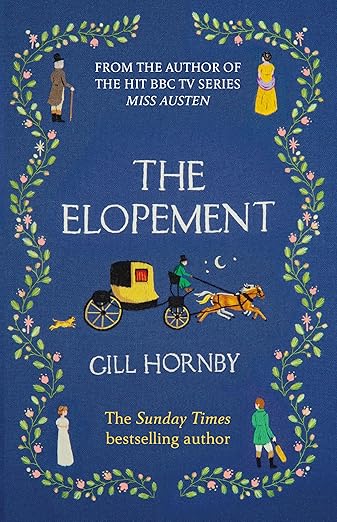
The Elopement by Gill Hornby

Another short post as I’m catching up with the backlog of books I haven’t reviewed.

Penguin |22 May 2025| 469 pages| e-book| Review book| 3*

1820. Mary Dorothea Knatchbull is living under the sole charge of her widowed father, Sir Edward – a man of strict principles and high Christian values. But when her father marries Miss Fanny Knight of Godmersham Park, Mary’s life is suddenly changed. Her new stepmother comes from a large, happy and sociable family and Fanny’s sisters become Mary’s first friends. Her aunt, Miss Cassandra Austen of Chawton, is especially kind. Her brothers are not only amusing, but handsome and charming.

And as Mary Dorothea starts to bloom into a beautiful young woman, she forms an especial bond with one Mr Knight in particular. Soon, they are deeply in love and determined to marry. They expect no opposition. After all, each is from a good family and has known the other for some years.

It promises to be the most perfect match. Who would want to stand in their way?

The Elopement by Gill Hornby is historical fiction about the life of Jane Austen’s niece Fanny Knight and Mary Dorothea Knatchbull, Fanny’s stepdaughter. I wanted to read it because I loved her earlier books about Jane Austen’s extended family, Miss Austen and Godmersham Park. However, I was a bit disappointed as I think it fails to capture that flavour of Jane Austen’s novels that I have loved ever since I first read Pride and Prejudice as a young teenager.

There are many characters listed at the beginning of the book – there are the Knights of Godmersham Park; the Knatchbulls of Mersham-le-Hatch and the Austens of Chawton Cottage, where Cassandra, Jane Austen’s elder sister, and her mother lived. Cassandra Austen only has a cameo role.

Fanny’s father was Edward Austen, who was adopted by the wealthy Knight family (Thomas Knight was a cousin), taking their name in 1812. In 1820 Fanny married Sir Edward Knatchbull, a widower, with six children. Fanny and Mary Dorothea, the only daughter, had a difficult relationship right from the start, unable to break through their natural reserve. Fanny is not a warm character and Mary is reluctant to accept her as a substitute mother – neither of them are willing to be open with each other and maintain an icy politeness. However, Mary and Fanny’s brothers and sisters get on well; very well with one brother in particular.

I didn’t find it evenly paced, beginning very slowly with a rushed ending. I found the first part of the book was too drawn out (even boring in parts) and I thought I’d have to abandon it, but I read on and the second part held my interest and I finished the book. I liked the insight into the wider Austen family and the social context – family relationships, attitudes towards duty, marriage, the position of women and the dangers of childbirth.

The Author’s Note is very interesting, explaining that the narrative exactly follows Fanny Knight’s record of events she recorded in her daily journals that she kept from 1804, when she was eleven years old until she was eighty. Gill Hornby highlights:

‘ … the perilous nature of the lives of the married women. The birth of every child is a moment of danger. The loved ones of expectant mothers are on high alert. … If you married young and were happily fertile, then it was a game of Russian roulette, year after year.

Many thanks to the publishers for a review copy via NetGalley.

Gabriel’s Moon by William Boyd

I’ve been making good progress with my reading, but I’m way behind with writing about the books I’ve read. So it’s time to catch up with a few short posts.

My first one is the first book I read for the 20 Books of Summer ChallengeGabriel’s Moon by William Boyd.

Description

Gabriel Dax is a young man haunted by the memories of a tragedy: every night, when sleep finally comes, he dreams about his childhood home in flames. His days are spent on the move as an acclaimed travel writer, capturing changing landscapes in the grip of the Cold War. When he’s offered the chance to interview a political figure, his ambition leads him unwittingly into the shadows of espionage.

As Gabriel’s reluctant initiation takes hold, he is drawn deeper into duplicity. Falling under the spell of Faith Green, an enigmatic and ruthless MI6 handler, he becomes ‘her spy’, unable to resist her demands. But amid the peril, paranoia and passion consuming Gabriel’s new covert life, it will be the revelations closer to home that change the rest of his story . . .

Gabriel’s Moon by William Boyd is his 18th book, but it’s the first book by him that I’ve read. I loved it right from the start. It’s well written, one of those books that makes me want to read on and on eager to know what happens next.

I wondered about the title – what is Gabriel’s Moon? The Prologue set in 1936 enlightened me straight away. When Gabriel was six years old his family home burnt down. He escaped, but his mother died in the fire, caused, so the fire brigade claimed, by the naked flame of the nightlight burning by his bed. It was a small candle covered by a glass dome that resembled the moon. His mother would light it as part of a bedtime ritual that was important to him, signifying order and calm. But, his mind has blanked out all his memories of that night, although he still has nightmares about the fire.

By the early 1960s Gabriel had become a successful travel writer and in 1960 he travelled to the newly independent Republic of the Congo to interview the Prime Minister, Patrice Lumumba. And thus he is accidentally drawn into the intrigue surrounding Lumumba’s murder. And then Dax is drawn into the dangerous and shadowy world of espionage.

I loved it. It’s a gripping tale that kept me turning the pages as Gabriel travels from Africa to London, Cadiz and then Warsaw. At home he visits a psychoanalyst, hoping to discover the truth about the tragic events of his childhood. He is drawn deeper and deeper into ever more complex and dangerous situations, whilst in thrall to Faith Green, his MI6 handler, who effortlessly manipulates him.

Gabriel’s Moon is the first novel in a new espionage trilogy. The second book, The Predicament will be released on September 4. 2025 and I’m looking forward to reading more about Gabriel Dax.

Many thanks to the publishers for a review copy via NetGalley.

  • Publisher ‏ : ‎ Viking
  • Publication date ‏ : ‎ 5 Sept. 2024
  • E-book
  • Print length ‏ : ‎ 263 pages 
  • Source: NetGalley
  • My rating: 5*

Spell the Month in Books: June 2025

Spell the Month in Books is a linkup hosted by Jana on Reviews From the Stacks on the first Saturday of each month. The goal is to spell the current month with the first letter of book titles, excluding articles such as ‘the’ and ‘a’ as needed. That’s all there is to it! Some months there are optional theme challenges, such as “books with an orange cover” or books of a particular genre, but for the most part, any book you want to use is fair game!

This month’s Spell the Month in Books theme is Books that you found or currently see at the library. For this theme I’ve used books I’ve previously borrowed from the library for the letters J, U, and E and a book I’ve seen on the library’s website for the letter N.

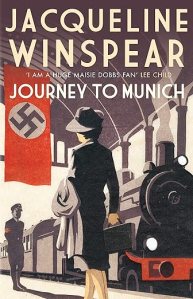
Journey to Munich by Jacqueline Winspear – Travelling into the heart of Nazi Germany, Maisie encounters unexpected dangers – and finds herself questioning whether it’s time to return to the work she loved. But the Secret Service may have other ideas!

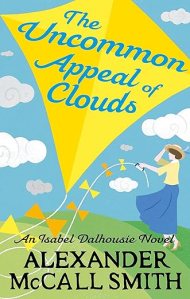
Uncommon Appeal of Clouds by Alexander McCall Smith – an Isabel Dalhousie book – An unexpected appeal for help from a collector who has been the victim of an art theft threatens to take Isabel Dalhousie far outside her comfort zone.

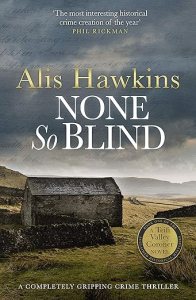
None So Blind by Alis Hawkins – West Wales, 1850. When an old tree root is dug up, the remains of a young woman are found. Harry Probert-Lloyd, a young barrister forced home from London by encroaching blindness, has been dreading this discovery. He knows exactly whose bones they are. Working with his clerk, John Davies, Harry is determined to expose the guilty. But the investigation turns up more questions than answers and raises long-buried secrets. The search for the truth will prove costly.

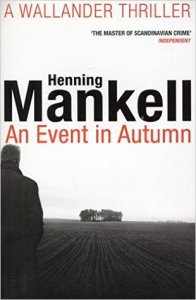
An Event in Autumn by Henning Mankell a Wallender thriller – Kurt Wallander’s life looks like it has taken a turn for the better when his offer on a new house is accepted, only for him to uncover something unexpected in the garden – the skeleton of a middle-aged woman. As police officers comb the property, Wallander attempts to get his new life back on course by finding the woman’s killer with the aid of his.

The next link up will be on July 5, 2025 when the optional theme will be: Set in a fantasy world or fictional place.

Top Ten Tuesday: Books on My Summer 2025 to-Read List

Top Ten Tuesday is a weekly meme created by The Broke and the Bookish and now hosted by Jana at That Artsy Reader Girl. For the rules see her blog.

The topic today is Books on My Summer 2025 to-Read List. I’m taking part in the 20 Books of Summer but didn’t make a list this year because In the past I don’t think I’ve ever managed to read the lists I’ve compiled because I just can’t stick to reading from a list – as soon as a book is on a list my desire to read it just dies. So, I decided to make it simple and read from my TBRs and the books on my Netgalley Shelf.

Anyway, here is a list of books I might read this summer, just picked at random from the e-books on my Kindle, without thinking too hard about which ones to list.:

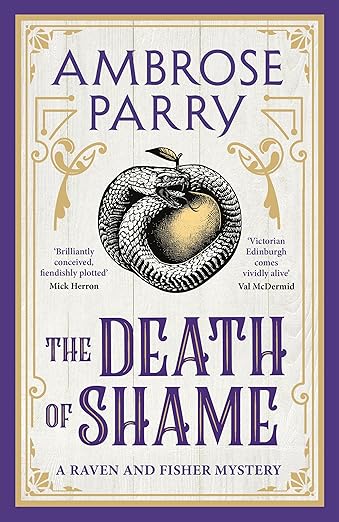
  1. The Death of Shame by Ambrose Parry (A Raven and Fisher Mystery Book 5) Historical fiction set in Victorian Edinburgh, a mix of fact and fiction incorporating the social scene, historical and medical facts.
  2. The Elopement by Gill Hornby, historical fiction about the life of Jane Austen’s niece Fanny Knight and her stepdaughter.
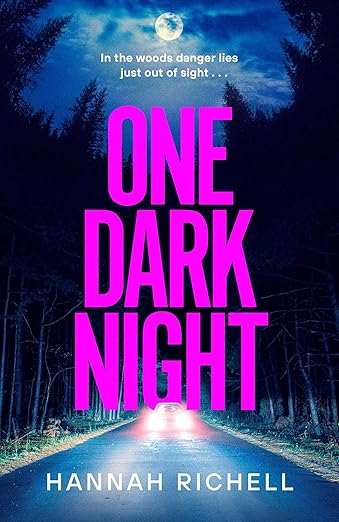
  3. One Dark Night by Hannah Richell, a gothic thriller about the murder of a young girl at Halloween.
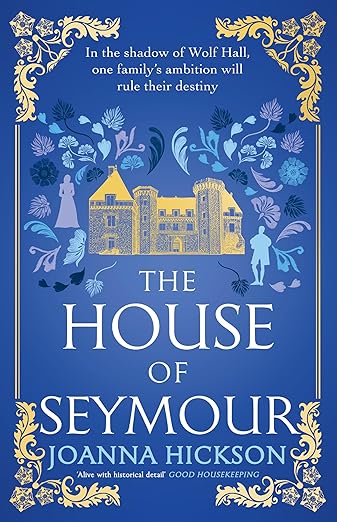
  4. The House of Seymour by Joanna Hickson, (The House of Seymour, Book 1) historical fiction set in the 15th century during King Henry VI’s reign.
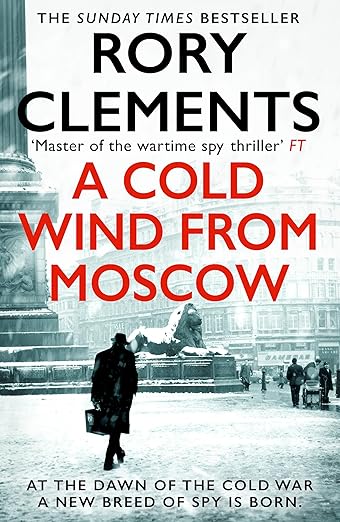
  5. A Cold Wind from Moscow by Rory Clements, (Tom Wilde Book 8) historical fiction set at the start of the Cold War,
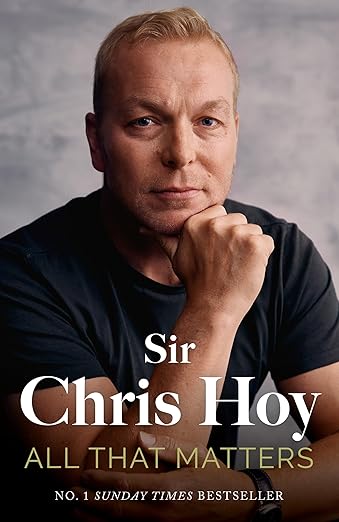
  6. All that Matters by Chris Hoy, a memoir cycling legend Sir Chris Hoy reveals the truth of his cancer diagnosis and how he is determined to find hope and happiness on the home straight.
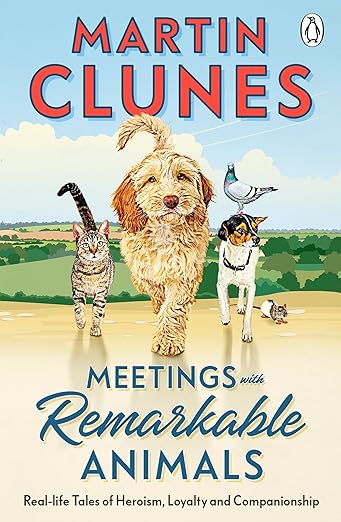
  7. Meetings With Remarkable Animals by Martin Clunes, the Heartwarming Journey of Animals Who’ve Guided, Rescued, and Saved Us in Surprising Ways.
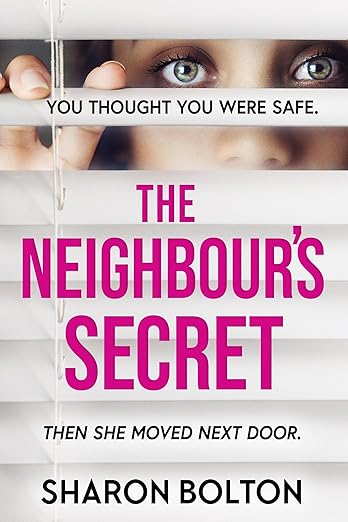
  8. The Neighbour’s Secret by Sharon Bolton, a psychological thriller.
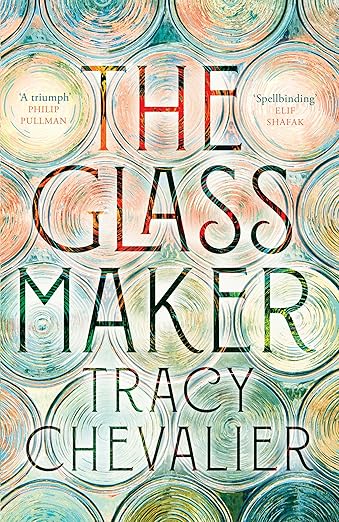
  9. The Glassmaker by Tracy Chevalier, historical fiction set in Venice in 1486.
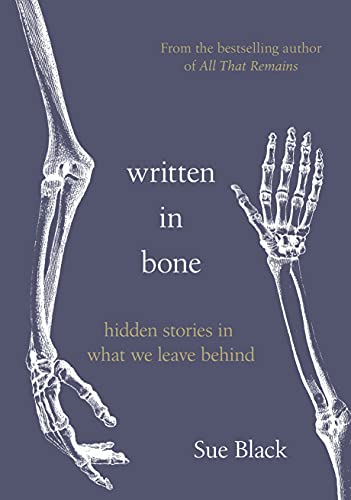
  10. Written in Bone by Sue Black, hidden stories in what we leave behind.

The House of Lost Whispers by Jenni Keer

Boldwood Books|25 April 2025| 378 pages| e-book| Review book| 3*

Summary:

What if another world existed… where the Titanic had never sunk?

When the ill-fated maiden voyage of the Titanic leaves Olivia Davenport orphaned, she’s sent to live with her guardians, the Fairchilds, in their huge Jacobean mansion. But the Fairchilds have more to worry about than a grieving young girl – with war in Europe imminent and four sons to protect.

Olivia feels alone and friendless. Until she hears a voice from behind the wall in her tower bedroom. A voice from a man called Seth. Convinced he’s merely a product of her grieving imagination, it’s not until after the heartbreak of war that Olivia discovers that he exists in an overlapping world, just a shudder in time away from her own. A world where the Titanic never sank… Where everything since has been just slightly… different.

All Olivia wants is to find a way into his reality. And not just to see the faces of her beloved parents once again. But also to meet Seth. Who might just be the love of her life…

I enjoyed reading Jenni Keer’s debut novel, The Hopes and Dreams of Lucy Baker several years ago and thought I’d like to read more of her books. This one is her eighth book, so I missed the books in between. I don’t often read romance or fantasy novels but The House of Lost Whispers has both elements and it’s also historical fiction set before, during and after the First World War. I preferred the historical element, especially the middle section about the War. But I also enjoyed reading the fantasy element about the anomaly in the magnetic field surrounding the earth causing vibrations, disrupting the fabric of space and time. This resulted in the formation of a duplicate earth, one parallel with our world, in which the Titanic did not sink on 12th April 1912.

I think this is a very interesting and possibly original idea, exploring what life would have been like for Olivia and her family if the Titanic had not been sunk. The book also explores loss and grief, family life, friendship and romantic relationships, as well as the devastating and horrific events of the First World War. As described in the blurb Olivia in the ‘real’ world and Seth in the parallel world can hear each other through the wall in her tower bedroom (the whispers), but despite their efforts they cannot break through to meet.

It’s beautifully descriptive, bringing the settings to life and there is also a murder mystery to solve. My only criticisms are that at times I did get a bit confused about Seth’s character and his parallel in the ‘real’ world, and I could have done without the love scenes (too descriptive in places). As I read on I was wondering how it would end and maybe Jenni Keer wondered too because the conclusion seemed rushed and rather neatly sown up. I was a bit disappointed, although I can’t imagine how else it could have ended. But overall it kept me reading, wanting to know what would happen next.

Many thanks to the publishers for a review copy via NetGalley.

WWW Wednesday: 14 May 2025

WWW Wednesday is run by Taking on a World of Words.

The Three Ws are:

What are you currently reading?
What did you recently finish reading?
What do you think you’ll read next?

Currently I am reading The Boy With No Shoes: a Memoir by William Horwood, the author of The Duncton Chronicles an allegorical tale about the moles of Duncton Wood. It’s about his childhood in south-east England after the Second World War – the unwanted child of a mother who rejects him, and whose other children bully him.

I’m also reading The House of Lost Whispers by Jennie Kerr, a mix of historical fiction and magical realism. It begins in 1912 when thirteen-year-old Olivia goes to live at Merriford Manor with her guardians after her parents were drowned when the Titanic sank. She hears a voice through her bedroom wall. A voice from a man called Seth. At first she thinks he’s a ghost. But it soon becomes clear that he lives in an overlapping world that is just a shudder in time away from her own. I wasn’t too sure about the mix of genres, but it’s working well so far.

The last book I read was Bleak House by Charles Dickens, which is over 1000 pages full of description and lots of characters, about the complex and long-drawn out lawsuit of Jarndyce v Jarndyce. I’ll be writing more about it in a later post.

What will I read next? I’m thinking of reading The Curious Case of the Village in the Moonlight by Steve Wiley, a novella about Vincent Van Gogh. Van Gogh painted Starry Night whilst living in an asylum, near the village of Saint-Rémy, where a lamplighter is doing his rounds in the village. It will be his last round before electricity is installed during green hour — an absinthe-drenched celebration in his honour. The curious hour would transform the night from familiar to fantastical, with the village street lamps mysteriously vanishing.

But when the time comes I may find myself reading something different, as the mood takes me.