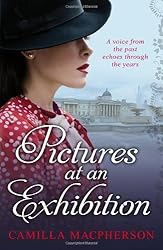
Pictures at an Exhibition by Camilla Macpherson

I enjoyed Pictures at an Exhibition by Camilla Macpherson very much. It’s a dual time period novel moving between the present day and the Second World War, a format I think that can be hard to do successfully. In this book, Camilla Macpherson’s first published novel, I think it is successful as I was equally keen to find out what happened next in both periods.

Pictures at an Exhibition is structured around Daisy’s letters to her cousin Elizabeth telling her about the paintings on display at London’s National Gallery during the war years – one a month. In the present day Claire reads the letters, left to her husband Rob, by his grandmother, Elizabeth. They are not just about the paintings but also about Daisy’s life and the man she meets and loves. Claire meanwhile, is struggling to recover from a tragedy that threatens to overwhelm her and wreck her marriage. She decides to read the letters, one a month, and visit the National Gallery to see the paintings and compare them with Daisy’s descriptions.

I found the characters thoroughly convincing, the settings and the time periods contrasting vividly and loved all the details about the paintings. I also liked the way the characters developed throughout the book. For example, at the beginning of the book, which I found so devastatingly sad, Claire is full of anger and grief, affecting her relationship with Rob:

It was the grief speaking. It could do strange things grief. She had not known that until now. She had never had to know. It had brought with it this desperate, physical need to blame someone, someone who would be right there when she had to lash out – Rob. The only person who was always there. (page 106)

She becomes obsessed with the letters, the paintings and with Daisy’s life. It’s a remarkable portrayal of a woman in crisis and how she managed to find herself again. Daisy’s story is just as convincing describing life in London during the Blitz and along with Claire I really wanted to know more about her and what happened to her.

I think it was the art that drew me to this book in the first place and I found those parts of the book absolutely fascinating. The National Gallery did display one painting a month after most of them had been transported away from London and the bombs for safe keeping. You can see the paintings described by scanning the QR codes at the beginning of each chapter and also see them on Camilla Macpherson’s website, and of course on the National Gallery’s site too. I knew of most of them before, but not all of them and as I was reading I printed copies to see what Daisy and Claire saw.

But by the end of the book it was the characters and the story that had captivated me too.  It’s about life and death, love and loss, grief and relationships and I found it compelling reading – when I wasn’t reading it I was thinking about it and keen to get back to it. It’s a book I want to re-read at some time – and there aren’t many of those.

My thanks go to Camilla Macpherson, who kindly sent me a copy of her book. I look forward to reading more of her work in the future.
Books Read in May

I can’t quite believe it but despite spending many hours in the garden in May mowing the grass and weeding (there are still too many weeds!) I managed to read ten books, bringing my total for the year so far to 45. They’re a bit of a mixed bag of excellent and not very good, with some good ones in between!

They are, in the order I read them, with links to my reviews (* marks crime fiction novels):

  1. The Big Four* by Agatha Christie – a bit of a let down, not up to her best!
  2. The Lost Army of Cambyses by Paul Sussman – goodish
  3. The Dance of Love by Angela Young – her second book due out at the end of July. I loved it!
  4. The Wicked Day by Mary Stewart – good
  5. The Graveyard Book by Neil Gaiman – very good
  6. Nemesis* by Agatha Christie – disappointing
  7. The Witch’s Brat by Rosemary Sutcliff – good
  8. No Stranger to Death*by Janet O’Kane – very good, her first book
  9. The Little Coffee Shop of Kabul by Deborah Rodriguez -not very good and I don’t intend to write about it
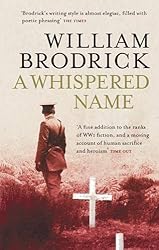
  10. A Whispered Name* by William Broderick – excellent – see my thoughts below.

I’m not taking The Dance of Love into account in considering which book is my favourite book of the month because I’m saving my review for July when the book is published – but I can say now that it is brilliant!

The Graveyard Book and No Stranger to Death are both really good books and as I was reading each one I thought either could be my favourite book for May but then I read A Whispered Name and that decided it – it is my favourite book of the month and also my Crime Fiction Pick of the Month (hosted by Kerrie at Mysteries in Paradise)!


A Whispered Name by William Brodrick is the third Father Anselm novel, which won the Crime Writers’ Association Gold Dagger Award in 2009.

I think this is a most remarkable book and it kept me glued to the pages as I read about the First World War and the effects it had on those who took part, those left at home and on future generations. It is, of course, historical fiction.

From the back cover:

During the slaughter of Passchendaele in 1917, an Irish soldier faced a court martial for desertion. On the panel was a young captain, Herbert Moore, charged with a responsibility that would change him for ever.

After the war Herbert became a monk, one of the founders of Larkwood monastery, where Father Anselm came across two visitors, Kate Seymour and an unnamed old man, searching for Father Herbert. But he had died in 1985 and no one could answer their questions about the trial of a deserter, Joseph Flanagan and Father Herbert’s part in it. Father Herbert was revered and loved by all who knew him and Anselm was deeply dismayed at the thought that there was anything in his past that he had lied about and he set out to discover the truth.

I think the whole book is so well thought out with chapters revealing what happened from different characters’ viewpoints during the war and what Anselm discovered as he went through the records and talked to people. Nothing is straight forward, the records are ambiguous and there is confusion about identities. The horror of the war is there:

After the wallop, Herbert found himself prostrate with his face against the dirt, vaguely aware that time had passed, that water was creeping on him; that he would have to move or he’d drown.

… Herbert slid through a sludge of intestines and grit, hauling himself into the open. Staring across the beaten land he tried to gain his bearings … he couldn’t see anyone else from the regiment. (page 35)

And Herbert did indeed serve on a court martial that condemned Joseph Flanagan to death. But there is not just the horror of war in this book, it’s an intricate, evocative novel focussing on the themes of morality, justice, sacrifice and human redemption. It is a book above all that identifies the place of the individual within history, written so lyrically putting the past under a searching spotlight. One of the best books I’ve read for quite some time.

A Whispered Name is a thoroughly researched book with a list of sources at the end of the book, but it never reads like a dry factual account – it comes so vividly to life. Although based on fact, gathered from memoirs, reports, published research, Battalion War diaries and the original transcripts of trials, William Brodrick explains in his Author’s Note:

This novel is not about FGCMs [Field General Court Martial] in general. It does not imply a comprehensive critique of First World War executions from any perspective, be that historical, legal or moral. Rather, one might say, it is a parable of how a man found meaning in death, and how another – on seeing that – found faith in life. And it is about a fictional trial that cannot be compared with any genuine case. (p 344) (my emphasis)

William Brodrick became a barrister, having been an Augustinian monk for six years (the other way round from his fictional character, Father Anselm). After 10 years at the Bar, his interest in writing led him to writing the Father Anselm books.

The Father Anselm books are:

  1. The Sixth Lamentation (2003)
  2. The Gardens of the Dead (2006)
  3. A Whispered Name (2008)
  4. The Day of the Lie (2012)
  5. The Discourtesy of Death (2013)

I’ve now read the first three books and think A Whispered Name is probably the best. I have yet to read the next two – I hope to do so soon.

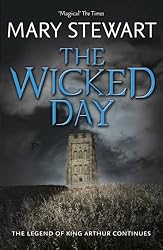
The Wicked Day by Mary Stewart

The Wicked Day is a sequel to Mary Stewart’s Merlin trilogy, telling the story of Mordred, King Arthur’s illegitimate son, who was foretold by Merlin as Arthur’s bane. It blends together fact and fiction as Mary Stewart explains in her afterword, Arthur was a real historical figure and she based her books on him using Geoffrey of Monmouth’s History of the Kings of Britain, written in the twelfth century and Sir Thomas Malory’s Le Morte d’Arthur, written in the fifteenth. Mordred, however, is probably as fictional as Lancelot.

I liked most of this book, the first part about Mordred’s early life is the best part. He grows up in the Orkneys, living with foster parents, until he is taken to the court of King Lot and his wife Queen Morgause as one of Lot’s bastard sons, unaware that Morgause, Arthur’s half-sister, is his real mother. This part of the book parallels the ending of The Last Enchantment but told from Mordred’s perspective.

All the characters from the legends are there, with the exception of Merlin – the High King Arthur, his beautiful Queen, Guinevere, his knights, Gawain and his brothers, AgravainGaheris and Gareth (Arthur’s nephews) and the sorceress, Morgause, still plotting against Arthur. Mordred is portrayed as a good person, courageous but misunderstood and controlled by his destiny:

If Merlin saw it written in the stars that you would be Arthur’s doom, then how can you escape it? There will come a day, the wicked day of destiny, when all will come to pass as he foretold. (page 240)

After a good opening third the book lost some of its appeal for me. Unlike the earlier books, The Wicked Day is narrated in the third person, which is probably why it seems less engaging to me. With the exception of the Epilogue, the passion and the magic are missing from the last part of the book which is a dry account of battles.

I wondered how Mary Stewart was going to resolve the story because in her version of it Arthur and Mordred, who is traditionally depicted as the villain, become reconciled to each other and Arthur acknowledges Mordred as his son and heir. Mordred is no villain, but not exactly a hero either. So, how come they ended up as enemies? She managed a plausible conclusion but I thought it was rather an anti-climax.

This is my third book for Carl’s Once Upon A Time VIII challenge and also qualifies for the Historical Fiction Reading challenge and the Read Scotland 2014 Challenge.

Added 17 May 2014:

Mary Stewart died in 10 May 2014 aged 97 – her obituary in The Telegraph describes her as an ‘author of romantic thrillers who wrote for love not money, and had an intuitive feel for the past.’

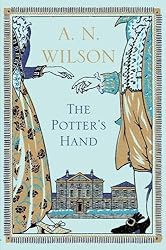
The Potter's Hand by A N Wilson

Now that the TBR Triple Dog Dare has finished I am free to read anything I want. I have bought/borrowed a few books since the beginning of the year and I immediately turned to The Potter’s Hand by A N Wilson, a library book I borrowed in March and fortunately I’ve been able to renew it. I had actually read the first couple of chapters, because I just couldn’t stop myself once I’d glanced at the dramatic opening paragraph, which I wrote about in a Book Beginnings post in March, but I resisted reading any more until April!

The novel begins in 1768 and roughly follows the fortunes of the Wedgwood family until 1805, 10 years after the death of Josiah Wedgwood, an English potter and the founder of the Wedgwood company. I say roughly because the narrative moves back and forth in time and place. It is a most remarkable book, which kept me wanting to read it each time I had to stop reading – it’s a long book which took me several days to read.

As Wilson explains in an Afterword the broad outlines of the story and most of the details are true, but he has altered dates and rearranged historical events and nearly all the letters are invented. It is ‘meant to be read as fiction, even thought it is intended in part, as an act of homage to one of the great men of our history.’

For me it really did convey what it must have been like to live in that period – whilst the the American War of Independence, the French Revolution, were taking place. It was a time of great change (what time isn’t?) both social and political change as the industrial revolution got under way in England. It’s full of ideas about colonialism, the abolition of slavery, working conditions, and women’s rights. It brought about small changes as well as big ones – for example, before Josiah’s time many families ate off pewter plates or wooden platters, but with his production of creamware ‘there was hardly a respectable household in the kingdom which did not eat its dinner off well-glazed delicate plates.’

Wedgwood’s fame was international and resulted in an order to supply Catherine the Great, the Empress of Russia with an enormous dinner service – the Frog Service, decorated with illustrations of grand houses, scenes of country estates, parks and gardens and numerous other British landscapes. And his great creation towards the end of his life was the Portland Vase, a copy of the original cameo glass Roman vase. But Wedgwood was not only a master craftsman, he was also involved with his friends – philosophers, scientist and inventors – in the development of the canals and roads improving transportation as his factory grew and prospered .

It’s big on character (lots of them), the main ones being Josiah Wedgwood himself, ‘Owd Wooden Leg‘, his daughter Sukey, his nephew Tom Byerley, his childhood friend Caleb Bowers and Blue Squirrel, an American Cherokee Tom fell in love with in America. But there are plenty more who come in and out of the narrative along the way, both fictional and historical, including Voltaire, George Stubbs (who painted the Wedgwood family portrait) and Samuel Taylor Coleridge. I was particularly interested in Dr Erasmus Darwin, Charles Darwin’s grandfather, with his stammer and familiar way with his lady patients (if Wilson’s depiction is true to life) and his ideas on creation and evolution.

Overall it is the story of a remarkable family, their lives, loves, work, illnesses, depressions, addictions and deaths. I found it fascinating throughout, whether it was set in America during the fight for independence, or in England in Wedgwood’s factories, or his grand new house Etruria Hall, or travelling through England on the new canals.

The Last Enchantment by Mary Stewart

Magic is the door through which mortal man may sometimes step, to find the gates in the hollow hills, and let himself through into the halls of the other world. (The Last Enchantment, page 121)

I love books that take me away to another time and place – The Last Enchantment (1979) by Mary Stewart is just such a book, magically whisking me back to the time of King Arthur and Merlin. This is not a book to read quickly, but a book to savour both for the story and for Mary Stewart’s descriptive writing.

I’ve been fascinated with the legend of King Arthur from childhood, the tales of the Sword in the Stone, the Knights of the Round Table, the Lady of the Lake, and of Merlin and so on. The Last Enchantment is the third book of the Arthurian Saga, a book of myth and legend and about the conflict between good and evil.

The narrator is Merlin and this book is set after Arthur has become the High King of Brtian, he has drawn the sword, Caliburn (Excaliber) from the stone and he is now plunged into battle against the Saxons , whilst Merlin is in a battle of a different kind, against Arthur’s half-sister, Morgause, the rose-gold witch. Merlin is now getting older and although he is losing his powers, they have not totally deserted him.

In fact this is a story of power, peopled by many richly depicted characters from Bedwyr, Arthur’s companion, who takes the place of Lancelot in this book, to Nimue (Niniane, Vivien), Merlin’s pupil who Merlin initiates into his magic powers. There is the story of Mordred’s birth (his mother Morgause had seduced Arthur), of Guinevere and her rape by King Melwas, and Merlin’s illness and recovery in the wild forest, and his incarceration in the Crystal Cave.

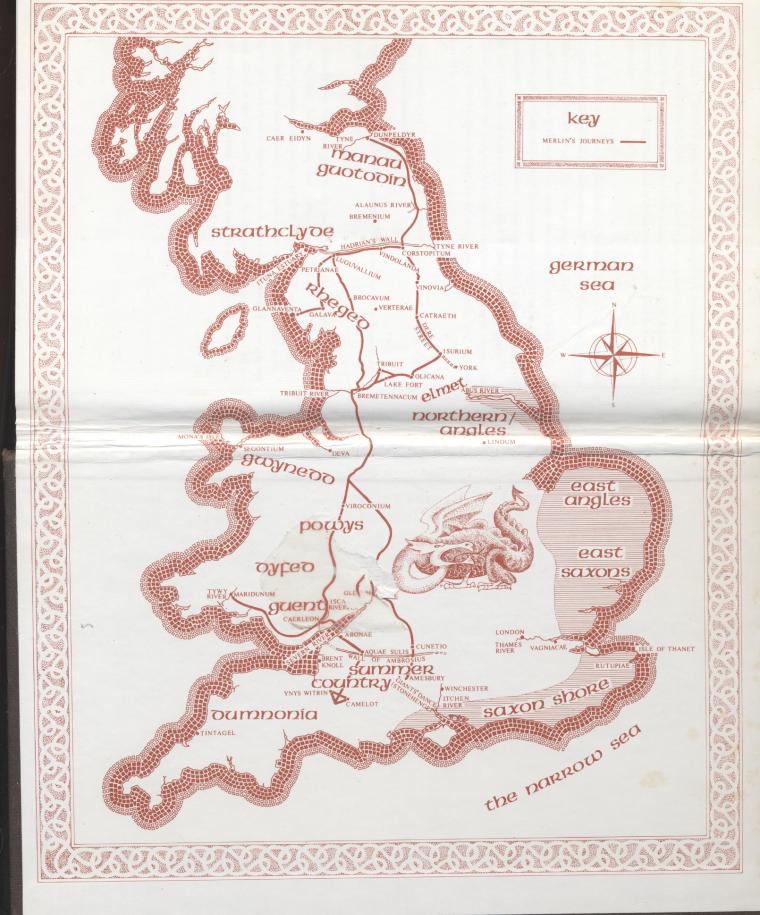
Above all, it is about Merlin and his relationship with Arthur and towards the end of the book with Niniane. As it narrated through Merlin’s eyes the battles that followed Arthur’s acsension are not the main focus of the book. He travels around the country and there is a helpful map on the endpapers of my hardback copy showing the routes he took and the places he visited.

Last Enchantment map 001

(I spent quite some time studying the map and working out what the places are called today.)

Merlin’s travels took him to numerous places including Dunpeldyr in the north-east, possibly on the site of the hill-fort on the present day Traprain Law, not far from Haddington and Dunbar, now in Scotland, then part of Northumbria; Caerleon (now the northern outskirts of Newport in South Wales); Galava (near present day Ambleside in the Lake District; and Vindolanda on the Great Wall of the Emperor Hadrian, where he visits his friend Blaise, to name but a few. It tells of how Merlin built Camelot on the hill then known as Caer Camel (caer is Welsh for fort or castle), a fictional place on a flat topped hill, not far from the sea and the Lake with its Isle of Glass.

Many years ago I read the first two books, The Crystal Cave (1970), about Merlin’s early days and The Hollow Hills (1973), in which Arthur learns who he is and becomes King.  I’d borrowed the books from the library, but never read the third book, so I was really happy when I found it in a library sale a few years ago for just 10p. I can’t think why I’ve not read it until this year, just too many other books clamouring to be read all at once, I expect.

Mary Stewart was born Mary Rainbow in January 1916 in County Durham. She currently lives in Scotland. On Goodreads I found this video of an interview with Mary Stewart in 1992 in which she talks about her writing and another interview with her in 1999, published by the University of Rochester. There are 2 other books following on from the Merlin TrilogyThe Wicked Da(1983), in which Mordred is the main character and The Prince and the Pilgrim (1995).

This historical fantasy is a perfect book not only for the Mount TBR Reading Challenge, but also the Once Upon a Time Challenge, the Historical Fiction Reading Challenge and because Mary Stewart lived in Scotland the Read Scotland 2014 Challenge too.

The King's Evil by Edward Marston

I’m still reading from my own unread books and turned to The King’s Evil for some historical crime fiction. It’s the first in Edward Marston’s Restoration series, featuring Christopher Redmayne, an architect and Jonathan Bale, a parish constable.

The King’s Evil is set in London in September 1666, just as the Great Fire of London has begun, eventually devastating a large part of the old medieval City of London. I liked Marston’s description of the fire, conjuring up the sights and sounds, the fear and panic it caused and the efforts to stop its spread – although I’m sure they didn’t use ‘dynamite’ to blow up houses to create a fire break. Anyway this anachronism didn’t spoil my enjoyment of this book.

Redmayne, a Royalist – a supporter of the Court and King Charles II – has designed a new house for Sir Ambrose Northcott and Bale is a Puritan who views Charles with great disapproval and is wondering if the fire is a consequence of the corruption in society as a result of the Restoration of the Crown:

England was once more ruled by a Stuart king. A monarchy which Jonathan had been pleased to see ended was now emphatically restored. As a result, London was indeed a wicked city and nobody was better placed to see the extent of its depravity than someone who patrolled the streets in the office of constable. Jonathan was a God-fearing man who always sought guidance from above and he was bound to wonder if the conflagration really was a sign of divine anger. There were Biblical precedents of cities being punished for their corruption. (page 26)

The two men are brought together with the discovery of Sir Ambrose’s dead body in the cellars of his partly built new house. It’s a good story with some interesting characters, including Jesus-Died-To-Save-Me Thorpe and Redmayne’s older brother Henry, elegant, fashionable and a dissipated rake, who had introduced Christopher to Sir Ambrose. But it’s the setting in time and place that interested me most – the period when Christopher Wren was the leading architect in rebuilding London – the bustle and energy of the times and the lingering conflict between Royalists and Parliamentarians.

The mystery of who killed Sir Ambrose moves along swiftly, with a few surprises along the way, as you would expect, but nothing too surprising. Redmayne travels to Sir Ambrose’s country house, Priestfield Place in Shipbourne, Kent and crosses the Chanel to Paris following the trail of the killer. It’s the ending of the book that let it down somewhat for me – it’s all a bit rushed and abrupt, but overall I enjoyed it and will read more in the series.

Edward Marston, who also writes under the name of Keith Miles, is a prolific author. He is a former chairman of the Crime Writers’ Association. He has several series of books, listed on his website and also on Fantastic Fiction.

The King’s Evil fits into several challenges I’m doing – The Mount TBR Reading Challenge, TBR Triple Dog Dare,the Historical Fiction Challenge, My Kind of Mystery Challenge and What’s in a Name (royalty category).