My Friday Post: Cold Earth by Ann Cleeves

Book Beginnings Button

Every Friday Book Beginnings on Friday is hosted by Gillion at Rose City Reader where you can share the first sentence (or so) of the book you are reading, along with your initial thoughts about the sentence, impressions of the book, or anything else the opener inspires.

My book today is Cold Earth by Ann Cleeves, one of my TBR books, that I’ve just begun to read.

Cold Earth (Shetland Island, #7)

It begins:

The land slipped while Jimmy Perez was standing beside the grave. The dead man’s family had come from Foula originally and they’d carried the body on two oars, the way bodies were always brought for burial on that island.

Also every Friday there is The Friday 56, hosted by Freda at Freda’s Voice.
30879-friday2b56These are the rules:

  1. Grab a book, any book.
  2. Turn to page 56, or 56% on your eReader. If you have to improvise, that is okay.
  3. Find any sentence (or a few, just don’t spoil it) that grabs you.
  4. Post it.
  5. Add the URL to your post in the link on Freda’s most recent Friday 56 post.

Page 56:

Outside the rain had stopped and a faint, milky sunlight filtered through the gloom. Instead of looking back towards Lerwick, Sandy headed towards Sullom Voe and stopped at the new hotel that had been built just outside the village of Brae. Its accommodation was used solely for oil, gas and construction workers and had been full since it had been slotted together like a giant bit of Lego several years before. Sandy had been inside once for the Sunday-lunch carvery. It felt a bit like going abroad and wandering into another world.

~~~

Blurb

In the dark days of a Shetland winter, torrential rain triggers a landslide that crosses the main Lerwick-Sumburgh road and sweeps down to the sea.

At the burial of his old friend Magnus Tait, Jimmy Perez watches the flood of mud and peaty water smash through a croft house in its path. Everyone thinks the croft is uninhabited, but in the wreckage he finds the body of a dark-haired woman wearing a red silk dress. In his mind, she shares his Mediterranean ancestry and soon he becomes obsessed with tracing her identity.

Then it emerges that she was already dead before the landslide hit the house. Perez knows he must find out who she was, and how she died.

~~~

I have read all the preceding Shetland books and watched the TV adaptations of Ann Cleeves’ novels, both the Shetland and Vera series. The books and the TV versions are separate things – the TV versions are based on Ann Cleeves’ characters but plotlines and the characters can differ. For example Cassie, Fran’s daughter, in the TV version is a teenager and goes to university, whereas in the books she is a child. I prefer the books, although I really appreciate seeing the beautiful setting and the scenery of both Shetland and Northumberland in the TV versions.

What about you? Does it tempt you or would you stop reading? 

My Friday Post: Bitter Lemons of Cyprus by Lawrence Durrell

Book Beginnings Button

Every Friday Book Beginnings on Friday is hosted by Gillion at Rose City Reader where you can share the first sentence (or so) of the book you are reading, along with your initial thoughts about the sentence, impressions of the book, or anything else the opener inspires.

My book today is Bitter Lemons of Cyprus by Lawrence Durrell, one of the books I’m currently reading.

Bitter Lemons of Cyprus

It begins:

Journeys, like artists, are born and not made. A thousand differing circumstances contribute to them, few of them willed or determined by the will – whatever we may think. They flower spontaneously out of the demands of our natures – and the best of them lead us not only outwards in space, but inwards as well. Travel can be one of the most rewarding forms of introspection …

Also every Friday there is The Friday 56, hosted by Freda at Freda’s Voice.

30879-friday2b56These are the rules:

  1. Grab a book, any book.
  2. Turn to page 56, or 56% on your eReader. If you have to improvise, that is okay.
  3. Find any sentence (or a few, just don’t spoil it) that grabs you.
  4. Post it.
  5. Add the URL to your post in the link on Freda’s most recent Friday 56 post.

Page 56: Durrell is buying a house in the Greek village of Bellapaix and the owners have gathered their family in the village cafe to agree upon the price.

They sat on a semicircle of chairs, sipping coffee and arguing in low voices; a number of beards waggled, a number of heads nodded. They looked like a rugger scrum in an American film receiving last-minute instructions from their captain. Soon they would fall upon us like a ton of bricks and gouge us. I began to feel rather alarmed.

~~~

I’ve visited Cyprus several times, but not the area Durrell wrote about in this book – Kyrenia in Northern Cyprus. His description of it and Bellapaix makes me wish I could have seen it then in the 1950s.

Blurb

Bitter Lemons of Cyprus is Lawrence Durrell’s unique account of his time in Cyprus, during the 1950s Enosis movement for freedom of the island from British colonial rule. Winner of the Duff Cooper Memorial Prize, it is a document at once personal, poetic and subtly political – a masterly combination of travelogue, memoir and treatise.

‘He writes as an artist, as well as a poet; he remembers colour and landscape and the nuances of peasant conversation . . . Eschewing politics, it says more about them than all our leading articles . . . In describing a political tragedy it often has great poetic beauty.’ Kingsley Martin, New Statesman

‘Durrell possesses exceptional qualifications. He speaks Greek fluently; he has a wide knowledge of modern Greek history, politics and literature; he has lived in continental Greece and has spent many years in other Greek islands . . . His account of this calamity is revelatory, moving and restrained. It is written in the sensitive and muscular prose of which he is so consummate a master.’ Harold Nicolson, Observer

~~~

What about you? Does it tempt you or would you stop reading? 
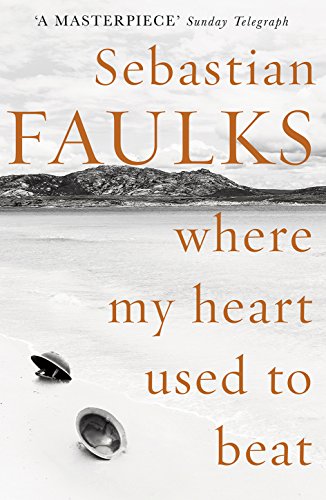
My Friday Post: Where My Heart Used To Beat by Sebastian Faulks

Book Beginnings Button

Every Friday Book Beginnings on Friday is hosted by Gillion at Rose City Reader where you can share the first sentence (or so) of the book you are reading, along with your initial thoughts about the sentence, impressions of the book, or anything else the opener inspires.

On Thursday I went to Barter Books in Alnwick and brought home a pile of books – more about that later on. One of those books is Where My Heart Used to Beat by Sebastian Faulks:

With its free peanuts and anonymity, the airline lounge is somewhere I can usually feel at home; but on this occasion I was in too much of a panic to enjoy its self-importance.

I can’t say I have ever felt at home in an airport lounge! I’m wondering what the narrator is panicking about.

Also every Friday there is The Friday 56, hosted by Freda at Freda’s Voice.

30879-friday2b56These are the rules:

  1. Grab a book, any book.
  2. Turn to page 56, or 56% on your eReader. If you have to improvise, that is okay.
  3. Find any sentence (or a few, just don’t spoil it) that grabs you.
  4. Post it.
  5. Add the URL to your post in the link on Freda’s most recent Friday 56 post.

Pages 55- 56:

My lodging was on the top floor – of course – with windows on both sides. The study was at the front, but the bedroom overlooked a willow and a stream, on which two young men were inexpertly rowing. Some lines from Tennyson – ‘By the margin, willow-veil’d …’ swam in and out of my mind.

~~~

Blurb

On a small island off the south coast of France, Robert Hendricks – an English doctor who has seen the best and the worst the twentieth century had to offer – is forced to confront the events that made up his life. His host is Alexander Pereira, a man who seems to know more about his guest than Hendricks himself does.
The search for the past takes us through the war in Italy in 1944, a passionate love that seems to hold out hope, the great days of idealistic work in the 1960s and finally – unforgettably – back into the trenches of the Western Front.

This moving novel casts a long, baleful light over the century we have left behind but may never fully understand. Daring, ambitious and in the end profoundly moving, this is Faulks’s most remarkable book yet.

~~~

What about you? Does it tempt you or would you stop reading? 

My Friday Post: World Enough & Time by Christian McEwan

Book Beginnings Button

Every Friday Book Beginnings on Friday is hosted by Gillion at Rose City Reader where you can share the first sentence (or so) of the book you are reading, along with your initial thoughts about the sentence, impressions of the book, or anything else the opener inspires.

World Enough & Time: On Creativity and Slowing Down

This week I’m featuring World Enough & Time: On Creativity and Slowing Down by Christian McEwen, a book I’ve borrowed from a friend:


When the Lilliputians first saw Gulliver’s watch, ‘that wonderful kind of engine … a globe, half silver and half of some transparent metal [glass!]’, they told themselves it had to be his god. After all, ‘he very seldom did anything without consulting it; he called it his oracle, and said it pointed out the time for every action of his life.’

Also every Friday there is The Friday 56, hosted by Freda at Freda’s Voice.

30879-friday2b56These are the rules:

  1. Grab a book, any book.
  2. Turn to page 56, or 56% on your eReader. If you have to improvise, that is okay.
  3. Find any sentence (or a few, just don’t spoil it) that grabs you.
  4. Post it.
  5. Add the URL to your post in the link on Freda’s most recent Friday 56 post.

Page 56:

Consider this quotation:

and this is what we mean by friends. Even when they are absent, they are with us … even when they are weak, they are strong; and … even when they are dead, they are alive.

CICERO

~~~

About the Book (extracted from Goodreads)

Slowness can open doors to sustained creativity, claims poet and teacher Christian McEwen. Over the course of ten years training teachers to write their own poems in order to pass the craft along to students, McEwen realized that nothing comes easily when life is conducted at a high rate of speed. She draws not only on personal experience, but on readings ranging from literary anecdote and poetry to Buddhism, anthropology, current news, and social history, all supplemented by interviews with contemporary writers and artists. This is a real reader’s book, one that stands up as both sustained narrative and occasional inspiration.

~~~

This is a book to take your time over reading it – you can read straight through or dip in and out of the chapters, focusing on different themes. I don’t want to rush through it – so at times, as I’m reading it I may quote further extracts  in future posts rather than writing a review.

What about you? Does it tempt you or would you stop reading? 

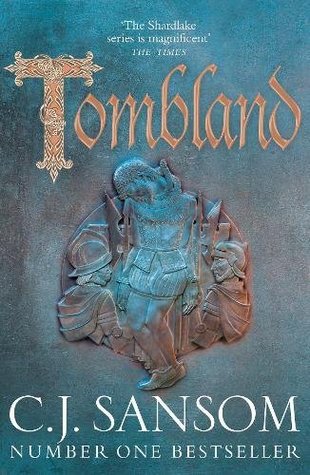
My Friday Post: Tombland by C J Sansom

Book Beginnings Button

Every Friday Book Beginnings on Friday is hosted by Gillion at Rose City Reader where you can share the first sentence (or so) of the book you are reading, along with your initial thoughts about the sentence, impressions of the book, or anything else the opener inspires.

This week I’m featuring Tombland by C J Sansom, one of the books I’m currently reading.

Tombland (Matthew Shardlake, #7)

It begins with a Prologue:

January 1549

I had been in my chambers at Lincoln’s Inn when the messenger came from Master Parry, asking me to attend to him urgently. I wondered what might be afoot. He was the Lady Elizabeth’s Comptroller, head of the financial side of her household, and I had worked under him since I was recommended to Elizabeth by Queen Catherine Parr two years before, following King Henry’s death.

It continues with

Chapter One

June 1549

It rained throughout our journey to Hatfield Palace; hard, heavy rain that dripped from our caps and made our horses’ reins slippery and slick. Occasionally, a gust of cold wind drove it at us slantwise; as though even now, in early June, the chill of the hard winter and cold spring was reluctant to let go of the land.

Also every Friday there is The Friday 56, hosted by Freda at Freda’s Voice.

30879-friday2b56These are the rules:

  1. Grab a book, any book.
  2. Turn to page 56, or 56% on your eReader. If you have to improvise, that is okay.
  3. Find any sentence (or a few, just don’t spoil it) that grabs you.
  4. Post it.
  5. Add the URL to your post in the link on Freda’s most recent Friday 56 post.

Pages 56 – 57:

I turned to the young man. ‘I understand that you visited Master Boleyn in gaol.’

Lockswood turned to his master, who nodded his agreement, then said, ‘I visited him last week in the castle gaol, where he is held until trial. An unpleasant place, sir, and Master Boleyn was in a sorrowful state. He seemed shocked by what had happened to him, kept doddering -‘

~~~

About the Book (extracted from Amazon)

Tombland is the seventh novel in C. J. Sansom’s number one bestselling Shardlake series.

It’s set in the summer of 1549, two years after the death of Henry VIII, England is sliding into chaos . . .

The nominal king, Edward VI, is eleven years old. His uncle Edward Seymour, Duke of Somerset, rules as Protector. The extirpation of the old religion by radical Protestants is stirring discontent among the populace while the Protector’s prolonged war with Scotland is proving a disastrous failure and threatens to involve France. Worst of all, the economy is in collapse, inflation rages and rebellion is stirring among the peasantry.

Matthew Shardlake is asked to investigate the murder of Edith Boleyn, the wife of John Boleyn – a distant Norfolk relation of Elizabeth’s mother Anne Boleyn.  Then he and his assistants get caught up in the rebellion against the landowners’ enclosures of the common land as thousands of peasants led by Robert Kett establish a vast camp outside Norwich.

~~~

I am thoroughly absorbed by this book, reading it at a leisurely pace, enjoying all the details. I knew about the early enclosures of common land, but hadn’t heard of Kett’s Rebellion before. It’s a long book of 866 pages including an historical essay, Reimagining Kett’s Rebellion, notes and a bibliography.

What about you? Does it tempt you or would you stop reading? 

My Friday Post: In a Dark, Dark Wood by Ruth Ware

Book Beginnings Button

Every Friday Book Beginnings on Friday is hosted by Gillion at Rose City Reader where you can share the first sentence (or so) of the book you are reading, along with your initial thoughts about the sentence, impressions of the book, or anything else the opener inspires.

This week I’m featuring In a Dark, Dark Wood by Ruth Ware, one of the books I mentioned in Top Ten Books On My Fall 2018 TBR.

In a Dark, Dark Wood

About the Book

Nora hasn’t seen Clare for ten years. Not since the day Nora walked out of her old life and never looked back. 

Until, out of the blue, an invitation to Clare’s hen party arrives. A weekend in a remote cottage – the perfect opportunity for Nora to reconnect with her best friend, to put the past behind her. 

But something goes wrong. 

Very wrong.

And as secrets and lies unravel, out in the dark, dark wood the past will finally catch up with Nora.

This was Ruth Ware’s debut thriller. But, I’m not sure I want to read this book as I wasn’t impressed by the only other book by her that I’ve read, The Woman in Cabin 10.

It begins:

I am running.

I am running through moonlit woods, with branches tearing at my clothes and my feet catching in the snow-bowed bracken.

~~~

Also every Friday there is The Friday 56, hosted by Freda at Freda’s Voice.

30879-friday2b56These are the rules:

  1. Grab a book, any book.
  2. Turn to page 56, or 56% on your eReader. If you have to improvise, that is okay.
  3. Find any sentence (or a few, just don’t spoil it) that grabs you.
  4. Post it.
  5. Add the URL to your post in the link on Freda’s most recent Friday 56 post.

Page 56:

At last I could see the road, a pale grey snake in the deepening shadows. As I broke out from he woods I heard the soft hoot of an owl, and I obeyed Flo’s instructions, turning right along the tarmac. I hadn’t been running for long when I heard the sound of a car behind me and stopped, pressing myself up against the verge.

~~~

What about you? Does it tempt you or would you stop reading? If you have read it what did you think?