First Chapter, First Paragraph

First chapterEvery Tuesday Diane at Bibliophile by the Sea hosts First Chapter First Paragraph Tuesday Intros to share the first paragraph sometimes two, of a book that she’s reading or planning to read soon.

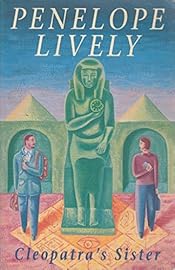
This week I’m featuring Cleopatra’s Sister by Penelope Lively.
Howard Beamish became a palaeontologist because of a rise in the interest rate when he was six years old. His father, a cautious man with a large mortgage, announced that the projected family holiday to the Costa Brava was no longer feasible. A chalet was rented on the north Somerset coast instead and thus, on a dank August afternoon, Howard picked up an ammonite on Blue Anchor Beach.

He presented it to his parents. ‘What’s this?’

It’s a stone,’ said his father, who was listening to the test match.

‘No, it isn’t,’ retorted Howard, an observant child.

‘It’s a fossil, dear,’ said his mother. ‘That’s a very old sort of stone.’

‘Why?’ persisted Howard after a few moments. The single word embraced a vast range of query, for which he did not have the language.

His mother, too, paused to consider and was also defeated, though for different reason. She evaded the issue by offering Howard a tomato sandwich, which he accepted with enthusiasm while continuing to pore over the ammonite. During the rest of the afternoon, he collected five more fossil fragments, including one embedded in a slab of rock weighing several pounds.

Penelope Lively is one of my favourite authors, so I’m expecting to enjoy this book. I’ve quoted more than the first paragraph as I loved the conversation between Howard and his parents and the description of the scene on the beach as Howard ate his tomato sandwich and collected fossils. It shows the influence of chance on our lives – and I’m also fascinated by fossils.

Blurb:

Detached and unwordly paleontologist Howard Beamish is on a journey that is to change his life. Travelling to Nairobi, his plane is forced to land in Marsopolis, the capital of Callimbia, where Cleopatra’s sister entertained Antony. Also on the flight is Lucy Faulkner, a journalist with a sketchy knowledge of Callimbia’s political turbulence. As chance throws them together, Howard and Lucy become embroiled in a revolution that is both political and personal.

‘Every sentence is a pleasure to read’ Sunday Express

‘A fluent, funny, ultimately moving romance in which lovers share centre stage with Lively’s persuasive meditations on history and fate. . .a book of great charm with a real intellectual resonance at its core’ The New York Times Book Review

What do think – would you read on?

My Friday Post: The Eagle of the Ninth

Book Beginnings Button

Every Friday Book Beginnings on Friday is hosted by Gillion at Rose City Reader where you can share the first sentence (or so) of the book you are reading, along with your initial thoughts about the sentence, impressions of the book, or anything else the opener inspires.

The Eagle of the Ninth

This year I’m hoping to read more from my own shelves than last year so I’ve been looking at some of the books that I’ve had for years. The Eagle of the Ninth by Rosemary Sutcliff is one of my TBRs – I bought it in a library book sale, not sure when that was, over 10 years ago, I should think. Today I got it down off the shelf and began reading:

From the Fosseway westward to Isca Dumnoniorum the road was simply a British trackway, broadened and roughly metalled, strengthened by corduroys of logs in the softest places, but otherwise unchanged from its old estate, as it wound among the hills, thrusting further and further into the wilderness.

Also every Friday there is The Friday 56, hosted by Freda at Freda’s Voice.

Friday 56

These are the rules:

  1. Grab a book, any book.
  2. Turn to page 56, or 56% on your eReader.
  3. Find any sentence (or a few, just don’t spoil it) that grabs you.
  4. Post it.
  5. Add the URL to your post in the link on Freda’s most recent Friday 56 post.

Page 56:

A great gust of wind swooped against the house like a wild thing striving to batter its way in; the lamplight jumped and fluttered, sending shadows racing across the chequered board – and the ghost of last year were once more a year away. Marcus looked up, and said, as much for the sake of shutting out his own thoughts as for anything else, ‘I wonder what possessed you to settle here in Britain, Uncle Acquila, when you could have gone home?’

Blurb from the back cover:

The Ninth Legion marched into the mists of northern Britain. And they were never seen again. Four thousand men disappeared and the eagle standard was lost.

Marcus has to find out what happened to his father, who led the Ninth Legion. So he sets out into the unknown, on a quest so hazardous that no one expects him to return …

This is the first of Sutcliff’s series of novels about Roman Britain. The film, The Eagle (2011) is adapted from her book. I read some of her books when I was a child and loved them. I’m hoping this one will be as good.

First Chapter, First Paragraph

First chapter

Every Tuesday Diane at Bibliophile by the Sea hosts First Chapter First Paragraph Tuesday Intros to share the first paragraph sometimes two, of a book that she’s reading or planning to read soon. This week I’m featuring The Red House by Mark Haddon.

The Red House

It begins:

Cooling towers and sewage farms. Finstock, Charlbury, Ascott-under-Wychwood. Seventy miles per hour, the train unzips the fields. Two gun-grey lines beside the river’s meander. Flashes of sun on the hammered metal. Something of the steam about it, even now. Hogwarts and Adlestrop. The night mail crossing the border. Cheyenne sweeping down from the ridge. Delta blues from the boxcar. Somewhere those secret points that might just switch and send you curving into a world of uniformed porters and great aunts and summers at the lake.

I was struck by the imagery of the train unzipping the fields and the mix of different train journeys, with the hint of nostalgia and the promise of something unknown about to happen. And I like the cover – the small black illustrations against the white background and the black lines meeting at the red house.

Blurb (Amazon):

Family, that slippery word, a star to every wandering bark, and everyone sailing under a different sky.

After his mother’s death, Richard, a newly remarried hospital consultant, decides to build bridges with his estranged sister, inviting Angela and her family for a week in a rented house on the Welsh border. Four adults and four children, a single family and all of them strangers. Seven days of shared meals, log fires, card games and wet walks.

But in the quiet and stillness of the valley, ghosts begin to rise up. The parents Richard thought he had. The parents Angela thought she had. Past and present lovers. Friends, enemies, victims, saviours. And watching over all of them from high on the dark hill, Karen, Angela’s stillborn daughter.

The Red House is about the extraordinariness of the ordinary, weaving the words and thoughts of the eight characters together with those fainter, stranger voices – of books and letters and music, of the dead who once inhabited these rooms, of the ageing house itself and the landscape in which it sits.

Once again Mark Haddon, bestselling author of The Curious Incident ofthe Dog in the Night-time and A Spot of Bother, has written a novel that is funny, poignant and deeply insightful about human lives.

What do you think – would you read on or not?

First Chapter, First Paragraph: A Cupboard Full of Coats

First chapter

Every Tuesday Diane at Bibliophile by the Sea hosts First Chapter First Paragraph Tuesday Intros to share the first paragraph sometimes two, of a book that she’s reading or planning to read soon.

My opener this week is from A Cupboard Full of Coats by Yvvette Edwards which was longlisted for The Man Booker Prize in 2011.

A Cupboard Full of Coats

It begins:

It was early spring when Lemon arrived, while the crocuses in the front garden were flowering and before the daffodil buds had opened, the Friday evening of a long, slow February, and I had expected when I opened the front door to find an energy salesperson standing there, or a charity worker selling badges, or any one of a thousand random insignificant people whose existence meant nothing to me or my world.

He just knocked, that was all, knocked the front door and waited, like he’s just come back with the paper from the shop, and the fourteen years since he’d last stood there, the fourteen years since the night I’d killed my mother, hadn’t really happened at all.

Blurb from Amazon:

Crushed by an impossible shame, Jinx’s life has been little more than a shell; estranged from her husband, she is even relieved when he takes her young son with him. When Lemon, an old friend of her mother’s, turns up on her doorstep, Jinx is forced to confront her past, and with the pain of remembrance comes the possibility of redemption. But Lemon has his own secrets to share, and together they unravel an unforgettable family drama, stoked with violence and passion. Rich with voices from East London and the West Indies, Edwards’s narrative is delivered with a unique and uncompromising bite that announces a new talent in British fiction.

I’ve borrowed this book from the library, attracted first of all by the title, wondering why it was called A Cupboard Full of Coats, and then by these opening paragraphs. I want to know more about Jinx, why she killed her mother and how the cupboard full of coats comes into the story.

What do you think and would you read on?

First Chapter, First Paragraph

First chapter

Every Tuesday Diane at Bibliophile by the Sea hosts First Chapter First Paragraph Tuesday Intros to share the first paragraph sometimes two, of a book that she’s reading or planning to read soon.

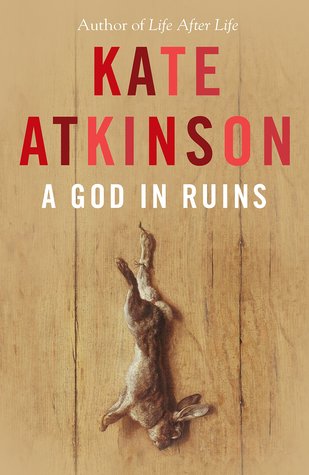
My opener this week is from A God in Ruins by Kate Atkinson:A God in Ruins (Todd Family, #2)

30 March 1944

The Last Flight

Naseby

He walked as far as the hedge that signalled the end of the airfield.

The beating of the bounds. The men referred to it as ‘his daily constitutional’ and fretted when he didn’t take it. They were superstitious. Everyone was superstitious.

Blurb:

“He had been reconciled to death during the war and then suddenly the war was over and there was a next day and a next day. Part of him never adjusted to having a future.”

Kate Atkinson’s dazzling Life After Life explored the possibility of infinite chances and the power of choices, following Ursula Todd as she lived through the turbulent events of the last century over and over again.

A GOD IN RUINS tells the dramatic story of the 20th Century through Ursula’s beloved younger brother Teddy–would-be poet, heroic pilot, husband, father, and grandfather-as he navigates the perils and progress of a rapidly changing world. After all that Teddy endures in battle, his greatest challenge is living in a future he never expected to have.

An ingenious and moving exploration of one ordinary man’s path through extraordinary times, A GOD IN RUINS proves once again that Kate Atkinson is one of the finest novelists of our age.

I haven’t read Life After Life, so I’m hoping that won’t matter and that this book will read well as a standalone. If you’ve read it what do you think?

First Chapter, First Paragraph

First chapterEvery Tuesday Diane at Bibliophile by the Sea hosts First Chapter First Paragraph Tuesday Intros to share the first paragraph sometimes two, of a book that she’s reading or planning to read soon.

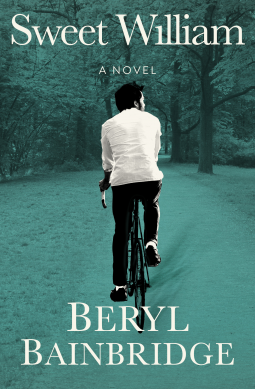
My opener this week is from Sweet William by Beryl Bainbridge, a book Greta from Open Road Integrated Media offered me on NetGalley as I’ve recently reviewed The Bottle Factory Opening. 

Sweet William was first published in 1975 – this e-book edition is due to be published 29 November 2016.

It begins:

In the main entrance of the air terminal a young man stood beside a cigarette machine, searching in the breast pocket of his blue suit for his passport. A girl, slouching in a grey coat, as if she was too tall, passively watched him.

‘It’s safe,’ he said, patting his pocket with relief.

Blurb

Romantic comedy meets social satire in this delirious novel about sexual freedom versus British tradition in swinging 1960s London.

When dull professor Gerald leaves London for the United States, his fiancée, Ann, is a bit afraid and sad to see him go’”never has he looked so handsome and masculine as when he’s about to board the plane. But a few days later at a religious service, Ann is beckoned to sit next to a stranger with yellow curls and a nose like a prizefighter’s. Her heart inexplicably begins to race; she feels like she has the flu. This stranger, William McClusky, tells Ann in his Scottish accent that he is a playwright who will be interviewed on TV the very next day. Furthermore, he promises to have a television dropped by her house so she can watch him! From this first bizarre seduction, Ann is infatuated, and in the days following, William begins to take over her life.

In the throes of the affair, Ann gives up her BBC job, helps a friend get an abortion, encourages adultery, and writes a break-up letter to her fiancé. Her engagement to Gerald had been rushed, after all, and was designed to serve her mother’s desires more than her own. With William, on the other hand, everything feels different. But is this new man really who he says he is? Is he a genius or a fraud, a compassionate soul or a cheater? Perhaps William is simply a means by which Ann can play out her dangerous fantasies and finally take part in the swinging sixties. Only one thing is certain: Now that she’s with him, there’s no turning back.

An ironic investigation into the art of self-deception and the repercussions of sexual freedom, this blend of black comedy and social satire showcases the wit of award-winning author Beryl Bainbridge, and affirms her status as a mainstay in twentieth-century British literature.

I’ve read a few of Beryl Bainbridge’s books (see below) and loved each one, so I’m really hoping to love this one too.

Dame Beryl Margaret Bainbridge, DBE was an English novelist. She won the Whitbread Awards prize for best novel in 1977 and 1996 and was nominated five times for the Booker Prize. She was described in 2007 as ‘a national treasure’. In 2008, The Times newspaper named Beryl Bainbridge among their list of The 50 greatest British writers since 1945.