Throwback Thursday: Digging to America

I’m linking up today with Davida @ The Chocolate Lady’s Book Review Blog for Throwback Thursday. It takes place on the Thursday before the first Saturday of every month (i.e., the Thursday before the monthly #6Degrees post). The idea is to highlight one of your previously published book reviews and then link back to Davida’s blog.

This is my first Throwback Thursday post and I’ve decided to start with one of my first book reviews – Digging to America by Anne Tyler, posted on June 20 2007.

This is the first paragraph:

I’m so glad I’ve read Digging to America. I’d been resisting reading it because when I first heard about I just didn’t like the sound of it; I think what put me off were the names of some of the characters, particularly Bitsy who came over to me as a know-it-all bossy woman. It just shows you shouldn’t make snap judgements like that.

Click here to read the rest of this review

After I read this I intended to read more of Anne Tyler’s books – but I didn’t!

There are plenty to choose from. She’s written twenty novels. In 1989 she won the Pulitzer Prize for Breathing Lessons; in 1994 she was nominated by Roddy Doyle and Nick Hornby as ‘the greatest novelist writing in English’; in 2012 she received the Sunday Times Award for Literary Excellence; and in 2015 A Spool of Blue Thread was a Sunday Times bestseller and was shortlisted for the Baileys Women’s Prize for Fiction and the Man Booker Prize. Her latest book is Redhead by the Side of the Road, which was longlisted for the Booker Prize 2020.
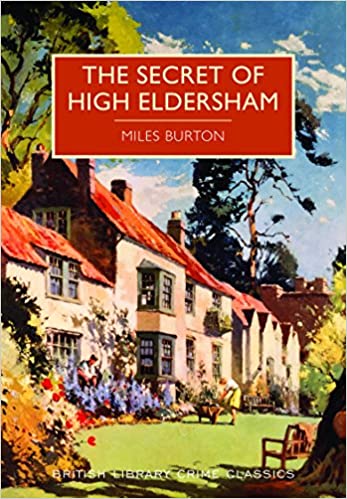
The Secret of High Eldersham by Miles Burton

Rating: 4 out of 5.

The Secret of High Eldersham by Miles Burton was first published in 1930. Miles Burton is a pseudonym. His real name was Cecil John Charles Street (1884 – 1964) and he also wrote under the names of John Rhode and Cecil Way. I like these names – variations on the word ‘street’. This edition was published by the British Library in 2016 and is one of my TBRs.

It’s not an easy book to write about. There is a murder – that of the landlord of the Rose and Crown Inn in the village of High Eldersham. He was found dead slumped in a chair, having been stabbed in the neck. The local police don’t feel able to deal with the murder so call in help from Scotland Yard.

But when Detective Inspector Young arrives he discovers that there is something very strange about the village and its inhabitants. Like a lot of small and remote villages the local people keep themselves to themselves and are very wary of strangers – they’re not made welcome and they don’t stay very long. But it’s more than that. Strange things are happening, and Young’s theory to account for the queerness of the place seemed to him (and to me) ‘so impossible, so utterly fanciful, that to entertain it was to doubt his own sanity.’ It concerns ancient legends and customs with a supernatural element. And this is what makes it difficult to write about because to say anything more about this ‘queerness‘ would be to give away a major part of the plot.

Young decides he can’t deal with this on his own and he contacts his friend, Desmond Merrion, a brilliant individual from the intelligence branch of the Admiralty, he had met during the war. He writes to Merrion inviting him to the inquest into the Inn’s landlord death, where he meets a war-time acquaintance, Laurence Hollesley.

From that point on the novel branches into two stories – the murder mystery and a thriller full of danger, drama and pace, plus a damsel in distress and spot of smuggling thrown into the mix. I enjoyed it. It’s easy to read, even if I find it difficult to write about, with clearly identifiable characters and a good sense of location. There’s suspense and the tension rises as the mystery reaches its climax.

Merrion also appears in the one other book I have by Miles Burton – Death in the Tunnel, which I hope to read soon.

The Luminaries by Eleanor Catton

Sometimes I read books and have no desire to write about them, not because I didn’t enjoy them but because I just want to get on and read the next book. And this summer has been one of those times, so that now I’m finding difficult to remember all the details of the books I’ve read because I didn’t write about them soon after I finished reading. It’s been a strange time during this pandemic and it’s not been easy to concentrate. But I do want to keep a record of my reading and the only way now to catch up is to write some brief notes about each book, beginning with The Luminaries by Eleanor Catton, the winner of the 2013 Booker Prize,

Rating: 4 out of 5.

I downloaded The Luminaries by Eleanor Catton 3 years ago. I read it in July. It is a long and detailed book, written with such intricate plotting and numerous characters that it bewildered me at times. It’s historical fiction set in New Zealand in the 1860s, during its gold rush and it has everything – gold fever, murder, mystery and a ghost story too.

Blurb from Goodreads:

It is 1866, and young Walter Moody has come to make his fortune upon the New Zealand goldfields. On the stormy night of his arrival, he stumbles across a tense gathering of twelve local men who have met in secret to discuss a series of unexplained events: A wealthy man has vanished, a prostitute has tried to end her life, and an enormous fortune has been discovered in the home of a luckless drunk. Moody is soon drawn into the mystery: a network of fates and fortunes that is as complex and exquisitely ornate as the night sky. Richly evoking a mid-nineteenth-century world of shipping, banking, and gold rush boom and bust, The Luminaries is a brilliantly constructed, fiendishly clever ghost story and a gripping page-turner. 

I found the structure a bit of a stumbling block at first as the chapters halve in length from the very long opening chapter to the very short final chapter – so that from feeling overwhelmed by the length and detail of the opening chapters, by the time that I neared the ending I felt distinctly dissatisfied with the brevity of the concluding chapters – the early chapters are too long and the final ones are too short. And the significance of the astronomical headings completely bypassed me.

But if this sounds as though I didn’t enjoy this novel, that is wrong, because I did for the major part of the book. I loved the pictures it builds up of the setting in New Zealand, the frontier town and its residents from the prospectors to the prostitutes, and the obsessive nature of gold mining. And I did become fully absorbed in the story during the week it took me to read. it

These are the other books I read in July and August and have not yet reviewed:

  • Thin Air by Michelle Paver
  • The Birdwatcher by William Shaw
  • Still Life by Val McDermid
  • Dead Man’s Footsteps by Peter James

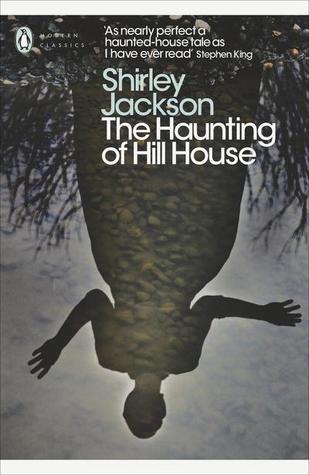
My Friday Post: The Haunting of Hill House by Shirley Jackson

Every Friday Book Beginnings on Friday is hosted by Gillion at Rose City Reader where you can share the first sentence (or so) of the book you are reading. You can also share from a book you want to highlight just because it caught your fancy.

Today my Book Beginning is from The Haunting of Hill House by Shirley Jackson.

No living organism can continue for long to exist sanely under conditions of absolute reality; even larks and katydids are supposed by some to dream. Hill House, not sane, stood by itself against its hills, holding darkness within; it had stood so for eighty years and might stand for eighty more. Within, walls might continue upright, bricks met neatly, floors were firm, and doors were sensibly shut; silence lay steadily against the wood and stone of Hill House, and whatever walked there, walked alone.

Also every Friday there is The Friday 56, hosted by Freda at Freda’s Voice. *Grab a book, any book. *Turn to Page 56 or 56% on your  ereader . If you have to improvise, that is okay. *Find a snippet, short and sweet, but no spoilers!

These are the rules:

  1. Grab a book, any book.
  2. Turn to page 56, or 56% on your eReader. If you have to improvise, that is okay.
  3. Find any sentence (or a few, just don’t spoil it) that grabs you.
  4. Post it.
  5. Add the URL to your post in the link on Freda’s most recent Friday 56 post.

  1. Grab a book, any book.
  2. Turn to page 56, or 56% on your eReader. If you have to improvise, that is okay.
  3. Find any sentence (or a few, just don’t spoil it) that grabs you.
  4. Post it.
  5. Add the URL to your post in the link on Freda’s most recent Friday 56 post.

Page 56:

The sun went down smoothly behind the hills, slipping almost eagerly, at last, into the pillowy masses. There were already long shadows on the lawn as Eleanor and Theodora came up the path toward the side veranda of Hill House, blessedly hiding its mad face in the growing darkness.

This book has been described as a ‘perfect work of unnerving terror’, so it’s ideal reading for Hallowe’en.

Blurb:

Alone in the world, Eleanor is delighted to take up Dr Montague’s invitation to spend a summer in the mysterious Hill House. Joining them are Theodora, an artistic ‘sensitive’, and Luke, heir to the house. But what begins as a light-hearted experiment is swiftly proven to be a trip into their darkest nightmares, and an investigation that one of their number may not survive. Twice filmed as The Haunting, and the inspiration for a 10-part Netflix series, The Haunting of Hill House is a powerful work of slow-burning psychological horror.

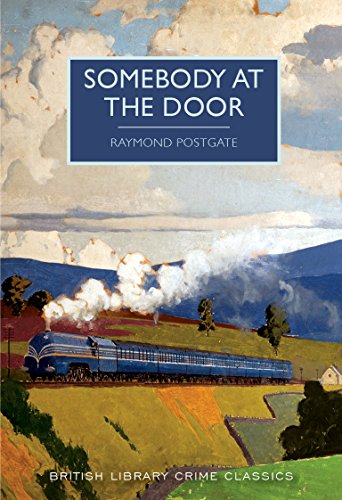
Somebody at the Door by Raymond Postgate

Rating: 4 out of 5.

Somebody at the Door is one of the British Library Crime Classics, originally published in 1943. It’s set in 1942 and it gives a vivid picture of what life was like in wartime England. There is an interesting introduction by Martin Edwards.

In January 1942, Henry Grayling is on the 6.12 train from Euston, travelling home to Croxburn from work in London. There’s a fuel shortage so there are less trains than usual and the carriages are crowded – Grayling views all his fellow passengers with dislike and suspicion as he clutches his attache case, containing £120 pounds close to his chest.

He sits next to a young man, Evetts, who works for the same company and is smoking a foul smelling pipe, and on his other side is the Vicar of Croxburn, both of whom he knows. He also recognises Ransom, a corporal in the Home Guard platoon in which he, Grayling is a second lieutenant. The other occupants of the carriage are a fair young man with a club foot, a refugee doctor, a fat middle aged woman and her teenage daughter, and two young working men in overalls. Most of the passengers are suffering from colds, coughing and sneezing and Grayling has to hold his handkerchief in front of his nose. He is relieved to leave the train when it eventually pulls into the station at Croxburn. However, when Grayling arrived home he is seriously ill and dies later that evening.

An autopsy reveals that he had died of mustard gas poisoning and Inspector Holly finds that there are too many suspects; Grayling was an extremely unlikable person. The rest of the book reads like a collection of short stories as Holly investigates Grayling’s fellow passengers. Their stories are detailed and at times I felt they were too long and slowed the book down too much, but they are interesting in themselves. I particularly like the German refugee’s story, casting light on what life was like in Germany just before and at the onset of the war.

I did enjoy the book, the characters stand out as real people and also reflect Postgate’s own likes and dislikes. Martin Edwards’ introduction gives the background to Postgate’s writing – he was an atheist and a one-time Communist. His stories reveal the corruption in local government at that period, and the attitudes of the British government in the lead up to the war. The murder mystery is really secondary to the suspects’ stories, which makes the book more a reflection of the period, which Postgate does really well, than crime fiction. However, the murder mystery is well plotted, giving me plenty to unravel and it was only in the final section that I guessed who had killed Grayling.

  • Kindle Edition
  • File Size : 3089 KB
  • Print Length : 239 pages
  • Publisher : British Library Publishing (10 Oct. 2017)
  • Source: Prime Reading Library

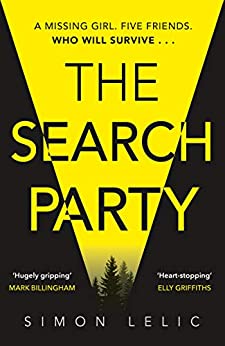
The Search Party by Simon Lelic

Rating: 4.5 out of 5.

Viking| 20 August 2020| 352 pages print length| Hardback| Review Copy

Three years ago I read The House by Simon Lelic and enjoyed it, so I was looking forward to reading The Search Party. I’m delighted to say that I think it is even better.

16-year-old Sadie Saunders is missing and five of her friends set out into the woods to find her. At the same time the police’s investigation, led by Detective Inspector Robin Fleet and Detective Sergeant Nicola Collins, is underway. The narrative alternates between the two groups. Sadie is a clever girl, popular with her school friends and loved by her parents, who favour her over her twin brother Luke and their younger brother, Dylan.

The opening lines propelled me straight into the story as one of Sadie’s friends, lost in the woods her makes an incoherent phone call to the emergency services. The caller doesn’t know their location other than it is ‘somewhere in the woods‘ near an abandoned building. And from that point on I was gripped, compelled to follow this complex novel, full of red herrings and multiple twists and turns. It is tense from start to finish, ending in an exhausting and terrifying chase that had me on the edge of my seat!

I really like Fleet, and the way he stands up to his boss, Superintendent Burton, whose main concern is the cost of the investigation. Burton puts pressure on him to arrest Mason, assuming he has killed Sadie even though her body has not been found. Mason is part of the search party, but Fleet’s instincts tell him Mason is innocent. Fleet is known for his ability to find missing persons and sticks to his gut feelings.

My only criticism is that at times the teenagers’ rambling discussions about what could have happened to Sadie and their disagreements went on too long for my liking. But that is just a minor point. They are all keeping secrets and in their interviews with the police they all lie and withhold vital facts and they are suspicious of each other, not knowing who they can trust. And I couldn’t decide what had happened to Sadie – had she run away, committed suicide or was she murdered and if so who was the murderer. They are all suspects, including Sadie’s parents. It was only just before the end of the book that I realised just what had happened.

My thanks to NetGalley and Viking, the publishers for a review copy.