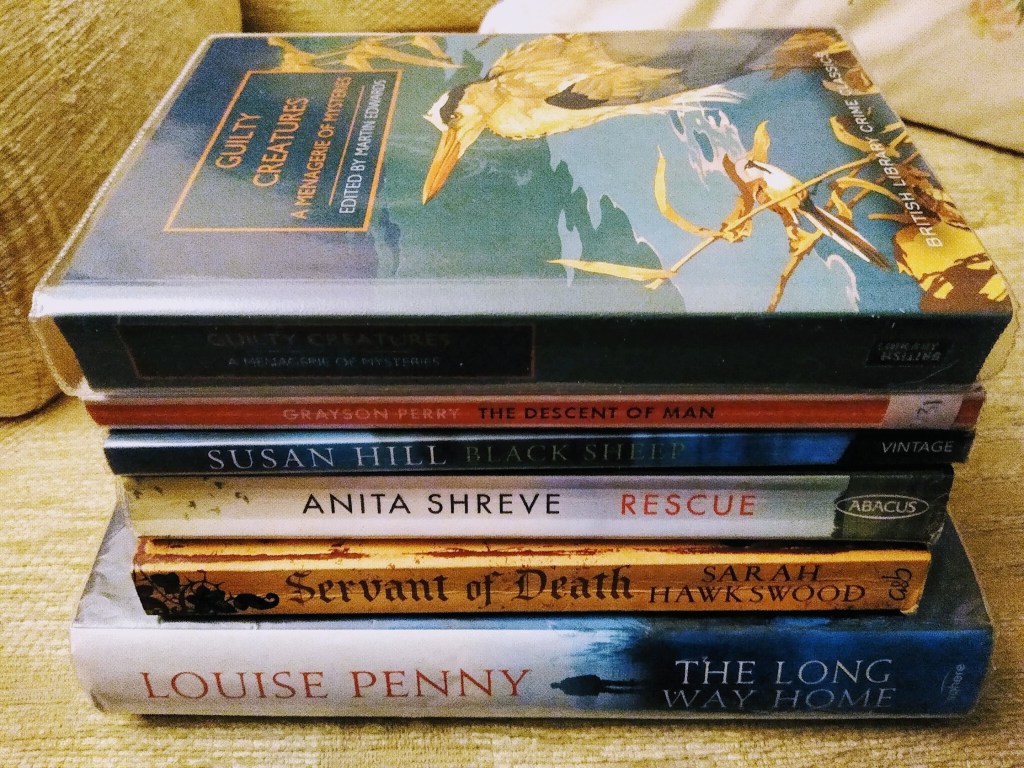
Recent Loans from the Library

Guilty Creatures: A Menagerie of Mysteries edited and introduce by Martin Edwards. I like these anthologies as much, if not more, for Martin Edwards’ introductions than for the actual stories. I often find that they’re too short for my liking, but I’m hoping there will be some that will prove me wrong. This collection includes stories by Arthur Conan Doyle, G K Chesterton, Edgar Wallace, Josephine Bell and Christianna Brand, among others.

The Descent of Man by Grayson Perry. During the fist lockdown I loved watching Grayson’s Art Club, Channel 4’s documentary series hosted by him and his wife, psychotherapist Philippa Perry. In this book he is looking at masculinity, particularly examining how men dominate much of our world, how men dress and act, how men resort to crime and violence, and how men feel.

Black Sheep by Susan Hill, a novella about a brother an sister who grew up in a coal mining village and yearn to escape. Neither can break free and their decisions result in brutal consequences. It sounds a bit grim!

Rescue by Anita Shreve. The last few books by Anita Shreve I’ve read haven’t been as good as her earlier ones, so I’m hoping this one won’t be disappointing. It’s about a paramedic who rescues a troubled young woman from a car crash. They start a love affair and have a daughter. Eighteen years later he is raising the girl on his own,

Servant of Death by Sarah Hawkswood, historical murder mystery set in the 12th century, the first in the Bradcote and Catchpole mystery series. The Lord Bishop of Winchester’s clerk – is bludgeoned to death in Pershore Abbey and laid before the altar in the attitude of a penitent. Who hated him enough to murder him?

The Long Way Home by Louise Perry. I thought it looked familiar and when I got home and checked my blog I realised I’d borrowed this book before – in 2018! But I took it back unread, thinking I’d try to get the first one. It’s the 10th Chief Inspector Gamache novel – and I still haven’t read any of the previous books, so maybe I’ll read this one this time.

Nonfiction November: Week 2 Book Pairings

Week 2: (November 8-12) – Book Pairing with Katie at Doing DeweyThis week, pair up a nonfiction book with a fiction title. It can be a “If you loved this book, read this!” or just two titles that you think would go well together. Maybe it’s a historical novel and you’d like to get the real history by reading a nonfiction version of the story. 

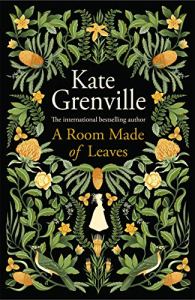
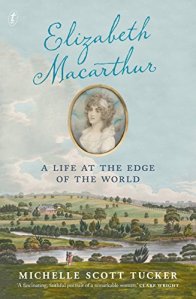
Earlier this year I read the novel A Room Made of Leaves by Kate Grenville and I’m pairing it with Elizabeth Macarthur: A Life at the Edge by Michelle Scott Tucker, which I haven’t read yet.

Kate Grenville is one of my favourite authors, so I was very keen to read A Room Made of Leaves. It’s historical fiction telling the story of the Macarthurs, Elizabeth and John Macarthur, who settled in Australia at the end of the eighteenth century. It’s based on the real lives of the Macarthurs using letters, journals and official documents of the early years of the New South Wales colony. Her writing suits me – historical fiction, with good descriptive writing setting the scenes vividly in their locations. I find her books difficult to put down and they stay in my mind long after I’ve finished reading. This one is no exception.

Whenever I read historical fiction I always want to know how much is fact and how much is fiction, how accurate it is. And so this novel intrigued me because Kate Grenville’s book begins with an editor’s note about ‘the ‘incredible discovery of Elizabeth Macarthur’s secret memoirs’ in a tin box containing old papers, revealing the real person behind the few letters she wrote home to her family and friends and a lot of ‘dull correspondence with her adult children’. Was this true, I wondered. So I turned to the back of the book to read Grenville’s Author’s Note and in that she clarifies that this is not history and, although the extracts from Elizabeth’s letters are from the letters of the real Elizabeth Macarthur, she has ‘taken some liberties in order to shape this work of fiction’. The old documents were Grenville’s ‘inspiration and guide’. In other words you have to bear in mind the epigraph, an actual quotation from one of Elizabeth’s letters: Believe not too quickly, a reminder that this is fiction.

It made me want to know more about the Macarthurs, and what was indeed their history, so I was delighted to find out that Kate Grenville references Michelle Scott Tucker’s biography: Elizabeth Macarthur: A Life at the Edge of the World as the standard biography in her Acknowledgements and I was even more delighted to see that it’s available as a ebook. So it is now in my Kindle and I’m keen to read it as soon as possible. I want to see what Michelle Scott Tucker has made of the same historical sources – history, after all, is an interpretation of the facts from the records, trying to explain what happened and why, dependent on available evidence. Fiction is more flexible and can fill in the gaps where the documentary evidence is lacking.

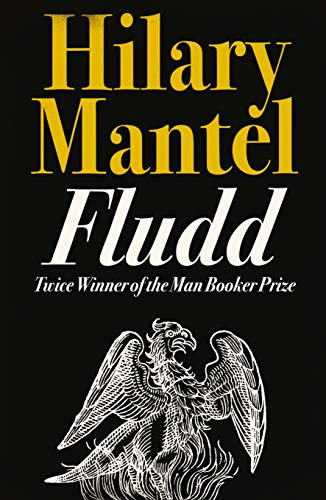
Contemporary Novellas: Fludd by Hilary Mantel

A dark fable of lost faith and awakening love amidst the moors

5*

Novellas in November began this week, hosted by Cathy and Rebecca. Each week they will take it in turns to host a “buddy read” of a featured book they hope you will join in reading – see their blogs for details.

The definition of a novella is loose – it’s based on word count rather than number of pages – but they suggest aiming for 150 pages or under, with a firm upper limit of 200 pages. The prompt for this week is contemporary fiction, defined as post 1980 and hosted by Cathy,

My choice this week is Fludd by Hilary Mantel, first published in 1989 by Viking. My copy, published in 2010 by Fourth Estate, has 181 pages followed by additional features at the end, including an About the Author section, and an interview with Hilary Mantel.

Description:

Fetherhoughton is a drab, dreary town somewhere in a magical, half-real 1950s north England, a preserve of ignorance and superstition protected against the advance of reason by its impenetrable moor-fogs. Father Angwin, the town’s cynical priest, has lost his faith, and wants nothing more than to be left alone. Sister Philomena strains against the monotony of convent life and the pettiness of her fellow nuns. The rest of the town goes about their lives in a haze, a never-ending procession of grim, grey days stretching ahead of them.

Yet all of that is about to change. A strange visitor appears one stormy night, bringing with him the hint, the taste of something entirely new, something unknown. But who is Fludd? An angel come to shake the Fetherhoughtonians from their stupor, to reawaken Father Angwin’s faith, to show Philomena the nature of love? Or is he the devil himself, a shadowy wanderer of the darkest places in the human heart?

Full of dry wit, compassionate characterisations and cutting insight, Fludd is a brilliant gem of a book, and one of Hilary Mantel’s most original works.

My thoughts:

It is 1956, set in the north of England in the fictional village of Fetherhoughton, which is loosely based on the village where Mantel grew up. She was brought up as a Catholic and the idea for the story came from a conversation with her mother about her childhood. When she was around four the Bishop decreed that all the statues in the church were to be removed which annoyed the parishioners and she heard the adults talking about what to do with the statues. One suggestion was to bury them. Her mother also told her about a young priest, who everyone liked, and who disappeared. It was assumed that there was a girl involved. The two events combined in her mind and came out as this novel.

Mantel clarifies in a Note before the story begins that the church in Fludd bears some resemblance, but not much to the Roman Catholic Church in the real world. Fludd was a real person (1574 – 1637), a physician, scholar and alchemist and she adds that

In alchemy, everything has a literal and factual description, and in addition a description that is symbolic and fantastical.

This sets the scene for what follows – there is a mystery that lies beyond the visible world, miraculous things appear to happen and very ordinary things appear miraculous. There is a hint of the supernatural.

The story centres on Fludd, a young priest who comes to the Church of St Thomas Aquinas to help Father Angwin, a cynical priest who has lost his faith. The Bishop, a modern man, is concerned about Father Angwin and wants to bring him and the Catholic community up to date – so the statues in the church have to go. This has a most disturbing effect on all concerned – not just the church and Father Angwin, but also the the nuns in the convent, and the school, both under the stern eye of Mother Perpetua.

Fludd, himself is something of a mystery. When he eats the food disappears, but he is not seen eating. When he pours out whisky for Father Anwin the bottle always remains full. Strange things happen, a wart disappears from one character’s face and finds its way to another’s, one character apparently spontaneously combusts, another disappears and there’s a tobacconist who may or may not be the devil. The real question is just who is Fludd?

I enjoyed it all immensely – partly about religion and superstition, but also a fantasy, a fairy tale, told with wit and humour with brilliant characterisation.
Books Read in October 2021: Part One

I won’t be able to finish reading any more books this month, but it’s been a bumper month of reading, with a total of 8 books. Five of them are nonfiction (including one audiobook) which is probably the first time I’ve read more nonfiction than fiction during one month. But I’ve only written posts about 2 of them! I’ve definitely spent more time reading than writing this month.

These are books I’ve reviewed with links to my posts:

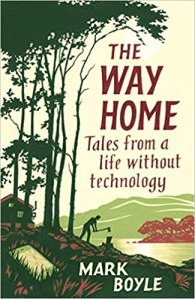
The Way Home: Tales from a life without technology by Mark Boyle 4* – This is not a ‘how to’ book, nor is it a guide to living without technology. It’s an account of what it was like for him, living in a wooden cabin he built on a smallholding in Ireland. He has no running water, no car, no electricity or any of the things it powers: the internet, phone, washing machine, radio or light bulb. He writes about the loneliness he experienced, the lack of contact with his parents and friends, and the damage to his relationships. The book follows the seasons of the year and is a collection of tales about his experiences and his observations about attempting to live a technology-free life.

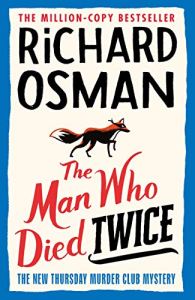
The Man Who Died Twice by Richard Osman 1* – light, easy to read crime fiction, this is a follow up to The Thursday Murder Club. Many people have written glowing reviews of this book, but Richard Osmond’s style of humour differs from mine, so I didn’t find it very funny. I don’t like being so negative about a book but I think the characters are rather stereotypical and the plot is over complicated and unconvincing. In addition it’s written in the present tense which usually irritates me – and it did.

And here are a few notes about 2 of the remaining 6 books with links to Amazon:

The Library of the Dead by T L Huchu 4* – I loved this fantasy novel, set in a future or alternative Edinburgh, with a wealth of dark secrets in its underground. Teenager Ropa, has dropped out of school to become a ghost talker and when a child goes missing in Edinburgh’s darkest streets, Ropa investigates his disappearance. It’s a dark story, but with flashes of humour to lighten the darkness, and is a mix of Zimbabwean and Scottish magic and culture. If you enjoy Ben Aaronvitch’s Rivers of London novels, you’d enjoy this book.

I Love the Bones of You by Christopher Eccleston 5* an audiobook read by actor, Christopher Eccleston, who has played many roles. He is probably my favourite Doctor Who and I especially loved his portrayal of Maurice Scott in the BBC drama The A Word. Maurice is an eccentric and lovable man who has an autistic grandson. I Love the Bones of you is not the usual celebrity autobiography that is just all about him and his work. This is a really vivid portrait of his relationship with his family and particularly with his father who had dementia at the end of his life. He talks about his lack of confidence in his acting ability together with his experiences with anorexia, depression and breakdowns and talks honestly about his struggles with mental health..

~~~

Part Two of Books Read in October 2021 will follow shortly.

Book Beginnings & The Friday 56: The Count of Monte Cristo by Alexandre Dumas

Every Friday Book Beginnings on Friday is hosted by Gillion at Rose City Reader where you can share the first sentence (or so) of the book you are reading. You can also share from a book you want to highlight just because it caught your fancy.

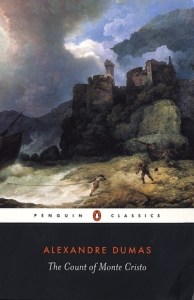
There are just two books left on my Classics Club book list and so, I’ve decided it’s time for me to read one of them, The Count of Monte Cristo by Alexandre Dumas. It is particularly daunting as it is so long, depending on which edition you read. The Penguin Classics edition is 1313 pages long.

The Book Begins:

On the 24th of February 1810, the look-out at Notre Dame de la Garde signalled the three-master, the Pharaon from Smyrna, Trieste, and Naples.

As usual, a pilot put off immediately, and rounding the Chateau d’If, got on board the vessel between Cape Morgion and Rion Island.

Also every Friday there is The Friday 56, hosted by Freda at Freda’s Voice. *Grab a book, any book. *Turn to Page 56 or 56% on your  ereader . If you have to improvise, that is okay. *Find a snippet, short and sweet, but no spoilers!

These are the rules:

  1. Grab a book, any book.
  2. Turn to page 56, or 56% on your eReader. If you have to improvise, that is okay.
  3. Find any sentence (or a few, just don’t spoil it) that grabs you.
  4. Post it.
  5. Add the URL to your post in the link on Freda’s most recent Friday 56 post.

Page 56:

‘I do not know what M. de Villefort promised you,’ said the gendarme, ‘but I know we are taking you to the Chateau d’If’.

By a rapid movement, which the gendarme’s practiced eye had perceived, Dantes sprang forward to precipitate himself into the sea; but four vigorous arms seized him as his feet quitted the bottom of the boat. He fell back cursing with rage.

Summary:

Thrown in prison for a crime he has not committed, Edmond Dantes is confined to the grim fortress of If. There he learns of a great hoard of treasure hidden on the Isle of Monte Cristo and he becomes determined not only to escape, but also to unearth the treasure and use it to plot the destruction of the three men responsible for his incarceration. Dumas’ epic tale of suffering and retribution, inspired by a real-life case of wrongful imprisonment, was a huge popular success when it was first serialized in the 1840s.

Book Beginnings & The Friday 56: Now is the Time by Melvin Bragg

Every Friday Book Beginnings on Friday is hosted by Gillion at Rose City Reader where you can share the first sentence (or so) of the book you are reading. You can also share from a book you want to highlight just because it caught your fancy.

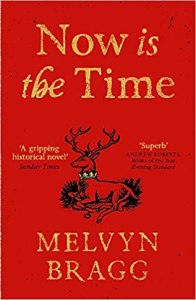
This week I’m featuring Now is the Time by Melvyn Bragg. I loved his Soldiers Return quartet amongst some of his other books, so I’m hoping this historical fiction set in 1381 at the time of  the Peasants’ Revolt will be as good. Richard II was on the throne of England when a vast force of people led by Wat Tyler and John Ball demanded freedom, and equality.

The Book Begins:

The accused priest stood before the court. He was dressed in the cheapest cloth. From his scuffed and shabby habit, from his spare frame and plainness of manner in the ornately, hierarchically dressed company of the ecclesiastical court, he seemed to be just another casualty of the harsh laws of the Church. But there was about him a self-composure, which threw out the challenge of his independence too arrogantly for the taste of the court.

Also every Friday there is The Friday 56, hosted by Freda at Freda’s Voice. *Grab a book, any book. *Turn to Page 56 or 56% on your  ereader . If you have to improvise, that is okay. *Find a snippet, short and sweet, but no spoilers!

These are the rules:

  1. Grab a book, any book.
  2. Turn to page 56, or 56% on your eReader. If you have to improvise, that is okay.
  3. Find any sentence (or a few, just don’t spoil it) that grabs you.
  4. Post it.
  5. Add the URL to your post in the link on Freda’s most recent Friday 56 post.

Page 56:

Armies in Normandy, Ireland and the north and the English garrisons abroad had not been paid for months. The uprising in Flanders had ruined the rich English wool trade. Aristocrats were accused of corruption and vanity campaigns; Plantagenet heirlooms and jewels had been pawned to city merchants. It was said that it was now the city; not the government, that controlled policy.

Summary (from Amazon):

At the end of May 1381, the fourteen-year-old King of England had reason to be fearful: the plague had returned, the royal coffers were empty and a draconian poll tax was being widely evaded. Yet Richard, bolstered by his powerful, admired mother, felt secure in his God-given right to reign.

Within two weeks, the unthinkable happened: a vast force of common people invaded London, led by a former soldier, Walter Tyler, and the radical preacher John Ball, demanding freedom, equality and the complete uprooting of the Church and state. They believed they were rescuing the King from his corrupt ministers, and that England had to be saved. And for three intense, violent days, it looked as if they would sweep all before them.

Now is the Time depicts the events of the Peasants’ Revolt on both a grand and intimate scale, vividly portraying its central figures and telling an archetypal tale of an epic struggle between the powerful and the apparently powerless.

~~~

I vaguely remember learning about Wat Tyler and the Peasant’s Revolt at school. This book should fill in the gaps in my memory!