Stamboul Train by Graham Greene

Vintage Digital/ 2010/ e-book/ Print length: 216 pages/ My own copy/ 4*

Stamboul Train was first published in the UK in 1932 and was renamed Orient Express when it was published in the USA. My copy is an e-book, with an Introduction by Christopher Hitchins.

I read it in February and didn’t find time to write about it then, so this is just a mini review that really only skates over the surface of the novel. I enjoyed it, set in the early 1930s, about a three day journey on the luxurious Orient Express travelling from Ostend to Constantinople (Instanbul or Stamboul), via Cologne, Vienna and Belgrade.

Greene weaves a web of subterfuge, murder and politics around his characters, including Carleton Myatt, a Jewish businessman, who trades in currants; Coral Musker, a dancer, a chorus girl on her way to join the Dunn’s Babies dance troupe in Constantinople; a journalist, Mabel Warren, a lesbian who drinks too much; Dr Czinner, a Yugoslavian on his own mission of revolution (as Hutchins describes it), a dissident communist leader, travelling under the name of schoolteacher Richard John – Mabel has recognised him as Dr Czinner and is after a scoop from him for her newspaper; and Josef Grünlich, a murdurous burglar. .

It’s a dismal book in some respects. Written in 1931, it reflects the anti-Semitism of the period, although I think Greene’s description of Myatt’s generosity towards Coral in giving her his berth in a first-class sleeping compartment shows some sympathy towards Jews. Having said that, I also think the characters as a whole are stereotypical, but the tension that he builds around them is palpable.

Greene’s storytelling saved the book for me, with descriptions of the train itself and the glimpses of the countryside as the train speeds along – as well as Myatt’s dramatic car journey through the snow-laden countryside to and from the railway station at Subotica on the Yugoslavian border. Written just as the Nazi party was preparing to take power in Germany there is a sense of unease throughout the novel.
The Chapel in the Woods by Dolores Gordon-Smith

Severn House| 1 March 2022| 256 pages| e-book| Review copy| 3*

The Chapel in the Woods is the 11th Jack Haldean Murder Mystery, set in the 1920s.

Major Jack Haldean, a former World War I pilot, is a detective story writer. He and his wife Betty are visiting his cousin Isabelle and her husband Arthur in the hamlet of Croxton Abbas in Sussex. The neighbouring estate, Birchen Bower, had recently been bought by Canadian Tom Jago and his wife Rosalind. A fortnight earlier he had sent Derek Martin and his wife, Jean, in advance to open up the house and unpack their belongings, but when the Jagos arrive they discover the house open and that most of their things including Rosalind’s diamonds had been stolen. And the Martins have disappeared. But Jago can’t believe that Martin is the thief, maintaining he is perfectly honest. Jack has formerly helped his friend Detective Superintendent Ashley of the Sussex Police with a number of cases and as he is staying locally he gets involved in the police investigations.

Jago is renovating the 17th century house, built around 1620, by William Cayden, set in woodland. The chapel in the woods contains the tomb of Anna, Cayden’s wife who was a native of Peru. Her tomb, a box tomb, is decorated with an elaborately carved leaping jaguar – hence the legend of the Jaguar Princess who haunts the chapel and grounds taking the form of a jaguar.

It gets more and more complicated. In the Victorian period Josiah Cayden, an explorer and big game hunter had imported wild animals from South America, wanting to recreate a piece of the Amazon in the grounds. And now the locals are convinced that there is something in the woods that shouldn’t be there. There have been stories about dead and mutilated animals being found around Birchen Bower woods, and every so often dogs and ponies go missing. So, when Jago hosts the village fete, the local residents throng to the estate, some keen to follow the path into the woods to visit the chapel, only to find a dead body, apparently mauled by a jaguar.

And then there is another body … Is there really a jaguar roaming the woods, or is something supernatural going on? And who stole the diamonds, was it Derek Martin or someone else? Where is Derek Martin? What is the truth about the legend of the Jaguar Princess?

It is entertaining, with a mysterious, even supernatural atmosphere in parts, but it all seems to me too unlikely and fanciful and too convoluted. I liked the setting, the scenes in the woodlands and the historical aspects. But, there is too much repetition of the events and too much discussion about the various possibilities. I lost interest and just wanted to know how the mystery was resolved. It all gets sorted out and ends as Jack explains how he uncovered what had really happened.

My thanks to Severn House for a review copy via NetGalley.

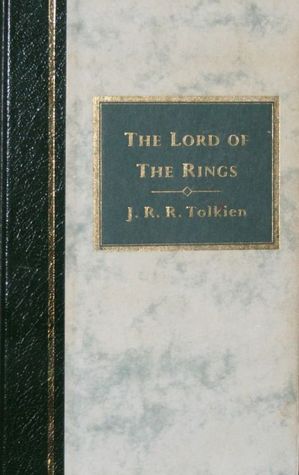
Book Beginnings & The Friday 56: The Fellowship of the Ring by J R R Tolkein

Every Friday Book Beginnings on Friday is hosted by Gillion at Rose City Reader where you can share the first sentence (or so) of the book you are reading. You can also share from a book you want to highlight just because it caught your fancy.

I’m currently reading The Fellowship of the Ring by J R R Tolkein, the first book in The Lord of the Rings, one of the few books I’ve previously read several times. I first came across it at the library when I was a teenager and I loved it so much that I decided I needed to buy my own copy for myself. It contains all three books, The Fellowship of the Ring, The Two Towers and The Return of the King.

The Book begins with a Prologue: Concerning Hobbits

Hobbits are an unobtrusive but very ancient people, more numerous formerly than they are today; for they love peace and quiet and good tilled earth: a well-ordered and well-farmed countryside was their favourite haunt.

Chapter 1: A Long-Expected Party

When Mr Bilbo Baggins of Bag-End announced that he would shortly be celebrating his eleventy-first birthday with a party of special magnificence, there was much talk and excitement in Hobbiton.

Also every Friday there is The Friday 56, hosted by Freda at Freda’s Voice, where you grab a book and turn to page 56 (or 56% of an eBook), find one or more interesting sentences (no spoilers), and post them.

Page 56:

Frodo took the envelope from the mantelpiece, and glanced at it, but did not open it.

‘You’ll find his will and all the other documents in there, I think,’ said the wizard. ‘You are the master of Bag-End now. And also, I fancy, you’ll find a golden ring.’

‘The ring!’ exclaimed Frodo. ‘Has he left me that? I wonder why. Still it may be useful.’

‘It may, and it may not,’ said Gandalf. ‘I should not make use of it, if I were you. But keep it secret, and keep it safe! Now I am going to bed.’

Synopsis from Goodreads

Sauron, the Dark Lord, has gathered to him all the Rings of Power – the means by which he intends to rule Middle-earth. All he lacks in his plans for dominion is the One Ring – the ring that rules them all – which has fallen into the hands of the hobbit, Bilbo Baggins.

In a sleepy village in the Shire, young Frodo Baggins finds himself faced with an immense task, as the Ring is entrusted to his care. He must leave his home and make a perilous journey across the realms of Middle-earth to the Crack of Doom, deep inside the territories of the Dark Lord. There he must destroy the Ring forever and foil the Dark Lord in his evil purpose.

~~~~~

Re-reading it now, it has lost none of the magic I found the first time. It is one of my all time favourite books

Shelf Control

Shelf Control is a weekly celebration hosted by Lisa @ Bookshelf Fantasies, of the unread books on our shelves. Lisa says: “Pick a book you own but haven’t read, write a post about it (suggestions: include what it’s about, why you want to read it, and when you got it), and link up! For more info on what Shelf Control is all about, check out my introductory post, here.”

Want to join in? Shelf Control posts go up every Wednesday. See the guidelines at the bottom of the post, and jump on board!

This is my first time doing this. I’ve been looking at my TBRs recently and making lists of ones to read before too long. This book is one of the oldest on my shelves.

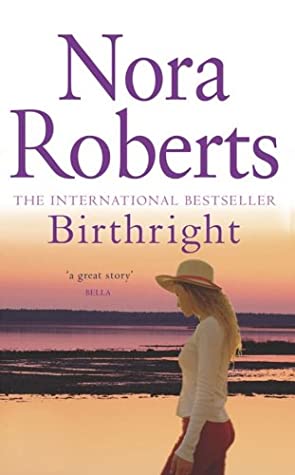
I remembered I have a copy of Birthright by Nora Roberts when I read Cath’s post about the books she has been reading and one of them was by Nora Roberts. I bought it in September 2008 along with three other books from the book stall at the Charnock Richard service station on the M6 and it has remained unread on my bookshelves ever since. I’ve read two of the other books I bought and enjoyed them.

Blurb from Goodreads:

When five-thousand-year-old human bones are found at a construction site in the small town of Woodsboro, the news draws archaeologist Callie Dunbrook out of her sabbatical and into a whirlwind of adventure, danger, and romance.

While overseeing the dig, she must try to make sense of a cloud of death and misfortune that hangs over the project-fueling rumors that the site is cursed. And she must cope with the presence of her irritating-but irresistible-ex-husband, Jake. Furthermore, when a stranger claims to know a secret about her privileged Boston childhood, she is forced to question her own past as well.

A rich, thrilling, suspenseful tale, Birthright follows an inspiring heroine, an intriguing hero, and a cast of fascinating characters whose intertwined lives remind us that there is much more going on under the surface than meets the eye. 

Why I bought it:

I liked the sound of it from the blurb – an archaeological dig when five-thousand-year-old human bones are found, a sense of death and misfortune combined with a mystery about the archaeologist Callie Dunbrook’s past. According to the author’s information inside the book Nora Roberts is “indisputably the most celebrated and beloved women’s writer today.” Sorry, but I’d never heard of her before or read any of her more than 100 books. I thought I’d better remedy that.

Want to participate in Shelf Control? Here’s how:

  • Write a blog post about a book that you own that you haven’t read yet.
  • Add your link in the comments to Lisa’s latest post, or link back from your own post, so Lisa can add you to the participant list.
  • Check out other posts, and…

Have fun!

What do you think? Have you read this book? Do you think I’ll enjoy it? Or shouldn’t I bother reading it?

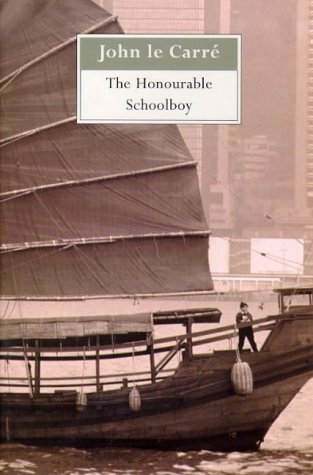
The Honourable Schoolboy by John Le Carré

Rating: 5 out of 5.

I read Tinker, Tailor, Soldier, Sailor, the first book in John le Carré’s Karla trilogy, a long time ago and I remember enjoying it very much. The story continues in the second book, The Honourable Schoolboy, which I think is brilliant. First published in 1977, it won the Gold Dagger award for the best crime novel of the year and the James Tait Black Memorial Prize.

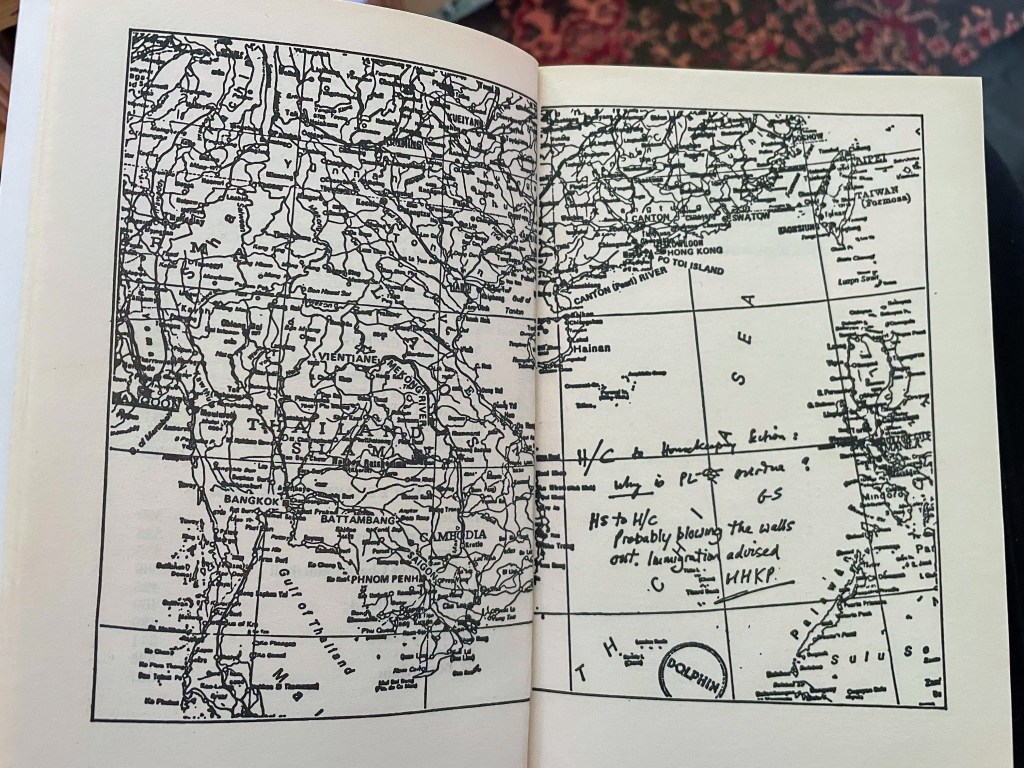
It’s wide ranging, set in 1974 in London, Hong Kong, Thailand, Vietnam, Phnom Pen (Cambodia), Vientiane (the capital and largest city of the Lao People’s Democratic Republic) Laos. My paperback copy has a map which is on such a small scale and is so detailed that it’s hardly legible. But, at least I could just about make out the main locations!

To say this has a complicated plot is a huge understatement. The amount of detail is staggering and for a while I was rather confused about what was happening. It certainly isn’t a book to read when you’re tired – you need to read it with a clear mind and be prepared to let yourself get fully immersed in the story. Tinker, Tailor, Soldier, Spy ends as George Smiley unmasks the identity of the ‘mole’, recruited by Karla, his Russian counterpart, as a spy within the British Secret Service. So, if you haven’t read Tinker, Tailor, Soldier, Spy you may want to read it before reading The Honourable Schoolboy because le Carré reveals the identity of that ‘mole’ in the first paragraph.

He then goes on to tell what happened afterwards as Smiley set about dealing with the consequences of that mole’s betrayal. He is appointed as a caretaker chief of the British Secret Service, known as ‘the Circus’, the name derived from the address of that organisation’s secret headquarters, Cambridge Circle. Smiley has Karla’s photo on his wall, determined to chase him down in revenge. Safe houses were closed and spies were recalled from abroad. In his search for Karla, Smiley sends Jerry Westerby, the eponymous Honourable Schoolboy to Hong King, undercover as a reporter, where he discovers a money laundering operation run by Moscow Intelligence and also an opium smuggling operation.

There are many characters and the action moves rapidly between Smiley in London and Westerby as he travels all over the various locations in the Far East. Le Carré’s style is clear and straight forward, the spy jargon, with the defined interwoven into the narrative, moving rapidly from one set of characters, all fully developed, to the next. Smiley, although the controlling character, is not present in much of the book. He is an enigmatic character, a lonely man, a ‘round little man in a raincoat’, as he walks alone in the evenings around the byways of London, immersed in his thoughts crammed with images, always ending in front of his own house where his estranged wife Ann lives.

From a slow start the pace steadily rose until the finale. It was gripped, eager to know how it would end. It was so much better than I thought when I began it and it’s definitely a book I’d like to re-read as I’m sure that I missed a lot in this first reading. But not right now as I’m keen to get on with the next book in the trilogy, Smiley’s People.

Traitor in the Ice by K J Maitland

Headline Review| 31 March 2022| 461 pages| e-book| Review copy| 2*

I don’t have very much to say about Traitor in the Ice, the second Daniel Pursglove book, by K J Maitland. It is set during the Great Frost of 1607-8 in England, when the Thames and many other rivers were frozen solid, but the countryside was the hardest hit. I preferred the first Daniel Pursglove book, The Drowned City.

It is a dark historical novel, describing life in England under the new king, James I of England and VI of Scotland. Daniel is continuing his search for the mysterious Spero Pettingar, suspected of plotting another conspiracy to kill James and reinstate a Catholic monarch and is sent by the Secretary of State, Robert Cecil, Lord Salisbury, to Battle Abbey, near Hastings, in Sussex, a Catholic household, suspected of sheltering Catholic priests.

Daniel is an interesting character, needing all his determination and courage to discover what has been going on at Battle Abbey. It’s made even more difficult as it seems that everyone has something to hide, not just their politics and religious dissent, but also murder. A little bit more of his background is revealed in this second book, but he still remains a mysterious figure. And Spero Pettingar is an even more mysterious character, who is he – is he hiding at Battle Abbey? And will Daniel uncover all the secrets concealed within the Abbey?

But I enjoyed K J Maitland’s Author’s Note and information she gives in ‘Behind the Scenes of this Novel’ more than the novel. The details of her historical research are fascinating, with information about the real people behind her characters, such as Lady Magdalen, Viscountess Montague who did live at Battle Abbey. And the Glossary at the end of the book is also most helpful explaining a lot of the terms in the book I hadn’t come across before.

However, the book failed to hold my interest throughout as the wealth of detail she has put into the novel slows the action down and took away much of the suspense and tension – I felt like I was drowning in description. And at times I wasn’t really sure what was happening, especially at the end of the book – the Epilogue is mystifying.

My thanks to Headline Review for a review copy via NetGalley