The Classics Club Spin Result

The spin number in The Classics Club Spin is number …

2

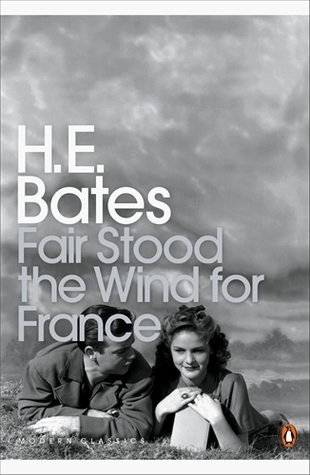
which for me is Fair Stood the Wind for France by H E Bates. The rules of the Spin are that this is the book for me to read by Sunday the 3rd December 2023.

Synopsis from Amazon

When John Franklin brings his plane down into Occupied France at the height of the Second World war, there are two things in his mind – the safety of his crew and his own badly injured arm. It is a stroke of unbelievable luck when the family of a French farmer risk their lives to offer the airmen protection. During the hot summer weeks that follow, the English officer and the daughter of the house are drawn inexorably to each other.

I’m looking forward to reading it.

Did you take part in the Classics Spin? What will you be reading?

Mini Reviews

I’ve been reading almost non-stop and not pausing long enough to write proper reviews, so it’s time for a brief look at some of the books I’ve read. These notes are not as detailed as I usually write, but when you read quickly this is the result!

Friend of the Devil by Peter Robinson, the 17th DCI Banks book 4*

Inspector Alan Banks and his team, the Western Area Major Crimes Squad, investigate the murder of 19-year-old Hayley Daniels who was found raped and strangled in the Maze, a tangle of narrow alleys behind Eastvale’s market square, after a drunken night on the town with a group of friends. There are plenty of suspects and it’s a matter of looking at who was where and when to find the murderer. It wasn’t who I thought it was.

DI Annie Cabbot, on loan to the Eastern area, is assigned to look into the murder of Karen Drew, a quadriplegic, who was found dead in her wheelchair on a seaside cliff. It’s only when Annie discovers the real identity of Karen Drew, that the question of why anyone would want to murder a quadriplegic, becomes clear. But who could have done it? Annie has to revisit an earlier case to find the culprit.

Although this can be read as a stand-alone novel, part of the enjoyment in reading the series in order is that you see the development of the main characters and their relationships over the years. The books are basically police procedurals but along the way there’s a lot about Alan and Annie as people rather than police officers. I have become fond of the regular characters in these books.

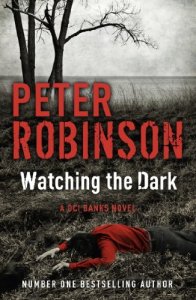
Watching the Dark by Peter Robinson, the 20th DCI Banks book 4.5*

This is the description on Goodreads: DCI Alan Banks reluctantly investigates DI Bill Quinn with Inspector Joanna Passero. Quinn, convalescing at St Peter’s Police Treatment Centre, was killed by a crossbow on the tranquil grounds, and left compromising photos. Quinn may be disreputable, linked to a vicious crime in Yorkshire and to a cold case – English Rachel Hewitt 19 vanished in Estonia six years ago.

Banks is not happy about this investigation, not only at the murder of one of their own officers, but because of the involvement of Joanna Passero who seems to him to be determined to prove that Quinn was a corrupt cop.

The team’s investigations lead them to a group smuggling illegal immigrants from Eastern Europe into the UK, taking Banks and Passero to Tallin in Estonia, whilst Annie heads the investigation in the UK. It’s remarkably complex. It’s also long, with many twists and turns, and it became too repetitive in the middle of the book, which is why I haven’t given it 5 stars. But I did enjoy it more than Friend of the Devil, especially the setting in Estonia. Robinson’s books are all definitely grounded in their settings, whether they’re in Yorkshire, Estonia, or elsewhere.

I have now read 20 of the 28 DCI Banks books.

I think the setting in Estonia means I can add Watching the Dark to the Wanderlust Bingo card in Central/Eastern Europe square.
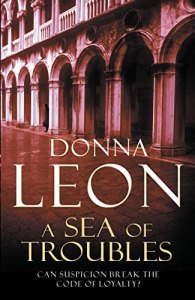
A Sea of Troubles by Donna Leon

A Sea of Troubles is Donna Leon’s 10th Commissario Guido Brunetti novel. I’ve been reading them out of order of publication on and off for several years now and this book is the earliest one in the series that I’ve read. Her books are crime fiction, but also discuss various social and cultural issues and A Sea of Troubles is no exception. 

Brunetti is one of my favourite detectives. He is happily married with two children. He doesn’t smoke or drink to excess and often goes home for lunch to his beautiful wife Paola, who is a wonderful cook – in this book she treats him to a delicious apple cake made with lemon and apple juice and ‘enough Grand Marnier to permeate the whole thing and linger on the tongue for ever.’ (page 238)

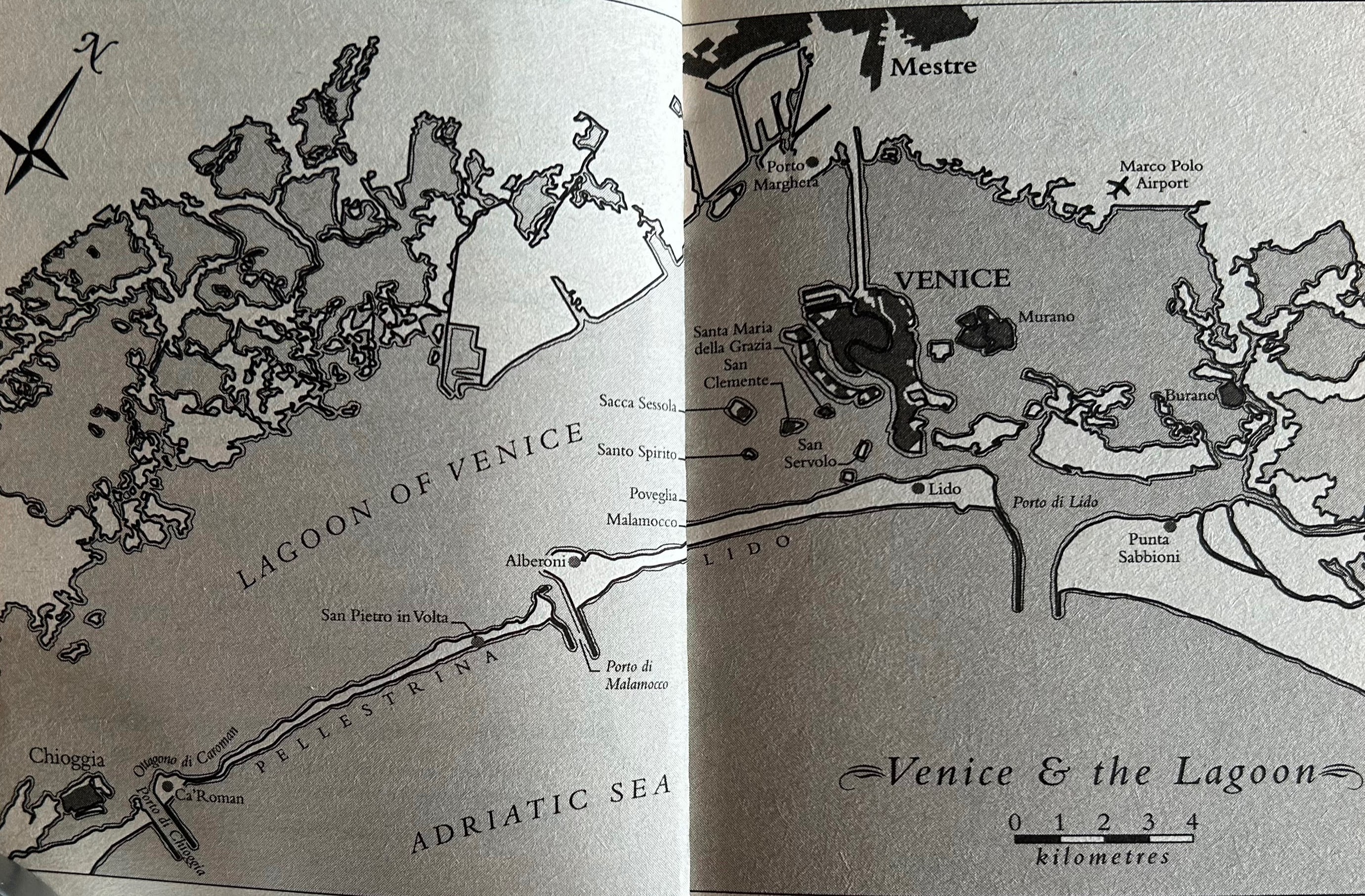
I read it eagerly, keen to get to the bottom of the mystery surrounding the deaths of two clam fishermen, father and son, off the island of Pellestrina, south of the Lido on the Venetian lagoon, when their boat suddenly exploded. As well as the mystery the issues Leon highlights in this book are concerning pollution and the overfishing of clams that is destroying the clam beds.

I was fascinated by the island, never having heard of it before. It’s a long and narrow island (11 km long, and 25 to 210 metres wide) that separates the Venetian Lagoon from the Adriatic Sea. Fishing is the primary source of income and alongside the inner side of the thin peninsular are scores of vongolari, the clam fishing boats.

Pellestrina is a closely knit community, the islanders bound together by a code of loyalty and a suspicion of outsiders. Brunetti is finding it difficult to penetrate their silence, as even though he is a Venetian, he is regarded by the islanders as an outsider, a foreigner. So when his boss’s secretary, the ever-resourceful Signorina Elettra, volunteers to visit her cousin who lives in the village there to see what she can find out, he lets her go. And then is most concerned when she falls for a young man on the island. And Paola begins to question why he is so interested in Elettra, having noticed that he had thought about little else than her for over a week. He then realises his feelings for Elletra are not so straightforward after all.

However, the crime still needs resolving and Brunetti finds himself in a web of political intrigue, corruption and secrets. From a slow start the ending is dramatic and action packed with Brunetti and Elletra in danger of their lives.

  • Publisher ‏ : ‎ Arrow; 1st edition (26 Feb. 2009)
  • Language ‏ : ‎ English
  • Paperback ‏ : ‎ 336 pages
  • Source: I bought it
  • My rating: 5*

Book Beginnings on Friday & The Friday 56: Death is Now My Neighbour by Colin Dexter

Every Friday Book Beginnings on Friday is hosted by Gillion at Rose City Reader where you can share the first sentence (or so) of the book you are reading. You can also share from a book you want to highlight just because it caught your fancy.

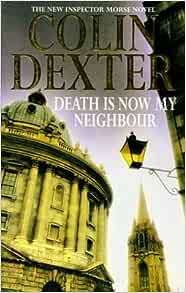
I’m featuring Death is Now My Neighbour by Colin Dexter, one of the Inspector Morse novels. I’ve read this recently for my 20 Books of Summer Challenge.

Book Beginning:

From the Prolegomenon

‘What time do you call this, Lewis?’.

‘The missus’s fault. Not like her to be late with the breakfast.’

Chapter 1

It is perhaps unusual to begin a tale of murder with a reminder to the reader of the rules governing conditional sentences in a language that is incontrovertibly dead. In the present case, however, such a course appears not wholly inappropriate.

Also every Friday there is The Friday 56, hosted by Freda at Freda’s Voice, where you grab a book and turn to page 56 (or 56% of an eBook), find one or more interesting sentences (no spoilers), and post them.

Page 56:

In his earlier years Geoffrey Owens had been an owl, preferring to pursue whatever tasks lay before him into the late hours of the night, often through into the still, small hours. But now, in his mid-forties, he had metamorphosed into a lark, his brain seeming perceptibly clearer and fresher in the morning.

Description from Goodreads:

As he drove his chief down to Kidlington, Lewis returned the conversation to where it had begun.
‘You haven’t told me what you think about this fellow Owens – the dead woman’s next-door neighbour.’
‘Death is always the next-door neighbour,’ said Morse sombrely.

The murder of a young woman . . . A cryptic ‘seventeenth-century’ love poem . . . And a photograph of a mystery grey-haired man . . .

More than enough to set Chief Inspector E. Morse on the trail of a killer.

And it’s a trail that leads him to Lonsdale College, where the contest between Julian Storrs and Dr Denis Cornford for the coveted position of Master is hotting up.

But then Morse faces a greater, far more personal crisis . . .

~~~

I thoroughly enjoyed this book, the penultimate book in the series and hope to write more about it in a separate post. Morse is nearing retirement and he is not a well man – his drinking is now causing him problems, enough to make him go to the doctor, who diagnoses diabetes. But does Morse follow his doctor’s advice?

This is the novel in which Morse’s first name is revealed – these days it’s not the revelation for the current readers as it was for its first readers.

What do you think, does it appeal to you? What are you currently reading?

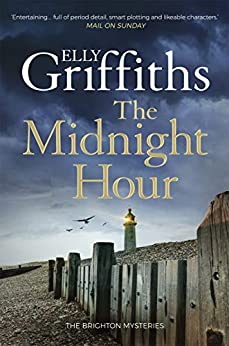
The Midnight Hour by Elly Griffiths

Brighton, 1965

When theatrical impresario Bert Billington is found dead in his retirement home, no one suspects foul play. But when the postmortem reveals that he was poisoned, suspicion falls on his wife, eccentric ex-Music Hall star Verity Malone.

Frustrated by the police response to Bert’s death and determined to prove her innocence, Verity calls in private detective duo Emma Holmes and Sam Collins. This is their first real case, but as luck would have it they have a friend on the inside: Max Mephisto is filming a remake of Dracula, starring Seth Billington, Bert’s son. But when they question Max, they feel he isn’t telling them the whole story.

Emma and Sam must vie with the police to untangle the case and bring the killer to justice. They’re sure the answers must lie in Bert’s dark past and in the glamorous, occasionally deadly, days of Music Hall. But the closer they get to the truth, the more danger they find themselves in…

The Midnight Hour is the sixth book in the DI Edgar Stephens and Max Mephisto series. Known as the ‘Magic Men’ they had been part of a top-secret espionage unit during the War. These books are historical crime fiction, beginning with The Zig Zag Girl set in 1950. Now, with The Midnight Hour, fifteen years have gone by and DI Stephens’ wife, Emma formerly a policewoman is now a private detective working with Sam (Samantha) Collins, formerly an investigative reporter.

There’s a lot going on as both Edgar’s team and Emma and Sam investigate Bert’s death, at first in competition and then they combine forces. Bert’s son Aaron thinks his mother, Verity, killed Bert, who has a very shady past, with plenty of affairs with other women. And there are other suspects with a motive to want him dead.

It provides an insight into what life was like in the mid 1960s, particularly for women. There was plenty of sexism, with, for example, married women being forced to retire from the police force. Married women were not allowed to drive panda cars, and were largely employed to make tea and do the paperwork. Women were expected to stay at home looking after the home and their children.

I enjoy the Dr. Ruth Galloway series, with the forensic archaeological details, despite wishing they weren’t written in the present tense. I also find the theatrical elements of this series fascinating and much prefer the fact that they are written in the past tense. I really liked the glimpses of Max and Seth Bellington, Bert’s son, filming a remake of Dracula in Whitby.

You can read this as a standalone as there is a guide to the main characters and their back stories at the end of the book, but it helps if you read at least some of the earlier books to have a sense of who everyone is and the character progression.

Rating: 4 out of 5.

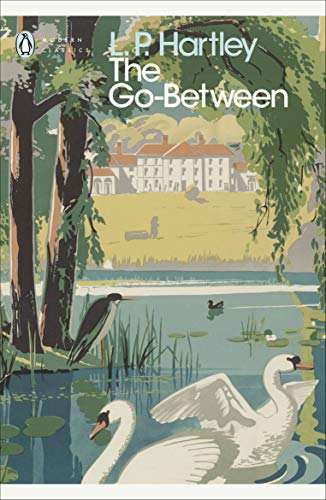
Book Beginnings on Friday & The Friday 56: The Go-Between by L P Hartley

Every Friday Book Beginnings on Friday is hosted by Gillion at Rose City Reader where you can share the first sentence (or so) of the book you are reading. You can also share from a book you want to highlight just because it caught your fancy.

I’m featuring The Go-Between by L P Hartley, one of the latest books I’ve bought. It’s a book I’ve wanted to read for ages.

Book Beginning:

From the Prologue

The past is a different country: they do things differently there.

Chapter 1

The eighth of July was a Sunday and on the following Monday I left West Hatch, the village where we lived near Salisbury, for Brandham Hall. My mother arranged that my Aunt Charlotte, a Londoner, should take me across London. Between bouts of stomach-turning trepidation I looked forward wildly to the visit.

Also every Friday there is The Friday 56, hosted by Freda at Freda’s Voice, where you grab a book and turn to page 56 (or 56% of an eBook), find one or more interesting sentences (no spoilers), and post them.

Page 56:

This morning, my first Sunday at Brandham Hall, Marcus did not come down with me. He said he didn’t feel well.

Description from Goodreads:

When one long, hot summer, young Leo is staying with a school-friend at Brandham Hall, he begins to act as a messenger between Ted, the farmer, and Marian, the beautiful young woman up at the hall. He becomes drawn deeper and deeper into their dangerous game of deceit and desire, until his role brings him to a shocking and premature revelation. The haunting story of a young boy’s awakening into the secrets of the adult world, The Go-Between is also an unforgettable evocation of the boundaries of Edwardian society. It was adapted into an internationally-successful film starring Julie Christie and Alan Bates.

~~~

What do you think, does it appeal to you? What are you currently reading?