Every Friday Book Beginnings on Friday is hosted by Gillion at Rose City Readerwhere you can share the first sentence (or so) of the book you are reading. You can also share from a book you want to highlight just because it caught your fancy.
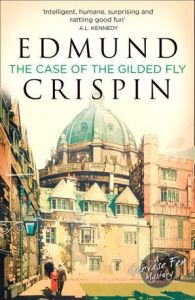
I’m featuring The Case of the Golded Fly by Edmund Crispin, a Gervase Fen Mystery, one of my TBRs – a locked room mystery, first published in 1944.
Book Beginning:
Prologue in Railway Trains
To the unwary traveller, Didcot signifies the imminence of his arrival at Oxford; to the more experienced, another half-hour at least of frustration.
Also every Friday there is The Friday 56, hosted by Freda at Freda’s Voice, but she is taking a break and Anne at My Head is Full of Books has taken on hosting duties in her absence. You grab a book and turn to page 56 (or 56% of an eBook), find one or more interesting sentences (no spoilers), and post them.
Page 56:
In the big entrance hall, lit only by a single bulb in the roof, the night porter dozed uncomfortably in his box and so failed to see either the person who flitted silently up the big staircase to Peter Graham’s room, or what that person was carrying out on its return.
Description from Amazon:
The very first case for Oxford-based sleuth Gervase Fen, one of the last of the great Golden Age detectives. As inventive as Agatha Christie, as hilarious as P.G. Wodehouse, this is the perfect entry point to discover the delightful detective stories of Edmund Crispin – crime fiction at its quirkiest and best.
A pretty but spiteful young actress with a talent for destroying men’s lives is found dead in a college room just yards from the office of the unconventional Oxford don Gervase Fen. Anyone who knew the girl would gladly have shot her, but can Fen discover who did shoot her, and why?
Published during the Second World War, The Case of the Gilded Fly introduced English professor and would-be detective Gervase Fen, one of crime fiction’s most irrepressible and popular sleuths. A classic locked-room mystery filled with witty literary allusions, it was the debut of ‘a new writer who calls himself Edmund Crispin’ (in reality the choral and film composer Bruce Montgomery), later described by The Times as ‘One of the last exponents of the classical English detective story . . . elegant, literate, and funny.’
~~~
What do you think, does it appeal to you? What are you currently reading?
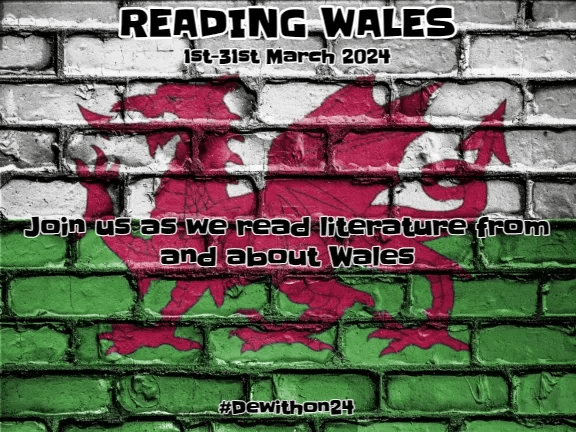
The sixth Reading Wales celebration (aka Dewithon 24), a month-long event during which book lovers from all parts of the world are encouraged to read, discuss and review literature from and about Wales, began on Saint David’s Day, 1 March, and ends today.
I’ve finished reading two books one , I let You Go, set mostly in Wales and Maiden Voyages by Siân Evans, a Welsh historian, which I’ll write about in a later post.
A tragic accident. It all happened so quickly. She couldn’t have prevented it. Could she?
In a split second, Jenna Gray’s world descends into a nightmare. Her only hope of moving on is to walk away from everything she knows to start afresh. Desperate to escape, Jenna moves to a remote cottage on the Welsh coast, but she is haunted by her fears, her grief and her memories of a cruel November night that changed her life forever.
Slowly, Jenna begins to glimpse the potential for happiness in her future. But her past is about to catch up with her, and the consequences will be devastating . . .
My thoughts:
I loved I Let You Go, Clare Mackintosh’s debut novel, part psychological thriller and part police procedural. It won Theakston’s Old Peculier Crime Novel of the Year Award in 2016, beating J K Rowling writing as Robert Galbraith. I’ve had this book since 2017 and I started to read it then but it begins with a tragedy, as five year old Jacob is killed by a hit-and-run driver, and I didn’t feel up to reading it at that time and put it back on the shelf for a while. Clare Mackintosh, a former police officer, is a member of Crime Cymru, a consortium of Welsh crime writers who promote Welsh crime fiction.
This is a difficult book to review without giving away spoilers so I’m not going into detail about the plot. It is set partly in Bristol, England where Jacob is killed, and then moves into a small coastal village in Wales where Jenna is trying to make a new life for herself. It’s heart-wrenching reading as Jenna tries to put the past behind her and at times I thought this was a romantic novel. But it’s not, as it becomes clear that there are secrets in her past that haunt her. It’s almost a book of two parts and the second half is dark and violent, full of suspense and menace, and really shocking twists and turns. The characters are fully rounded, extremely well-drawn and realistic. The settings are vividly described, especially of the beautiful Welsh coast line. I could picture it so well and it made me long to be there.
After a slow start this became a book I didn’t want to stop reading. It’s a powerful novel that kept me glued to its pages and it’s one of the best books I’ve read this year. I’ll certainly be reading more by Clare Mackintosh.
It’s a blazing summer when two men arrive in the village. They’re coming for gold. What they bring is trouble.
Cal Hooper was a Chicago detective, till he moved to the West of Ireland looking for peace. He’s found it, more or less – in his relationship with local woman Lena, and the bond he’s formed with half-wild teenager Trey. So when two men turn up with a money-making scheme to find gold in the townland, Cal gets ready to do whatever it takes to protect Trey. Because one of the men is no stranger: he’s Trey’s father.
But Trey doesn’t want protecting. What she wants is revenge.
Crackling with tension and slow-burn suspense, The Hunter explores what we’ll do for our loved ones, what we’ll do for revenge, and what we sacrifice when the two collide, from the Sunday Times and New York Times bestseller Tana French
I’ve loved several books by Tana French, especially The Searcher, the first Cal Hooper mystery, so I was really looking forward to reading the second, The Hunter. I wasn’t disappointed and enjoyed this one almost as much. Like The Searcher this is a slow-burner, a book to savour, not one to rush through.
Two years have gone by since the events told in The Searcher. Ex-Chicago detective Cal Hooper is now settled in Ardnakelty, a remote Irish village and Trey Reddy is now fifteen. Trey’s father, Johnny who has been absent from the village for four years suddenly returns. But Trey is suspicious of her father’s true motives and doesn’t trust him, or the rich Londoner, Cillian Rushborough, Johnny met in London. The two of them are out to fleece the villagers, claiming there is gold on their land. But just who is scamming who?
I liked the slow build up to the mystery – there is a murder, but the body is only discovered later on in in the book. And it is the characters not the murder that are the focal point. I loved Tana French’s beautiful descriptions of the Irish rural landscape. It’s the sort of book I find so easy to read and lose myself in, able to visualise the landscape and feel as if I’m actually there with the characters, watching what is happening.
Many thanks to Penguin for a review copy via NetGalley.
Every Friday Book Beginnings on Friday is hosted by Gillion at Rose City Readerwhere you can share the first sentence (or so) of the book you are reading. You can also share from a book you want to highlight just because it caught your fancy.
I’m featuring I Let You Go by Clare Mackintosh, a book I’m currently reading. It won Theakston’s Old Peculier Crime Novel of the Year Award in 2016, beating J K Rowling writing as Robert Galbraith. I’ve had this book since 2017 and I started to read it then but as it begins with a tragedy I didn’t feel up to reading it and put it back on the shelf for a while. I picked it up again recently when I discovered that Clare Mackintosh, a former police officer, is a member of Crime Cymru, a consortium of Welsh crime writers to promote Welsh crime fiction. And as March is Reading Wales Month I think it’s a good time to read it now.
Book Beginning:
Prologue: The wind flicks wet hair across her face, and she screws up her eyes against the rain. Weather like this makes everyone hurry: scurrying past on slippery pavements with chins buried into collars.
and then Chapter One:
Detective Inspector Ray Stevens stood next to the window and contemplated his office chair, on which an arm had been broken for at least a year.
Also every Friday there is The Friday 56, hosted by Freda at Freda’s Voice, but she is taking a break and Anne at My Head if Full of Books has taken on hosting duties in her absence. You grab a book and turn to page 56 (or 56% of an eBook), find one or more interesting sentences (no spoilers), and post them.
Page 56:
Ray sighed. Puberty had turned his son into a grunting, uncommunicative teenager, and he was dreading the day the same thing happened to his daughter. You weren’t supposed to have favourites, but he had a soft spot for Lucy, who at nine would seek him out for a cuddle and insist on a bedtime story.
Description from Amazon:
A tragic accident. It all happened so quickly. She couldn’t have prevented it. Could she?
In a split second, Jenna Gray’s world descends into a nightmare. Her only hope of moving on is to walk away from everything she knows to start afresh. Desperate to escape, Jenna moves to a remote cottage on the Welsh coast, but she is haunted by her fears, her grief and her memories of a cruel November night that changed her life forever.
Slowly, Jenna begins to glimpse the potential for happiness in her future. But her past is about to catch up with her, and the consequences will be devastating . . .
~~~
What do you think, does it appeal to you? What are you currently reading?
Several years ago I used to take part in the Stacking the Shelves meme. This meme is now hosted by Marlene at Reading Reality and the details are on her blog, as well as a huge amount of book reviews. Why not visit her blog if you haven’t already found it? The gorgeous graphic is also used courtesy of the site.
It’s all about sharing the books you are adding to your shelves, may they be physical or virtual. This means you can include books you buy in physical stores or online, books you borrow from friends or the library, review books, gifts and of course e-books!
A breathtaking mystery of love, lies and a cold case come back to life, Homecoming is an immersive, twisting epic from the bestselling Kate Morton, told with her trademark intricacy and beauty.
Adelaide Hills, 1959. At the end of a scorching hot day, in the grounds of a grand country house, a local man makes a terrible discovery. Police are called, and the small town of Tambilla becomes embroiled in one of the most mystifying murder investigations in the history of Australia.
London, 2018. Jess is a journalist in search of a story. Having lived and worked in London for nearly two decades, a phone call summons her back to Sydney, where her beloved grandmother, Nora, has suffered a fall and is seriously ill in hospital.
Seeking comfort in her past, Jess discovers a true crime book at Nora’s house chronicling a long-buried police case: the Turner Family Tragedy of 1959. And within its pages she finds a shocking personal connection to this notorious event – a crime that has never truly been solved.
After the mysterious disappearance of her fiancé, Alma Hughes moves to a remote island in the North Atlantic, where she hopes to weather her grief and nurture her ailing dog. But the strange town of Violette has mysteries as well.
Townsfolk say that the radio tower overlooking their town broadcasts messages through their home appliances, their dreams, even the sea itself. When lightning strikes the tower, illuminating the sky in a brilliant flash, Alma finds herself caught in the unexplainable aftermath of one of Violette’s deadliest storms.
As the sea consumes the island, threatening its very existence, the deaths and lost memories of the recently departed also devastate the community. Alma, with a unique link to the lost, may be the only one who can help them move on. But to do so, she must confront a tragic loss of her own.
On this doomed island haunted by echoes of the departed, Alma searches for meaning in her future—and dares to discover the power of hope among the living.
As a Bolton teenager with a paper round, Clive Myrie read all the newspapers he delivered from cover to cover and dreamed of becoming a journalist. In this deeply personal memoir, he tells how his family history has influenced his view of the world, introducing us to his Windrush generation parents, a great grandfather who helped build the Panama Canal, and a great uncle who fought in the First World War, later to become a prominent police detective in Jamaica.
~~~
An Instance of the Fingerpost: Explore the murky world of 17th-century Oxford by Iain Pears – Oxford in the 1660s. Sarah Blundy stands accused of the murder of Robert Grove, a fellow of New College. Four witnesses describe the events surrounding his death: Marco da Cola, a Venetian Catholic intent on claiming credit for the invention of blood transfusion; Jack Prescott, the son of a supposed traitor to the Royalist cause, determined to vindicate his father; John Wallis, chief cryptographer to both Cromwell and Charles II, a mathematician, theologian and master spy; and Anthony Wood, the famous Oxford antiquary. Each one tells their version of what happened but only one reveals the extraordinary truth. Brilliantly written and utterly convincing.
~~~
The Great Deceiver by Elly Griffiths – book 7 of 7 in the Brighton Mysteries
Magician Max Mephisto, now divorced and living in London, is on his way to visit daughter Ruby and her new-born baby when he is hailed by a voice from the past, fellow performer Ted English, aka the Great Deceiver. Ted’s assistant, Cherry, has been found dead in her Brighton boarding house and he’s convinced that he’ll be accused of her murder.
Max agrees to talk to his friend, Superintendent Edgar Stephens, who is investigating the case. What Max doesn’t know is that the girl’s family have hired private detective duo Emma Holmes (aka Mrs Stephens) and Sam Collins to do some digging of their own.
The inhabitants of the boarding house, most of whom are performing in an Old Time Music Hall show on Brighton pier, are a motley crew. The house is also connected to a sinister radio personality called Pal. When a second magician’s assistant is killed, Edgar suspects a serial killer. He persuades Max to come out of semi-retirement and take part in a summer show. But who can pose as his assistant? Edgar shocks the team by recommending someone close. . .
The Invisible Man is my Classics Club spin book The rules of the Spin are that this was the book for me to read by 3rd March 2024 and I did. In fact I finished it about two weeks early and only got round to writing about it a few days ago. The Invisible Man was first published in 1897, a science fiction novel, originating in Pearson’s Weekly. But it was not quite what I expected. And I certainly didn’t expect it to turn into slapstick comedy.
Synopsis from Amazon
‘The man’s become inhuman … He has cut himself off from his kind. His blood be upon his own head.’
One night in the depths of winter, a bizarre and sinister stranger wrapped in bandages and eccentric clothing arrives in a remote English village. His peculiar, secretive activities in the room he rents spook the locals. Speculation about his identity becomes horror and disbelief when the villagers discover that, beneath his disguise, he is invisible.
Griffin, as the man is called, is an embittered scientist who is determined to exploit his extraordinary gifts, developed in the course of brutal self-experimentation, in order to conduct a Reign of Terror on the sleepy inhabitants of England. As the police close in on him, he becomes ever more desperate and violent.
In this pioneering novella, subtitled ‘A Grotesque Romance’, Wells combines comedy, both farcical and satirical, and tragedy – to superbly unsettling effect. Since its publication in 1897, The Invisible Man has haunted not only popular culture (in particular cinema) but also the greatest and most experimental novels of the twentieth century.
My thoughts
Griffin, a scientist, is a stranger to the village of Iping in West Sussex, staying at the Coach and Horses Inn. His story is a sad one. Whilst experimenting he has managed to make himself invisible, and dresses from top to toe in clothes, which even in winter makes him stand out from the crowd. Everything he does leads everyone to wonder what is wrong with him and draws attention to himself. What follows grows in intensity, as Griffin causes first confusion, then panic and finally madness. There’s a lot of shouting, pushing and fighting and surprisingly (to me at any rate) quite a lot of comedy – after all the invisible man is as naked as a new born baby.
I enjoyed it. There’s not much to the plot, it’s mainly a character study really, but what an amazing personality. And being invisible is not what he had thought – having to walk around with no shoes or socks on, especially in winter is not funny, neither is the sight of undigested food floating around mid-air. But it is worse than that because Griffin is only at the start of his escapade. By the end he is stark staring bonkers. Wells demonstrates the dangers of using science beyond control. Griffin has succeeded in lowering the refractive index of his body to make it invisible – ‘Either a body absorbs light or reflects it, or refracts it, or does all these things. If it neither refracts nor absorbs light, it cannot of itself be visible.’