Top 5:books to recommend for Halloween

aloweeb

Top 5 Tuesday was created by Shanah at Bionic Book Worm, and it is now being hosted by Meeghan at Meeghan Reads. For details of all of the latest prompts for October to December, see Meeghan’s post here.

It’s time to talk about Top 5 books to recommend for Halloween. It’s trick or treat time — are you going to tell us your best scary books or cutesy Halloween tales?

I’m a reluctant reader of scary stories but these are five I have read and enjoyed:
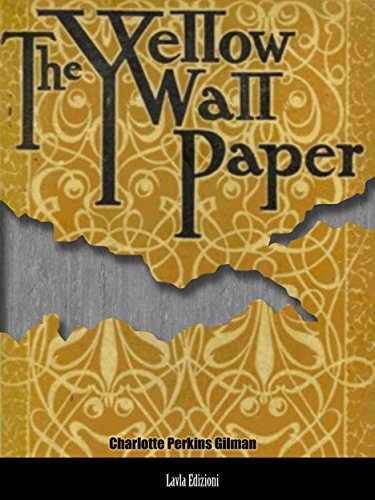
The Yellow Wallpaper by Charlotte Perkins Gilman, a suspense story of a young woman slowly but surely losing her mind – or is it a case of a woman suffering from post-natal depression most cruelly treated by her doctor husband? The un-named woman has just had a baby, which she is unable to bear to be near her. She spends most of her time in an attic bedroom, with barred windows and a bed fixed to the floor. The walls are covered in a hideous yellow wallpaper which has been torn off in places. It’s not a beautiful yellow like buttercups but it makes her think of old, foul bad yellow things – and it smells.  The pattern is tortuous and she sees a woman trapped behind the wallpaper as though behind bars, crawling and shaking the pattern attempting to escape. Definitely a creepy and disturbing story! By the end I began to question just what was real and what was imagination – it’s psychologically scary!

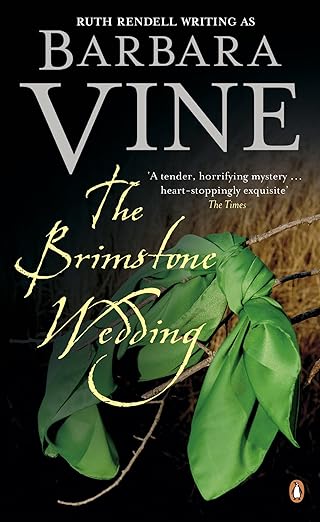
The Brimstone Wedding by Barbara Vine, a horrifying mystery. I think it is one of the best of Barbara Vine’s books that I’ve read – nearly as good as A Dark-Adapted Eye and writing under her real name, Ruth Rendell, A Judgement in Stone. Jenny Warner is a carer at a retirement home, Middleton Hall where she meets Stella Newland, who is dying of lung cancer. At first Stella never mentions her husband or her past life, but gradually she confides in Jenny, telling her things she has never said to her son and daughter – things about her life she doesn’t want them to know.  The subtle horror of what I was reading gripped me. It is indeed a ‘chilling’ book.

Broken Voices by Andrew Taylor, a ghost story set in an East Anglian cathedral city just before the First World War when two schoolboys are left at the cathedral school during the Christmas holidays. They lodge with Mr Ratcliffe, a semi-retired schoolmaster, a bachelor now in his seventies who lived with Mordred, his malevolent cat, in a grace-and-favour house granted to him by the Dean and chapter of the cathedral. An ancient tragedy is connected with the cathedral and the bell tower – the cathedral is full of shifting shadows, and the bell tower is haunted by fragments of melody, which one of the boys can hear. The story has a creepy atmosphere and a tension as the boys investigate the tower in the dead of night. It’s suitably ambiguous. It’s not spelled out and you can make your own decision – was there a ghost and was there a murder.

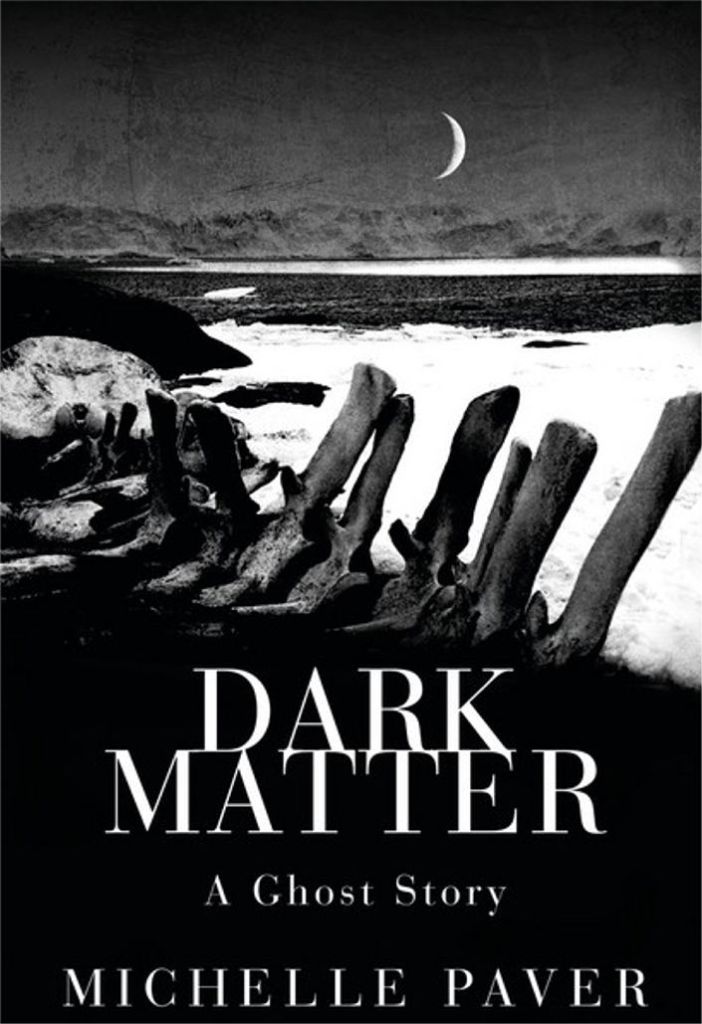
Dark Matter by Michelle Paver, a ghost story in the form of a diary – that of Jack Miller who in 1937 was part of an expedition to the High Arctic to study its biology, geology and ice dynamics and to carry out a meteorological survey. As the darkness descends, Jack is left alone at the camp and his nightmare really begins. Jack describes the ‘dark matter‘ of the title, as that part of the universe that cannot be seen or detected, but is there. It’s a chilling book, very chilling, both in the setting in the High Arctic and in atmosphere. And it is very scary! 

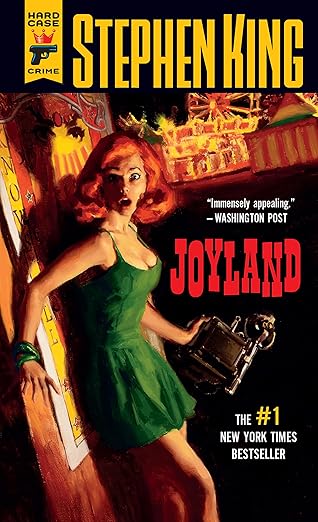
Joyland, by Stephen King, a ghost story, a love story, a story of loss and heartbreak, set in a funfair. It’s also a murder mystery and utterly compelling to read. It’s narrated by Devin Jones, looking back forty years to the time he was a student, suffering from a broken heart, as his girlfriend had just rejected him and he spent a summer working at Joyland, in North Carolina, an amusement park with ‘a little of the old-time carny flavor‘. The Horror House, is a ‘spook’ house which is said to be haunted by the ghost of Linda Gray, whose boyfriend cut her throat in the Horror House. The boyfriend had not been found and it appears he may be a serial killer as there had been four other similar murders in Georgia and the Carolinas.

It’s also a story of friendship, of Tom and Erin, of children with the ‘sight’, a young boy in a wheelchair and his mother, and Dev’s search for the killer. I loved it! King tells his tale, with just a touch of horror and the supernatural.

Dead Man’s Time by Peter James: Book Beginnings & The Friday 56

Every Friday Book Beginnings on Friday is hosted by Gillion at Rose City Reader where you can share the first sentence (or so) of the book you are reading. You can also share from a book you want to highlight just because it caught your fancy.

I’m featuring Dead Man’s Time by Peter James, his 9th Roy Grace crime fiction thriller. It’s one of my TBRs. I started reading it a few days ago.

Brooklyn, February 1922

The boy’s father kissed him goodnight for the last time – although neither of them knew that.

Also every Friday there is The Friday 56, hosted by Freda at Freda’s Voice, but she is taking a break and Anne at My Head is Full of Books has taken on hosting duties in her absence. You grab a book and turn to page 56 (or 56% of an eBook), find one or more interesting sentences (no spoilers), and post them.

‘It’s Nurse Wilson, Mr Daly. Your sister is weakening. I think you should come back quickly.’

Description from Amazon UK

Detective Superintendent Roy Grace is haunted by the past in his latest case, and his private life, in Dead Man’s Time, by award winning crime writer Peter James.

A vicious robbery at a secluded Brighton mansion leaves its elderly occupant fighting for her life. Millions of pounds’ worth of valuables have been stolen.

Within days, Grace is racing against the clock, following a murderous trail that leads him from the shady antiques world of England, across Europe and all the way back to the New York waterfront’s gang struggles of 1922, chasing a killer driven by the force of one man’s greed and another man’s fury.

Although the Roy Grace novels can be read in any order, Dead Man’s Time is the ninth gripping title in the bestselling series. Enjoy more of the Brighton detective’s investigations with Want You Dead and You Are Dead.


The Classics Club Spin Result

The spin number in The Classics Club Spin is number …

3

which for me is The Stars Look Down by A J Cronin. The rules of the Spin are that this is the book for me to read by 18th December, 2024. I added The Stars Look Down by A J Cronin because I enjoyed The Citadel many years ago. So, I’m looking forward to reading it but I hadn’t realised that it is 712 pages long!

Synopsis from Amazon

The Stars Look Down was A.J. Cronin’s fourth novel, published in 1935, and this tale of a North country mining family was a great favourite with his readers.

Robert Fenwick is a miner, and so are his three sons. His wife is proud that all her four men go down the mines. But David, the youngest, is determined that somehow he will educate himself and work to ameliorate the lives of his comrades who ruin their health to dig the nation’s coal. It is, perhaps, a typical tale of the era in which it was written – there were many novels about coal mining, but Cronin, a doctor turned author, had a gift for storytelling, and in his time wrote several very popular and successful novels

In the magnificent narrative tradition of The CitadelHatter’s Castle and Cronin’s other novels, The Stars Look Down is deservedly remembered as a classic of its age.

Did you take part in the Classics Spin? What will you be reading?

I’m the King of the Castle by Susan Hill

I read I’m the King of the Castle by Susan Hill for the 1970 Club hosted by Simon and Karen.

Description from Amazon UK for the Mass Market paperback edition published in 2014:

‘Some people are coming here today, now you will have a companion.’

But young Edmund Hooper doesn’t want anyone else in Warings, the rambling Victorian house he shares with his widowed father. Nevertheless Charles Kingshaw and his mother are soon installed and Edmund sets about persecuting his fearful new playmate.

From the dusty back rooms of Warings through the gloomy labyrinth of Hang Wood to the very top of Leydell Castle, Edmund pursues Charles, the balance of power slipping back and forth between bully and victim. With their parents oblivious, the situation speeds towards a crisis…

Darkly claustrophobic and morally ambiguous, Susan Hill weaves a classic tale of cruelty, power, and the dangerous games we play as children.

It is a depressing, tragic, heart-rending story about 11 year-old Charles Kingshaw’s misery and torture when he and his mother Helena, went to live at Warings, the home of Joseph Hooper and his bully of a son, Edmund, also aged 11. It’s well written, with well defined characters and I could easily visualise the setting, but I can’t say I enjoyed it. There is that awful sense of foreboding all the way through.

I really disliked Edmund who took great delight in terrorising Charles. As for the parents I was shocked at their behaviour and attitudes. Mrs Kingshaw is oblivious to what is going on between the boys and how much Charles fears Edmund. Charles is a sensitive boy, but smart and resourceful. He decides to run away, but Edmund follows him into Hang Wood and they lose their way. Charles can cope, but Edmund falls to pieces, cries like a baby, and injures himself falling into a stream. However, after the adults rescue them and they return to Warings Charles succumbs again to Edmund’s bullying, dominated by his cruelty. Things come to a climax when they all visit a ruined castle, where Charles is really the ‘King of the Castle’ and Edmund falls off a high wall. There is no way that all will end well. It reminded me of that sense of impending tragedy in The Lord of the Flies. It’s disturbing, dark and violent. The ending was inevitable and totally tragic.

I’ve had this book for a long time and can’t remember when or where I bought it, nor why I haven’t read it before now. My copy is a secondhand hardback published by Longman in 1970. The Introduction clarifies that Susan Hill wrote the book for adults. It’s a chilling novel that explores the extremes of childhood cruelty.

The Girl Next Door by Ruth Rendell

Rating: 5 out of 5.

Ruth Rendell, Lady Rendell of Babergh, also known as Barbara Vine, who died aged 85 in 2015, was a literary phenomenon. From 1964, when Inspector Reginald Wexford first appeared in From Doon With Death, she wrote more than sixty novels, including police procedurals, standalone and psychological mysteries plus numerous books of short stories. Many of them were adapted for television or made into feature films.

The Girl Next Door by Ruth Rendell, is one of my TBRs, a book that’s been sitting on my bookshelves since 2016. It’s one of her later novels, a stand-alone book, first published in 2014, a year before her death.

Description from Amazon UK

Beneath the green meadows of Loughton, Essex, a dark network of tunnels has been dug. A group of children discover them. They play there. It becomes their place.

Seventy years on, the world has changed. Developers have altered the rural landscape. Friends from a half-remembered world have married, died, grown sick, moved – or disappeared.

Work on a new house called Warlock uncovers a long buried grisly secret: the bones of two severed hands are discovered in a box, and an investigation into a long-buried crime of passion begins.

The friends, who played together as children, begin to question their past. And a weary detective, more concerned with current crimes, must investigate a case of murder.

The book begins just before the second world war when Woody killed his wife and her lover when he discovered they were having an affair. He then cut off their hands, a right hand and a left that they had held together, and put them in a biscuit tin, which he buried in a tunnel, where the local children played.

Time moves on to 1944. Ruth Rendell describes a garden where the neighbourhood children play:

The garden was not beautiful. It had no flowering trees, no roses, no perfumed herbs. Tunnels they called it at first. The word ‘qanat’, an impossible word, was found by Daphne Jones and adopted by the rest of them. It meant, apparently, a subterranean passage for carrying water, in some oriental language. They liked it because it started with a q without a u. Their schoolteachers had taught them that no word could ever start with q unless followed by u, so Daphne’s idea appealed to them and the tunnels became qanats. (pages 13 – 14)

Time moves on again and we meet up with the children as adults in their seventies, when the skeletal hands have been discovered. The qanats were actually the foundations of a house called Warlock in Loughton, twelve miles north of London and most of the children, are now still living in the area. When they read the newspaper report about the discovery of the hands they get together and reminisce about their childhood and playing in the tunnels, wondering whose hands had been buried.

This is when the book expands into a study of ageing as well as murder mystery:

As you get older, you forget names: those you studied with, lived next door to, the people who came to your wedding, your doctor, your accountant and those who cleaned your house. Of these people’s names you forget perhaps half, perhaps three quarters. Then whose names do you never forget, because they are incised on the rock of your memory? Your lovers (unless you have been promiscuous and there are too many) and the children you went to your first school with. You remember their names unless senility steps in to scrape them off the rock face. (page 17)

It’s quite a long book, nearly 350 pages in a small font in my copy and Ruth Rendell takes time to describe these old friends’ lives and reveals their relationships, their loves and losses and those of their own children and grandchildren as well as their regrets, and bereavements. I felt I really got to know them as real people. Long buried secrets rise to the surface, and old passions are reignited.

From the beginning we know the identity of the murderer, Woody and that of his wife Anita, but not that of the man, whose hand had held Anita’s. At times I thought I’d worked out who it was but when his identity was revealed it wasn’t who I thought it was – it was more complicated than I’d realised. And who is ‘the girl next door‘? I did work that out correctly. It is in some places a bleak novel, and all the characters’ lives have changed by the end of the book. It’s a book that really gripped me and drew me on to find out more. And I really enjoyed how it shows the changes that have taken place in society from the 1930s onward.

I’ve read several of Ruth Rendell’s standalone books and I think this is one of her best. I’ve also read some of her Inspector Wexford books and those she wrote under the name of Barbara Vine.

Top 5:non-human characters

Top 5 Tuesday was created by Shanah at Bionic Book Worm, and it is now being hosted by Meeghan at Meeghan Reads. For details of all of the latest prompts for October to December, see Meeghan’s post here.

It’s time to talk about books with non-human characters  animals or supernatural creatures… maybe even a park bench. Who are your favourite non-human characters?

This is a selection of some of the books with non-human characters that I’ve read and enjoyed. I’ve read all these books, so the links in the titles take you to my reviews.

The Guest Cat by Takashi Hiraide. The main character in this book is a stray cat, Chibi, who made herself at home with a couple in their thirties who lived in a small rented house in a quiet part of Tokyo. At first the cat was cautious and just peeked inside their little house but eventually Chibi spent a lot of time with the couple coming and going as she pleased.

The Toymakers by Robert Dinsdale –  a wonderful book about Papa Jack’s Emporium in London, a toyshop extraordinaire. The toys it sells aren’t ordinary toys – they seem alive, from patchwork dogs, to flying pegasi, Russian dolls that climb out of one another, runnerless rocking horses, whales that devour ships, fire-breathing dragons and many others to the toy soldiers that wage war on each other.

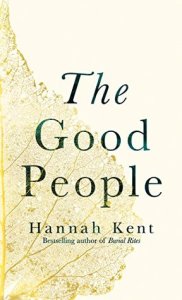
The Good People by Hannah Kent is set in 1825/6, a long gone world of people living in an isolated community, a place where superstition and a belief in fairies held sway. People talk of others being ‘fairy-swept’ or ‘away with the fairies’, and kept with the music and lights, dancing under the fairy hill.This is not a fairy story, but one in which their existence is terrifyingly real to the people of the valley. The villagers believe that the fairies live in Piper’s Grave, ‘the lurking fairy fort’, at the end of the valley, a place where few people went, a neglected and wild place. People see lights there, glowing near a crooked whitethorn tree that stood in a circle of stone. Nóra is completely unable to cope with Micheál, her four-year old grandson. There is talk that he is ‘fairy-struck’.

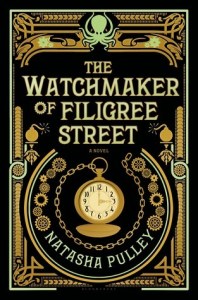
The Watchmaker of Filigree Street by Natasha Pulley, described as ‘steampunk’, this is a mixture of historical fact and fantasy set in Victorian times, both in London and Japan. The main characters are Thaniel Stapleton, who works in the telegraphy department of the Home Office in London, Keita Mori, watchmaker extraordinaire and an inventor of amazing clockwork creations and Grace Carrow, an Oxford physicist who sneaks into an Oxford library dressed as a man, desperate to prove the existence of the luminiferous ether. I loved Katsu, the clockwork octopus, which was made by Mori.

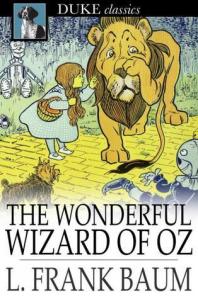
The Wonderful Wizard of Oz by L Frank Baum. I enjoyed this entertaining story, pure escapism, which I would have loved as a child, following Dorothy’s adventures in the Land of Oz after the cyclone whisked her house high in the air out of Kansas and set it down on top of the Wicked Witch of the East, thus killing her. Dorothy and her little dog, Toto, are very anxious to get back home to Kansas and they set out on the yellow brick road leading to the Emerald City to ask the Wizard of Oz to help them. On the way she meets the Scarecrow, the Tin Man and the Cowardly Lion, who go with her as they want the Wizard to give them brains, a heart and courage respectively.

Their journey is interrupted in various places and by a variety of creatures, some very dangerous indeed; as in most fairy tales, there is a fair amount of violence in the book, as Dorothy and her friends combat the Wicked Witch of the East.