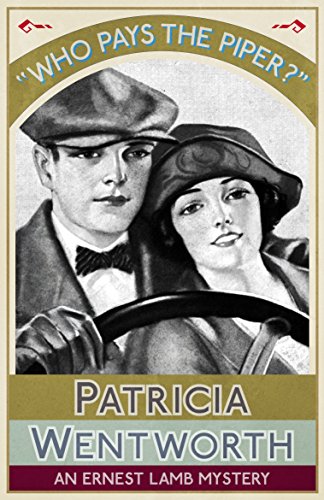
Who Pays the Piper? by Patricia Wentworth

Dean Street Press| 2016| 255 pages| e-book|3.5* rounded up to 4*

This month, Liz at Adventures in Reading, Running and Working from Home is hosting another Dean Street Press December. After my disappointment reading The Red Lacquer Case by Patricia Wentworth I decided to see if Who Pays the Piper? was any better. And I’m delighted to say that it is. It was originally published in 1940, so 16 years later than The Red Lacquer Case. It’s the 2nd book in the Inspector Ernest Lamb Mysteries. This new edition published by Dean Street Press features an introduction by crime fiction historian Curtis Evans.

Description from Dean Street Press:

Lucas Dale, new owner of King’s Bourne, was flirting with danger when he showed his priceless collection of pearls to the guests assembled in his period salon. But when, under threat, he forced lovely Susan Lenox to break her engagement and consent to marry him, he started a train of events that inevitably led to murder, shattering the quiet of the English village. Bill Carrick, Susan’s former fiancé, is the primary suspect, but as Inspector Ernest Lamb and Detective Frank Abbott soon discover, Dale’s questionable past offered motives of revenge and greed to darken the mystery. Motives which would lead another victim into the path of murder…

It’s a murder mystery, so that may explain why I prefer this one to The Red Lacquer Case, as I do enjoy crime fiction more than stories about enemy agents and unconvincing kidnappers that left me feeling exasperated. Who Pays the Piper? is complicated, with many twists and turns, convincing characters and plenty of suspects with plausible motives, along with red herrings – very much like some of Agatha Christie’s plots.

The title is part of the saying ‘He who pays the piper calls the tune’ meaning that the person who provides the money for something decides what will be done, or has a right to decide what will be done. The ‘piper’ in the title is Lucas Dale, who in the opening pages declares that he always gets what he wants. And having bought Bourne House from Mrs O’Hara what he wants is Susan Lennox, her niece. He forces her to agree to marry him and break her engagement with Bill Carrick, which in turn makes him a prime suspect when Lucas is found dead, shot through the back of his head. Bill had been overheard threatening to kill him. 

But he is not the only suspect and it is down to Inspector Ernest Lamb and Sergeant Frank Abbott (who also appear in some of the Miss Silver books) to investigate the case. They discover Dale’s questionable past includes others with a motive to kill him. There is his ex-wife wife, Cora de Lisle and Vincent Bell, his American business partner who both wanted money from Dale. I thoroughly enjoyed trying to unravel it all, even though when the murderer was revealed I was rather surprised.

Wars of the Roses:Book One -Stormbird: Book Beginnings & The Friday 56

Every Friday Book Beginnings on Friday is hosted by Gillion at Rose City Reader where you can share the first sentence (or so) of the book you are reading. You can also share from a book you want to highlight just because it caught your fancy.

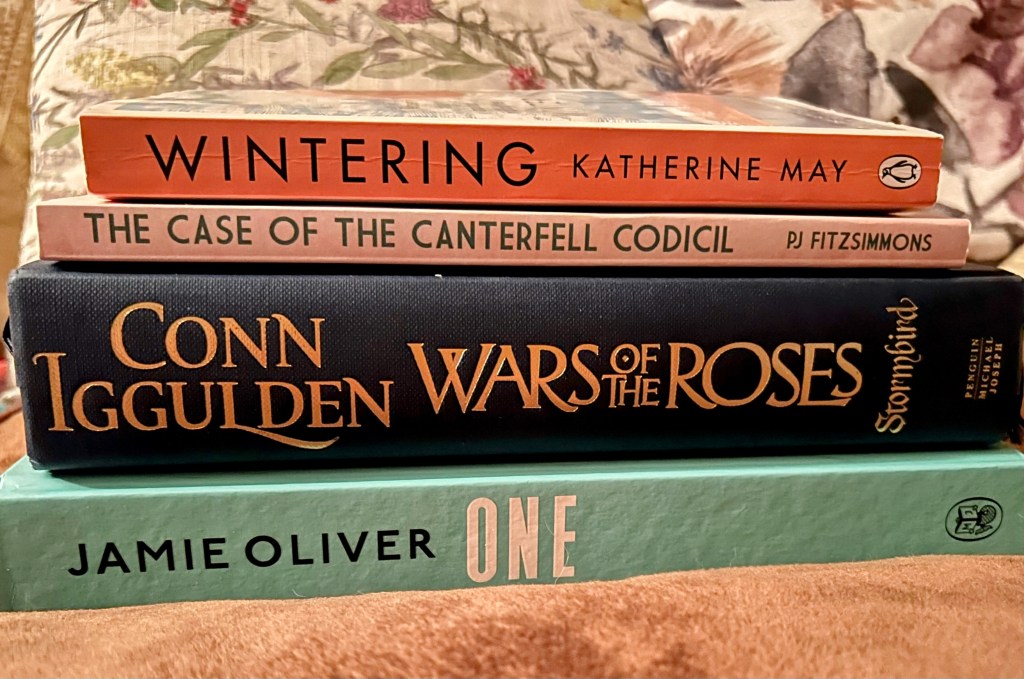
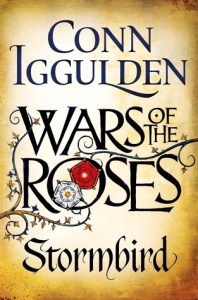
Wars of the Roses: Stormbird by Conn Iggulden is the first episode of The Wars of the Roses series and is one of the books I was given at Christmas.

The book begins with a Prologue set in 1337 as Edward III lay dying.

Prologue:

Anno Domini 1377

Bowls of dark royal blood lay beneath the bed, forgotten by the physician. Alice Perrers rested on a chair, panting from the effort of wrestling the king of England into his armour. The air in the room was sour with sweat and death and Edward lay like his own effigy, pale and white-bearded.

Part One – Chapter One:

Anno Domini 1443

Sixty six years after the death of Edward III

England was cold that month.

Also every Friday there is The Friday 56, hosted by Freda at Freda’s Voice, but she is taking a break and Anne at My Head is Full of Books has taken on hosting duties in her absence. You grab a book and turn to page 56 (or 56% of an eBook), find one or more interesting sentences (no spoilers), and post them.

Page 56

‘They’ve asked for the marriage to take place in the cathedral at Tours, that’s what. Land that will have the French army camped outside, ready to take possession of the price of the truce,that’s what! I’m not letting Henry walk in there, William, not while there’s life in me.’

Description from Goodreads:

King Henry V – the great Lion of England – is long dead.

In 1437, after years of regency, the pious and gentle Henry VI, the Lamb, comes of age and accedes to the English throne. His poor health and frailty of mind render him a weakling king -Henry depends on his closest men, Spymaster Derry Brewer and William de la Pole, Duke of Suffolk, to run his kingdom

Yet there are those, such as the Plantagenet Richard, Duke of York, who believe England must be led by a strong king if she is to survive. With England’s territories in France under threat, and rumours of revolt at home, fears grow that Henry and his advisers will see the country slide into ruin. With a secret deal struck for Henry to marry a young French noblewoman, Margaret of Anjou, those fears become all too real.

As storm clouds gather over England, King Henry and his supporters find themselves besieged abroad and at home. Who, or what can save the kingdom before it is too late?

I’ve read some of Iggulden’s historical fiction novels and loved them, so I’m looking forward to reading this in the new year.

Other books in the Wars of the Roses series are:

  • Stormbird (2013)
  • Trinity (2014) (titled Margaret of Anjou in North America)
  • Bloodline (2015)
  • Ravenspur (2016)

What do you think, does this book appeal to you? What are you currently reading?

The Red Lacquer Case by Patricia Wentworth

Dean Street Press| 2016| 224 pages| e-book|2*

This month, Liz at Adventures in Reading, Running and Working from Home is hosting another Dean Street Press December. I decided to read The Red Lacquer Case by Patricia Wentworth for this event. It was originally published in 1924. This new edition published by Dean Street Press features an introduction by crime fiction historian Curtis Evans.

Description from Amazon:

There was a hand pressed against the window, a large hand that looked unnaturally white, the blood driven from it by the pressure of a man’s weight. The light showed the pale fingers—and the still paler palm crossed by a dark, jagged scar.

Young Sally Meredith is distracted from her jam recipes by a visit from uncle Fritzi, who is accompanied by a mysterious red lacquer case containing a deadly secret. A band of unscrupulous international agents are close behind, and when the eccentric uncle disappears into the night the lacquer case is stolen. But Sally is now the only person who knows how to open the case – she is kidnapped, her life in terrible danger.

Meanwhile Bill Armitage, formerly Sally’s fiancé and still in love with her, begins with the aid of Scotland Yard to search for her. The ending of this clever detective story is, unexpected and piquantly, in high contrast to the preceding terrors.

Previously I’ve read two books by Patricia Wentworth, The Girl in the Cellar, the last of her Miss Silver books, which I didn’t think was very convincing, and The Brading Collection, the 17th Miss Silver book,which I thought was much better. So, I wasn’t sure what to expect from The Red Lacquer Case: A Golden Age Mystery. It’s a romance/spy thriller, very much in the same vein as Agatha Christie’s first Thomas and Tuppence novel, The Secret Adversary, a spy/detective story that is fast and furious with Tommy and Tuppence landing themselves in all sorts of dangerous situations.

In The Red Lacquer Case, Sally, a former suffragette, finds herself in danger when her uncle Fritzi shows her how to open the red lacquer case, a cigar case, in which he has placed his formula for a deadly gas that he thinks enemy agents are determined to get from him. The case has a pattern of raised roses and fishes with goggling eyes. Her tells her

You touch here and here, pressing, and, with the other hand, touching this flower on one side and this on the other, you pull.

But, he tells her, if you try to open it without knowing the correct sequence it will release enough acid to destroy the formula inside.

Over night the case is stolen, thus setting in motion a sequence of events that sees Sally being kidnapped and in terrible danger as the kidnappers try to get her to open the case. Sally is plucky and feisty, able to withstand whatever they try, but she is also naive. Meanwhile Bill Armitage, formerly Sally’s fiance and still in love with her, begins with the aid of Scotland Yard to search for her. At this point the narrative becomes very repetitive and irritating and my interest flagged to the point where I couldn’t wait for the book to end. Sadly, after many twists and turns, the ending, in one final twist, was just irritating and unbelievable. It left me feeling exasperated. I think this book began well, setting up an interesting mystery, but then became tedious reading, and ended, I thought, in such a disappointing way.

I have one more book by Patricia Wentworth to read, Who Pays the Piper? and I’m hoping it will be better than this one.

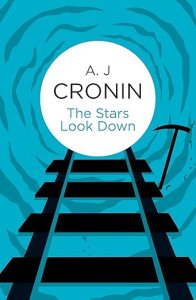
The Stars Look Down by A J Cronin

Bello| 2013| 714 pages| e-book|5*

The Stars Look Down by A J Cronin is quite simply one of the best books I’ve read this year. There is so much more in this book than I’m able to mention in this post! it’s a family saga chronicling the lives of a number of interconnected families over a period of thirty years. 

Synopsis from Amazon:

The Stars Look Down was A.J. Cronin’s fourth novel, published in 1935, and this tale of a North country mining family was a great favourite with his readers.

Robert Fenwick is a miner, and so are his three sons. His wife is proud that all her four men go down the mines. But David, the youngest, is determined that somehow he will educate himself and work to ameliorate the lives of his comrades who ruin their health to dig the nation’s coal. It is, perhaps, a typical tale of the era in which it was written – there were many novels about coal mining, but Cronin, a doctor turned author, had a gift for storytelling, and in his time wrote several very popular and successful novels

In the magnificent narrative tradition of The CitadelHatter’s Castle and Cronin’s other novels, The Stars Look Down is deservedly remembered as a classic of its age.

It’s my spin book for The Classics Club and it was the fourth book he wrote. Many years ago I read his fifth book, The Citadel, which I thought was excellent. The Stars Look Down was first published in 1935. The story starts in 1903 in a North Country mining town, Sleescale, a fictional town, as its inhabitants experienced social and political upheaval. It ends in 1933. It highlights the terrible conditions in the coal mines, the lack of workers’ rights and the need for change in the relationship between the coal miners and the mine owners.

There are three main characters, David Fenwick and Joe Gowlan, both from mining families, and Arthur Barras, the Neptune pit owner’s son. The characters and those connected to them, making up a large cast, are convincingly drawn. It’s a long book, but I read it quickly, completely absorbed in all the sub plots and keen to know how it would all be resolved. There is plenty of drama, with scenes including a flood in the pit, killing one hundred and five miners, including David’s father and brother. Cronin’s descriptive writing is so strong, conveying the terrible conditions in the pit, as the miners find themselves trapped and slowly realise there is no way out. Those scenes in particular made a big impression on me and will stay with me for quite some time.

David goes into politics determined to improve the miners’ working conditions, whilst Joe leaves the mine and becomes a successful businessman, a swindler, engaging in dodgy deals to become wealthy. Arthur, meanwhile, is dominated by his father, Robert, but after the flood, he realises Robert is ignoring the safety of his workers in order to make a profit and the two become estranged. He is unable to forget the men who had died in the Neptune pit and the carnage of the war is abhorrent to him; he refuses to fight and is imprisoned.

Despite the multiple sub plots and characters I was able to keep track of them all. Cronin is a superb storyteller and his story held my interest all the way to its end. He made an excellent case for the nationalisation of the coal mines, as he did for the creation of the National Health Service in his next book, The Citaldel. I’m looking forward to reading more of his books.

About a. j. cronin

Profile Image for A.J. Cronin.

Archibald Joseph Cronin was a Scottish novelist, dramatist, and non-fiction writer who was one of the most renowned storytellers of the twentieth century. His best-known works are The Citadel and The Keys of the Kingdom, both of which were made into Oscar-nominated films. He also created the Dr. Finlay character, the hero of a series of stories that served as the basis for the long-running BBC television and radio series entitled Dr. Finlay’s Casebook.
-Wikipedia: http://en.wikipedia.org/wiki/A.J._Cronin

Six Degrees of Separation from Sandwich by Catherine Newman to A Shilling for Candles by Josephine Tey

It’s time again for Six Degrees of Separation, a monthly link-up hosted by Kate at Books Are My Favourite and Best. Each month a book is chosen as a starting point and linked to six other books to form a chain. A book doesn’t need to be connected to all the other books on the list, only to the one next to it in the chain.

This month starts with Sandwich by Catherine Newman, a book set in Cape Cod, described as a moving, hilarious story of a family summer vacation full of secrets, lunch, and learning to let go.

My first link is The Widow’s War by Sally Gunning. This is historical fiction set in 1761 about a whaler’s wife, Lyddie, in the Cape Cod village of Satucket in Massachusetts, living with the daily uncertainty that her husband Edward will simply not return. And when her worst fear is realised, she finds herself doubly cursed. She is overwhelmed by grief, and her property and rights are now legally in the hands of her nearest male relative: her daughter’s overbearing husband, whom Lyddie cannot abide. She decides to challenge both law and custom for control of her destiny, but she soon discovers the price of her bold “war” for personal freedom to be heartbreakingly dear.

My second link is a book about another widow, The Widow’s Tale by Mick Jackson. It’s narrated by the widow and is rather rambling as befits a woman in her sixties on the verge of a nervous breakdown. Her husband has died, she’s taken it badly, and goes to live in a rented cottage on the bleak Norfolk coast, shunning other people. She drinks to forget herself, sits in pubs alone, doing the crossword and reading a book to pass the time. She drives out to places she once knew, goes for solitary walks,  gets stuck in the saltmarshes, and is definitely quirky and obsessional.

Elly Griffith’s character, archaeologist Ruth Galloway also lives in a cottage on the Norfolk coast. So, My third link is The Janus Stone. Ruth is called in to investigate when builders, demolishing a large old house in Norwich, uncover the skeleton of a child – minus the skull – beneath a doorway. Is it some ritual sacrifice or just plain straightforward murder? The house was once a children’s home. When DCI Harry Nelson meets the Catholic priest who used to run it he tells him that two children did go missing forty years before – a boy and a girl. They were never found. When carbon dating proves that the child’s bones predate the children’s home, Ruth is drawn more deeply into the case. But as spring turns to summer it becomes clear that someone is trying very hard to put her off the scent by frightening her half to death…

More missing children are the subject of My fourth link. It’s On Beulah Height by Reginald Hill. When a child goes missing during one long, hot dry summer it reminds Dalziel of the three little girls who had gone missing 15 years earlier from the village of Dendale in Yorkshire just before it was flooded to provide a new reservoir. No bodies were ever found. Once again during another hot summer the waters of the reservoir recede and the old village re-emerges from the depths.

This book is tightly plotted with many twists that made me change my mind so many times I gave up trying to work out who the murderer was and just read for the pleasure of reading. Hill’s descriptive writing is rich and full of imagery.

There is a bird on the cover of On Beulah Height, so My fifth link is to another book with a bird on the coverThe Crow Trap by Ann Cleeves, the first Vera book. Rachael, Anne and Grace are all staying at Baikie’s an isolated cottage on the North Pennines whilst they carry out an environmental survey. When Rachael arrives at the cottage she is confronted by the body of her friend Bella Furness, who it appears has committed suicide. Then Grace is found dead and the mystery really begins and it is down to DI Vera Stanhope, to get to the bottom of the mystery. Vera is a great character and even though I do like Brenda Blethyn’s portrayal of her in the TV series, I prefer her as she is in the books –  a woman in her fifties, who looks like a bag lady. 

My final link is A Shilling for Candles by Josephine Tey in which Inspector Alan Grant also investigates an apparent suicide. A young and beautiful film star, Christine Clay was found dead beneath the cliffs of the south coast. But he soon discovers that it was in fact murder as a coat button was found twisted in her hair and he suspects a young man, Robin Tisdall who had been staying with Christine in a remote cottage near the beach, especially when it is revealed that she has named him as a beneficiary in her will. Tisdall has lost his coat and so the search is on to find it to prove either his innocence or guilt.

The books in my chain are mainly a mix of crime and historical fiction.

What is in your chain, I wonder?

Next month (January 4, 2025), we’ll start with the 2024 Booker winner, Orbital by Samantha Harvey.

The Christmas Book Hunt by Jenny Colgan

Summary from Amazon:

A heartwarming meet-cute short story from the Sunday Times bestselling author of The Christmas Bookshop. A Christmas mission…

Mirren’s beloved great-aunt Violet is seriously ill. Her one Christmas wish is to be reunited with a long-lost hand-illustrated book from her childhood, a challenge Mirren gladly accepts to give Violet some much-needed festive cheer.

An enchanting journey…

With no sign of the cherished volume online, Mirren falls into the fascinating world of rare books. From London to snowy Hay-on-Wye and Edinburgh’s cobbled streets, she chases leads from bookshop to bookshop—and bumps into mysterious, charming Theo, who, unbeknownst to her, is searching for the same book for reasons of his own…

The start of a new chapter?

As the two join forces to track the book down before time runs out for Violet, will Mirren find her Christmas miracle—and maybe even a kiss under the mistletoe… ?

I normally don’t choose to read romantic stories, and I’m not a fan of short stories but The Christmas Book Hunt by Jenny Colgan sounded interesting because of the book connection. Although it’s described as a short story, at over 100 pages I think it is really a novella. It looked at first as though I was going to find it too cutesy but once the story got going I began to enjoy it. Mirren is looking for a copy of A Child’s Garden of Verses by Robert Louis Stevenson, a particular one that had belonged to her Great Aunt Violet. It was a special edition, with hand-drawn plates by Aubrey Beardsley and now Great Aunt Violet, who is in hospital seriously ill would love to see the book for Christmas. I loved that book as a child, so this is what made the story irresistible for me. It’s easy reading and I read it quickly.

I also liked the story of Mirren’s search in various bookshops in various places in England and Scotland trying to track down what had happened to that particular version of the book. She went to the book town Hay-on-Wye, bookshops in Edinburgh and a secondhand bookshop in Northumberland that sounds very like Barter Books in Alnwick, my favourite bookshop. I was not so keen on the romance element as the relationship develops between Mirren and Theo, who is not the person he appears to be. There are one or two coincidences that cropped up towards the end of the book that I thought were rather remarkable and conveniently tied up all the ends. But overall it was the book element that I found most satisfying.