Ghost Walk by Alanna Knight

The 4th book in Alanna Knight’s Rose McQuinn historical crime fiction series, Ghost Walk is set in 1897 mainly in Eildon, a village in the Scottish Borders.

Three years have passed since Rose McQuinn’s husband, Danny, disappeared in Arizona, whilst working for Pinkerton’s Detective Agency. During that time she has become a Lady Investigator and is about to marry her lover, Detective Inspector Jack Macmerry of the Edinburgh Police. But when a nun from the local convent claims to have received a letter from Danny she is anxious to find out if he is still alive. Rose hopes Danny’s older relative, Father McQuinn, a priest living in the village of Eildon in the Scottish Borders will be able to tell her more.

Rose lives in Solomon’s Tower, a (fictional) tower at the foot of Arthur’s Seat, an old volcano in Edinburgh. A mysterious deerhound, Thane lives somewhere on Arthur’s Seat and often accompanies her. There is a deep bond between the two of them and he often seems to read her mind and understand when she is in danger. As the novel begins Rose and Thane go to Eildon, to meet her future in-laws, just before the wedding, which will also give her an opportunity to talk to Father McQuinn. However, before she can ask him about Danny, he dies under mysterious circumstances and Rose becomes convinced that both his death and that of his housekeeper are in fact murders.

But the main focus of this book is not the murder mystery, nor the suspicions about a Fenian plot to assassinate Queen Victoria during the Jubilee celebrations, but the relationships between Rose and Jack, who has to stay in Edinburgh to testify at a trial, and also between Rose and Jack’s parents, particularly his mother who refuses to acknowledge that Rose is a widow. It also highlights the position of women in a country village during that period. I wanted to know more about Thane, particularly his role at the end of the book – how did he escape with his life?

I liked Rose for her determination to discover the truth and her persistence in being a Lady Detective, despite much opposition. There are nine books in the Rose McQuinn series. I’ve read the first one as well as Ghost Walk and hope to read the others to find out more about her.

  • Publisher ‏ : ‎ Allison & Busby (6 Sept. 2012)
  • File size ‏ : ‎ 537 KB
  • Print length ‏ : ‎ 288 pages
  • My own copy
  • Rating: 3*

Historical Fiction Challenge 2023

Marg at The Intrepid Reader hosts the Historical Fiction Reading Challenge. Each month, a new post dedicated to the HF Challenge will be created where you can add the links for the books you have read.

Everyone can participate! If you don’t have a blog you can post a link to your review if it’s posted on Goodreads, Facebook, or Amazon, or you can add your book title and thoughts in the comment section if you wish.

Any sub-genre of historical fiction is accepted (Historical Romance, Historical Mystery, Historical Fantasy, Young Adult, History/Non-Fiction, etc.)

During the following 12 months you can choose one of the different reading levels:

20th Century Reader – 2 books
Victorian Reader – 5 books
Renaissance Reader – 10 books
Medieval – 15 books
Ancient History – 25 books
Prehistoric – 50+ books

I love historical fiction so in 2023 I’m hoping to reach the Medieval level, that is to read 15 books.

The Black Mountain by Kate Mosse #NovNov22

Week 4 in Novellas in November is Contemporary novellas (post 1980)

The Black Mountain by Kate Mosse (136 pages) 3*

This is a Quick Reads publication – a series of short books by bestselling authors and celebrities. They are designed to encourage adults who do not read often, or find reading difficult, to discover the joy of books. I like the long novels Kate Mosse writes, so I wondered what this short novel would be like.

It is historical fiction set in May 1706 on the northern part of the island of Tenerife, where Ana and her family live in the shadow of a volcano, known locally as the Black Mountain. It’s also a murder mystery – Ana’s father Tomas had apparently committed suicide, but Anna just can’t accept that and reading the letter he’d left she is convinced it was murder. She is determined to find out the truth.

Legend says the mountain has the devil living inside it and when the devil was angry he sent fire and rocks up into the sky. However, there has been no eruption for thousands of years and no one believes it is a threat. Sometimes the earth trembled and shook but the sky never turned red. Until, that is two days after Tomas’ death. He had seen the signs that the mountain was about to erupt and had tried to warn people – but they didn’t want to know. When more tremors occur, and grey ash starts falling Ana realises the danger signs are increasing and she needs to warn people that they must flee before the volcano erupts and destroys their world.

I enjoyed this novella, reading it quickly, feeling almost as though I was also in danger as the Black Mountain threatens to erupt and wondering if Ana would discover the truth about her father’s death in time for her to escape.

The Black Mountain is based on a real historical event. The town of Garachio erupted from May 4 to 5, 1706, which was disastrous not only for the town but also for the entire archipelago. Its port concentrated a large part of the international trade that linked the island with Europe, Africa and America.

~~~

I’ve read a few of the Quick Reads. Here’s a list of all the available titles.

Two Short Reviews: Coffin Road by Peter May and The Wonder by Emma Donoghue

Two more short reviews as I try to catch up on the books I’ve been reading. Both are excellent books, each one with a great sense of location and descriptive writing bringing the scenes and characters vividly to life.

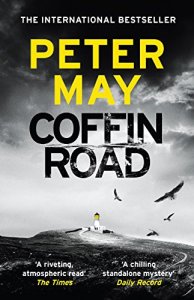
First, Coffin Road by Peter May, is a standalone novel, set on the Isle of Harris in the Outer Hebrides. I read it because I loved his Lewis trilogy. There are 3 strands to the story. There’s a mystery surrounding a man, washed up during a storm on a deserted beach on the Isle of Harris. He is wearing a life jacket, is battered and bruised – and has no idea who he is or where he is. The only clue to why he is living on Harris is a folded map of a path named the Coffin Road and following the route marked on the map he finds some hidden beehives that are familiar to him. In the second strand DS George Gunn investigates the murder of a bludgeoned corpse discovered on a remote rock twenty miles to west of the Outer Hebrides. And thirdly, a teenage girl in Edinburgh is desperate to discover the truth about her scientist father’s suicide.

It is fast-paced, almost impossible to put down, and full of intrigue and mystery. Each strand of the story kept me guessing, wondering what the connections between them were. It’s tense with the sense that time is running out for all the characters and I wasn’t sure whether any of them were reliable narrators or were who they appeared to be.

In addition the bees have a major role in the story. All the facts about the bees slot seamlessly into the story and I learned quite a lot about bees that I didn’t know before, especially their role in climate change.

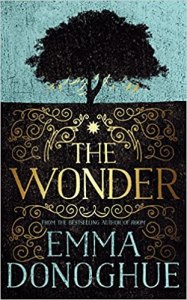
The Wonder is a very strange story. It’s uncomfortable reading, but I felt I just had to read it. And although it moves at a slow pace I read it quickly in large chunks. It is tense, full of atmosphere and just like Coffin Road, I found it almost impossible to put it down, such is the power of Emma Donoghue’s storytelling.

The plot is simple: it is set in a small village in the Irish Midlands in the 1850s. Eleven-year-old Anna O’Donnell stops eating, but remains miraculously alive and well. A nurse, Lib Wright, trained in the Crimea by Florence Nightingale, and a nun, Sister Michael are hired by a committee of influential locals to spend two weeks observing her to make sure she is not being fed secretly.

Lib observes Anna in scrupulous detail, noting Anna’s symptoms. At first she seems a healthy little girl but as the two weeks go by she develops worrying symptoms – downy cheeks, scaly skin, blue fingertips, and swollen lower limbs and hands. Lib begins to realise that it is not just a question of how Anna is managing to exist without food, but also why. What is motivating Anna to persist in saying she is not hungry and doesn’t need to eat? The answer seems to lie in her religious beliefs, and maybe religious hysteria is playing a part as well as the clash between medical science and faith. But is there more to it? Lib wonders about the family’s relationships and the effect of Anna’s brother’s death just a few months before Anna stopped eating.

As Donoghue explains in her author’s note The Wonder is an invented story, inspired by almost fifty cases of so-called Fasting Girls in the British Isles, Western Europe and North America between the 16th and 20th centuries. A film of the book is available on Netflix, but I don’t think I could bear to watch it.

The Island by Victoria Hislop: A Short Post

I have been struggling to write posts recently. I haven’t been able to settle down to writing after finishing a book, either because I’m too eager to read the next book, or like Heavenali I’ve been so distracted and mithered by other things going on in my life, mostly minor that shouldn’t really bother me, but do, that I am finding it hard to concentrate on writing.

So, that is why I haven’t written about a number of books I read earlier this year. Some of them are books that qualify for the Wanderlust Bingo CardThe Island by Victoria Hislop, The Fellowship of the Ring by J R R Tolkien, The Night of the Mi’raj by Zoë Ferraris and Coffin Road by Peter May. These aren’t the only books I’ve read that need to write about, but it’s a start.

The first one I’m writing about is The Island by Victoria Hislop, her debut novel and one of my TBRs. It’s been on my bookshelves for years and I did start reading it soon after buying it, but I didn’t get very far and put it back on my bookshelves. Since then I’ve read three other books by Victoria Hislop and enjoyed them so I decided to try it again, especially as it fills the Island Square (set in Greece) on the Wanderlust Bingo card. I began reading it in August, when I took it away with me, visiting family, but didn’t find much time to read it and had to set it to one side. After I returned home I went on to read other books until October when I picked it up once more.

It is historical fiction set in Plaka on the island of Crete and in Spinalonga, a tiny, deserted island just off the coast of Plaka. I wasn’t very sure I would like it when I read the first chapter about Alexis Fielding longing to find out about her mother’s past. Sofia had never told her anything about it and all that Alexis knew was that Sofia had grown up in Plaka, a small Cretan village before moving to London. She gave Alexis a letter to take to an old friend, Fotini, promising that through her she will learn more. And once Fotini entered the story I was hooked as she told what had happened to Sophia’s grandmother, Eleni and her daughters, Anna and Maria after Eleni caught leprosy and was sent to live on Spinalonga.

Beginning before the Second World War the story moved between Plaka and Spinalonga and I loved all the details of Elena’s life on Spinalonga, but then when the narrative moved on to describing her daughters’ lives I began to lose interest. Instead of a fascinating historical novel about leprosy it changed into a historical romance, which I didn’t enjoy as much as the earlier part of the book. Overall, I think it’s too long and drawn out, and the ending is a bit too neat. So I’m giving this book 4*, combining 5* for Eleni’s story and 2-5* for both the beginning and the ending.

I’m hoping to write similar short posts for the other three books.

Book Beginnings & The Friday 56: Nemesis by Rory Clements

Every Friday Book Beginnings on Friday is hosted by Gillion at Rose City Reader where you can share the first sentence (or so) of the book you are reading. You can also share from a book you want to highlight just because it caught your fancy.

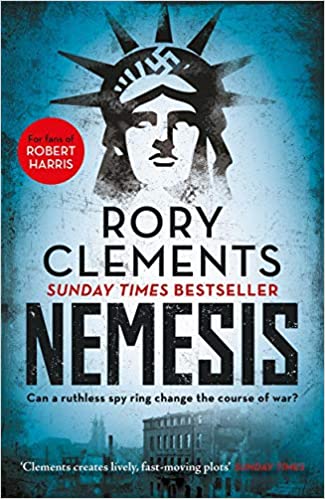
Today I’m featuring Nemesis by Rory Clements, the third book in his Tom Wilde series, historical fiction set in the Second World War. I’ve read books 1, 2, 4 and 5. It’s probably better to read them in sequence, but I’ve found they read well as standalone books. I am about to start this one.

This was the best day of his life, watching his beloved boy, here in this ancient chamber of light.

Also every Friday there is The Friday 56, hosted by Freda at Freda’s Voice, where you grab a book and turn to page 56 (or 56% of an eBook), find one or more interesting sentences (no spoilers), and post them.

Page 56:

Why was the door open?

He stood on the front doorstep, as his eyes adjusted to the gloom. Across the road, beside the fenced-off garden at the centre of the square, he thought he saw shadowy movement. At first he dismissed it, but then, he heard voices too.

RORY CLEMENTS is a Sunday Times bestselling author. He won the CWA Ellis Peters Historical Award for his second novel, Revenger, and a TV series of the John Shakespeare novels is currently in development. 

Synopsis from Amazon:

In a great English house, a young woman offers herself to one of the most powerful and influential figures in the land – but this is no ordinary seduction. She plans to ensure his death . . .

On holiday in France, Professor Tom Wilde discovers his brilliant student Marcus Marfield, who disappeared two years earlier to join the International Brigades in Spain, in the Le Vernet concentration camp in the foothills of the Pyrenees. Wilde secures his release just as German tanks roll into Poland.

Meanwhile, a U-boat sinks the liner Athenia in the Atlantic with many casualties, including Americans, onboard. Goebbels claims Churchill put a bomb in the ship to blame Germany and to lure America into the war.

As the various strands of an international conspiracy begin to unwind, Tom Wilde will find himself in great personal danger. For just who is Marcus Marfield? And where does his loyalty lie?

A brilliantly intelligent, gripping WW2 spy thriller from the Sunday Times bestselling author of Corpus and Hitler’s Secret.

What do you think? Would you read it?