The Way of All Flesh by Ambrose Parry

Edinburgh, 1847. City of Medicine, Money, Murder

Canongate Books|30 August 2018|417 pages|Review copy|5*

The Way of All Flesh is the debut novel from Ambrose Parry: co-written by best-selling crime writer Chris Brookmyre and consultant anaesthetist Dr Marisa Haetzman.

I knew as soon as I began reading The Way of All Flesh that I was going to enjoy it – it’s historical crime fiction at its very best.

Full of atmosphere and historical detail, I could easily believe I was there in Edinburgh in 1847 as Dr James Young Simpson, a professor of midwifery, discovered the anaesthetic properties of chloroform. It combines fact and fiction most successfully, the social scene, historical and medical facts slotting perfectly into the plot.

It begins with the death of Evie, a prostitute in Edinburgh’s Old Town, found by Will Raven, a young medical student about to start his apprenticeship with Dr Simpson. Will, Evie’s friend is suspicious, the place was reeking of drink and Evie’s body was in a state of contortion. He flees the scene, not wanting to be implicated in her death. There is a mystery surrounding Will – he has a past that he wants to conceal, and he is in trouble with a couple of villains who beat him, slashing his face when he is unable to repay his debt to a moneylender.

Will is anxious to fit in with the more genteel society of the New Town, where Dr Simpson has his surgery, a place where people from all levels of society congregated – the poor who attended his clinics, the wealthy who also wanted treatment, and the medical students and colleagues experimenting with new drugs and medical techniques. When Will comes across similar deaths during his work with Dr Simpson he is determined to find out who is responsible  – was it the same person who had killed Evie?

Sarah, Dr Simpson’s housemaid is an ambitious and enterprising young woman who would love to have a career in medicine just like the male medical students. Initially she dislikes Will, but eventually they join forces to uncover the killer in the depths of Edinburgh’s dark underworld . Through Sarah’s eyes we see the frustrations and limitations that all women experienced and through Will’s eyes we see the grim realities and danger that women at all levels of society faced with childbirth and unwanted pregnancies, and the brutally primitive state of the medicine of the period. The medical scenes are indeed gruesome and the attitudes of some of the clergy with their opposition to the use of anaesthetics is deplorable. The authors have combined their specialities to provide a compelling murder mystery interwoven with the exciting discovery of chloroform and how it transformed surgery.

This is without doubt an impressive and well written book that gripped me throughout – definitely one of the best books that I’ve read so far this year.

And I am so pleased that this is not the end of Will as Chris and his wife, Marisa are planning more novels revealing the development of medicine and the part that the Simpson household played. Also, I see that Benedict Cumberbatch’s SunnyMarch production company has secured the TV rights to The Way of All Flesh.

Thank you to Canongate Books and NetGalley for my copy of this book for review.

Six Degrees of Separation from Where Am I Now? to The Book of Illusions

I love doing Six Degrees of Separation, a monthly link-up hosted by Kate at Books Are My Favourite and Best. Each month a book is chosen as a starting point and linked to six other books to form a chain. A book doesn’t need to be connected to all the other books on the list, only to the one next to it in the chain.

This month the chain begins with with Where Am I Now? by Mara Wilson, subtitled True Stories of Girlhood and Accidental Fame. Mara Wilson is a former child actress best known for her starring roles in Matilda and Mrs. Doubtfire. I haven’t read this book which tells the story of one young woman’s journey from accidental fame to relative (but happy) obscurity. 

Where Am I Now?

As the title of Mara Wilson’s book is a question my first link is to another book with a question in the title. When Will there Be Good News? by Kate Atkinson. A tale of disasters beginning when six year old Joanna witnessed the murder of her mother, older sister and baby brother. It’s the third in her Jackson Brodie series. I raced through this very quickly as I was so keen to find out what happened. I know I missed the clues and I’d love to re-read it sometime!

When Will There Be Good News? (Jackson Brodie, #3)One Good Turn (Jackson Brodie #2)Three Act Tragedy (Hercule Poirot, #11)

The second link is to another book by Kate Atkinson, One Good Turn. This is the second  Jackson Brodie book, a cleverly constructed and complicated murder mystery. It’s a puzzle and like the Russian dolls within dolls (which also feature in this book), there is a thread connecting it all together. I didn’t think it was quite as good as When Will There Be Good News?, but still enjoyed it.

Another book with a number in the title is Agatha Christie’s  Three Act Tragedy, also a book containing lots of puzzles to be solved. Poirot plays a secondary role, preferring to think rather than act and it is Mr Satterthwaite and Sir Charles who investigate the deaths of two of the guests at Sir Charles Cartwright’s party. This is one of Christie’s earlier books (1935) and I really enjoyed it.

Mr Satterthwaite, along with Mr Harley Quin, also features in Agatha Christie’s short story collection The Mysterious Mr Quin, first published in 1930 . This is my favourite of her collections, containing some of her very best short stories.

The Mysterious Mr. Quin (Harley Quin, #1)The Breaking Point: Short StoriesThe Book Of Illusions

My fifth link is to another collection of short stories: The Breaking Point by Daphne du Maurier. These stories are dark, difficult, perturbing – and sometimes shocking, telling of double lives, split personalities, paranoia and conflict, each one with a ‘breaking point’. One of the stories is The Menace about a silent movie star, a heart-throb until the advent of the ‘feelies’ when it is discovered that his magnetism is almost non-existent.

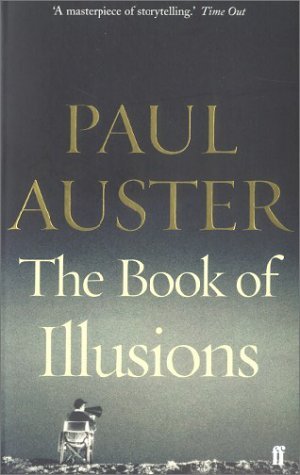
One of the characters in The Book of Illusions by Paul Auster is a silent movie star – Hector Mann. There are many layers to this novel; it’s a detective story with gothic overtones, a love story and a novel about the passing of the 20th century, ending as the last weeks of the century approach. It’s a circular story as well, ending with the hope that it ‘will start all over again.’

And this completes my chain beginning and ending with books about movie stars, passing through murder mysteries and short story collections, and moving from the US to the UK and back to the US, linked by the titles, authors and characters.

Next month (October 6, 2018), we’ll begin with a book I haven’t read (or heard of before) – a story of teenage rebellion, The Outsiders by S. E. Hinton.

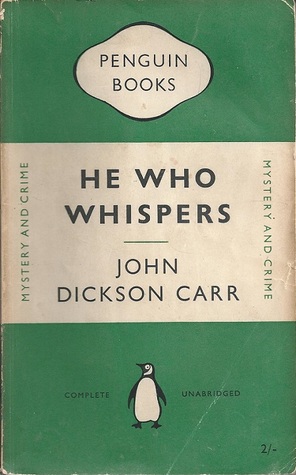
He Who Whispers by John Dickson Carr

He Who Whispers by John Dickson Carr was my Classics Club Spin book for August. It was first published in 1946. Carr (1906 – 1977) was an American writer who also wrote under the pseudonym of Carter Dickson and Carr Dickson. In 1936 he was elected to the Detection Club in London. He Who Whispers is one of his ‘locked room’  mysteries/impossible crimes, featuring Dr Gideon Fell, an amateur sleuth.

He Who Whispers by John Dickson Carr

I really didn’t know what to expect so I was pleased to find that I thoroughly enjoyed this book. It’s well written, set in 1945 just after the end of the Second World War when Miles Hammond is finding it hard to getting used to peacetime. London is still showing the scars of the war and he feels that his life is unreal. He has been discharged from the Army after being in hospital suffering from diesel-oil poisoning.

Then, gasping out to the end like a gauleiter swallowing poison, the war is over. You come out of hospital – a little shakily, your discharge papers in your pocket – into a London still pinched by shortages; a London of long queues, erratic buses, dry pubs; a London where they turn on the street-lights and immediately turn them off again to save fuel; but a place free at last from the intolerable weight of threats.

People didn’t celebrate that victory hysterically, as for some reason or other the newspapers liked to make out. What the newsreels showed was only a bubble on the huge surface of the town. Like himself, Miles Hammond thought, most people were a little apathetic because they could not yet think of it as real. (page 6)

His friend, Dr Gideon Fell, has invited him to dinner as a guest at the Murder Club, their first meeting in five years, where the speaker is Professor Rigaud. But when he arrives he finds none of the members of the Club have turned up. The only other people there are the Professor, and a beautiful blonde called Barbara Morell. Rigaud, however, tells them the story he had prepared for the Club – a tale of an impossible murder on the top of a ruined tower, that had once been part of a French chateau burnt down by the Hugeunots in the 16th century, and a mysterious woman, Miss Fay Seton.

The body of Howard Brooke was found lying on the parapet of the tower by two children between 10 minutes to 4 and 5 minutes past 4. He had been stabbed through his body with a sword-stick and yet the evidence showed conclusively that during this time not a living soul came near him. Rigaud points out the difficulties of scaling the wall of the tower, leading Miles to suspect he is alluding to ‘some sort of supernatural being that could float in the air‘ – in other words, a vampire.

Now, six years later Miles, Rigaud and Barbara together with Dr Fell set about trying to solve the mystery. I was fascinated by Dr Fell, supposedly based upon G. K. Chesterton (author of the Father Brown stories), in his appearance and personality. He’s immensely tall and fat, with a big mop of grey-streaked hair, and wearing a long, dark cape. He strides along ‘with a rolling motion like an emperor, and the sound of his throat-clearing preceded him like a war-cry‘.

I thought the characterisation was excellent and there is a great sense of location. The book is full of tension and there is a real sense of approaching danger and disaster as the characters struggle to uncover the truth. It is only due to Dr Fell’s ingenuity that their fears are calmed and he produces a rational explanation and reveals the truth. I too was puzzled and the book had kept me guessing right to the end. Even then when I knew what had happened I was so involved with the characters that  I was left wondering –  what happened next? 

Now, I’m keen to read more of John Dickson Carr’s books. There are a lot of them – see the list at Fantastic Fiction.

  • Paperback: 206 pages
  • Publisher: Penguin Books in association with H.Hamilton (1953)
  • Source: I bought my copy
  • Rating: 4*

New-to-Me Books from Barter Books

Yesterday I went to my favourite bookshop Barter Books, one of the largest secondhand bookshops in Britain. This is where you can ‘swap’ books for credit that you can then use to get more books from the Barter Books shelves.

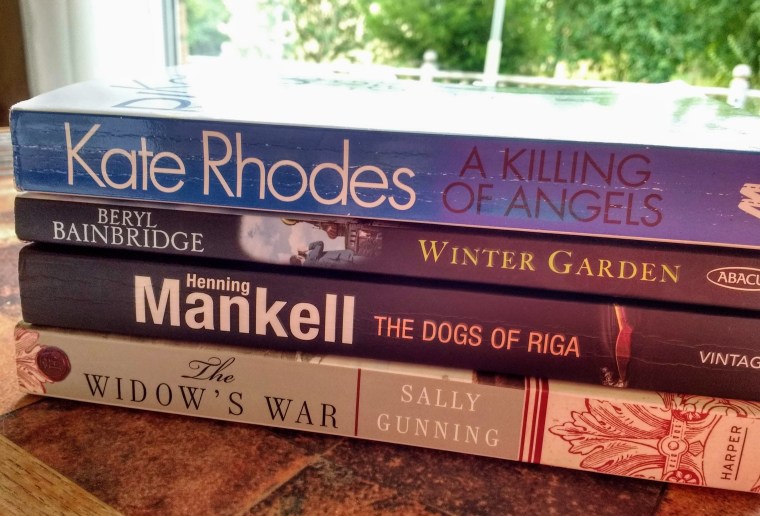
These are the books I brought home:

img_20180829_073215012_hdr


A Killing of Angels by Kate Rhodes (a new-to-me author) – the second book in her Alice Quentin series. I haven’t read the first book but I thought this looks good – it’s a psychological thriller. At the height of a summer heatwave, a killer stalks the City of London.The avenging angel leaves behind a scattering of feathers with each body – but why these victims? What were their sins?

Winter Garden by Beryl Bainbridge – described on the back cover as ‘surreal’ (TLS) and ‘very funny as well as a frightening book’ (Guardian), I’m not sure what I’ll make of this book about a womaniser who begins an extra-marital affair, but I’ve liked other books by Beryl Bainbridge.

The Dogs of Riga by Henning Mankell. I’ve enjoyed a couple of his books before, so this Inspector Wallander book caught my eye. A little raft is washed ashore on a beach in Sweden. It contains two men, shot dead. They’re identified as criminals, victims of a gangland hit. Wallander’s investigation takes him to Latvia.

The Widow’s War by Sally Gunning – another new-to-me author. This is historical fiction set in 1761 about a whaler’s wife in the Cape Cod village of Satucket in Massachusetts, living with the daily uncertainty that her husband Edward will simply not return. And when her worst fear is realised, she finds herself doubly cursed.

Have you read any of these? Do they tempt you too?

Dog Will Have His Day by Fred Vargas

Dog Will Have His Day (The Three Evangelists, #2)

I enjoyed the first book in Fred Vargas’ Three Evangelists series so much – see my review – that I decided to read the next one Dog Will Have His Day  and I’ve reserved the third book, The Accordionist at the library. I love Fred Vargas’s books. She writes such quirky crime fiction, with eccentric characters and intricate plots that I love and find so difficult to solve.

The three ‘Evangelists’ are thirty-something historians, Mathias, Marc and Lucien, all specialists in three different periods of history, who live in a rambling house in Paris. Actually there are only two of the three Evangelists in Dog Will Have His Day – Marc and Mathias – who help ex-special investigator Louis Kehlweiler, to uncover the mystery surrounding a tiny fragment of human bone Louis had found.

Louis is another one of Vargas’ eccentric characters, known variously as Ludwig/Louis, the son of a French woman and a German soldier, he carries Bufo, a toad, around in his pocket and even talks to it. Even though he is retired he still keeps newspaper cuttings and files on any criminal activity of any kind, which is where Marc helps him. And he also still keeps watch on all his observation posts, numbering the public benches and even trees in the Paris parks.  Sitting on bench 102 one evening he had seen a pile of dog excrement on a grid around a tree. This annoyed him – he didn’t like his lookout posts to be fouled – but the next morning the rain had washed the grid clean and all that remained from the dog poo was the tiny bone. The bone, which turned out to be the top joint of a big toe, probably that of an elderly woman, convinces Louis that a murder has taken place. And, of course, he has to find out who it had belonged to and what had happened.

His search takes him and Marc to a small fishing village in Finistére in Brittany, where they are later joined by Mathias, in the hope of identifying the victim and the murderer. There Louis not only comes across an ex-girlfriend, discovers the answer to a mystery in his own family history, but he also discovers that an old woman, Marie had been found dead on the beach. It had been recorded as an accidental death but Louis is convinced she was murdered – but who killed her and why?

This really is a strange murder mystery, full of bizarre events and characters – plus an extraordinary machine that prints out vague answers to questions. I found it compelling reading. I see from the synopsis of The Accordionist that Louis is also in the third book in the series with the three ‘Evangelists’ – I’m hoping my reserved copy will be available from the library soon.

  • Paperback: 256 pages
  • Publisher: Vintage; Reprint edition (9 April 2015)
  • Language: English
  • ISBN-10: 0099589885
  • ISBN-13: 978-0099589884
  • Source: Library book
  • My rating 4.5*

WWW Wednesday: 15 August 2018

IMG_1384-0

WWW Wednesday is run by Taking on a World of Words.

The Three Ws are:

What are you currently reading?
What did you recently finish reading?
What do you think you’ll read next?

I’m currently reading:

I’ve started my Classics Club Spin book, He Who Whispers by John Dickson Carr. Set not long after the Second World War end this is a ‘locked room’ type of mystery, in which the body of Howard Brooks is found, stabbed to death, on the top of a tower, but the evidence shows that no one entered or left the tower during the time the murder took place.

And I’m still reading Wedlock: How Georgian Britain’s Worst Husband Met His Match by Wendy Moore, non fiction about Mary Eleanor Bowes who was the richest heiress in 18th century Britain. She fell under the spell of a handsome Irish soldier, Andrew Robinson Stoney and found herself trapped in an appallingly brutal marriage. Fascinating reading that if it was fiction you’d say you couldn’t believe it.

I’ve recently finished:  

The Story Keeper by Anna Mazzola, which was published on 26th July 2018. See yesterday’s post for the opening paragraphs and synopsis. It’s beautifully written and as I like folklore and legends, with a mystery interwoven within it, I’ve been enjoying this very much.

I’ll post my review in the next few days.


My next book could be:

The Way of All Flesh by Ambrose Parry, co-written by best-selling crime writer Chris Brookmyre and consultant anaesthetist Dr Marisa Haetzman, to be published on 30 August 2018.

Synopsis

Edinburgh, 1847. City of Medicine, Money, Murder.

Young women are being discovered dead across the Old Town, all having suffered similarly gruesome ends. In the New Town, medical student Will Raven is about to start his apprenticeship with the brilliant and renowned Dr Simpson.

Simpson’s patients range from the richest to the poorest of this divided city. His house is like no other, full of visiting luminaries and daring experiments in the new medical frontier of anaesthesia. It is here that Raven meets housemaid Sarah, who recognises trouble when she sees it and takes an immediate dislike to him. She has all of his intelligence but none of his privileges, in particular his medical education.

With each having their own motive to look deeper into these deaths, Raven and Sarah find themselves propelled headlong into the darkest shadows of Edinburgh’s underworld, where they will have to overcome their differences if they are to make it out alive.

Have you read any of these books?  Do any of them tempt you?