Saturday Selection

I’ve recently finished Whatever You Love by Louise Doughty and am over halfway into The Mystery of Edwin Drood by Charles Dickens. Even though I’ve started The Serpent Pool by Martin Edwards I’m thinking what to read after that. I have a number of books lined up – my birthday books for example, but I have several library books and a couple of new books that are also in the running. They are:

  • The Tapestry of Love by Rosy Thornton. I’ve read one other book by Rosy, which I enjoyed very much – Hearts and Minds, so I was delighted when she asked me if I’d like to read her latest book. I see that other bloggers have already reviewed it with good reports, so I’m sure I’ll enjoy this one too. It’s about Catherine who moves from  England to a rural idyll in a tiny hamlet in the Cevennes mountains, where she sets up in business as a seamstress.  But sometimes a rural idyll isn’t what it seems …
  • Seeking Whom He May Devour by Fred Vargas. This is a library book.  I surprised myself by borrowing this book as I don’t like to read scary books and the blurb tells me that this is a frightening and surprising novel about a problem with wolves in  the French mountains – possibly involving a werewolf.
  • Yet another book (another library book) with a French connection is All Our Wordly Goods by Irene Nemirovsky. I’m hoping to enjoy this as much as I did her other books – Fire in the Blood and Suite Francaise. It’s the gripping story of family life and starcrossed lovers, of commerce and greed , set against the backdrop of France from 1911 to 1940.
  • I read about Thirteen Hours by Deon Meyer on Bernadette’s blog Reactions to Reading and was convinced that I should read it too. Fortunately my library had a copy. Set in South Africa (and translated from Afrikaans) Detective Benny Griessel investigates the disappearance of an American backpacker, whilst trying to stay sober and mentoring the next generation of detectives.
  • And for something completely different I have The Pantomime Life of Joseph Grimaldi by Andrew McConnell Stott. This came to me via LibraryThing’s Early Reviewers Programme. Grimaldi was the most celebrated of English clowns and this biography not only tells the story of his life but also paints a picture of the theatrical scene in London in Georgian England. Grimaldi was also an acrobat and an innovator, who struggled with depression.

Birthday Books

These are the books I had for my birthday.

The Rough Guide to Crime Fiction is a reference book that I can just dip into. The rest are all books I’d love to read immediately. If you click on the photo you’ll see from the enlarged view showing the creasing on the spine that I’ve already started to read the Creative Writing book. I’m always fascinated by this type of how-to book and already have a few. I saw this at one of the airport bookshops on our recent trip to Stuttgart (see Flickr for some photos) and thought it looked interesting – I’m much better at reading books like this than actually writing anything.

I’ve also read the first few pages of Peter Ackroyd’s Dickens. I’ve read several of Dickens’s books and am currently reading The Mystery of Edwin Drood, so I want to know more about him. This biography begins with his death and the reactions to his death, not only in Britain but also in America.

I’ve read Martin Edwards earlier Lake District Mysteries – they’re excellent. I couldn’t resist reading the startling opening of this latest one, The Serpent Pool:

The books were burning.

Pages crackled and bindings split. The fire snarled and spat like a wild creature freed from captivity to feast on calfskin, linen and cloth. Paper blackened and curled, the words disappeared. Poetry and prose, devoured by flames. (page 7)

This grabs my attention and makes me want to read on immediately.

But there are also the other books I can’t wait to get to:

  •  Susan Hill’s latest Simon Serrailler novel The Shadows in the Street, because I’ve all the others and found them all compelling reading.  This is the fifth one.
  • The Sunday Philosophy Club by Alexander McCall Smith, the first Isabel Dalhousie book. I’ve read and loved some of the later ones.
  • The Year of the Flood by Margaret Atwood. I’ve read good reports of this book. Margaret Atwood is one of my favourite authors and this book promises to be just as good as her others.

As usual I wish I could read all of them at once!

The Body on the Beach by Simon Brett: Book Review

The Body on the Beach is the first in Simon Brett’s Fethering Mysteries. It’s an easy read, a ‘cozy mystery’, set in a fictitious village on the south coast of England. Not a typical village as it has a large residential conurbation, but at its heart is the High Street, with its flint-faced cottages, dating back to the early 18th century. Radiating out from the High Street are a number of new developments, Victorian and Edwardian houses, bungalows, post-war council houses and a large private estate of huge houses backing on to the sea.

Carole Seddon has taken early retirement from her career at the Home Office to live there and as the book opens she is confronted by a new neighbour, Jude, who with her informality and casual approach to life breaks all the accepted local conventions. Carole views her with slight distaste. But when Carole is also confronted by the the discovery of a dead body on the beach, that has disappeared by the time the police go to investigate, she gradually accepts Jude’s help. Together they set about solving the mystery, which gets more complicated with the discovery of the body of a local lad.

This is an entertaining whodunnit which I liked well enough. It wasn’t too difficult to work out the identity of the first body and the culprit. I liked the contrast between Carole and Jude – Carole, set in her ways, reserved and conventional and the flamboyant, casual Jude. Despite her informality Jude reveals very little about her life and relationships, despite Carole’sefforts to get to know more about her.  I also liked the way Brett so convincingly describes the relationships between the different groups of Fethering’s residents.

There are 11 books in the Fethering series.  I’ve already read the fourth –  Murder in the Museum, so there are plenty more to read, the latest one being The Shooting in the Shop. The full list is in Wikipedia and Simon Brett also has a website.

Agatha Christie Reading Challenge: My Progress

The Agatha Christie Reading Challenge is an open-ended challenge to read all of Agatha Christie’s books and short stories, run by Kerrie at Mysteries in Paradise. I first read some of Christie’s books when I was a teenager and hadn’t read any for years until I borrowed a copy of The Crooked House from my local library three years ago. This reminded me of how much I had enjoyed her books and set me off reading them again. Over the years I must have read a good number of them but had never kept any records of what I read at the time.

So when I saw that Kerrie was running this challenge I decided to join in. It’s one of the best challenges out, for me at least, because all you have to do is read Agatha Christie’s books at your own pace and link to the Agatha Christie Carnival once a month. There’s no pressure to meet any deadlines – if you haven’t read any Christie books for the Carnival that’s OK and you just carry on reading when you like.

I’m not even trying to read them in the order they were published, even though Kerrie and some others are, because I’m reading books I already own or books that I find in librarys and/or bookshops. So far I’ve read 17 and 2 collections of her short stories – I’ve listed them on a separate page.

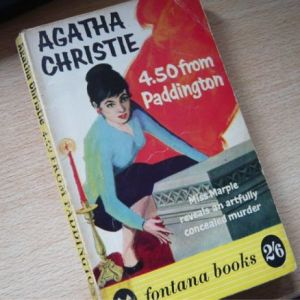
My latest find is 4.50 from Paddington, which I received from Juxtabook as part of my prize in her recent competition. Catherine described this book as a ‘rather aged paperback’ and it is, but then it is 50 years old, published in 1960 for just 2/6 (in old money). It may be old and faded, but because it was published soon after Agatha Christie wrote it, it has a contemporary feel about it. I’ve watched so many TV and film versions, with different actors playing the part of Miss Marple, some more successfully than others that it’s interesting to see this book. I’m not sure who the woman on the front cover is meant to portray – surely not Miss Marple?

And this is the back cover – really that’s all the blurb you need to capture your interest.

This will be my next Agatha Christie book to read.

Death on the Nile by Agatha Christie: Book Review

Death on the Nile is a pre-Second World War novel, first published in 1937. It shows Agatha Christie’s interest in Egypt and archaeology and also reflects much of the flavour and social nuances of the pre-war period. In it she sets a puzzle to solve –  who shot Linnet Doyle, the wealthy American heiress? Although the novel is set in Egypt, an exotic location, it is essentially a ‘locked room mystery’, as the characters are passengers on the river-steamer SS Karnak, cruising on the Nile. Amongst them is the famous Hercule Poirot, a short man dressed in a white silk suit, a panama hat and carrying a highly ornamental fly whisk with a sham amber handle ‘a funny little man (pages 37 – 38). Linnet is the girl who has everything, good looks and wealth:

A girl with golden hair and straight autocratic features ‘a girl with a lovely shape’ (page 3). She was used to being looked at, being admired, to being the centre of the stage wherever she went. (page 41)

Linnet has recently married Simon Doyle, who was previously engaged to her friend, Jacqueline. This sets in motion a series of events that results in Linnet’s death. When Jacqueline follows them on their trip down the Nile she is the obvious suspect, driven by her jealousy of Linnet. Also on board are an imperious American, Miss Van Schuyler, her niece Cornelia Robson and Miss Bowers, her companion; a novelist Mrs Salome Otterbourne and her daughter, Rosalie; Mrs Allerton and her son, Tim; Linnet’s American solicitor, an excitable Italian archaeologist, a radical English socialist and a young English solicitor.

Poirot is on holiday, but he finds himself discussing the nature of criminals and motives for murder with Mrs Allerton. He says the most frequent motive is money:

that is to say gain in its various ramifications. Then there is revenge, and love, and fear ‘and pure hate, and benefice’. (page 83)

The motive in this case seems straightforward, looking at who gains from Linnet’s death, but this is a complicated plot (when is one of Christie’s books not complicated?) and following on from Linnet’s murder, her maid is also found dead, Linnet’s pearls are missing, several characters are not what them seem and with the arrival of Colonel Race, a member of the British Secret Service, it seems there is also an international murderer and agitator on board. Poirot knew

that Race was a man of unadvertised goings and comings. He was usually to be found in one of the out-posts of Empire where trouble was brewing. (page 120)

It does seem a very unlikely plot, dependent on precise timing, but Poirot works his way through the significant facts and arrives at the truth. He tells Race that

This is a crime that need audacity, swift and faultless execution, courage, indifference to danger and a resourceful, calculating brain. This crime wasn’t safe! It hung on a razor edge, It needed boldness. (page 272)

All in all, an enjoyable puzzle to solve, most of which I’d worked out along with Poirot.

A Dark-Adapted Eye by Barbara Vine: Book Review

A few months ago we went to the Science Centre in Glasgow where we spent time in the Planetarium, looking at the night sky as it appears without urban light pollution. To see the stars and planets you need a dark-adapted eye and the lights are slowly dimmed until they all come into focus.

In Barbara Vine’s A Dark-Adapted Eye, the narrator Faith has spent her life avoiding thinking, talking or reading about at the events that led up to her aunt’s hanging for murder. She only develops a “dark-adapted eye” very slowly when asked by a crime writer for her memories. This is psychological crime fiction, you know right from the beginning who the murderer is, but not why or how the murder was committed. It’s not even clear immediately who the victim is.

Slowly, very slowly, with lots of hints and questions about how things could have turned out differently the family relationships and events that led up to the tragedy are revealed. Because of this it’s not a quick read and I think it’s a book that could stand many re-readings, just to work out how everything ties in together and for different perspectives to become clearer. I borrowed this book from the library, but it’s one I’d like to own to delve into its secrets.

Faith and the other members of her family are all so well described and the settings too. This is a book where you can see events and people so clearly through their thoughts and emotions as much as through their actions, but their secrets are so well concealed. Vera, Faith’s aunt, prim, snobbish and obsessional is the murderer. Her brother is shocked and removes all photos of her, refusing to read the newspaper reports or go to her trial, as does Faith. Slowly, it appears that Vera has killed her half-sister, the beautiful, the perfect Eden, but how or why is not clear until near the end of the book, or at least it wasn’t clear to me. Francis, Vera’s elder son changed his name as soon as she was arrested and the younger son, Jamie is living in Italy as the book begins. Jamie has a major part in the story but he was only 6 when his mother was hanged and remembers nothing about the situation.

Eden and Vera have a love/hate relationship, which only gets worse as the years go by. I began by disliking both of them, then swinging from one to the other as Faith describes them and their relationship. In fact I was doing that all the way through this book, never quite sure what to believe. And by the end just when you think you understand it all, Vine throws everything into question yet again and the reader is left to decide just what did happen, just what was the truth. Fantastic.