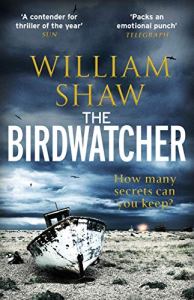
I read The Birdwatcher by William Shaw in the summer and didn’t get round to reviewing it. So, this is a short post summarising what I thought about it.
I enjoyed this book, set in Dungeness on the Kent coast. Sergeant William South is a birdwatcher a methodical and quiet man. Very much a loner, South is not a detective and has always avoided investigating murder. But he does have one friend, a fellow birdwatcher, Bob Rayner and one morning he finds Bob has been brutally beaten to death. DS Alexandra Cupidi, a new CID officer, is leading the investigation and Shaw is reluctantly assigned to her team. Having recently moved from London she relies on William for his knowledge of the area.
Alternating with the present day story is the story of Billy, a thirteen year old living in Northern Ireland during the ‘Troubles’. And hidden within that story is the reason for South’s reluctance to investigate murders. Life becomes uncomfortable for South as Cupidi takes over his house for the base for their investigation and also lands him with the responsibility of entertaining her troubled teenage daughter, Zoe after school – he introduces her to birdwatching.
Shaw is an excellent storyteller and I liked his writing style. This is very much a character-driven mystery as the suspense builds to a climax and his description of Dungeness, with its wind-swept shingle beach close to the Nuclear Power Station and Romney Marsh provides an atmospheric and vivid backdrop. I liked William, and was irritated by Alexandra. So I’m pleased to discover that this is a prequel to Shaw’s DS Alexandra Cupidi series. Currently there are five books, with the sixth to be published next year, so I have plenty more to read.
Sometimes I read books and have no desire to write about them, not because I didn’t enjoy them but because I just want to get on and read the next book. And this summer has been one of those times, so that now I’m finding difficult to remember all the details of the books I’ve read because I didn’t write about them soon after I finished reading. It’s been a strange time during this pandemic and it’s not been easy to concentrate. But I do want to keep a record of my reading and the only way now to catch up is to write some brief notes about each book, beginning with The Luminaries by Eleanor Catton, the winner of the 2013 Booker Prize,
⭐⭐⭐⭐
Rating: 4 out of 5.
I downloaded The Luminaries by Eleanor Catton 3 years ago. I read it in July. It is a long and detailed book, written with such intricate plotting and numerous characters that it bewildered me at times. It’s historical fiction set in New Zealand in the 1860s, during its gold rush and it has everything – gold fever, murder, mystery and a ghost story too.
Blurb from Goodreads:
It is 1866, and young Walter Moody has come to make his fortune upon the New Zealand goldfields. On the stormy night of his arrival, he stumbles across a tense gathering of twelve local men who have met in secret to discuss a series of unexplained events: A wealthy man has vanished, a prostitute has tried to end her life, and an enormous fortune has been discovered in the home of a luckless drunk. Moody is soon drawn into the mystery: a network of fates and fortunes that is as complex and exquisitely ornate as the night sky. Richly evoking a mid-nineteenth-century world of shipping, banking, and gold rush boom and bust, The Luminaries is a brilliantly constructed, fiendishly clever ghost story and a gripping page-turner.
I found the structure a bit of a stumbling block at first as the chapters halve in length from the very long opening chapter to the very short final chapter – so that from feeling overwhelmed by the length and detail of the opening chapters, by the time that I neared the ending I felt distinctly dissatisfied with the brevity of the concluding chapters – the early chapters are too long and the final ones are too short. And the significance of the astronomical headings completely bypassed me.
But if this sounds as though I didn’t enjoy this novel, that is wrong, because I did for the major part of the book. I loved the pictures it builds up of the setting in New Zealand, the frontier town and its residents from the prospectors to the prostitutes, and the obsessive nature of gold mining. And I did become fully absorbed in the story during the week it took me to read. it
These are the other books I read in July and August and have not yet reviewed:
Every Friday Book Beginnings on Friday is hosted by Gillion at Rose City Readerwhere you can share the first sentence (or so) of the book you are reading. You can also share from a book you want to highlight just because it caught your fancy.
If Ronnie Wilson had known, as he woke up, that in a couple of hours he would be dead, he would have planned his day, somewhat differently.
Also every Friday there is The Friday 56, hosted by Freda at Freda’s Voice. *Grab a book, any book. *Turn to Page 56 or 56% on your ereader . If you have to improvise, that is okay. *Find a snippet, short and sweet, but no spoilers!
These are the rules:
Grab a book, any book.
Turn to page 56, or 56% on your eReader. If you have to improvise, that is okay.
Find any sentence (or a few, just don’t spoil it) that grabs you.
Post it.
Add the URL to your post in the link on Freda’s most recent Friday 56 post.
Grab a book, any book.
Turn to page 56, or 56% on your eReader. If you have to improvise, that is okay.
Find any sentence (or a few, just don’t spoil it) that grabs you.
Post it.
Add the URL to your post in the link on Freda’s most recent Friday 56 post.
Page 56:
And another part of his brain was telling him that while one plane hitting the Twin Towers was an accident, two was something else.
Dead Man’s Footsteps is the fourth Roy Grace novel, a fast paced police procedural. There’s a woman in hiding, a skeleton discovered in a storm drain, a man believed to have died in the 9/11 disaster, and a body found in the boot of a car submerged in a river in Australia. And there is the continuing story about Sandy, Grace’s wife, who had disappeared 9 years earlier.
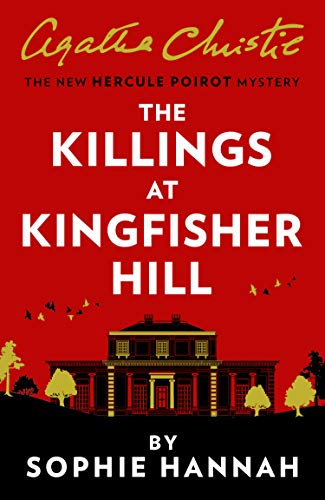
The Killings at Kingfisher Hill is Sophie Hannah’s fourth Hercules Poirot mystery novel and the first one I’ve read. I have read some of Hannah’s books previously. So, I know that she writes complicated and tricky plots. Whilst not attempting to reproduce Christie’s Poirot this book is loosely based on Christie’s books, as Hannah incorporates all the twists and turns, red herrings and misdirections that you find in them. There’s a country house setting, a number of suspects, and a gathering together at the end where Poirot reveals all.
Blurb:
Hercule Poirot is travelling by luxury passenger coach from London to the exclusive Kingfisher Hill estate, where Richard Devonport has summoned him to prove that his fiancée, Helen, is innocent of the murder of his brother, Frank. But there is a strange condition attached to this request: Poirot must conceal his true reason for being there.
The coach is forced to stop when a distressed woman demands to get off, insisting that if she stays in her seat, she will be murdered. Although the rest of the journey passes without anyone being harmed, Poirot’s curiosity is aroused, and his fears are later confirmed when a body is discovered with a macabre note attached…
Could this new murder and the peculiar incident on the coach be clues to solving the mystery of who killed Frank Devonport? And if Helen is innocent, can Poirot find the true culprit in time to save her from the gallows?
I wasn’t expecting a cloned Poirot and Hannah’s Poirot is not Christie’s Poirot. There’s no Captain Hastings in this book, Poirot’s faithful friend. Instead Poirot is accompanied by Inspector Catchpole from Scotland Yard. How on earth he got to be an inspector is beyond me – he comes across as rather dim and stupid and Poirot treats him as such, endlessly explaining things to him and telling him what to do in an officious manner.
There are three strands to the plot – who killed Frank Devonport; who is the hysterical woman with an ‘unfinished face’ who insists she will be murdered if she sits in a specific seat on the coach; and who is the mysterious woman who tells Poirot she is a murderer – what a stupid thing to do when she knows he is a ‘world-renowned detective’? And I wondered what makes Richard so sure that Helen didn’t kill Frank when she had immediately confessed that she had? And I’m still wondering why when he was invited to Kingfisher Hall, an exclusive and private country estate, he went by coach with 30 other passengers – even if it was a ‘luxury’ coach. I just can’t see Poirot travelling by coach!
This all makes the book extremely convoluted, confusing and tangled as well as long-winded. Poirot though works his way methodically through the mess and gets to the truth. However, I found it quite dull and repetitive and rather contrived. So, my rating for this book is 2.5 stars, rounded up to 3.
My thanks to HarperCollins for a review copy via NetGalley.
Faber and Faber Ltd/ 19 March 2020/ 256 pages/ Kindle edition/ 5*
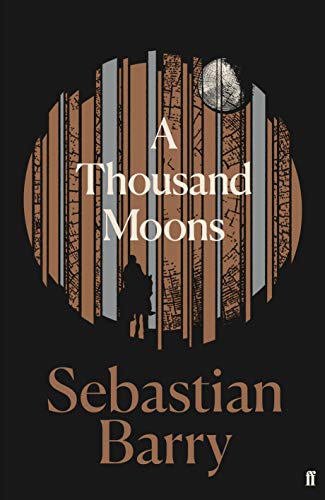
Three years ago I read Sebastian Barry’s Days Without End which has to be one of the best books I’ve read, so I began reading A Thousand Moons with great anticipation of a good read. I wasn’t disappointed and I loved it. It continues the story of Thomas McNulty and John Cole, and Winona, the young Indian girl they had adopted. It really helps if you have read Days Without End first to understand the characters’ history and relationships and how they got to this stage in their lives.
Winona is a young Lakota orphan adopted by former soldiers Thomas McNulty and John Cole. Living with Thomas and John on the farm they work in 1870s Tennessee, she is educated and loved, forging a life for herself beyond the violence and dispossession of her past. But the fragile harmony of her unlikely family unit, in the aftermath of the Civil War, is soon threatened by a further traumatic event, one which Winona struggles to confront, let alone understand.
They are living and working on a farm owned by Lige Magan in Tennessee, about seven miles from a little town called Paris. It is now the 1870s, some years after the end of the Civil War, but the town was still full of rough Union soldiers and vagabonds on every little byway. Dark skin and black hair were enough to get you beaten up – and it wasn’t a crime to beat an Indian. Life wasn’t any better for the other two workers on the farm, black ex-slaves, Rosalee Bouguereau and her brother, Tennyson. These are dangerous times not just in the town but also in the woods outside the town from Zach Petrie’s gang of ‘nightriders’.
Winona remembers little of her early life, beyond seeing in the back of her mind a ‘blackened painting’ of blood and screaming, bayonets, bullets, fire and death. But their lives are full of love at the farm; Winona is loved as a daughter by Thomas and John, who are themselves lovers. She works for lawyer Briscoe as his clerk and ventures into town for supplies, which was where she met Jas Jonski, a young man who declares he wants to marry her. At first she hopes that she might very much like to marry Jas. But, then things go disastrously wrong. First racism rears its ugly head as Jas is white and the Paris townspeople began to talk. As his employer said he thought Jas had gone mad or wicked in some way – ‘to want to go marrying something closer to a monkey than a man’ was how he put it.
And then came the dreadful day when Winona was brutally attacked so badly that she shook for two weeks and something deep within her was shaking a long time after. She can’t remember at first what had actually happened to her, except that she was plied with ‘distillery whiskey’, nor who had carried out the assault. But all the signs pointed to Jas Jonski. Then Tennyson Bouguereau was also attacked, and their peaceful happy life was shattered. Winona set out for revenge. And in so doing she began to remember more about her early life and about her mother, a strong Lakota woman, full of courage and pride.
‘A thousand moons’ was her mother’s deepest measure of time. To her time was ‘a kind of hoop or a circle not a long string and if you walked far enough she said you could find the people still living in the long ago’ – ‘a thousand years all at once’. As she sets off on her quest it is the thought of her mother’s courage that enabled Winona to find her own courage – the ‘courage of a thousand years’.
I just love everything about this book, so beautifully written, rendering the way the characters speak so that I could hear them, and describing the landscape so poetically and lyrically that the scenes unfolded before my eyes; and the characters too, all real people from the American West of the 1870s, as though I was there in their midst. It would make a superb film.
Sebastian Barry was born in Dublin in 1955. His novels and plays have won, among other awards, the Kerry Group Irish Fiction Prize, the Costa Book of the Year award, the Irish Book Awards Best Novel, the Independent Booksellers Prize and the James Tait Black Memorial Prize. He also had two consecutive novels, A Long Long Way (2005) and The Secret Scripture (2008), shortlisted for the MAN Booker Prize. He lives in Wicklow with his wife and three children.
My thanks to Faber and Faber Ltd for my copy of this book, via NetGalley.
I decided to read The Second Sleep because I enjoy Robert Harris’ books and when I saw him on a TV programme talking about this book I thought it sounded interesting and a bit different. I’m glad I did because I thoroughly enjoyed most of it – it was the ending that I felt was rather flat.
I read it at the end of June and I wish I’d written about it straight away – but I didn’t, it got left because I’ve been finding it difficult to concentrate on writing reviews. So, this is one of my catching up posts that can’t do justice to the books. But, I really do think that you should go into reading this book with an open mind, without knowing too much about it.
The blurb certainly made me want to read it:
Dusk is gatheringas a young priest, Christopher Fairfax, rides across a silent land.
It’s a crime to be out after dark, and Fairfax knows he must arrive at his destination – a remote village in the wilds of Exmoor – before night falls and curfew is imposed.
He’s lost and he’s becoming anxious as he slowly picks his way across a countryside strewn with the ancient artefacts of a civilisation that seems to have ended in cataclysm.
What Fairfax cannot know is that, in the days and weeks to come, everything he believes in will be tested to destruction, as he uncovers a secret that is as dangerous as it is terrifying …
As I began reading I had that feeling that this is a book I was going to enjoy – historical fiction, with a mystery to it as well. There is something not quite right about Faifax’s mission as he approaches that remote village in the dark, something menacing and dangerous. The signs are all there – a cataclysmic disaster and a terrifying secret await him when he reaches that village.
But then – all is not as it first appears and I wondered if all this is a smoke screen – what is really going on, is this really the medieval England I’ve read about in history books? And here it is – the nub of the matter – what is going on, where and when are these events taking place? This is an imagined world, a piece of speculative fiction, a bleak and brutal world under a strict authoritarian rule. It’s about progress, or lack of it, about the rule of law, and the power of knowledge.
As I expect in Harris’ novels, apart from that abrupt ending, it is paced well, as more and more information about this strange time and place are revealed the tension rises and rises. The characters became real to me and I could easily visualise all the scenes – in other words I was gripped and involved in the story. So, it was with a sense of an anti-climax that I reached the ending – was that it? I wanted to know more. Even so, I can say that this is a book I thoroughly enjoyed and I think I’d like to re-read it sometime, prepared for the ending.
I was interested in the title, the second sleep, referring to the characters’ sleep pattern of having a period of wakefulness of a couple of hours in the middle of the night and then returning to bed for a second period of sleep. I wondered if that was historical fact – these days it’s not considered to be good to have a broken sleep pattern. It was – I found this BBC article, which explains there is a wealth of historical evidence that humans used to sleep in two distinct chunks and that during the waking period people were quite active – as they are in this book. They often got up, went to the toilet or smoked tobacco and some even visited neighbours. Most people stayed in bed, read, wrote and often prayed. Countless prayer manuals from the late 15th Century offered special prayers for the hours in between sleeps.




 BooksPlease