The Corpse in the Snowman by Nicholas Blake

A Golden Age Mystery
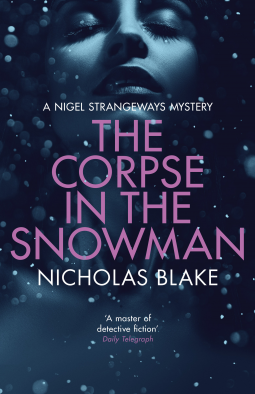
Publication date 2017, Ipso Books, 305p. First published as The Case of the Abominable Snowman in 1941 by Collins UK (The Crime Club)

Review copy from the publishers, Ipso Books, via NetGalley

My rating: 3 stars

I enjoyed The Corpse in the Snowman by Nicholas Blake* a vintage murder mystery with a complicated plot. There’s a death and a body hidden in a snowman that is only discovered when a thaw sets in. It is set in 1940 in an isolated country house with a closed cast of characters and an amateur detective, Nigel Strangeways, helping the police and eventually solving the mystery. There are numerous twists and turns and red herrings before the murderer is revealed.

Easterham Manor in Essex, the home of the Restorick family is cut off from the neighbouring village by snow. Strange things have been going on. On Christmas Eve the family and their guests had gathered in what was said to be a haunted room waiting to see if the ghost would appear when  Scribbles, the family cat  sprang at a corner of the room and repeatedly struck her head against the wall and turned herself into a whirling dervish.

Some weeks later Nigel Strangeways and his wife Georgia  have been invited by Georgia’s cousin, Clarissa to stay at the Manor’s Dower House to investigate the cat incident. The next morning Elizabeth Restorick is found hanged and naked in her room, a hint of a smile playing on her painted lips. Was it suicide, or a murder made to look like suicide? Nigel is convinced it was murder and finds there are plenty of suspects. Elizabeth was a drug addict – so, was she killed by the doctor who was treating her addiction, or by Will Dykes, a romantic novelist in love with Elizabeth, or her friend Miss Ainsley, described as a ‘nondescript sort of fribble‘ -a frivolous or foolish person – or by one of the family?

The title and the first chapter give away a vital element of the plot – the snowman, built by the Restorick children, twins John and Priscilla, melts to reveal a corpse hidden inside. But at this point the identity of the corpse is unknown and as I was reading the rest of the book I kept trying to work out who it could be. It wasn’t too difficult, but it did detract a little from the mystery and I didn’t enjoy it as much as his earlier book Malice in Wonderland.

*Nicholas Blake was the pseudonym of Poet Laureate Cecil Day-Lewis (1904 – 1972), one of the leading British poets of the 1930s. He began writing mysteries in 1935 to supplement his income from poetry and published his first Nigel Strangeways detective novel, A Question of Proof in 1935. The Corpse in the Snowman aka The Case of the Abominable Snowman is the 2nd in the series.

My thanks to the publishers for a review copy via NetGalley.
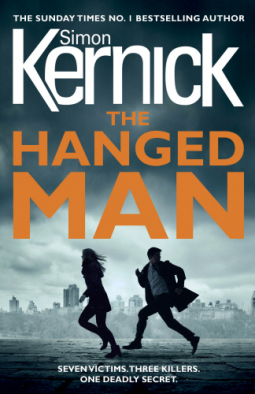
The Hanged Man by Simon Kernick

Expected publication date 16 November 2017

Review copy from the publishers, Random House, Century, via NetGalley

My rating: 2.5 stars

In December 2016 I read the first book in this series The Bone Field by Simon Kernick. It ended on a cliff-hanger in the last sentence (just when you thought it was all over). The Hanged Man is the second book in the series and refers back to events in The Bone Field, but in enough detail so it probably doesn’t matter much if you haven’t read the first book. It’s packed full of action right from the opening chapter as Hugh Manning and his wife are on the run from some very dangerous and violent people who are out to kill them. The police are also looking for Hugh as he is the only witness to what had happened at the farmhouse (dubbed ‘The Bone Field‘) where the bodies of seven women had been found.

Ray Mason, suspended from the police after the events told in The Bone Field, and now exonerated, is back on the case, working with Dan Watts in the National Crime Agency. The main suspects are the Kalamans,  brother and sister, Alastair and Lola Sheridan and a mysterious character called Mr Bone. It’s  told through different characters’ viewpoints, including Ray’s partner, ex-cop and now a PI, Tina Boyd. With so many characters acting as narrator it’s useful that Kernick uses the first person when telling what happens as seen through Ray’s eyes, whereas the rest are told in the third person.

It’s complicated, maybe over-complicated and I found myself racing through it. There are too many characters and sub-plots. Some characters are like cardboard cut-outs, the ‘baddies’ really bad and the ‘goodies’, particularly Ray Mason, who breaks all the rules, not much better. It’s a world full of corruption and secrets, where life is of little account and murder commonplace, and nobody is safe. But because I knew the identities of the criminals from the start there is no mystery – it’s just a matter of who will get to Manning first, the police or the villains and will the villains be caught? There’s climatic ending – but is this really the end …?

My thanks to the publishers for a review copy via NetGalley.

Amazon UK
Amazon US


Birdcage Walk by Helen Dunmore

Birdcage Walk

Blurb:

It is 1792 and Europe is seized by political turmoil and violence. Lizzie Fawkes has grown up in Radical circles where each step of the French Revolution is followed with eager idealism. But she has recently married John Diner Tredevant, a property developer who is heavily invested in Bristol’s housing boom, and he has everything to lose from social upheaval and the prospect of war. Soon his plans for a magnificent terrace built above the two-hundred-foot drop of the Gorge come under threat. Tormented and striving Diner believes that Lizzie’s independent, questioning spirit must be coerced and subdued. She belongs to him: law and custom confirm it, and she must live as he wants—his passion for Lizzie darkening until she finds herself dangerously alone.

Weaving a deeply personal and moving story with a historical moment of critical and complex importance, Birdcage Walk is an unsettling and brilliantly tense drama of public and private violence, resistance and terror from one of our greatest storytellers.

My thoughts:

This is Helen Dunmore’s last book, but the first one of hers I’ve read, although Exposure is sitting in my Kindle waiting to be read. It’s historical fiction, although I think it’s mainly a meditation on death and the legacy we leave behind. And that is most poignant as although at the time she was writing the book Helen Dunmore didn’t know it she was seriously ill and she died earlier this year. She was the author of 12 novels, three books of short stories, numerous books for young adults and children and 11 collections of poetry.

As she wrote in the Afterword:

I suppose that a writer’s creative self must have access to knowledge of which the conscious mind and the emotions are still ignorant, and that a novel written at such a time, under such a growing shadow, cannot help being full of a sharper light, rather as a landscape becomes brilliantly distinct in the last sunlight before a storm. I have rarely felt the existence of characters more clearly, or understood them more deeply – or enjoyed writing about them more.

I was completely absorbed in this book as I read it. It’s written beautifully and poetically, moving slowly as the details of Lizzie and Diner’s marriage come sharply into focus. Birdcage Walk was first published in March 2017, so I’m coming a bit late to reading it and the drawbacks of that are that I’ve seen several reviews and have realised that (like many books) there are mixed opinions about it. I’ve seen criticisms that the pace is too slow, and that much of the plot is given away in the opening chapters. But I felt the pace was just right for the story and the subject matter, and I think the opening chapters set the scene and the theme of the book – that is, that life is transitory, that the individual vanishes, as it were, that no record is left of the lives of many of past generations, despite the effect they had on the lives of their contemporaries.

The Prelude reveals that Birdcage Walk in the present day is a paved path between railings with pleached lime trees arching overhead on their cast-iron frame. But back at the end of the 18th century it was where Diner had started to build a terrace of houses with fantastic views over the Avon Gorge (before the building of the Clifton Suspension Bridge). When war was declared between Britain and France in 1793 this had a disastrous effect and like many builders and developers, Diner’s building work slowed and then ceased as he went bankrupt.

The novel shows the effect of the French Revolution on England through newspaper reports and letters, which I thought was effective casting light on the contemporary scene and showing the horror of what was happening across the Channel. The main focus, however, is on Lizzie. Diner’s repressive and jealous nature comes increasingly to the fore as his building work decreases, and the tension between him and Lizzie soars, accelerated when she discovers what had happened to Lucie, his first wife. The sense of foreboding and menace present in their marriage pervades the whole novel.

Many thanks to Grove Atlantic for providing me with an ARC copy through NetGalley.

My rating: 4*

Amazon UK
Amazon US

The Last Hours by Minette Walters

Blurb:

June, 1348: the Black Death enters England through the port of Melcombe in the county of Dorsetshire. Unprepared for the virulence of the disease, and the speed with which it spreads, the people of the county start to die in their thousands. 

In the estate of Develish, Lady Anne takes control of her people’s future – including the lives of two hundred bonded serfs. Strong, compassionate and resourceful, Lady Anne chooses a bastard slave, Thaddeus Thurkell, to act as her steward. Together, they decide to quarantine Develish by bringing the serfs inside the walls. With this sudden overturning of the accepted social order, where serfs exist only to serve their lords, conflicts soon arise. Ignorant of what is happening in the world outside, they wrestle with themselves, with God and with the terrible uncertainty of their futures. 

Lady Anne’s people fear starvation but they fear the pestilence more. Who amongst them has the courage to leave the security of the walls?

And how safe is anyone in Develish when a dreadful event threatens the uneasy status quo…?

My thoughts:

I liked the historical setting of The Last Hours in 1348 at the time of the Black Death.  It’s well researched, giving vivid descriptions of the setting in an moated manor in the Dorsetshire countryside and of the Black Death, the plague that ravaged the population in 1348. The characters are interesting, showing the clear division between the serfs and the lord of the manor, but I thought some of them were rather one-dimensional, such as Sir Richard of Develish (Lady Anne’s husband) who is portrayed as irredeemably villainous.

I think the book as a whole is overlong and so slow in parts where the description is so detailed that it slows down the action to snail’s pace. It could have been shorter without losing any of the drama.

What really interested me was the medical development and health issues, as people struggled to understand the nature of the plague, what caused it, how it spread so quickly and how could they treat it. And what disappointed me most is the ending – there isn’t one. The last sentence reads: ‘To be continued …

You can watch Minette Walters talking about her book:

My thanks to the publishers and NetGalley for a digital review copy.

Amazon UK

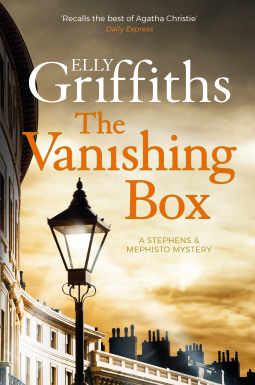
The Vanishing Box by Elly Griffiths

Publication date: 2 November, 2017, Quercus Books

Source: review copy via NetGalley

My rating: 3*

Blurb:

Christmas 1953. Max Mephisto and his daughter Ruby are headlining Brighton Hippodrome, an achievement only slightly marred by the less-than-savoury support act: a tableau show of naked ‘living statues’. This might appear to have nothing in common with DI Edgar Stephens’ investigation into the death of a quiet flowerseller, but if there’s one thing the old comrades have learned it’s that, in Brighton, the line between art and life – and death – is all too easily blurred…

My thoughts:

This is the fourth book in the DI Stephens and Max Mephisto series. Known as the ‘Magic Men’ they had been part of a top-secret espionage unit during the War.

It is set in 1953 at Christmas just a few months after the previous book in the series, The Blood Card and magician Max Mephisto is still sceptical about performing magic on TV with his daughter Ruby in a show called Magician and Daughter. Meanwhile his old friend, DI Edgar Stephens and his team are faced with solving the murder of Lily Burtenshaw, who had been strangled and found in her room tied to a chair, leaning forward and pointing to an empty crate with ‘King Edward Potatoes’ written on the side.

Max and Ruby are performing at the Brighton Hippodrome using a human sized version of the Vanishing Box in their act. The variety show also includes an act called the Living Tableaux, showing scenes from famous paintings or classical statutory, posed by a troupe of showgirls, naked apart from skimpy flesh coloured pants. Two of the showgirls, Betty and Janette, have become friends with Lily and are lodging at the same boarding house, but Edgar wonders if there is another connection between Lily and the Living Tableau? There is something so theatrical about the way the body was posed. Edgar and his two sergeants, Emma Homes and Bob Willis, begin their search for the killer, looking for motives and suspects. Then more murders are discovered and it becomes a desperate hunt to find the killer before he/she strikes again.

I enjoyed this book but for me there is too much focus on the main characters and their relationships. Edgar is engaged to Ruby, although Max is still not too happy about it.  However, his work means he isn’t able to spend much time with her. Meanwhile Emma’s feelings for him are getting stronger and their relationship deepens as she is drawn into deadly danger. Max’s relationship with Mrs M, his landlady in Brighton, is winding down and he is attracted to Florence, another one of the showgirls.

I liked the insight into the 1950s, particularly the theatre life. Illusion and misdirection play a large part – from the acts in the variety show to the murders, and all is not what it seems. The misdirection in the form of several twists and turns threw me off course.The clues are there, if you can but see them, yet I still had little idea who the killer could be until very near the end.

My thanks to Quercus Books and Netgalley for an advance review copy of this book ahead of publication on 2nd November.

Conclave by Robert Harris


Conclave

I really didn’t expect to enjoy Conclave as much as I did, but then I’ve enjoyed all of his books that I’ve read, so I shouldn’t have been surprised. Conclave is about an election of a Pope and I found it absolutely fascinating as the process of the election unfolded. Harris describes the procedure as Cardinal Lomeli, the Dean of the College of Cardinals leads the 118 Cardinals through the voting stages. I felt as though I was a fly on the wall watching it throughout as the Cardinals are locked inside the Sistine Chapel, isolated from contact with the outside world.

There are quite a lot of characters involved, which at first was a bit confusing but soon their personalities became clearer and I began to have my favourites and hope that one of them would be elected. It’s all seen from Lomeli’s point of view, so my thoughts were coloured by what he reveals about each of the main candidates. As they progress through the stages of the election, whittling down the candidates to just a few, lots of secrets, scandals and disagreements are revealed. It becomes increasingly tense with each stage and Lomeli, who had been wanting to retire before the last Pope had died, finds that he too is one of the contenders – most reluctantly:

All he had ever desired in this contest was to be neutral. Neutrality had been the leitmotif of his career. (page 98)

And he realised that, whoever was elected Pope would never be able to wander around the city at will, could never browse in a bookstore or sit outside a café, but would remain a prisoner here! (page 142)

It’s also dramatic as events in the outside world impact on the Conclave.  I was completely engrossed and hoping that my favourite would be elected. Harris has thoroughly researched the subject and seamlessly woven the facts into the novel. He visited the locations used during a Conclave that are permanently closed to the public and interviewed a number of prominent Catholics including a cardinal who had taken part in a Conclave, as well as consulting many reports and books.

There is one point that I found hard to accept (I think that to say any more would spoil the book), although it is something I’d thought might happen but I’d dismissed as rather fanciful. Nevertheless I still think this is a 5* book as I enjoyed it so much – one of the best books I’ve read this year.

  • Format: Kindle Edition
  • File Size: 3282 KB
  • Print Length: 287 pages
  • Page Numbers Source ISBN: 0091959179
  • Publisher: Cornerstone Digital; 01 edition (22 Sept. 2016)
  • Source: I bought it
  • My rating: 5*