Transworld Digital |22 May 2025| 362 pages| e-book|Review book| 5*
Description
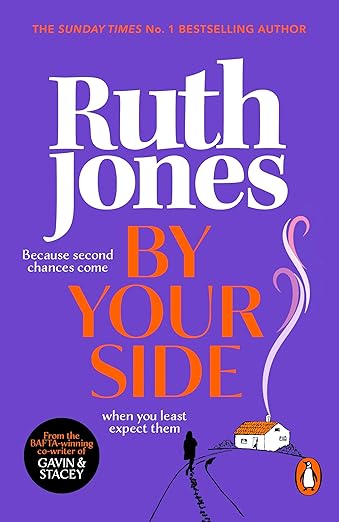
Linda Standish has been a friend to the friendless for the past thirty-three years, in her role at the council’s Unclaimed Heirs Unit. And now she’s looking forward to the joys of an early retirement.
But before she hangs up her lanyard, Linda takes on one last case – that of Levi Norman – a Welshman who made his home on a remote Scottish island for the five years before he died. Linda must visit Storrich to track down Levi’s remaining relatives . . .
What brought Levi here? And who did he leave behind? Obliged to travel (by hearse!) with her arch nemesis, and helped (and hindered…) by the local residents, Linda searches for clues to a life now lost. And in the process unexpectedly makes new friends, and discovers things about herself she never knew.
Bursting with all the heart and humour that has made Ruth’s name as a screenwriter and author, By Your Side is a joyful celebration of friendship, love and community.
I loved the TV series Gavin and Stacey which Ruth Jones co-wrote with James Corden and I loved By Your Side too. It’s the first one of her books that I’ve read but I’ll definitely look out for more to read. It’s an emotionally charged book as Linda Standish takes on her last case for the Council’s Unclaimed Heirs Unit, tracking down Levi Norman’s next of kin.
The story is told mainly from two perspectives, those of Linda and Levi. It’s told with gentle humour and laced with sadness as the details of both Levi’s and Linda’s lives are revealed. I really liked Linda, such a kind, compassionate character, who hides her vulnerability behind a confident exterior. She was looking forward to retirement and had made plans, most of which involved her four-year-old grandson, Zander, who lives with her and his father Struan. So she is devastated when she learns they will be moving to live near his ex-wife and her parents. All this just before Christmas and Linda has to travel to Storrich, the island where Levi died.
All she knows is that for the last five years seventy-five year old Levi had lived alone in Storrich, twenty miles off the mainland of Scotland. He had kept himself to himself and none of the local people knew anything about him. The story moves between their lives as Linda gradually discovers more about Levi, a Welshman, and the circumstances of his life and death.
It’s a well paced story, with wonderful characters, all well defined and believable. As I read it I could so easily hear Ruth Jones’ Welsh accent in Levi’s words. It’s a heartbreaking and poignant story, and at the same time an uplifting story, beautifully written bringing it all to life. It was a joy to read.
Many thanks to the publishers for a review copy via NetGalley.
Boldwood Books|25 April 2025| 378 pages| e-book|Review book| 3*
Summary:
What if another world existed… where the Titanic had never sunk?
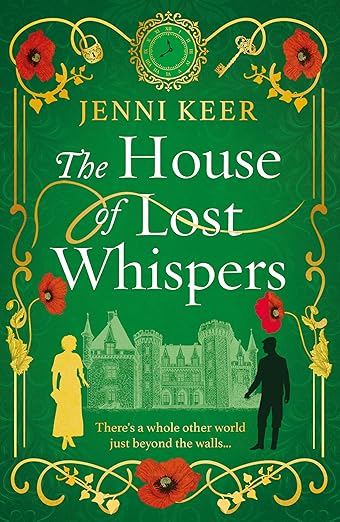
When the ill-fated maiden voyage of the Titanic leaves Olivia Davenport orphaned, she’s sent to live with her guardians, the Fairchilds, in their huge Jacobean mansion. But the Fairchilds have more to worry about than a grieving young girl – with war in Europe imminent and four sons to protect.
Olivia feels alone and friendless. Until she hears a voice from behind the wall in her tower bedroom. A voice from a man called Seth. Convinced he’s merely a product of her grieving imagination, it’s not until after the heartbreak of war that Olivia discovers that he exists in an overlapping world, just a shudder in time away from her own. A world where the Titanic never sank… Where everything since has been just slightly… different.
All Olivia wants is to find a way into his reality. And not just to see the faces of her beloved parents once again. But also to meet Seth. Who might just be the love of her life…
I enjoyed reading Jenni Keer’s debut novel, The Hopes and Dreams of Lucy Baker several years ago and thought I’d like to read more of her books. This one is her eighth book, so I missed the books in between. I don’t often read romance or fantasy novels but The House of Lost Whispers has both elements and it’s also historical fiction set before, during and after the First World War. I preferred the historical element, especially the middle section about the War. But I also enjoyed reading the fantasy element about the anomaly in the magnetic field surrounding the earth causing vibrations, disrupting the fabric of space and time. This resulted in the formation of a duplicate earth, one parallel with our world, in which the Titanic did not sink on 12th April 1912.
I think this is a very interesting and possibly original idea, exploring what life would have been like for Olivia and her family if the Titanic had not been sunk. The book also explores loss and grief, family life, friendship and romantic relationships, as well as the devastating and horrific events of the First World War. As described in the blurb Olivia in the ‘real’ world and Seth in the parallel world can hear each other through the wall in her tower bedroom (the whispers), but despite their efforts they cannot break through to meet.
It’s beautifully descriptive, bringing the settings to life and there is also a murder mystery to solve. My only criticisms are that at times I did get a bit confused about Seth’s character and his parallel in the ‘real’ world, and I could have done without the love scenes (too descriptive in places). As I read on I was wondering how it would end and maybe Jenni Keer wondered too because the conclusion seemed rushed and rather neatly sown up. I was a bit disappointed, although I can’t imagine how else it could have ended. But overall it kept me reading, wanting to know what would happen next.
Many thanks to the publishers for a review copy via NetGalley.
Every Friday Book Beginnings on Friday is hosted by Gillion at Rose City Readerwhere you can share the first sentence (or so) of the book you are reading. You can also share from a book you want to highlight just because it caught your fancy.
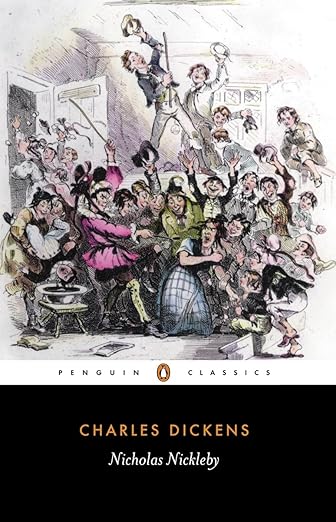
I’m getting to the end of reading Bleak House by Charles Dickens, so I’m looking around to find a book to read to replace it. One of the books I might read is Nicholas Nickleby by Charles Dickens.
Nicholas Nickleby is the third novel by Charles Dickens, originally published as a serial from 1838 to 1839 and published in book form in 1839. I know very little about and don’t remember watching any of the adaptations on TV or film.
The book begins:
There once lived, in a sequestered part of the county of Devonshire, one Godfrey Nickleby: a worthy gentleman, who, taking it into his head rather late in life that he must get married, and not being young enough or rich enough to aspire to the hand of a lady of fortune, had wedded an old flame out of mere attachment, who in her turn had taken him for the same reason. Thus two people who cannot afford to play cards for money, sometimes sit down to a quiet game for love.
Also every Friday there is The Friday 56, hosted by Freda at Freda’s Voice, but she is taking a break and Anne at My Head is Full of Books has taken on hosting duties in her absence. You grab a book and turn to page 56 (or 56% of an eBook), find one or more interesting sentences (no spoilers), and post them.
On page 56
‘Stop,’ cried Nicholas hurriedly; pray hear me. This is the grossest and wildest delusion, the completest and most signal mistake, that ever human being laboured under, or committed. I have scarcely seen the young lady half-a-dozen times, but if I had seen her sixty times, or am destined to see her sixty thousand thousand, it would be, and will be, precisely the same.
Description from Goodreads:
When Nicholas Nickleby is left penniless after his father’s death, he appeals to his wealthy uncle to help him find work and to protect his mother and sister. But Ralph Nickleby proves both hard-hearted and unscrupulous, and Nicholas finds himself forced to make his own way in the world. His adventures gave Dickens the opportunity to portray an extraordinary gallery of rogues and eccentrics, such as Wackford Squeers, the tyrannical headmaster of Dotheboys Hall, a school for unwanted boys; the slow-witted orphan Smike, rescued by Nicholas; and the gloriously theatrical Mr. and Mrs. Crummles and their daughter, the ‘infant phenomenon’. Like many of Dickens’s novels, Nicholas Nickleby is characterised by his outrage at cruelty and social injustice, but it is also a flamboyantly exuberant work, revealing his comic genius at its most unerring.
The 1952 Club hosted this week by Karen at Kaggsy’s Bookish Ramblings and Simon from Stuck in a Book blogs ends today. The idea is simply to read and review books published in 1952.
The Singing Sands: An Inspector Alan Grant Mystery by Scottish author Josephine Tey is the second book I’ve read for this event. It was the last book she wrote whilst she was terminally ill and was found among her papers when she died. It was published posthumously a few months after her death in 1952. Josephine Tey was a pseudonym of Elizabeth Mackintosh. Josephine was her mother’s first name and Tey the surname of an English Grandmother.
My copy is an e-book, published in 2023 by Evergreen Publishers.
This is the 6th and last Alan Grant Mystery. It’s a book you have to read slowly to fully take in all the details. Although the mystery is interesting and puzzling, what I enjoyed the most about this book is Tey’s descriptive writing, her observations, and her characterisation, particularly that of Alan Grant and the analysis of his mind. Her characters are believable, well developed and unforgettable.
It begins as Grant is travelling on an overnight train to the Scottish Highlands on sick leave from Scotland Yard. He planned to spend his time fishing whilst staying with his cousin, Laura who is married to his old school friend Tommy. He is suffering from claustrophobia and it seems as though he has had some sort of mental breakdown. His journey was fraught with anxiety:
Alan Grant, watching the lights of the yard float past beyond the steamed-up window and listening to the gentle sound of the wheels clicking over the points, was glad because the end of the journey was the end of a night’s suffering. Grant has spent the night trying not to open the door into the corridor. Wide awake, he had lain on his expensive pallet and sweated by the hour. He had sweated not because the compartment was too hot – the air-conditioning worked to a marvel – but because (O Misery! O Shame! O Mortification!) the compartment represented A Small Enclosed Space. … But to the initiate, the sad and haunted initiate, it was A Small Enclosed Space.
Overwork, the doctor called it. (pages 1 – 2)
As he left the train at the terminus he passed compartment B7 and saw the sleeping car attendant shaking the passenger trying to rouse him, assuming he was drunk. Although the compartment reeked of whisky, Grant realised he was dead and left the attendant to deal with it, thinking he’d had enough of dead men – they were not his responsibility. But automatically, he had picked up a newspaper and added it to the other papers he had under his arm. And later on he realised it had belonged to the dead man, on which he had scribbled a cryptic poem:
The beasts that talk, The streams that stand, The stones that walk, The singing sand, That guard the way To Paradise.
From then on Grant’s state of mind was in turmoil and he was intrigued by this poem and wondered what it meant. Surely he thought there were actually some singing sands somewhere. It totally occupied his mind and a large part of the book is about his thoughts as he became obsessed with finding out who the man was, why he was travelling to Scotland, what was his state of mind that he had ended up drunk on the train. He had a curious feeling of identification with the man in B7 in the sense of having an identity of interests. He wondered if B7 was also ‘wrestling with demons.’
The inquest concluded that the man’s death was an accidental death. He hadn’t been drunk just tipsy. He had a skull injury that was consistent with a backwards fall against the wash basin. But Grant still wanted to know more and continued to investigate.
He visited various places trying to find the singing sands and advertised in newspapers asking anyone who recognised the words of the verse to contact him. He visited Cladda (a fictional place) after Wee Archie, told him there were singing sands there. The singing sands do actually exist – they’re in the Isle of Eigg. I found this description and a photograph on the Walkhighlands website: In dry weather the grains of quartzite make a rasping or singing sound as you walk on them or when the wind scuffs them.
It’s definitely a book of its time and Tey has used a lot of slang and idioms that aren’t so recognisable today. One of her observations I found interesting was the subject of Scottish nationalism and the relationship between Scotland and England and I wondered if maybe she was expressing her own thoughts on the subject, but bearing in mind that this book is fiction, I can’t be sure. Referring to the 1707 Act of Union between England and Scotland Grant says: Scotland stepped thankfully on to England’s band-wagon and fell heir to all its benefits. Colonies, Shakespeare, soap, solvency and so forth.
Wee Archie, was supposedly a Scottish nationalist but was in fact an Englishman who called himself Gilleasbuig Mac- a’-Bruithainn and wielded a shepherd’s crook two feet taller than himself that ‘no shepherd would be found dead with’, and wore a kilt that ‘no Highlander would dream of being found alive in‘. Talking to Grant Archie spoke of ‘England’s iniquities to a captive and helpless Scotland. Anything less captive or helpless than the Scotland he (ie Grant) had known would be difficult to imagine.) Laura told Grant Archie didn’t have ‘a drop of Scottish blood in him. his father came from Liverpool and his mother was an O’Hanrahan.’ Grant remarked ‘Odd how all the most bigoted patriots are Auslanders,’ adding ‘I don’t think he’ll get far with those xenophobes, the Gaels.’ (page 23)
The Singing Sands is not a typical Agatha Christie puzzle type of crime fiction, but more an analysis of the characters’ emotional and psychological obsessions to be found in novels such as those of Ruth Rendell and Patricia Highsmith. I really enjoyed it.
I now want to know more about her and her life and I’ve found this biography that I’d like to read – Josephine Tey: A Life by Jennifer Morag Henderson.

It would be an excellent match for he was rich, and she was handsome” Sense & Sensibility, 1811
When Elinor and Marianne Dashwood’s father dies, they with their mother and younger sister are forced to leave their family home Norland Park and take up residence in a small rented cottage. There they experience love, romance, and heartbreak. Marianne falling madly in love with the dashing Mr. Willoughby while Elinor silently hides her own broken heart from those nearest to her. A story of very mixed fortunes in love.
Jane Austen is one of my favourite authors and I’ve read all of her novels, beginning with Pride and Prejudice, which I’ve reread over the years many times, and watched TV and film adaptations. This year is the 250th anniversary of Jane Austen’s birth, so this is an ideal time to reread some of her books and I’m joining Brona at This Reading Life in her Austen 2025 project to reread her books, along with the Classics Club’s Sync Read (or readalong).
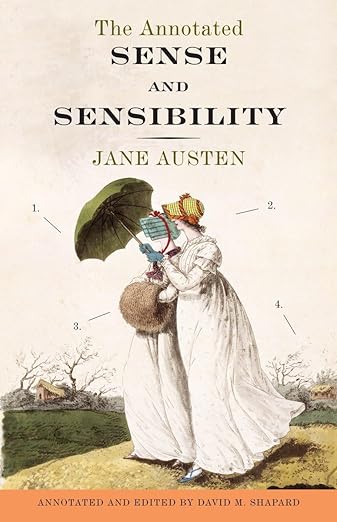
I first read Sense and Sensibility when I was at school but have never reread it. This time I read the annotated edition, edited by David M Shapard that gives explanations of historical context, citations from Austen’s life, letters, and other writings, definitions and clarifications, literary comments and analysis. There are multiple maps of England and London, an introduction, a bibliography, and a detailed chronology of events with more than 100 informative illustrations. I found I already knew some of the information given in some of these notes but others enhanced my understanding of the period. I particularly liked all the illustrations and the details about the cultural context, the social customs and conventions of the period.
Sense and Sensibility was Jane Austen’s first published novel. There was an earlier version, called Elinor and Marianne, that Jane Austen wrote in the form of letters probably in 1795 when she was nineteen. She returned to it after she began First Impressions, which later became Pride and Prejudice. Towards the end of 1797 she returned to Elinor and Marianne, modifying it and changing its name to Sense and Sensibility. It wasn’t until 1810 that she finished the book and it was published in 1811.
It focuses on the two Dashwood sisters, Elinor (aged 19) and Marianne (aged 16), who have contrasting temperaments. On the surface Elinor, the older sister represents sense or reason while Marianne represents sensibility or emotion. However as the story develops they both exhibit varying aspects of each characteristic. Marianne comes over at first as a rather silly teenager, emotional and passionate, who openly expresses her likes and dislikes, letting everyone know how much she is grieving for her father and how much she loves her new friend she met whilst living at Barton Cottage, John Willoughby. Elinor, however, is more restrained and discrete, controlling her emotions and reactions, even though she has strong feelings for her sister-in-law’s brother, Edward. Later in the book, however, both sisters display both ‘sense’ and ‘sensibility’, which I think makes them more believable as characters.
I’m not going into any more detail about the plot. A lot happens, there are misunderstandings and many secrets are exposed. I liked the way the story moves between the two sisters switching from one to another. At first I did feel more sympathetic towards Elinor, but Marianne did grow on me by the end of the book. They both grew in complexity as Jane Austen developed their characters. There are many other characters, some foolish or absurd providing comic relief and others who are nasty and selfish and cause both Elinor and Marianne much anguish and heartache.
I thoroughly enjoyed the book!
And now I’m looking forward to re-reading Pride and Prejudice.
I read 4 books in January, half the number I used to read. My reading has slowed down considerably over the last 2 years and I no longer write in much detail about them. But this year I’m hoping to get back to something more like normal and I’m aiming to write at least a paragraph or more about each of the books I’ve read each month.
There’s a Reason for Everything(my review) by E R Punshon 4* – I began this book in December and finished reading it in early January. It was first published in 1945 and I read the e-book published by Dean Street Press. It’s the 21st in the Bobby Owen mystery series, in which Bobby has recently been promoted from Inspector to Deputy Chief Constable of Wychshire, a complicated novel with murders, a missing painting allegedly by Vermeer, dodgy fine art dealers and an abandoned country mansion called Nonpareil.
I was perplexed for quite some time until I began to see what was behind the bewildering confusion in Punshon’s narrative. I think this is a cleverly constructed plot, with ingenious puzzles to piece together before all the answers are revealed. I was quite pleased to find out at the end that I’d worked out one of the clues correctly.
Sense and Sensibility by Jane Austen 5* – It’s about the three Dashwood sisters and their widowed mother as they leave their family estate at Norland Park after their father’s death when their half-brother John inherited the estate. This year is the 250th anniversary of Jane Austen’s birth, so this is an ideal time to reread some of her books and I’m joining Brona at This Reading Life in her Austen 2025 project to reread her books, along with the Classics Club’s Sync Read (or readalong).
I read the annotated edition, edited by David M Shapard that gives Explanations of historical context, Citations from Austen’s life, letters, and other writings, Definitions and clarifications, Literary comments and analysis, Multiple maps of England and London, An introduction, bibliography, and detailed chronology of events and More than 100 informative illustrations.
I’ll write more about this book in a later post.
Signal Moon by Kate Quinn 5* – a short story. I’m not a big fan of short stories, often finding them too short and wanting to know more. But this one is good and it fascinated me. It’s sci-fi involving a type of time-travelling, a mix of historical fiction, links to the code breakers at Bletchley Park and WW2. I loved it. It is, of course, impossible, set in two time periods, 1943 during World War 2 and 2023, but I didn’t have to work hard to believe in it. Kate Quinn’s narrative just drew me in. In 1943, Lily Baines is a Wren working for a “Y” station, picking up signals from German intelligence that were then sent to Bletchley Park for translation. Then she picks up a signal apparently from 2023 – it’s a cry for help from Matt Jackson a young US officer. It’s about an American ship that is taking heavy fire in the North Atlantic. Together Lily and Matt have to work out how to help each other: Matt to convince her that the war she’s fighting can still be won, and Lily to help him stave off the war to come.
Kate Quinn wrote this story to feature the information about the Y stations that she had discovered whilst researching Bletchley Park and hadn’t included in The Rose Code.
Keir Starmer: the Biography by Tom Baldwin 3.5* A Times Book of the Year; A Telegraph Book of the Year; A Daily Mail Book of the Year; A Waterstones Book of the Year
Dsecription from Amazon:
This authoritative – but not authorised – biography by Tom Baldwin provides answers by drawing deeply on many hours of interviews with Prime Minister himself, as well as unprecedented access to members of his family, his oldest friends and closest colleagues.Together, they tell an unexpectedly intimate story filled with feelings of grief and love that has driven him on more than any rigid ideology or loyalty to a particular faction.
The book tracks Starmer’s emergence from a troubled small town background and rebellious youth, through a storied legal career as a human rights barrister and the country’s chief prosecutor, to becoming an MP relatively late in life.Baldwin provides a vivid and compelling account of how this untypical politician then rose to be leader of his party in succession to Jeremy Corbyn, then transformed it with a ruthless rapidity that has enraged opponents from the left just as much as it has bewildered those on the right.
Above all, this is a book that should be read by anyone who wants to understand how someone who has too often been underestimated or dismissed as dull, now intends to change Britain.
My thoughts
This book was published in February 2024, five months before the General Election. I decided to watch the televised debates between him and Rishi Sunak, the then Prime Minister, and thought Starmer looked uncomfortable in most of them. All I knew about him was that he was the former Director of Public Prosecutions, and, as he often said in interviews, that growing up he lived in a pebble-dashed semi , that his ‘dad was a toolmaker‘ and his ‘mother was a nurse.’ So I hoped that Baldwin’s book would tell me more. Baldwin writes:
Starmer is a private man who has chosen to place himself in the white light of public scrutiny, while showing a determination that is itself exceptional to maintain a semblance of normality … often appearing uncomfortable at being a politician at all. (page xi)
He also describes him as ‘someone who is both extraordinary and very ordinary‘ (page xii). The biography is divided into five parts :
each of which begins by sketching a moment since he became a politician when this tension is most apparent. All of them also include descriptions of sometimes traumatic episodes that have wrenched him back to real life and away from the febrile – often fake – world of Westminster politics. (page xii).
In the first three parts he covers Starmer’s childhood and schooldays, his time as a student at Leeds University, where he was awarded a first-class law degree, and then at St Edmund Hall at Oxford University where he gained a postgraduate Bachelor of Civil Law degree. He then worked as a trainee barrister in London, eventually transitioning from a human rights lawyer into the country’s chief prosecutor. The fourth part describes how he became an MP, a member of the shadow cabinet and Leader of the Labour Party. The fifth part examines the leadership, before assessing what kind of prime minister he would make.
One friend said:
He’ll just turn up at the pub and be a totally normal and genuinely good bloke. But his public persona is very different, I almost don’t recognise him when I see him on TV.
And another said:
There is this enormous gap between Keir the human being and Keir the politician. At Jonny [Cooper]’s funeral, I saw the real one letting himself go – in the best way – to share his grief with his friends. But, when I watched him on TV at the party conference, he had seemed to be almost a different person, holding back and distant, almost wooden compared to the generous, humorous and empathetic man I’ve known for twenty years. (page 323)
It seems to me that he is a conscientious person who believes in working hard and playing hard. He is resilient and driven. He believes in fairness and social justice, putting the country before the party, a serious, clever man, who wants to get things done and change the country for the better.