Operation Pax by Michael Innes

When people disappear, one hears talk of Milton Porcorum

Operation Pax

Agora Books|3 May 2018|384 pages|e-book|Review copy|4*

Operation Pax by Michael Innes, an Inspector Appleby mystery, was originally published in 1951, and in the United States as The Paper Thunderbolt.

I enjoyed Operation Pax much more than I expected I would when I began reading it. Almost the first third of the book is about a petty thief, Alfred Routh, an unpleasant little man, who for much of the time is confused and bewildered by his own thoughts and fears, which plunge him into utter panic. As his fears spiral into a engulfing and terrifying fantasy, he finds himself in the little village of Milton Porcorum and here is where his nightmare really begins. A tall man with square shoulders ushers him within the walls of Milton Manor, a most bizarre place where Routh fears for his life. A place where experiments are carried out in a sequence of laboratories and dangerous animals are kept in enclosures surrounding the house. A place with a mysterious and unnamed ‘Director’ who masterminds the whole operation.

After that rather surreal opening the action moves to Oxford and a rather more normal atmosphere – but strange and disturbing things are happening there too. An undergraduate, Geoffrey Ourglass, has disappeared and both his uncle, a university don and his fiancée, Jane, Sir John Appleby’s younger sister are concerned for his safety. Jane enlists her brother’s help to find Geoffrey – and so begins an adventure involving the dons of St Bede’s college, a group of boisterous children on bikes, European refugees as well as Appleby, Jane and her taxi-driver, Roger Remnant. It takes us from St Bede’s college into the depths of the Bodleian Library, on the trail of clues, around Oxford and out into the surrounding countryside in a thrilling chase against time to rescue Geoffrey. There are strange phone calls and most mysterious of all a formula written on a scrap of paper that threatens the safety of the whole world – it must be found and destroyed.

I loved a number of things about this book – the descriptions of the dons and their ‘erudite’ conversations, the setting in Oxford and particularly in the Bodleian library is brilliant, and the children are lively, argumentative and entertaining, providing comic relief.  It is pure escapism with an incredibly unbelievable plot and strange eccentric characters that wormed their way into my mind and made it a book I just had to finish. Once it got going it is fast- paced and it kept me guessing about the identity of the mastermind behind the threat to mankind – I was completely wrong!

The Author

Michael Innes is the pseudonym of John Innes Mackintosh Stewart (1906 – 1994), a British scholar and novelist. He was born near Edinburgh, the son of a Scottish professor, and attended Edinburgh Academy, then Oriel College, Oxford where he won the Matthew Arnold Memorial Prize in 1939 and honours in English. He was a Lecturer, then a Professor in English at different universities, including Adelaide University in South Australia from 1935 to 1945. He became an Oxford fellow in 1949 and finished his academic career in 1973 as a Student (Fellow) at Christ Church Oxford.

As Michael Innes, he published numerous mystery novels and short story collections, most featuring the Scotland Yard detective John Appleby.

My thanks to Agora Books for an e-book review copy via NetGalley

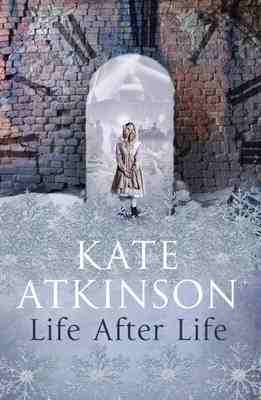
My Friday Post: Life After Life by Kate Atkinson

Book Beginnings Button

Every Friday Book Beginnings on Friday is hosted by Gillion at Rose City Reader where you can share the first sentence (or so) of the book you are reading, along with your initial thoughts about the sentence, impressions of the book, or anything else the opener inspires.

Life After Life by Kate Atkinson is one of my TBRs  and is one of the books on my 20 Books of Summer list. It’s about Ursula Todd as she lives through the turbulent events of the last century again and again. I bought it 5 years ago and have started reading it more than once, but have never finished it. But ever since I read and loved A God in Ruins about Ursula’s brother Teddy, I have been meaning to pick it up again.

Life after life


November 1930

A fug of tobacco smoke and damp clammy air hit her as she entered the café. She had come in from the rain and drops of water still trembled like delicate dew on the fur coats of some of the women inside. A regiment of white-aproned waiters rushed around at tempo, serving the needs of the Münchner at leisure – coffee, cake and gossip.

So far, this time round I think this may be the right time for me to read this book.

Also every Friday there is The Friday 56, hosted by Freda at Freda’s Voice.

30879-friday2b56These are the rules:

  1. Grab a book, any book.
  2. Turn to page 56, or 56% on your eReader. If you have to improvise, that is okay.
  3. Find any sentence (or a few, just don’t spoil it) that grabs you.
  4. Post it.
  5. Add the URL to your post in the link on Freda’s most recent Friday 56 post.

Page 56:

On the way home, Pamela carried both baby rabbits in her pinafore, holding it out proudly in front of her like Bridget with a tea-tray.

‘Look at you,’ Hugh said when they walked wearily through the garden gate. ‘Golden and kissed by the sun. You look like real countrywomen.’

‘More red than gold, I’m afraid,’ Sylvie said ruefully.

Blurb:

What if you had the chance to live your life again and again, until you finally got it right?

During a snowstorm in England in 1910, a baby is born and dies before she can take her first breath.

During a snowstorm in England in 1910, the same baby is born and lives to tell the tale.

What if there were second chances? And third chances? In fact an infinite number of chances to live your life? Would you eventually be able to save the world from its own inevitable destiny? And would you even want to?

Life After Life follows Ursula Todd as she lives through the turbulent events of the last century again and again. With wit and compassion, Kate Atkinson finds warmth even in life’s bleakest moments, and shows an extraordinary ability to evoke the past. Here she is at her most profound and inventive, in a novel that celebrates the best and worst of ourselves.

If you have read this book I’d love to know what you think about it. And if you haven’t, would you keep reading?

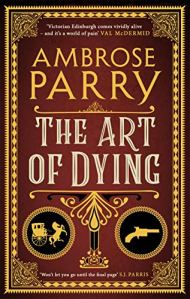
The Art of Dying by Ambrose Parry

Art of Dying

Canongate Books|29 August 2019|416 pages|e-book|Review copy|5*

A Note From the Publisher


Many thanks to Canongate Books for an e-book review copy via NetGalley.

A-Z of TBRs: E-Books: G, H and I

Once again I’ve been looking at all the forgotten e-books on my Kindle and this is the third instalment of my A – Z of my e-book TBRs – with a little ‘taster’ from each. These are all fiction.

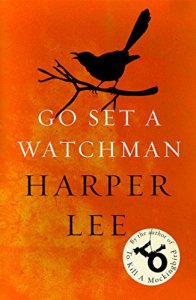
Go set a watchman

G is for  Go Set a Watchman by Harper Lee, on my Kindle since November 2014. I remembered I hadn’t read this when recently I got a copy of Furious Hours: Murder, Fraud and the Last Trial of Harper Lee by Casey Cep, in which she tells the story Harper Lee wanted to write and why she couldn’t after the success of To Kill a Mockingbird (which I loved).

Atticus Finch shot his left cuff, then cautiously pushed it back. One-forty. On some days he wore two watches: he wore two this day, an ancient watch and chain his children had cut their teeth on, and a wristwatch. The former was habit, the latter used to tell time when he could not move his fingers enough to dig in his watchpocket. He had been a big man before age and arthritis reduced him to medium size. He was seventy-two last month, but Jean Louise always thought of him hovering somewhere in his middle fifties – she could not remember him being any younger, and he seemed to grow no older. (page 17)

Go Set a Watchman is set two decades after To Kill a Mockingbird and is the story of Jean- Louise Finch – ‘Scout’ – as she returns home from New York City to visit her ageing father, Atticus. Her homecoming turns bittersweet when she learns disturbing truths about her close-knit family, the town and the people dearest to her. Memories from her childhood flood back, and her values and assumptions are thrown into doubt.

I’d dithered over whether to read this and then forgot I had it!

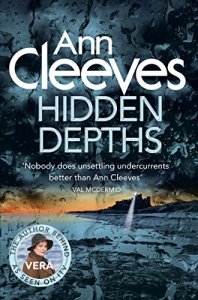
Hidden depths

is for Hidden Depths by Ann Cleeves, on my Kindle since March 2014. It’s the 3rd book in her Vera Stanhope series, which I have been reading totally out of order. It doesn’t spoil my enjoyment, especially as over the years I’ve been watching the TV series and I think I remember seeing the TV version of Hidden Depths years ago.

It’s hot summer on the Northumberland coast and Julie Armstrong arrives home from a night out to find her son strangled, laid out in a bath of water and covered with wild flowers. In the following extract, his mother, Julie is talking to Vera:

Julie was sitting on the floor, her knees pulled up to her chin, her arms clasped around them. She looked up at the detective, who was still watching and waiting. It came to her suddenly that this woman, large and solid like rock, might once have known tragedy herself. That was why she could sit there without making those stupid sympathetic noises Sal and the doctor had made. This woman knew that nothing she could say would make it better. But Julie didn’t care about the detective’s sadness and the thought was fleeting. She went back to her story. (15).

Ann Cleeves is one of my favourite authors and I really should have read this book when I first bought it.

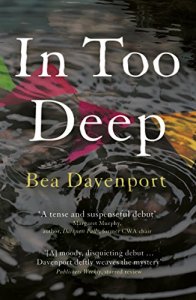
In too deep

I is for In Too Deep by Bea Davenport, on my Kindle since July 2013. I had totally forgotten that I had this book. Five years ago Maura fled life in Dowerby and took on a new identity, desperately trying to piece her life back together and escape the dark clouds that plagued her past. But then a reporter tracked her down, and persuaded her to tell her story, putting her own life in danger once again.

So then as I just get out the shower and the door buzzer sounds, I catch my breath. No-one ever comes to see me, and I don’t receive post unless it’s junk mail. When a man’s voice asks for Maura Wood, I feel a grip on my heart, clenching like a fist. I am frozen with fear.

I shiver involuntarily, goose bumps covering my body like guilty fingers. I haven’t heard that name for almost five years. I pull my towel tighter around me. ‘No, sorry. There’s no-one here of that name.’

But the voice has picked up on my pause. ‘I was told Maura Wood lives here. Is that not you, Maura?’

‘No, I’m not Maura. I’ve told you. Who is that?’

(7%)

Bea Davenport is the writing name of former print and broadcast journalist Barbara Henderson. In Too Deep, was her first crime/suspense novel. Bea spent many years as a newspaper reporter and latterly seventeen years as a senior broadcast journalist with the BBC in the north-east of England. Originally from Tyneside, she lives in Berwick-upon-Tweed, not very far away from me. I haven’t read any of her books.

If you’ve read any of these books please let me know what you think. Or if you haven’t read them do they tempt you?

The Family Upstairs by Lisa Jewell

 A house with the darkest of secrets.

Family upstairs

Random House UK Cornerstone|8 August 2019|464 pages|e-book |Review copy|5*

The Adventures of Maud West, Lady Detective by Susannah Stepleton

Narrative Non-Fiction 4*

Adventures of Maud West

The Adventures of Maud West, Lady Detective, by Susannah Stapleton and published by Picador, is subtitled ‘Secrets and Lies in the Golden Age of Crime‘. With a title like that I thought it sounded just the sort of book I would like – and I did.

It is so intriguing – was Maud West really who she said she was? Susannah Stapleton discovered that she really did exist and was indeed a private investigator with her own detective agency, based in London in the early part of the twentieth century, from 1905 onwards.  The book gives plenty of extracts from Maud West’s own accounts of her investigations under Golden Age crime fiction titles such as The Lady Vanishes, The Body in the Library, and They Do It With Mirrors, for example. But these accounts had me wondering just what was the truth and what was fiction. They are so incredible! Maud was truly an amazing person – a master of disguise, equally able to pass herself off as a man, or a fortune teller, or a parlour maid, and skilled with a revolver, able to face down blackmailers. There are photographs of Maud – at work in her office and in a number of disguises. And it was not just in Britain – she worked all over the place including  New York, Cape Town, Brazil, and Jakarta. 

But what makes the book so good, and what kept me glued to the pages are the details of how Susannah Stapleton went about her research, included within the main narrative of her book. I haven’t come across this before – usually  an author lists the sources used at the end – and there is just such a list (a very long and comprehensive list) at the end of this book.  I was more intrigued by Stapleton’s own methods of research into finding out about Maud than I was by Maud herself.

 I also loved all the details of the changing society in which Maud lived – the role of women in the struggle for equality, details of the living and working conditions and of the crimes that real life private detectives investigated – divorces, missing persons, adultery and theft.

It more than lived up to my expectations, but I am still wondering did she really do what she said she did? Whatever the truth she was a complex woman and a very private one at that.

Many thanks to the publishers, Picador, for my review copy via NetGalley.