Latest Additions at BooksPlease

BB bks Aug 2019

Yesterday I brought this little pile of books home from Barter Books in Alnwick, my favourite bookshop.

From top to bottom they are:

Waverley by Sir Walter Scott, his first novel, first published anonymously in 1814. It is set in the Jacobite Rebellion of 1745 and tells the story of Edward Waverley, an idealistic daydreamer whose loyalty to his regiment is threatened when they are sent to the Scottish Highlands. I’m inspired to read this by a recent visit to Abbotsford, Scott’s home in the Scottish Borders.

The Locked Room by Maj Sjowall and Per Wahloo, the eighth in the Martin Beck series – once more I’ve plunged into a series without reading the earlier books. But it appears that shouldn’t matter as each book is focused on one particular case. I’m not sure what to expect as the blurb on the back says it transforms the police force into the police farce.

The Daughters of Cain by Colin Dexter, the eleventh Inspector Morse mystery. Morse must solve two related murders — a problem complicated by a plethora of suspects and by his attraction to one of the possible killers. I’ve read several of the Morse books, so far, so I was pleased to find another one I haven’t read.

Strangers on a Train by Patricia Highsmith, a book I’ve wanted to read for a long time. Hitchcock’s 1951 film is based on this book. Guy Haines and Charles Anthony Bruno meet on a train. Bruno manipulates Guy into swapping murders with him. “Some people are better off dead,” Bruno remarks, “like your wife and my father, for instance.” 

Sleeping Beauties by Jo Spain, the third Inspector Tom Reynolds novel set in Dublin and the surrounding areas. I’ve read the fourth book and have copies of the first two to read, so I was pleased to find this book on the shelves. Five bodies are found in woodland and a young woman is missing. A search is under way – can she be found before she too is killed?

The Headhunters by Peter Lovesey, second book DCI Hen Mallin Investigation (I haven’t read the first!)  Mallin and her team investigate the discovery of a dead body, found on the beach at Selsey. Gemma had joked about murdering her boss – and now her boss is missing.

The Vault by Peter Lovesey. I’ve read one of his Peter Diamond books before and enjoyed it. This book is the sixth book in the Peter Diamond series. A skeletal hand is unearthed in the vault under the Pump Room in Bath, England, near the site where Mary Shelley wrote Frankenstein. Then a skull is excavated. The bones came from different corpses, and one is modern.

Hotel on the Corner of Bitter and Sweet by Jamie Ford. I’d borrowed a copy of this from the library but hadn’t finished it when I had to return it. In 1986, The Panama Hotel in Seattle has been boarded up for decades, but now the new owner has made a startling discovery in the basement: personal belongings stored away by Japanese families sent to internment camps during the Second World War. The novel goes back and forth between 1986 and World War Two

The Music Shop by Rachel Joyce, a book I’ve often wondered about reading. As the title reveals it is about Frank’s music shop, full of records, vinyl, that is. It’s set in 1988 and is a story about love and about how important music is in our lives. When Ilse asks Frank to teach her about music she is not what she seems and for Frank it opens up old wounds from his past.

Operation Pax by Michael Innes

When people disappear, one hears talk of Milton Porcorum

Operation Pax

Agora Books|3 May 2018|384 pages|e-book|Review copy|4*

Operation Pax by Michael Innes, an Inspector Appleby mystery, was originally published in 1951, and in the United States as The Paper Thunderbolt.

I enjoyed Operation Pax much more than I expected I would when I began reading it. Almost the first third of the book is about a petty thief, Alfred Routh, an unpleasant little man, who for much of the time is confused and bewildered by his own thoughts and fears, which plunge him into utter panic. As his fears spiral into a engulfing and terrifying fantasy, he finds himself in the little village of Milton Porcorum and here is where his nightmare really begins. A tall man with square shoulders ushers him within the walls of Milton Manor, a most bizarre place where Routh fears for his life. A place where experiments are carried out in a sequence of laboratories and dangerous animals are kept in enclosures surrounding the house. A place with a mysterious and unnamed ‘Director’ who masterminds the whole operation.

After that rather surreal opening the action moves to Oxford and a rather more normal atmosphere – but strange and disturbing things are happening there too. An undergraduate, Geoffrey Ourglass, has disappeared and both his uncle, a university don and his fiancée, Jane, Sir John Appleby’s younger sister are concerned for his safety. Jane enlists her brother’s help to find Geoffrey – and so begins an adventure involving the dons of St Bede’s college, a group of boisterous children on bikes, European refugees as well as Appleby, Jane and her taxi-driver, Roger Remnant. It takes us from St Bede’s college into the depths of the Bodleian Library, on the trail of clues, around Oxford and out into the surrounding countryside in a thrilling chase against time to rescue Geoffrey. There are strange phone calls and most mysterious of all a formula written on a scrap of paper that threatens the safety of the whole world – it must be found and destroyed.

I loved a number of things about this book – the descriptions of the dons and their ‘erudite’ conversations, the setting in Oxford and particularly in the Bodleian library is brilliant, and the children are lively, argumentative and entertaining, providing comic relief.  It is pure escapism with an incredibly unbelievable plot and strange eccentric characters that wormed their way into my mind and made it a book I just had to finish. Once it got going it is fast- paced and it kept me guessing about the identity of the mastermind behind the threat to mankind – I was completely wrong!

The Author

Michael Innes is the pseudonym of John Innes Mackintosh Stewart (1906 – 1994), a British scholar and novelist. He was born near Edinburgh, the son of a Scottish professor, and attended Edinburgh Academy, then Oriel College, Oxford where he won the Matthew Arnold Memorial Prize in 1939 and honours in English. He was a Lecturer, then a Professor in English at different universities, including Adelaide University in South Australia from 1935 to 1945. He became an Oxford fellow in 1949 and finished his academic career in 1973 as a Student (Fellow) at Christ Church Oxford.

As Michael Innes, he published numerous mystery novels and short story collections, most featuring the Scotland Yard detective John Appleby.

My thanks to Agora Books for an e-book review copy via NetGalley

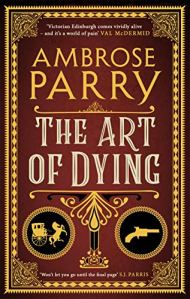
The Art of Dying by Ambrose Parry

Art of Dying

Canongate Books|29 August 2019|416 pages|e-book|Review copy|5*

A Note From the Publisher


Many thanks to Canongate Books for an e-book review copy via NetGalley.

A-Z of TBRs: E-Books: G, H and I

Once again I’ve been looking at all the forgotten e-books on my Kindle and this is the third instalment of my A – Z of my e-book TBRs – with a little ‘taster’ from each. These are all fiction.

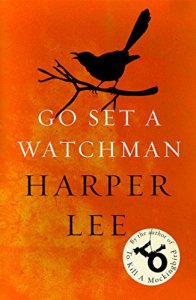
Go set a watchman

G is for  Go Set a Watchman by Harper Lee, on my Kindle since November 2014. I remembered I hadn’t read this when recently I got a copy of Furious Hours: Murder, Fraud and the Last Trial of Harper Lee by Casey Cep, in which she tells the story Harper Lee wanted to write and why she couldn’t after the success of To Kill a Mockingbird (which I loved).

Atticus Finch shot his left cuff, then cautiously pushed it back. One-forty. On some days he wore two watches: he wore two this day, an ancient watch and chain his children had cut their teeth on, and a wristwatch. The former was habit, the latter used to tell time when he could not move his fingers enough to dig in his watchpocket. He had been a big man before age and arthritis reduced him to medium size. He was seventy-two last month, but Jean Louise always thought of him hovering somewhere in his middle fifties – she could not remember him being any younger, and he seemed to grow no older. (page 17)

Go Set a Watchman is set two decades after To Kill a Mockingbird and is the story of Jean- Louise Finch – ‘Scout’ – as she returns home from New York City to visit her ageing father, Atticus. Her homecoming turns bittersweet when she learns disturbing truths about her close-knit family, the town and the people dearest to her. Memories from her childhood flood back, and her values and assumptions are thrown into doubt.

I’d dithered over whether to read this and then forgot I had it!

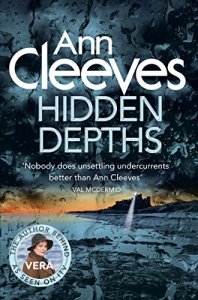
Hidden depths

is for Hidden Depths by Ann Cleeves, on my Kindle since March 2014. It’s the 3rd book in her Vera Stanhope series, which I have been reading totally out of order. It doesn’t spoil my enjoyment, especially as over the years I’ve been watching the TV series and I think I remember seeing the TV version of Hidden Depths years ago.

It’s hot summer on the Northumberland coast and Julie Armstrong arrives home from a night out to find her son strangled, laid out in a bath of water and covered with wild flowers. In the following extract, his mother, Julie is talking to Vera:

Julie was sitting on the floor, her knees pulled up to her chin, her arms clasped around them. She looked up at the detective, who was still watching and waiting. It came to her suddenly that this woman, large and solid like rock, might once have known tragedy herself. That was why she could sit there without making those stupid sympathetic noises Sal and the doctor had made. This woman knew that nothing she could say would make it better. But Julie didn’t care about the detective’s sadness and the thought was fleeting. She went back to her story. (15).

Ann Cleeves is one of my favourite authors and I really should have read this book when I first bought it.

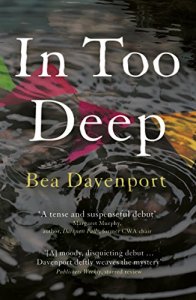
In too deep

I is for In Too Deep by Bea Davenport, on my Kindle since July 2013. I had totally forgotten that I had this book. Five years ago Maura fled life in Dowerby and took on a new identity, desperately trying to piece her life back together and escape the dark clouds that plagued her past. But then a reporter tracked her down, and persuaded her to tell her story, putting her own life in danger once again.

So then as I just get out the shower and the door buzzer sounds, I catch my breath. No-one ever comes to see me, and I don’t receive post unless it’s junk mail. When a man’s voice asks for Maura Wood, I feel a grip on my heart, clenching like a fist. I am frozen with fear.

I shiver involuntarily, goose bumps covering my body like guilty fingers. I haven’t heard that name for almost five years. I pull my towel tighter around me. ‘No, sorry. There’s no-one here of that name.’

But the voice has picked up on my pause. ‘I was told Maura Wood lives here. Is that not you, Maura?’

‘No, I’m not Maura. I’ve told you. Who is that?’

(7%)

Bea Davenport is the writing name of former print and broadcast journalist Barbara Henderson. In Too Deep, was her first crime/suspense novel. Bea spent many years as a newspaper reporter and latterly seventeen years as a senior broadcast journalist with the BBC in the north-east of England. Originally from Tyneside, she lives in Berwick-upon-Tweed, not very far away from me. I haven’t read any of her books.

If you’ve read any of these books please let me know what you think. Or if you haven’t read them do they tempt you?

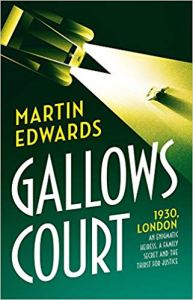
Gallows Court by Martin Edwards

Gallows Court by Martin Edwards has been on my radar since it was published last year. And I’ve read plenty of reviews full of praise for it, so my  expectations were high as I began reading, especially as I’ve thoroughly enjoyed all of his other books that I’ve read, particularly his Lake District murder mysteries. Gallows Court, set in 1930s London, is a change of direction for Martin Edwards, born out of his fascination with that period in history and his love of Golden Age detective fiction. It is the first in a series; the next book, due out in March next year, is to be Mortmain Hall, a sequel to Gallows Court. 

Gallows Court

Blurb (Amazon):

London, 1930.
A headless corpse; an apparent suicide in a locked room; a man burned alive during an illusionist’s show in front of thousands of people. Scotland Yard is baffled by the sequence of ghastly murders unfolding across the city and at the centre of it all is mysterious heiress Rachel Savernake. Daughter of a grand judge, Rachel is as glamorous as she is elusive.

Jacob Flint, a tenacious young journalist eager to cover the gruesome crimes, is drawn into Rachel’s glittering world of wealth and power. But as the body count continues to rise, Jacob is convinced Rachel is harbouring a dark secret and he soon becomes part of a dangerous game that could leave him dancing at the end of the hangman’s rope if he pursues the truth.

My thoughts:

I think this must be the twistiest book I’ve read – there are twists and turns galore, my head was spinning as I read the first 100 pages. I had to stop when I realised that apart from Rachel and Jacob I had little idea of who anybody was, what they were doing and how they interacted. There are so many characters and the story is told in short sections moving rapidly from scene to scene and from one viewpoint to another. I had to go right back to the beginning – start again and this time concentrate much more on who was who and what they were up to.

Jacob Flint is constant throughout, but Rachel Savernack is not. I was never sure about her, what to think of her, or who she really was because it’s obvious that there is more to her than first meets the eye. The pressure never lets up – there is always tension and suspicion about who is telling the truth, and who is not who they appear to be. You just cannot believe anything as it’s full of illusions and tricks to baffle and mislead. Towards the end the fog lifted and I began to suspect the truth. It is certainly a challenging book and if you enjoy an intricately plotted murder mystery with plenty of suspense and intrigue then this is the book for you.

  • Hardcover: 416 pages
  • Publisher: Head of Zeus (6 Sept. 2018)
  • Language: English
  • ISBN-10: 1788546075
  • ISBN-13: 978-1788546072
  • Source: Library book
  • Martin Edwards website.
  • My rating: 4*

Reading challenge: The Virtual Mount TBR

Clouds of Witness by Dorothy L Sayers

Clouds of Witness by Dorothy L Sayers, is the second Lord Peter Wimsey book and one of my 20 Books of Summer. It was first published in 1926. My copy was reprinted in 1984 and I bought it secondhand four years ago.

Clouds of witness Sayers

From the back cover of my paperback:

A man is found shot, and the Duke of Denver is charged with his murder. Naturally, it is his brother, Lord Peter Wimsey, who is called in to investigate the crime. This is a family affair, for the murdered man was the fiancé of the sister of Denver and Wimsey.

Why, then, does the Duke refuse to co-operate with the investigation? Is he really guilty, or is he covering up for someone? Why is Wimsey attacked by an enraged farmer on the lonely moors? Why is an attempt made on his life in a Soho street?

My thoughts:

So many questions! And as I read even more popped into my mind – why did Lady Mary, Wimsey’s sister, leave the house at 3am on the morning of the murder? Why is she feigning illness? Whose footprints are those near the body of Denis Cathcourt (the murdered man)? What is the significance of the diamond cat charm with eyes of bright emeralds? And why won’t the Duke defend himself? Then there are the bloodstains and signs that the body had been dragged to the door of the conservatory where it was found, leading into the nearby thicket. If the Duke didn’t kill Cathcart who did and why?

The evidence against the Duke is circumstantial. So, Wimsey has his work cut out to prove his innocence and save him from the death penalty. Together with his friend, Inspector Charles Parker (who is in love with Lady Mary), and Bunter, his manservant, they look for clues and interview the family’s guests on the night of the murder. There are several strands to the story and minor characters who all manage to confuse the mystery.

There are some memorable scenes, such as Wimsey and Bunter’s escapade on the moors when they attempted to get to Grider’s Hole. The fog had come on them suddenly, blotting out their surroundings and they had no idea what direction to take. They strode forward gingerly unable to distinguish uphill from downhill – then Wimsey tripped into a bog, and found himself sinking up to his thighs. As well as struggling in the foggy bog, Wimsey also got shot and rather dramatically flew to New York in pursuit of evidence, a dangerous journey in a fragile plane as a deep depression was crossing the Atlantic bringing storms with heavy rain and sleet, rising to a gale as the plane lurched from gust to gust.

The trial scene in the House of Lords is fascinating:

The historic trial of the Duke of Denver for murder opened as soon as Parliament reassembled after the Christmas vacation. The papers had leaderettes on ‘Trial by his Peers’, by a Woman Barrister, and ‘The Privilege of Peers: should it be abolished?’ by a Student of History. The Evening Banner got into trouble for contempt by publishing an article entitled ‘The Silken Rope’ (by an Antiquarian), which was deemed to be prejudicial, and the Daily Trumpet – the Labour organ – inquired sarcastically why, when a peer was tried, the fun of seeing the show should be reserved to the few influential persons who could wangle tickets for the Royal Gallery. (pages 217 -218)

Clouds of Witness is a book of its time, there is much banter, wit and humour, and plenty of snobbery of all types clearly showing the class distinctions between the working and upper classes. It is a clever story, well told, with colourful characters and I liked the details it gives about Wimsey’s family as I’ve been reading these books totally out of order.

All in all, I enjoyed it – 4*.

Reading challenges: 20 Books of Summer, Calendar of Crime, and Mount TBR challenge 2019