Top Five Tuesday: Books with Colours in the Title

Top 5 Tuesday was created by Shanah at Bionic Book Worm, and it is now being hosted by Meeghan at Meeghan Reads. You can see the Top 5 Tuesday topics for the whole of 2025 here

Today the topic is Books with Colours in the Title.

Blonde by Joyce Carol Oates, a work of fiction, not a biography of Marilyn Monroe. I had to keep reminding myself of that as I was reading, because it was so easy to believe in the characters. it’s a tragic story, intense and shocking in parts. It begins with a Prologue – 3 August 1962 with Death hurtling along towards 12305 Fifth Helena Drive, Brentwood, California. It then follows Norma Jeane Baker’s life in chronological sections from The Child 1932 – 1938 to The Afterlife 1959 – 1962. It switches from one narrator to the next, and from third person to first person perspective throughout. It’s brutal, tender and both lyrical and fragmented

Blue Heaven by C J Box. The action takes place over four days in North Idaho one spring. It’s a story about two children, Annie and William who decide to go fishing without telling their mother, Monica, and witness a murder in the woods. One of the killers sees them and they run for their lives. It’s written in a style that appeals to me – straightforward storytelling, with good descriptions of locality and characters, secondly characters that are both likeable and downright nasty, but not caricatures, and finally the ending was what I hoped, and also dreaded it would be.

 The Crimson Rooms by Katharine McMahon, set in London in 1924, with Britain still coming to terms with the aftermath of the First World War. Evelyn Gifford, one of the few pioneer female lawyers, takes on the case of Leah Marchant, who wants to get back her children who had been taken into care. She was accused of trying to kidnap her own baby. It’s early days for women to be accepted as lawyers and Evelyn struggles to defend Leah who distrusts her and wants Daniel Breen, Evelyn’s boss to defend her. It clearly shows the prejudice these women had to overcome just to qualify as lawyers, never mind the difficulties of persuading law firms to employ them and clients to accept them.

Gray Mountain by John Grisham, a book that puts the big American coal companies under the microscope, companies that are  ruining the environment by strip-mining in the Appalachian mountains. I was amazed to read the details – clear-felling the forests, scalping the earth and then blasting away the mountain tops to get at the coal. All the trees, topsoil and rocks are then dumped into the valleys, wiping out the vegetation, wildlife and streams. Gray Mountain is one of the mountains destroyed in this way.

The Man in the Brown Suit by Agatha Christie. The novel is a mix of murder mystery and international crime organised by an arch-villain known as ‘the Colonel’, involving violence (but not graphic) and suspense. Anne Beddingfield saw a man fall to his death on the live rails at Hyde Park tube station. He had a terrified look on his face and turning round Anne sees a man in a brown suit, who quickly becomes The Man in the Brown Suit both to her and the newspapers. A second death follows, this time a young woman, found strangled at Mill House, the home of Sir Eustace Pedler, MP. She was thought to be a foreigner. Anne decides to investigate and the trail takes her on board the Kilmorden Castle sailing to Cape Town. As usual there are a number of suspects and Anne has to work out who she can trust and who to believe

The Death of Shame by Ambrose Parry

Canongate Books| 5 Jun. 2025| 427 pages| e-book| Review copy| 5*

Description:

1854, Edinburgh.
Respectable public faces hide sordid private sins.

Apprentice Sarah Fisher is helping to fund Dr Will Raven’s emerging medical practice in exchange for being secretly trained as a medic, should the rules barring women ever change. Sarah needs no instruction in the inequalities that beset her gender, but even she has her eyes opened to a darker reality when a relative seeks her help in searching for her missing daughter. Annabelle Banks was promised a situation in a prestigious household, but there has been no word from her since she left home, and the agency that arranged her position says she never appeared.

Sarah’s inquiries lead her to reforming campaigners trying to publicise the plight of the hundreds of girls ensnared in Edinburgh’s houses of assignation. Sarah learns how young women are lured, deceived, trafficked and raped, leaving them ruined in the eyes of a society obsessed with moral purity, and where virginity is prized as a lucrative commodity.
Drawing upon real historical events, The Death of Shame takes Raven and Sarah into a treacherous labyrinth of exploitation, corruption, high-level complicity and Victorian-style revenge porn.

Ambrose Parry is the pseudonym of crime fiction author, Chris Brookmyre and Marisa Haetzman, a consultant anaesthetist. The combination of a crime fiction writer and an anaesthetist works excellently in Ambrose Parry’s novels. The research into the history of medicine is extensive, making this book a combination of historical fact and fiction, a tale of murder and medical matters, with the social scene, historical and medical facts slotting perfectly into an intricate murder mystery. 

The Death of Shame by Ambrose Parry is the 5th and final Raven and Fisher book. Dr Will Raven is no longer working with Dr Simpson (a real historical person, renowned for his discovery of chloroform) but is setting up his own medical practice with the financial assistance of Sarah Fisher. Sarah, who began working as a housemaid for Dr Simpson, then as a nurse, has ambitions to train as a doctor, something rarely possible for women in her position. So secretly Will is training her as his apprentice to become a doctor.

It’s set in 1854, when Will and his wife, Eugenie have two children, as she is struggling to bond with her children suffering from postnatal depression. The book begins with the death of her father, himself an eminent doctor with a wealthy practice. It appears he committed suicide but Eugenie can’t accept that and asks Will to investigate. Meanwhile Sarah has also been asked to investigate the disappearance of her young niece who has disappeared after leaving home to start a job in Edinburgh.

The plot is complicated and although you could read this as a standalone book as there is some background to what has happened in the earlier books, I really think it’s better to have read them – and they are well worth reading. Will and Sarah’s separate investigations take them into dark and desperate places dealing with blackmail, murder, suicide, abortion, rape, female exploitation, and prostitution. The position of women and girls in society and the dangers they faced are centre stage.

I always enjoy reading the Historical Notes at the end of the Raven and Fisher books and this one is no exception. It gives the factual background and sources that Ambrose Parry used and information about the real life people who are included in the book as well as Dr Simpson, such as Henry Littlejohn, Edinburgh’s police surgeon who served as Medical Officer for Health and medical advisor to the Crown, and Emily Blackwell, one of the pioneers of women in medicine.

This is a great ending to the series but I’d like to think this is not the end of their stories – I’d love to read more about them! In the meantime there is a short story, The Apple Falls Not Far by Ambrose Parry, a digital exclusive short story from the world of Raven and Fisher to read – more about that in a later post.

Six Degrees of Separation from  The Safekeep by Yael Van Der Wouden to Cat Among the Pigeons

It’s time again for Six Degrees of Separation, a monthly link-up hosted by Kate at Books Are My Favourite and Best. Each month a book is chosen as a starting point and linked to six other books to form a chain. A book doesn’t need to be connected to all the other books on the list, only to the one next to it in the chain.

This month we start with  The Safekeep by Yael Van Der Wouden, the Women’s Prize Winner for Fiction 2025. This is Amazon’s description:

It is fifteen years after the Second World War, and Isabel has built herself a solitary life of discipline and strict routine in her late mother’s country home, with not a fork or a word out of place. But all is upended when her brother Louis delivers his graceless new girlfriend, Eva, at Isabel’s doorstep – as a guest, there to stay for the season…

In the sweltering heat of summer, Isabel’s desperate need for control reaches boiling point. What happens between the two women leads to a revelation which threatens to unravel all she has ever known.

First link: I really didn’t know how to start this chain, until I remembered that the cover of Agnes Grey by Anne Bronte also has doors, although they are closed doors as opposed to the open doors on The Safekeep. This is a novel about a young woman, a governess and her experiences working for two families in Victorian England. Agnes is the younger daughter of an impoverished clergyman. Her parents had married against her mother’s family’s wishes and when their fortune was wrecked Agnes determines to help out by working as a governess. It gives a very clear picture of the life of a governess, with all its loneliness, frustrations, insecurities and depressions.

I am staying with doors for the second link, although they are not shown not on the cover, but in the title, with Doors Open by Ian Rankin. This was the first Rankin book wrote after he retired John Rebus in Exit Music. It’s about an art heist – planned by Mike Mackenzie, a self-made man, rich and bored with life, Robert Gissing, the head of Edinburgh’s College of Art and Allan Crickshank a banker with a passion for art that he cannot afford to buy on his salary. Between them they devise a plan to steal some of the most valuable paintings from the National Gallery of Scotland on the day that buildings normally closed to the public throw open their doors and invite them in.

My Third link is Exit Music by Ian Rankin, the 17th Inspector Rebus novel.  The Crime Thriller Award for  Author of the Year 2008 was awarded to Ian Rankin for this book. It marked the end of an era as Rebus came to the end of his career. At the beginning of this book Rebus is 10 days from his retirement and is anxious to tie up all the loose ends in his current cases, trying to get DS Siobhan Clarke interested in them. So when the body of the dissident Russian poet Alexander Todorov is found dead this is Rebus’s last case. He throws himself into the investigation, desperate to take his mind off the end of his career.

Which brings me rather obviously to my fourth link Exit Lines by Reginald Hill, a Dalziel and Pascoe murder mystery. In this one there are three elderly victims who all died violently one cold and storm-racked November night. A drunken Dalziel is a suspect in one as it seems he was driving the car that hit an elderly cyclist. The plot is intricate, with each separate case being linked together. I thought it was an excellent crime fiction novel which kept me guessing until the end.

My Fifth link is also about a murder that took place during a stormy night. It’s The Redemption of Alexander Seaton by Shona MacLean. Alexander Seaton is a schoolteacher in Banff. It’s set in 17th century Scotland, mainly in the town of Banff, where on a stormy night Patrick Davidson, the local apothecary’s assistant collapses in the street. The next morning he is found dead in the school house of Alexander Seaton, a failed minister, now a schoolteacher

My sixth link is about another schoolteacher, this time a headmistress, Miss Bulstrode in Agatha Christie’s novel Cat Among the Pigeons. She is the head of an exclusive and expensive girls’ school, Meadowbank, in England, said to be based on her daughter Rosalind’s school. Like Miss Brodie, Miss Bulstrode has built a reputation for excellence. But disaster strikes when two of the teachers, Miss Springer, the new Games Mistress and the History and German teacher, Miss Vansittart are murdered. Rather late in the day Hercules Poirot is called in to investigate their deaths.

My chain is mostly made up of two of my favourite genres, historical fiction and crime fiction. It went from a governess to a headmistress with murder mysteries in between. What is in your chain?

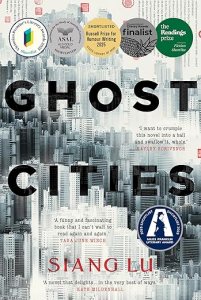
Next month (September 6, 2025), we’ll start with the winner of the 2025 Miles Franklin Literary AwardGhost Cities by Siang Lu.

One Dark Night by Hannah Richell

Simon & Schuster UK| 3 July 2025| 432 pages| e-book| Review copy| 5*

ELLIE
When the body of a young woman is discovered in the woods the morning after Halloween, arranged with ritualistic precision, teenager Ellie has more reason than most to be afraid …

RACHEL
 As both Ellie’s mum and the local school counsellor, Rachel, must grapple with the terror gripping the community, a tough job that’s made even harder when she realises her daughter is keeping secrets …

BEN
Police detective Ben Chase is desperate to solve the murder, but with his daughter Ellie struggling and the noose circling ever tighter, can he catch the killer before they strike again?

My thoughts:

I requested One Dark Night by Hannah Richell from NetGalley because I thought I’d like it when I read the blurb. And I was right! I haven’t read any of Richell’s books before but I’m certainly going to try some of her six earlier novels, all of them stand-alone stories. On her website she describes her work as suspenseful novels about families and friends tangled in secrets and lies. I’m drawn to buildings that creak with stories, to landscapes that shape the characters moving through them, and to the rich and often complex relationships between mothers, daughters and sisters.

One Dark Night is her sixth book, which she says is inspired by a real-life stretch of woodland and an old stone folly near where I currently live, supposedly one of the most haunted spots in England. Yes, it is very creepy.

I loved the spooky, tense atmosphere and as soon as I started reading it I knew I was going to enjoy this book. The settings are vividly described, the characters come across as real people, and the plot is amazing, multi- layered, with plenty of suspects for the murder and numerous twists and turns to throw me off the scent. For quite a while you don’t even know the name of the victim, who was found in the woods, called ‘Sally in the Wood’. It’s a police procedural centred on Ellie, a pupil at the private school, where her mother Rachel works as the school counsellor and her father, Ben, a detective sergeant who is on the investigation team. Ellie is struggling, having just started at the school and also because her parents are newly divorced.

In the Acknowledgements the author explains that the novel is loosely inspired by the place and stories of Sally in the Wood and the nearby stone folly, but the surroundings are drawn purely from her imagination. She had the idea for the novel after her daughter took part in a Girl Guides night hike to the stone folly above the spooky wood.

I found more information about the origins of the road, Sally in the Wood, on the Wiltshire & Swindon History Centre. The road forms a curved section of the A363 road on the Somerset-Wiltshire border that cuts through dense woodland near Bath – a perfect place to set a murder mystery. There are a few explanations for the name – one being that a girl called Sally was murdered in the woods or imprisoned in nearby Brown’s Folly, or that she was an actual road accident victim. It has a reputation of being an eerie place, where ‘no birds sing’, so you never know…

I loved it, one of the best books I’ve read so far this year!

Top 5 Tuesday:Top 5 books with sizes in the titles

Top 5 Tuesday was created by Shanah at Bionic Book Worm, and it is now being hosted by Meeghan at Meeghan Reads. You can see the Top 5 Tuesday topics for the whole of 2025 here

Today the topic is top 5 books with sizes in the titles.

These are all books I’ve read with links to my posts on them:

Small Things Like These by Claire Keegan. This won the 2022 Orwell Prize for Political Fiction, an award for outstanding novels and collections of short stories, first published in the UK or Ireland, that illuminate major social and political themes, present or past, through the art of narrative. It also won the Kerry Group Irish Novel of the Year 2022.

It is 1985 in a small Irish town. During the weeks leading up to Christmas, Bill Furlong, a coal merchant and family man faces into his busiest season. Early one morning, while delivering an order to the local convent, Bill makes a discovery which forces him to confront both his past and the complicit silences of a town controlled by the church.

Claire Keegan’s style of writing is a refreshing change from so many of the long and complicated books I so often read. It is precise, focused, and beautifully written bringing her characters to life – these are real, ordinary people, living ordinary lives in 1980s Ireland. And the detail is there too in all the particulars of everyday life – it packs a lot into its pages. 

Our Longest Days: A People’s History of the Second World War by the writers of Mass Observation. For six years the people of Britain endured bombs and the threat of invasion, and more than 140,000 civilians were killed or seriously wounded. Men and women were called to serve in the armed forces in record numbers, and everyone experienced air raids and rationing. In these terrible times, volunteers of almost every age, class and occupation wrote diaries for the “Mass Observation” project, which was set up in the 1930s to collect the voices of ordinary men and women.

Using many diaries that have never been published before, this book tells the story of the war – the military conflict, and, mainly, life on the home front – through these voices. Through it all, people carry on living their lives, falling in love, longing for a good meal, complaining about office colleagues or mourning allotment potatoes destroyed by a bomb.

An Awfully Big Adventure by Beryl Bainbridge. First published in 1989 and shortlisted for the Booker Prize, this is set in 1950, as a Liverpool repertory theatre company are rehearsing its Christmas production of Peter Pan. The story centres around Stella, a teenager and an aspiring actress who has been taken on as the assistant stage manager.

It’s semi-autobiographical based on Beryl Bainbridge’s own experience as an assistant stage manager in a Liverpool theatre. On the face of it this is a straight forward story of the theatre company but underneath it’s packed with emotion, pathos and drama. And it’s firmly grounded in a grim post-war 1950s England, food rationing still in operation and bombed buildings still in ruins overgrown with weeds.

The title is taken from Peter Pan, the play about the boy who never grew up, whose attitude to death was ‘To die will be an awfully big adventure.’ Bainbridge’s use of Peter Pan emphasises the themes of reality versus imagination, the loss of childhood innocence, and the quest for love.

Dirty Little Secrets by Jo Spain, a psychological thriller, set in Withered Vale, a small, gated community of just seven houses, outside the small village of Marwood in Wicklow in Ireland. On the surface it is a perfect place where the wealthy live their  privileged lives and keep themselves to themselves – until a cloud of bluebottles stream out of the chimney of number 4 and Olive Collins’ dead and disintegrating body is discovered inside. She had been dead for three months and none of the neighbours had bothered to find out why she hadn’t been seen all that time. But someone must have known what had happened to her – the question being who?

The Shortest Day by Colm Toibin, a short story about the mythical past, about the strange carvings found on certain stones, about archaeology, and about the unknown customs and rituals of our ancient past. It’s storytelling at its best – a tale of wonder and mystery.

Professor O’Kelly is writing notes about Newgrange, also called Bru na Boinne, a circular mound with a retaining wall that had a narrow passageway leading into a vaulted central chamber. There are spirals and diamond shaped designs cut into some of the stones both inside the chamber itself and outside the entrance to the passageway. It’s a burial chamber, a prehistoric monument in County Meath in Ireland, that was built around 3200 BC – older than Stonehenge and the Egyptian pyramids. It’s ringed by a stone circle, stones brought from the Mournes and Wicklow Mountains.

Meanwhile deep within the chamber there were whispers among the dead that the professor was coming again. They are concerned that he would discover the secret of the light penetrating the chamber on the winter solstice – the shortest day of the year. Some of the local inhabitants know of the secret but they never talk about it, except in whispers between themselves. When he arrives they put up a number of obstacles to prevent him from entering the chamber.

Six Degrees of Separation from Theory and Practice to The Night Hawks

It’s time again for Six Degrees of Separation, a monthly link-up hosted by Kate at Books Are My Favourite and Best. Each month a book is chosen as a starting point and linked to six other books to form a chain. A book doesn’t need to be connected to all the other books on the list, only to the one next to it in the chain.

This month we start with Theory & Practice by Michelle de Kretser, the winner of the Stella Prize for Fiction 2025, praised for its innovative structure and exploration of young love, jealousy, and literary inheritance.  I’ve not read it but it looks interesting. This is Amazon’s description:

It’s 1986, and ‘beautiful, radical ideas’ are in the air. A young woman arrives in Melbourne to research the novels of Virginia Woolf. In bohemian St Kilda, she meets artists, activists, students – and Kit. He claims to be in a ‘deconstructed’ relationship, and they become lovers. Meanwhile, a dismaying discovery throws her work on ‘the Woolfmother’ into disarray.

Theory & Practice is a mesmerising account of desire and jealousy, truth and shame. It makes and unmakes fiction as we read, expanding our notion of what a novel can contain. Michelle de Kretser, one of Australia’s most celebrated writers, bends fiction, essay and memoir into exhilarating new shapes to uncover what happens when life smashes through the boundaries of art..

I’ve read some of Virginia Woolf’s books, including my first link: Orlando, a fictionalised biography of Vita Sackville-West, based on her life. It tells the tale of an extraordinary individual who lives through centuries of English history, first as a man, then as a woman. This is a book steeped in history showing how the passage of time had changed both the landscape and climate of England along with its society. There are many vivid passages – such as her description of the ‘Great Frost’ of 1608, when the Thames was frozen for six weeks and Frost Fairs were held on the ice.

Second link: There have been several Frost Fairs over the centuries. Another one in 1669 is described in Edward Marston’s The Frost Fair, the fourth in the Christopher Redmayne Restoration series about an architect and Jonathan Bale, a parish constable. They are both visiting the fair when one of Bale’s sons gets into trouble on thin ice. They rescue the boy but in the process make a grim discovery – the frozen corpse of a man. The dead man is Jeronimo Maldini, an Italian fencing master who has been missing for some time. Redmayne is inclined to dismiss the case and leave the investigation to Bale; but all that changes when his own brother, Henry Redmayne, is charged with the murder.

Third link: The first Christopher Redmayne book is The King’s Evil set in London in September 1666, just as the Great Fire of London has begun, eventually devastating a large part of the old medieval City of London. It’s also a murder mystery. Redmayne is working to restore London after the Fire, when he becomes involved in investigating the murder of Sir Ambrose Northcott. whose body was found in the cellars of his partly built new house.

Which links nicely to my fourth link about another architect, Cat (Catherine) Hakesby: The Royal Secret by Andrew Taylor set in 1670. This is the 5th book in the Marwood and Lovett series. After designing a poultry house for the young daughter of Lord Arlington, the Secretary of State, Cat Hakesby (formerly Lovett) gains a commission to design one for Charles II’s sister, ‘Minette,’ the Duchess of Orléans. This is a complicated book, as Marwood is investigating the mysterious death of Richard Abbott, one of Lord Arlington’s men. It’s full of political intrigue, danger and conspiracy, involving witchcraft, poisonings, and tricky international relationships.

My Fifth link is conspiracy, which brings me to Agatha Christie’s They Came to Baghdad. Set in 1950 this is a story about international espionage and conspiracy. The heads of the ‘great powers‘ are secretly meeting in Baghdad, where if it all goes wrong ‘the balloon will go up with a vengeance.’ And an underground criminal organisation is out to make sure it does go wrong, aiming at ‘total war – total destruction. And then – the new Heaven and the new Earth.’ Victoria Jones, a short-hand typist, a courageous girl with a ‘natural leaning towards adventure’ and a tendency to tell lies gets involved after meeting with a young man, Edward, who is going out to Baghdad the following day to join an archaeological dig. 

My sixth link is archaeology in The Night Hawks by Elly Griffiths. Ruth Galloway is now Head of the Department of Archaeology at her old university, the fictional University of North Norfolk. The body of a young man who Detective Chief Inspector Nelson guesses is an illegal immigrant, an asylum seeker, is found on the beach at Blakeney Point. Then a skeleton, buried in a mound of what appears to be Bronze Age weapons, is also discovered on the beach by the group known as the Night Hawks when they were searching for buried treasure. Ruth, however is more interested in the hoard of Bronze Age weapons. 

My chain is mostly made up of two of my favourite genres, historical fiction and crime fiction. What is in your chain?

Next month (August 5, 2025), we’ll start with the 2025 Women’s Prize winner, The Safekeep by Yael Van Der Wouden.