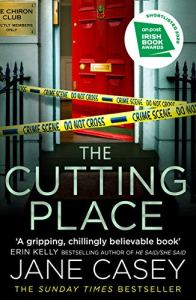
Cruel Acts and The Cutting Place by Jane Casey

This month I have caught up with reading two of Jane Casey’s Maeve Kerrigan books, and having read these two in quick succession I’m feeling as though I’ve overdosed on crime fiction. Too many murders in quick succession. I need to space them out.

Maeve is a Detective Sergeant with the Metropolitan Police – in the first six books she was a detective constable – and her boss Detective Inspector Josh Derwent are the two main characters. They have a confrontational working relationship and their spiky relationship is a recurring theme in the books. In fact they are both strong characters described in depth and completely believable. They’ve both changed as the series has grown, which is why it’s better to read the books in sequence to see how have they’ve developed.

The first book in Jane Casey’s Maeve Kerrigan series was The Burning, published in 2010, but I didn’t get round to reading it until February 2015. I was hooked immediately and read the next five books in quick succession by the end of August 2015. These are all police procedurals, fast-paced novels, with intriguing and complex plots and developing the relationships between the main characters. So, I think that although the books read well as stand-alones, it helps enormously to read them in order, especially to follow the relationship between Maeve and DI Josh Derwent.

Cruel Acts is the 8th book in the series and I enjoyed it more than The Cutting Place, the 9th book.

Blurb:
A year ago, Leo Stone was convicted of murdering two women and sentenced to life in prison. Now he’s been freed on a technicality, and he’s protesting his innocence. DS Maeve Kerrigan and DI Josh Derwent are determined to put Stone back behind bars where he belongs, but the more Maeve digs, the less convinced she is that he did it. Then another woman disappears in similar circumstances. Is there a copycat killer, or have they been wrong about Stone from the start?

The Cutting Place

Blurb
Everyone’s heard the rumours about elite gentlemen’s clubs, where the champagne flows freely, the parties are the height of decadence . . . and the secrets are darker than you could possibly imagine.

DS Maeve Kerrigan finds herself in an unfamiliar world of wealth, luxury and ruthless behaviour when she investigates the murder of a young journalist, Paige Hargreaves. Paige was working on a story about the Chiron Club, a private society for the richest and most privileged men in London. Then she disappeared. 

It’s clear to Maeve that the members have many secrets. But Maeve is hiding secrets of her own – even from her partner DI Josh Derwent. Will she uncover the truth about Paige’s death? Or will time run out for Maeve first?

~~~

I enjoy crime fiction because I like trying to work out happened and why. But I don’t like reading about horrific murders that are described in gory technicolour detail. Whilst there are brutal murders in these books they’ve not been too much for me to read. They are gritty stories but in The Cutting Place the murders and abuse of women and the violence involved is just a step too far for me. One of the changes in Maeve’s life came about in that book was when she acquired a new boy friend – the lawyer Seth Taylor – I didn’t like him straight away and I was right. Now I would like to know what happens next between Maeve and Josh as it seems to me that their relationship took a significant turn in The Cutting Place! So, I am hoping there will be a 10th book.

Jane Casey’s writing makes compelling reading, always satisfying even if her books take me to places and situations that appal and terrify me. Her books are down to earth and based on real life. As she explains at the end of the book, she is married to a criminal barrister ‘who makes sure her writing is realistic and as accurate as possible.’

Her next book is a standalone thriller, The Killing Kind, to be published 27 May 2021, featuring barrister Ingrid Lewis – one to look out for.

Exit by Belinda Bauer

Random House UK, Cornerstone| 21 January 2021| 336 pages| Kindle review copy| 4*

I wasn’t at all sure about Exit by Belinda Bauer when I first started to read it a few months ago, so put it to one side and only picked it up again a few days ago. What initially put me off was the opening chapter, which sets the scene for the work of the Exiteers, a group of people who provide support for people with a terminal illness to end their lives. Their role is ostensibly passive, just to be there to keep the dying company as they take their final breaths. But they do provide the means! And one assignment for John (real name Felix Pink) and Amanda goes wrong when they discover they have ‘helped’ the wrong man.

But I read on and what at first looks like a novel considering the ethics of assisted suicide turns into crime fiction as Felix and Amanda realise they have become murder suspects. It’s all mayhem after that as Felix, overcome with remorse, tries to put things right and to discover how and why the wrong man had died.

Far from being a ‘thriller’ it becomes a borderline ‘cosy’ murder mystery, verging on farce in places and I was amused by the wry humour and surreal scenes. It’s a comedy of errors, interspersed with poignant scenes as we learn about Felix’s grief over the deaths of his wife, Margaret and son James. His thoughts always end up with wondering what Margaret would do in the same situation.

It gets off to a slow start, the pace only gradually picking up in the later chapters, when the multiple twists kept me engaged and keen to know how it would end. There are quite a lot of characters in the book, which I found a bit confusing at first, although the main characters, Felix and Acting DC Calvin Bridges are clearly defined and distinctive characters. Some of the minor characters, such as old Greybeard and other clients in the betting shop, are clearly quirky and their actions absurd. And I particularly liked old Skipper, Albert’s father. But underneath the comedy there is a tragedy, as Felix discovers how he has been deceived all along. And the ending is bitter sweet. I began not sure I really wanted to read Exit and ended it feeling I’m glad I did. It’s unlike anything else I’ve read!

Thanks to the publishers and NetGalley for my proof copy.

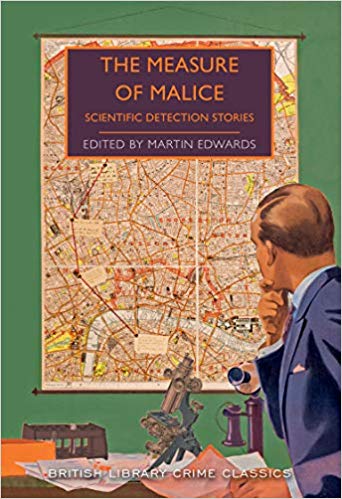
Measure of Malice: Scientific Detection Stories edited by Martin Edwards

The Measure of Malice edited by Martin Edwards is one of the more enjoyable short story collections that I’ve read. It contains 14 stories in which scientific/technological methods are used in the detection of crime. There is an excellent introduction by Martin Edwards with information about the authors, five of whom were doctors, two were engineers and one was an academic chemist.

As always with short story collections some stories are better than others. I’m highlighting a few of the better ones here:

The Boscombe Valley Mystery by A Conan Doyle was originally published in the Strand Magazine in October 1891, and is the first short story to feature Inspector Lestrade. It’s a solid story, solved by Sherlock Holmes by inspecting and analysing the footprints and signs at the scene of the crime.

The Horror of Studley Grange by L T Meade and Clifford Halifax (1894), from Stories for the Diary of a Doctor, originally published in the Strand Magazine. I enjoyed this one although it was pretty easy to predict. Ostensibly a ghost story, the solution involves the use of a laryngoscope.

After Death the Doctor by J J Connington, a Scottish professor of chemistry. This one was first published in 1934, involving a contemporary scientific gadget. The doctor in question is Doctor Shefford who together with Sergeant Longridge, investigate the murder of old Barnaby Leadburn, found dead with his throat cut.

The next two are the ones I enjoyed the most:

The Broken Toad by H C Bailey, first published in 1934, featuring the surgeon and Home Office Consultant, Reggie Fortune as he considers the death of a police constable from poisoning. I enjoyed all the detailed complications and Bailey’s literary mannered style of storytelling.

In the Teeth of the Evidence by Dorothy L Sayers, first published in 1939, about forensic dentistry, which starts as Lord Peter Wimsey is sitting in his dentist’s chair. The police had just visited the surgery, wanting to see his predecessor’s records to identify the victim of a burnt out garage. An upper right incisor crown and the filling in a molar provided the clues to his death. Gory if you actually visualise what is involved!

  • Publisher : Poisoned Pen Press (4 Feb. 2020)
  • Language: : English
  • Paperback : 336 pages
  • ISBN-10 : 1492699624
  • ISBN-13 : 978-1492699620
  • Source: The Poisoned Pen Press via NetGalley
  • My Rating: 3.5*

The Big Sleep by Raymond Chandler

In December I read 12 books, most of them short ones, and because I was reading them one after the other I hardly paused to write about them. Before they slip out of my memory I want to write about some of them at least. –

I particularly want to write about The Big Sleep by Raymond Chandler as it is one of those books that I’ve always heard about but have never read. It’s been on my Kindle for the last three years. It was first published in 1939 and is an excellent example of what is known as ‘hardboiled’ crime fiction, which generally featured a private eye with a whisky bottle in a filing cabinet, a femme fatale, and rich and usually corrupt clients. Female sexuality is a snare in a dangerous society where manipulative politicians and corrupt police thrive.

About the book:

Best-known as the creator of the original private eye, Philip Marlowe, Raymond Chandler was born in Chicago in 1888 and died in 1959. Many of his books have been adapted for the screen, and he is widely regarded as one of the very greatest writers of detective fiction. His books include The Big SleepThe Little SisterFarewell, My LovelyThe Long Good-byeThe Lady in the LakePlaybackKiller in the RainThe High Window and Trouble is My Business.

The Big Sleep has been adapted for film twice, in 1946 with Humphrey Bogart, Lauren Bacall, John Ridgely, Martha Vickers, and again in 1978, with Robert Mitchum, Sarah Miles, Richard Boone, Candy Clark.

My thoughts:

The novel is narrated by Philip Marlow, who describes himself as a ‘lone wolf, unmarried, getting middle-aged, and not rich.’ He’s been in jail more than once, likes liqour and women and the cops don’t like him much, although he does get on with a couple of them.

It’s not really the type of crime fiction that I like, but I did enjoy it. There are damsels in distress, gangsters, corrupt officials, and plenty of dark, violent and bloody situations. And of course there are murders – the ‘big sleep’ is death, after all. It’s fast-paced, violent, complicated and in times I found it a bit difficult to follow.

Reading the book took me back in time and place to Los Angeles in the late 1930s, a baking hot LA in which Private Investigator Marlow is hired by the paralysed millionaire General Stallwood, who is being blackmailed. His investigations are hampered by the General’s two daughters, one of whom proves to be a femme fatale, out to entrap Marlow and vindictive when her efforts fail. Chandler’s writing is sharp, snappy and richly descriptive with witty one-liners.

The Diabolical Bones by Bella Ellis

It’s Christmas 1845 and Haworth is in the grip of a freezing winter.

Hodder and Stoughton|5 November 2020| 309 pages| e-book| Review copy|4*

The Diabolical Bones is the second novel by Bella Ellis about the Brontë sisters. It’s historical fiction that brings the period (1845) and the setting vividly to life. It begins with Charlotte in 1852 looking back to that December of 1845 when her brother and sisters had still been alive and they had faced the hidden horror that lay within Top Withins Hall. This is a dark story, as the four Brontës discover – it involves not only murder, but also the occult and child exploitation. It highlights what life was like in the mid nineteenth century, the living conditions and the inequalities between the well-to-do and the poor.

Charlotte, Emily and Anne and their brother, Branwell became real people before my eyes, seeing them in their home in the Parsonage at Howarth. And together they make a formidable team as they set about discovering the truth about the bones of a child hidden in a chimney in the oldest part of Top Withins Hall, an ancient house high up on the moors above Howarth.

The Hall is the home of the Bradshaw family, known by Tabby, the Brontes’ housekeeper as a ‘bad lot’. She is steeped in the local superstitions and folklore and believes the land where the Bradshaws live is where the ‘hidden folk’ live. It fills her with horror as she tells the sisters about the children of Adam and Eve who live among the rocks and woodland, moors and rivers, unseen. In the past people would leave out offerings for them to keep away ill fortune. She warns them that now that there is a heavy price to be paid – and that the discovery of the bones is just the start of it.

There are links to other Brontë books in the names of some of the characters – for example, imagine finding Mrs Grace Poole, the guardian of the mad woman in the attic in Jane Eyre in charge of an orphanage. And I was delighted to find Emily in particular was inspired by Top Withins Hall and the events that took place there to write a novel, because its resemblance to Wuthering Heights struck me immediately. The more I read the more I could believe that the Brontë family were just as Bella Ellis has described them.

Bella Ellis’ is the Brontë inspired pen name for the author Rowan Coleman, who has been a Brontë devotee for most of her life – and it shows so well in this book. The setting is superb, the characters are ‘real’ and the book is well plotted. It was only towards the end that I suspected the identity of the main culprit and the danger that the four siblings had to face. I do hope there will be a third Brontë book.

My thanks to Hodder & Stoughton for an e-book review copy via NetGalley

My Friday Post: The Stone Circle by Elly Griffiths

Every Friday Book Beginnings on Friday is hosted by Gillion at Rose City Reader where you can share the first sentence (or so) of the book you are reading. You can also share from a book you want to highlight just because it caught your fancy.

At the moment I’m reading The Stone Circle by Elly Griffiths, the 11th book in the Dr Ruth Galloway mystery series. One of the reasons I’m enjoying it is because it has links to the 1st book in the series, The Crossing Places, and another is that I’m fascinated by standing stones and in particular by stone circles.

It begins:

12 February 2016

DCI Nelson,

Well, here we are again. Truly our end is our beginning. That corpse you buried in your garden, has it begun to sprout? Will it bloom this year? You must have wondered whether I, too, was buried deep in the earth. Oh ye of little faith. You must have known that I would rise again.

Also every Friday there is The Friday 56, hosted by Freda at Freda’s Voice. *Grab a book, any book. *Turn to Page 56 or 56% on your  ereader . If you have to improvise, that is okay. *Find a snippet, short and sweet, but no spoilers!

These are the rules:

  1. Grab a book, any book.
  2. Turn to page 56, or 56% on your eReader. If you have to improvise, that is okay.
  3. Find any sentence (or a few, just don’t spoil it) that grabs you.
  4. Post it.
  5. Add the URL to your post in the link on Freda’s most recent Friday 56 post.
  1. Grab a book, any book.
  2. Turn to page 56, or 56% on your eReader. If you have to improvise, that is okay.
  3. Find any sentence (or a few, just don’t spoil it) that grabs you.
  4. Post it.
  5. Add the URL to your post in the link on Freda’s most recent Friday 56 post.

Page 56:

Clough’s face gives nothing away. He hands over a Starbuck’s cup, which probably completely violates the karma of the dig, and looks around the trench with apparent interest. Ruth drinks the coffee gratefully.

~~~

Description:

DCI Nelson has been receiving threatening letters telling him to ‘go to the stone circle and rescue the innocent who is buried there’. He is shaken, not only because children are very much on his mind, with Michelle’s baby due to be born, but because although the letters are anonymous, they are somehow familiar. They read like the letters that first drew him into the case of The Crossing Places, and to Ruth. But the author of those letters is dead. Or are they?

Meanwhile Ruth is working on a dig in the Saltmarsh – another henge, known by the archaeologists as the stone circle – trying not to think about the baby. Then bones are found on the site, and identified as those of Margaret Lacey, a twelve-year-old girl who disappeared thirty years ago.

As the Margaret Lacey case progresses, more and more aspects of it begin to hark back to that first case of The Crossing Places, and to Scarlett Henderson, the girl Nelson couldn’t save. The past is reaching out for Ruth and Nelson, and its grip is deadly.