The Black Mountain by Kate Mosse #NovNov22

Week 4 in Novellas in November is Contemporary novellas (post 1980)

The Black Mountain by Kate Mosse (136 pages) 3*

This is a Quick Reads publication – a series of short books by bestselling authors and celebrities. They are designed to encourage adults who do not read often, or find reading difficult, to discover the joy of books. I like the long novels Kate Mosse writes, so I wondered what this short novel would be like.

It is historical fiction set in May 1706 on the northern part of the island of Tenerife, where Ana and her family live in the shadow of a volcano, known locally as the Black Mountain. It’s also a murder mystery – Ana’s father Tomas had apparently committed suicide, but Anna just can’t accept that and reading the letter he’d left she is convinced it was murder. She is determined to find out the truth.

Legend says the mountain has the devil living inside it and when the devil was angry he sent fire and rocks up into the sky. However, there has been no eruption for thousands of years and no one believes it is a threat. Sometimes the earth trembled and shook but the sky never turned red. Until, that is two days after Tomas’ death. He had seen the signs that the mountain was about to erupt and had tried to warn people – but they didn’t want to know. When more tremors occur, and grey ash starts falling Ana realises the danger signs are increasing and she needs to warn people that they must flee before the volcano erupts and destroys their world.

I enjoyed this novella, reading it quickly, feeling almost as though I was also in danger as the Black Mountain threatens to erupt and wondering if Ana would discover the truth about her father’s death in time for her to escape.

The Black Mountain is based on a real historical event. The town of Garachio erupted from May 4 to 5, 1706, which was disastrous not only for the town but also for the entire archipelago. Its port concentrated a large part of the international trade that linked the island with Europe, Africa and America.

~~~

I’ve read a few of the Quick Reads. Here’s a list of all the available titles.

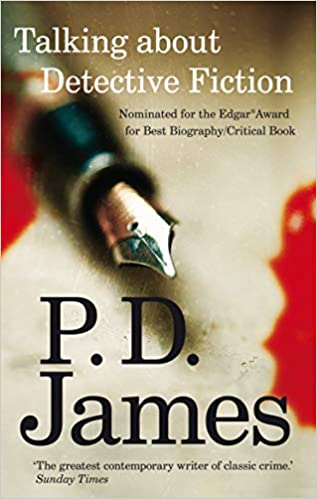
Talking About Detective Fiction by P D James #NovNov22

Week 3 in Novellas in November is Short Nonfiction.

Faber & Faber| 2010| 160 pages| Paperback|My Own Copy| 4*

From the birth of crime writing with Wilkie Collins and Dostoevsky, through Conan Doyle to the golden age of crime, with the rise of Agatha Christie, Ngaio Marsh and Margery Allingham, P. D. James brings a lifetime of reading and writing crime fiction to bear on this personal history of the genre. There are chapters on great American crime writers – the likes of Patricia Highsmith, Raymond Chandler and Dashiel Hammett. James also discusses many of her favourite famous detectives, from Sherlock Holmes to Philip Marlowe.

P.D. James, the bestselling author of Death Comes to Pemberley, Children of Men and The Murder Room, presents a brief history of detective fiction and explores the literary techniques behind history’s best crime writing.

I do like reading books about books and as crime fiction is one of my favourite genres I wanted to read Talking About Detective Fiction by P D James. In December 2006 she was asked to write the book by the Bodleian Publishing House, in aid of the Library. It’s a personal account and being a short book doesn’t go into much detail about any of the writers. It’s an overview of mostly British authors, with just one chapter, entitled Soft-centred and Hard-boiled in which she writes about the differences between the hard-boiled school of American fiction and some of the Golden Age writers.

I’m familiar with the work of most of the authors in this book, but there are some James mentions I haven’t read, such as Dashiell Hammett, who wrote short stories featuring the Continental Op and Sam Spade, who also appears in one full-length novel, The Maltese Falcon. James’ favourite of the hard-boiled writers was Kenneth Millar, who wrote under the pseudonym of Ross Macdonald, novels featuring private detective Lew Archer. But she didn’t give the details of any of his books.

The structure of the book is rather loose and meandering. Although it is divided into eight chapters, the works of some, such as Agatha Christie and Dorothy L Sayers appear in several chapters spread across the book as a whole. The book needs an index to draw the separate entries together! I think the parts I enjoyed the most are those in which James writes about her own methods of working, and the chapter on Telling the Story: Setting, Viewpoint and People.

There is a short bibliography and list of suggested reading at the end of the book. Throughout the book there are several cartoons, which add an amusing touch.

Finally, you need to be aware if you haven’t read The Murder of Roger Ackroyd that without any warning, she gives away not just a little spoiler, but the identity of the murderer! I was amazed!

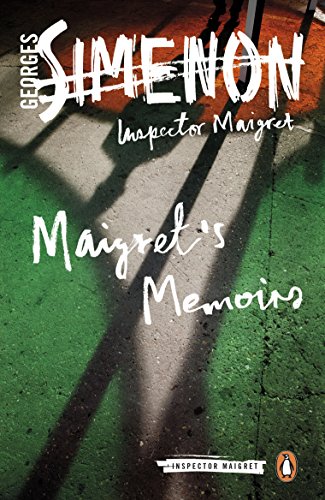
Maigret’s Memoirs by Georges Simenon Translated by Howard Curtis

Week 2 in Novellas in November is Novellas in translation and a Maigret book is an obvious choice for me. But Maigret’s Memoirs is not your usual Maigret mystery. This a memoir written by Simenon writing as his fictional character, Maigret.

Penguin Classics| 2016| 160 pages| My Own Copy| 4*

I can still see Simenon coming into my office the next day, pleased with himself, displaying even more self-confidence, if possible, than before, but nevertheless with a touch of anxiety in his eyes.’

Maigret sets the record straight and tells the story of his own life, giving a rare glimpse into the mind of the great inspector – and the writer who would immortalise him.

‘One of the greatest writers of the twentieth century . . . Simenon was unequalled at making us look inside, though the ability was masked by his brilliance at absorbing us obsessively in his stories’ Guardian

‘A supreme writer . . . unforgettable vividness’ Independent

The original French version of Maigret’s MemoirsLes Mémoires de Maigret, was first published in 1950. An English translation was later published in Great Britain in 1963. It is unlike any of the other Maigret novels. It’s a fictional autobiography by Georges Simenon writing as Maigret, beginning in 1927 or 1928 when Maigret and Simenon, calling himself Georges Sim, first ‘met’. I don’t recommend reading if you haven’t read some of the Maigret mysteries.

I enjoyed it – it’s a quick entertaining read as Maigret looks back to his first ‘meeting’ with Sim. He fills in some of the background of his early life and talks about his father and how he first met his wife, Louise. Simenon had written 34 Maigret novels before this one and Maigret took this opportunity to correct some of Simenon’s inaccuracies. I recognised some of the books – I’ve read 11 of his first 34 books.

One of the things that irritated Maigret the most was Simenon’s habit of mixing up dates, of putting at the beginning of his career investigations that had taken place later and vice versa. He’d kept press cuttings that his wife had collected and he had thought of using them to make a chronology of the main cases in which he’d been involved. And he also considered some details his wife had noted – concerning their apartment on Boulevard Richard Lenoir, pointing out that in several books Simenon had them living on Place des Vosges without explaining why. There were also times when he retired Maigret even though he was still several years away from retirement. Madame Maigret was also bothered by inaccuracies concerning other characters in the books and by Simenon’s description of a bottle of sloe gin that was always on the dresser in their apartment – that was in actual fact not sloe gin but raspberry liqueur given to them every year by her sister-in-law from Alsace.

Simenon drops facts and information piecemeal in his Maigret books and one thing I particularly like in Maigret’s Memoirs is that it is all about Maigret, but I did miss not having a mystery to solve.

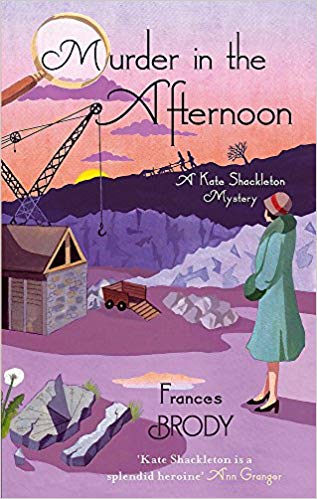
Book Beginnings & The Friday 56: Murder in the Afternoon by Frances Brody

Every Friday Book Beginnings on Friday is hosted by Gillion at Rose City Reader where you can share the first sentence (or so) of the book you are reading. You can also share from a book you want to highlight just because it caught your fancy.

Today I’m featuring one of my TBRs books Murder in the Afternoon by Frances Brody, the third Kate Shackleton Mystery set in the Yorkshire Dales in 1923.

My Book Beginning

Harriet held the cloth-covered basin in her thin hands, feeling the warmth. She and Austin trod the well-eorn path from their long strip of back garden on Nether End,

Mam wasn’t home. She’d hurried off to Town Street, to buy the Woodbines that Harriet accidentally on purpose forgot when she and Austin went to do the Saturday shop. Mam wanted a new house. She was sick to death of living in the back of beyond.

Also every Friday there is The Friday 56, hosted by Freda at Freda’s Voice, where you grab a book and turn to page 56 (or 56% of an eBook), find one or more interesting sentences (no spoilers), and post them.

Page 56:

‘Won’t you at least cordon off the mason’s hut, in case this does turn out to be a murder enquiry?’

His small eyes narrowed. I had overplayed my hand.

‘No, Mrs Shackleton, I will not.’

Synopsis:

Dead One Minute: Young Harriet and her brother, Austin, have always been scared of the quarry where their stonemason father works. So when they find him dead on the cold ground, they scarper quick smart and look for some help.

Alive the Next?: When help arrives, however, the quarry is deserted, and there is no sign of the body. Were the children mistaken? Is their father not dead? Did he simply get up and run away?

A Sinister Disappearing Act: It seems like another unusual case requiring the expertise of Kate Shackleton. But for Kate this is one case where surprising family ties makes it her most dangerous – and delicate – yet….

What do you think? Would you read it?

Book Beginnings & The Friday 56: Whispers Under Ground by Ben Aaronovitch

Every Friday Book Beginnings on Friday is hosted by Gillion at Rose City Reader where you can share the first sentence (or so) of the book you are reading. You can also share from a book you want to highlight just because it caught your fancy.

Today I’m featuring one of the books I’m currently reading, Whispers Under Ground by Ben Aaronovitch, the third book in his Rivers of London series, police procedurals of a very different kind – urban fantasy, set in the real world of London, a mix of reality and the supernatural.

My Book Beginning

Back in the summer I’d made the mistake of telling my mother what I did for a living. Not the police bit, which of course she already knew about having been at my graduation from Hendon, but the stuff about me working for the branch of the Met that dealt with the supernatural.

Also every Friday there is The Friday 56, hosted by Freda at Freda’s Voice, where you grab a book and turn to page 56 (or 56% of an eBook), find one or more interesting sentences (no spoilers), and post them.

Page 56:

I was carrying my magic bowl with both hands and stepping carefully on the frost-slippery cobbles.

Ben Aaronovitch is an English author and screenwriter. He is the author of the Rivers of London series of novels. He worked as a scriptwriter for Doctor Who and Casualty before the inspiration for his own series of books struck him whilst working as a bookseller in Waterstones Covent Garden. His unique novels are the culmination of his experience of writing about the emergency services and the supernatural. 

The series is to be adapted for television, bringing together all nine of the novels, plus the accompanying short stories, novellas and graphic novels, for the screen. The TV adaptation will be co-produced by Pure Fiction Television, See-Saw Films and Aaronovitch’s own production company Unnecessary Logo.

Synopsis:

Peter Grant is learning magic fast. And it’s just as well – he’s already had run-ins with the deadly supernatural children of the Thames and a terrifying killer in Soho. Progression in the Police Force is less easy. Especially when you work in a department of two. A department that doesn’t even officially exist. A department that if you did describe it to most people would get you laughed at. And then there’s his love life. The last person he fell for ended up seriously dead. It wasn’t his fault, but still.

Now something horrible is happening in the labyrinth of tunnels that make up the tube system that honeycombs the ancient foundations of London. And delays on the Northern line is the very least of it. Time to call in the Met’s Economic and Specialist Crime Unit 9, aka ‘The Folly’. Time to call in PC Peter Grant, Britain’s Last Wizard.

What do you think? Would you read it?

More Books from Barter Books

We went to Barter Books in Alnwick last week. It’s back to normal now – busy, but not too crowded. I didn’t go with any specific books in mind and just browsed the shelves. These are the books I brought home with me – I’m still in credit so these were ‘free’, as it were.

From top to bottom they are:

A Sea of Troubles by Donna Leon, a Commissarion Brunetti murder mystery. It’s been ages since I read one of her books. This one is set on the island of Pellestrina, south of the Lido on the Venetian Lagoon, where two clam fishermen have been murdered.

Harm Done by Ruth Rendell, an Inspector Wexford Mystery. I’ve read a few of her Wexford Mysteries. Two young girls have disappeared and then two far more serious crimes are committed, which affect the lives and attitudes of both the police and the public.

Innocence by Penelope Fitzgerald, set in the 1950s when Italy was picking up the pieces after the war. It’s historical fiction about an Italian marriage between an aristocratic girl and a low-born neurologist from rural southern Italy. I haven’t read any of her books, although I have The Gate of Angels on my TBR shelves.

Metroland by Julian Barnes – is a novel about Christopher Lloyd and his experiences growing up in the suburbs of London (so-called Metro-land), his brief life in Paris as a graduate student and the early years of his subsequent marriage. I’ve read and enjoyed two of his other books. This one was his first book.

Head of State by Andrew Marr – political fiction, described as a darkly comic tale of deception and skullduggery at Downing Street and Whitehall. Set in 2017, with the country on the edge of a political precipice, this was Marr’s first novel. I’ve read some of Marr’s history books and used to watch the Andrew Marr Show on Sunday mornings. I know that Head of State has had some critical reviews, but I thought I’d see for myself what it’s like.

If you’ve read any of these books I’d love to know what you think of them.