Carl’s R.I.P. VI challenge ended on 31 October and I’m pleased that I completed Peril the First, which was :
Read four books, any length, that you feel fit (my very broad definitions) of R.I.P. literature. It could be Stephen King or Sir Arthur Conan Doyle, Ian Fleming or Edgar Allan Poe’¦or anyone in between.
I read the following books (linked to my reviews):
These are all books that were on my to-be-read list. I think Blood Harvest has to be my favourite of the four and I thoroughly enjoyed it – a dark, scary book, disturbing, and completely gripping. I was particularly pleased that I finally read The Turn of the Screw as I first started to read it some years ago. It’s an ideal book for the RIP Challenge. Thanks go to Carl for hosting.
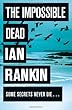
The Impossible Dead, Ian Rankin’s second book featuring Inspector Malcolm Fox is very readable, with a nicely complicated plot, and good characterisation. Fox is still in the Complaints, now officially called Professional Ethics and Standards, but it soon becomes apparent that really he wants to be in CID. I’m not sure what to make of Fox. He’s:
… diligent and scrupulous, never a shirker. He had put in the hours, been commended for his error-free paperwork and ability to lead a team: no egos and no heroes. He hadn’t been unhappy. He had learned much and kept out of trouble. If a problem arose, he either dealt with it or ensured it was moved elsewhere. (page 105)
And yet, he’s another loner, working best on his own, not letting on to his boss what he is working on, disregarding procedure and getting involved in cases outside his remit. He doesn’t drink because he’s an alcoholic, his marriage failed and his relationship with his sister leaves a lot to be desired (although it does improve in this book). Fox’s family life intrudes into his work and gives insight into his background and his relationship with his father and sister. He’s a complex character and I began to think that maybe he’s turning into Rebus.
Detective Constable Paul Carter has been found guilty of misconduct and Fox and his team are called to investigate whether his colleagues have covered up for him. When Paul’s uncle, Alan, a retired policeman, is found dead Fox is convinced it was murder and not suicide and begins his own independent investigations, despite being told it’s a CID case. He oversteps his remit too by investigating a cold case. When his investigations reveal links back to 1985, a time of turmoil when Scottish militants were intent on a split between Scotland and the rest of the UK, he discovers new evidence concerning the unsolved murder of one of the activists at that time.
In the second half of the book the pace and tension increase as Fox delves deeper and puts his own life in danger. I found it quite easy to see who the culprits were because their identity was signalled, but nevertheless it was a satisfying conclusion to the book.
It’s been a while since I wrote a Library Loot post and as I went to the library today I thought I’d combine it with a Teaser Tuesday post.
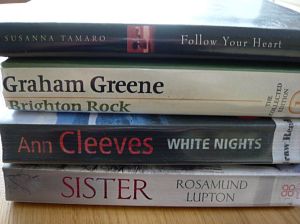
I’ve dipped into each book. From top to bottom they are:
Follow Your Heart by Susanna Tamaro, translated from the Italian by Avril Bardoni. I fancied reading something different from my usual type of book – this book won the Premio Donna Citta di Roma in 1994. From the book jacket – ‘it reflects on feelings and passions and how failure to communicate leads to futility, misunderstanding and tragedy – a meditation on existence.’ An old woman writes to her granddaughter:
As I have wandered aimlessly through the empty house these last few months, the misunderstandings and bad temper that marred our years together have vanished. The memories surrounding me now are of you as a child – a vulnerable, bewildered little creature. (page 3)
Brighton Rock by Graham Greene. A book I’ve known of for so many years and never read. I had no idea that it is a detective story! I love the way it begins:
Hale knew, before he had been in Brighton three hours, that they meant to murder him. With his inky fingers and his bitten nails, his manner cynical and nervous, anybody could tell he didn’t belong – belong to the early summer sun, the cool Whitsun wind of the sea, the holiday crowd. (page 1)
I can just see the scene!
White Nights by Anne Cleeves. I’ve been looking out for this book, the second in her Shetland Quartet, ever since I enjoyed reading the first one – Raven Black. Shetland detective Jimmy Perez investigates what seems at first to be a straightforward suicide. This is my teaser:
‘I don’t know my name’, he said flatly. No drama now. ‘I can’t remember it. I don’t know my name and I don’t remember why I’m here.’ (page 16)
Sister by Rosamund Lupton. More crime fiction, a psychological thriller. I’d read about this book on a blog (sorry, can’t remember which one – it may have been more than one blog) and thought it sounded good. Beatrice’s younger sister Tess is missing. She refuses to give up looking for her and is determined to discover the truth about Tess and what has happened to her.
For a moment, amongst the crowd, I saw you. I’ve since found out it’s common for people separated from someone they love to keep seeing that loved one among strangers; something to do with recognition units in our brain being too heated and too easily triggered. This cruel trick of the mind lasted only a few moments, but was long enough to feel with physical force how much I needed you. (page 26)
The last stop on Kerrie’s Crime Fiction on a Euro Pass is Turkey. The challenge has been to write posts linked to the country of the week. This time I’ve focused on the British author:
Barbara Nadel
Born in the East End of London, Barbara Nadel trained as an actress before becoming a writer. Now writing full-time, she has previously worked as a public relations officer for the National Schizophrenia Fellowship’s Good Companion Service and as a mental health advocate for the mentally disordered in a psychiatric hospital. She has also worked with sexually abused teenagers and taught psychology in schools and colleges, and is currently the patron of a charity that cares for those in emotional and mental distress.
I’d forgotten I’d pre-ordered Ian Rankin’s latest book The Impossible Dead, so it was a nice surprise yesterday when it was delivered. I don’t often buy a hardback book so that’s an additional pleasure, even if at nearly 400 pages it is quite heavy.
It is, of course, the follow-up book to The Complaints, starring D I Malcolm Fox and his team investigating other cops. I thoroughly enjoyed The Complaints and am hoping this will be as good if not even better.
From the back cover:
Asked to take on a simple case of police abuse, Malcolm Fox suddenly finds himself digging up a macabre death from the eighties. Little does he know that the answers he finds in that dark period of Scottish history will lead him to the highest echelons of power …
Now officially called Professional Ethics and Standards (you only need to add Team to the title to get the acronym PESTS!) they still call themselves The Complaints at least among themselves and other cops are never happy to see them or cooperate either.
I finished reading The House of Stairs, the third psychological thriller by Barbara Vine yesterday. It is a most remarkable book, in that it turns a murder mystery upside down, as it were. It is clear from the start that there has been a murder and the murderer is known – she has just been released from prison. But who did she murder? Why, where, when and how? The other characters all know – but not the reader.
The crime is only revealed very gradually, building up the suspense and tension in a series of flashbacks, as you realise the how, the where and the when, but only by inference – guesswork on my part really. The why too, can be worked out, but as for the who – I kept changing my mind, only finally deciding it must be this person, just a few pages before the denouement. Ruth Rendell writing as Barbara Vine certainly sets a puzzle, a tangled web of characters, situations, and psychological profiles. And, of course, there is a certain ambiguity right at the end. It’s not a book you can read quickly, but it certainly kept me turning the pages wanting to know what had happened.
The first person narrator is Elizabeth, who is told a terrible secret about her mother and lives her life as a consequence in fear of inheriting the family disease. At the beginning of the book she sees her old friend Bell, and follows her at a short distance, not sure it really is her. It gives her a sense of unease and a quiver of panic bringing back memories of earlier events that had resulted in Bell’s imprisonment for murder fourteen years ago.
She and Bell and a number of other characters (who come and go) lived with Cosette in the House of Stairs, so called because it’s a big house on five floors with a staircase of 106 stairs. Cosette had been married to Elizabeth’s mother’s cousin and they came to view each other as mother and daughter. Cosette is a caring character, very tolerant and easy-going, one who welcomes other people into her home, who listens to them and leaves them feeling revitalized. Bell, however, is cold and uncaring. The menace is felt as Bell climbs the stairs to her room on the top floor, the 104th step creaking as she does so and enters the room, the room with the dangerous window that came down to no more than six inches or so from the floor (page 121).
There is so much I could write about this book. For one thing there are various allusions to Henry James’s work, which Elizabeth is studying hoping to write a thesis about James – to say any more would be to reveal too much. Another allusion is to Tennyson’s poem Mariana and one that interested me greatly to a painting by Bronzino of Lucrezia Panciatichi, dressed in a beautiful red gown. It reminds Elizabeth of Bell, and when she wears a similar red dress found in Cosette’s belongings the resemblance is striking. I found a reproduction of the painting on Wikipedia:
Portrait of Lucrezia Panciatichi (circa 1540), Galleria degli Uffizi, Florence
Elizabeth has a thought, which struck me as particularly chilling. She looks at people
… wondering which of them, if any, are like her. I mean like her in that they have killed someone and been sent to prison for it, served their sentence and come out again. It is a new phenomenon. Murderers used to be hanged.
Now they are set free and come back to live among us. Or to exist. I look at people and I wonder. … ordinary people looking like everyone else, having ordinary jobs, perhaps living next door. (page 212)
The House of Stairs:
Paperback: 282 pages
Publisher: Penguin 1989
Source: I bought the book (a secondhand copy)
Rating 4/5
Barbara Vine’s earlier psychological thrillers are:




 I finished reading The House of Stairs, the third psychological thriller by Barbara Vine yesterday. It is a most remarkable book, in that it turns a murder mystery upside down, as it were. It is clear from the start that there has been a murder and the murderer is known – she has just been released from prison. But who did she murder? Why, where, when and how? The other characters all know – but not the reader.


