Service of All the Dead by Colin Dexter

Colin Dexter 001

A question on the TV show Pointless about the novels of Colin Dexter reminded me I have a few of his books to read, Service of All the Dead being one of them – and it was one of the pointless answers too! So that gave me the push to read it.  My copy is a secondhand book – an Omnibus containing  The Silent World of Nicholas Quinn as well as Service of All the Dead.

It really is one of the most puzzling crime fiction books I’ve read – if not the most puzzling! CI Morse sums it up himself:

There are some extremely odd points in this case, Lewis – or rather there were – each of them in itself suggestive but also puzzling. They puzzled all of us, and perhaps still do to some extent, because by the time we’d finished we’d got no less than five bodies on our hands and we were never in a position to learn what any of the five could have told us. (page 295)

Morse was on holiday, bored and at a loose end, when, stepping off a bus near St Frideswide’s Church in Oxford, he saw a notice advertising a jumble sale at the church – it seemed to him pre-ordained that he should enter the church. This set in motion his fascination with the death of the churchwarden, killed in the church the previous year and his subsequent discovery of the deaths of four more people. His interest is enhanced by the attraction he feels for Ruth Rawlinson, who cleans the church.

Aided by Sergeant Lewis, he digs into the history of the churchwarden, the vicar and members of the church and uncovers an intricate web of lies and deceit. Morse acts on instinct and consequently both Lewis and myself were in the dark for a great part of this book. He proposes several motives for the murders and alternate scenarios of what had happened before untangling the complex mess. There are plenty of red herrings and twists and turns.

Even though I was lost in the plot I found the book compelling reading – it’s a superbly constructed puzzle. This is certainly not a police procedural in the normal sense – there is little account of forensic evidence for example. It is strong on character and on place. The scene of the murders is St Frideswide’s, a fictional church, possibly based a couple of Oxford churches, St Michael-by-the-North-Gate with a Saxon tower and St Mary Magdalen and it is there in the tower that Morse suffers from his great fear of heights.

Service of All the Dead was first published in 1979. I suppose I must have seen the TV version of this book, as I watched all the episodes and this one was shown in 1987 – I don’t remember it! Inevitably as I read it I could see John Thaw as Morse and Kevin Whately as Lewis.
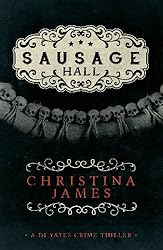
Sausage Hall by Christina James

When the publishers of Sausage Hall emailed me offering a review copy of the book I thought it sounded interesting, although I wasn’t keen on the title – I thought it sounded a bit gimmicky and it nearly putting me off reading it.  But I’m glad it didn’t because I would have missed out on a good story, a crime mystery with a sinister undercurrent exploring the murky world of illegal immigrants, and a well researched historical element. I enjoyed it.

Sausage Hall is the third book in the DI Yates series and although I haven’t read the first two that wasn’t a problem – it stands well on its own, but I’d like to read the two earlier books. This is set in the South Lincolnshire Fens and is an intricately plotted crime mystery, uncovering a crime from the past whilst investigating a modern day murder.

Synopsis from the back cover:

Sausage Hall: home to millionaire Kevan de Vries, grandson of a Dutch immigrant farmer. De Vries has built up a huge farming and food packing empire which extends, via the banana trade, to the West Indies. But Sleazy MD, Tony Sentance, persuades de Vries to branch out into the luxury holiday trade. De Vries and wife, Joanna, take the first cruise out to explore the potentially lucrative possibilities. However, back at home, a break-in at Sausage Hall uncovers a truly gruesome historical discovery. And when a young employee of de Vries is found dead in the woods, D.I. Yates is immediately called in … 

The narrative switches between the first person present tense (Kevan) and the third person past tense, which took me a bit to get used to. Actually I thought this worked very well; even though the use of the first person present tense usually irritates me, it didn’t in this book and it gives a good insight into Kevan’s character as well as providing essential information about his background and relationships.

I particularly liked DC Juliet Armstrong, DI Tim Yates’ colleague – the two make a good combination, even though Juliet spends a good part of the book isolated in hospital with Weil’s disease, having been bitten by a rat. In fact of the two characters I thought Juliet was the most clearly defined. Maybe a second reading would help clarify Yates’ character for me, or maybe this is where not reading the two earlier books is a drawback. This is not a book you can read quickly as there are plenty of characters and several plot threads that need to be kept in my mind as you read the book.

I liked the historical elements of the plot and the way Christina James has connected the modern and historical crimes, interwoven with the history of Kevan’s home, Laurieston House, known to the locals as ‘Sausage Hall’ and the secrets of its cellar – just what is the link between Cecil Rhodes, the Victorian financier, statesman, and empire builder of British South Africa, and the Jacobs family who were the previous owners of Sausage Hall?

Added to this is the mystery of the death of a young woman found dead in the woods near the De Vries food-packing plant in Norfolk. It seems she was employed at the plant although the supervisors there deny any knowledge of her. DI York suspects she is an Eastern European illegal immigrant. And as for Tony Sentance, just what is his hold over Kevan and his wife and their son, Archie? It was only just before the end that I suspected the truth. 

Publishers’ Biographical Note: ‘C.A. James was born in Spalding and sets her novels in the evocative Fenland countryside of South Lincolnshire. She works as a bookseller, researcher and teacher. She has a lifelong fascination with crime fiction and its history. She is also a well-established non-fiction writer, under a separate name.’

There is more information about Christina James and her books on her blog The earlier DI Yates books are In the Family and Almost Love.

  • Paperback: 256 pages
  • Publisher: Salt Publishing (17 Nov 2014)
  • Language: English
  • ISBN-10: 1907773827
  • ISBN-13: 978-1907773822
  • Source: review copy from the publishers

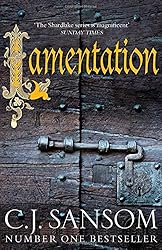
Lamentation by C J Sansom

Once again I am behind myself with writing about the books I’ve read! So here are just a few thoughts about C J Sansom’s historical novel, Lamentation, the sixth Matthew Shardlake book.

I have enjoyed the earlier books in the series so I had great expectations for Lamentation and I wasn’t disappointed. It’s set in 1546, the last year of Henry VIII’s life. Shardlake, a lawyer is asked by Queen Catherine (Parr) for help in discovering who has stolen her confessional book, Lamentation of a Sinner. What I like about these books is their historical setting and the Historical Notes giving yet more background to the period and emphasising that because the sources are ‘very thin’ that inevitably this is Sansom’s own interpretation of events and clarifying that Catherine Parr’s book was not, in the real world, stolen.

The book evokes the people, the sights, smells and atmosphere of Henry’s last year and at the same time it’s an ingenious crime mystery, full of suspense and tension. It begins as Shardlake is ordered to watch the burning at the stake of Anne Askew and other heretics (a real event). I’m not good at reading horrific scenes, but I managed this one without too much mental aversion of my eyes. Along with the mystery of the missing book, Shardlake is working on the Cotterstoke dispute between rival siblings, and has problems at home with his domestic servants.

I was also very taken with Shardlake’s introduction in Lamentation to William Cecil, Mary Tudor and a young Elizabeth I. I hope Sansom has more Shardlake books in mind.

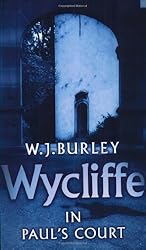
Wycliffe in Paul's Court by W J Burley

We had to spend nearly 4 hours yesterday in the Newcastle Emergency Eye Department as D has a corneal abrasion. As my Kindle needed charging I picked up a lightweight paperback to slip into my bag to while away the time – and I nearly finished it whilst we were there! It was Wycliffe in Paul’s Court by W J Burley.

Synopsis from the back cover:

Paul’s Court is a quiet corner in the heart of the city: an oasis of peace and safety – until the night when there are two violent deaths. Willy Goppel, an émigré from Germany, is found hanging from a beam in his home; and fifteen-year-old Yvette Cole, who may or may not have lived up to her wild reputation, is strangled and thrown half naked over the churchyard hedge.

Chief Superintendent Wycliffe has the aid of a shrewd local sergeant, Kersey, but they still find this a difficult case to crack. Did Willy assault the girl and then hang himself? Or was his death not suicide after all? As Wycliffe and Kersey dig deeper they gradually untangle a complex network of secrets in the quiet of Paul’s Court …

My thoughts

Although there are plenty of suspects, all from the five houses in Paul’s Court I could easily distinguish them, even with the distractions of a hospital waiting room from children crying that they wanted to go home and people talking loudly next to me. On the other hand, I wasn’t able to concentrate enough to follow all the clues and it was only just before the culprit was revealed that I had any idea who it was. But it was still an enjoyable read.

Wycliffe is a quiet, thoughtful detective who doesn’t let himself become desk-bound and gets very involved with the investigation. This is the first time he has worked with Kersey, who sized him up thus:

He saw a man with a clear view of right and wrong who was not a bigot; he recognised a close-grained moral toughness with a hint of old-fashioned puritan zeal, but no wish to burn heretics. A man of compassion but no sentimentalist, a reformer but not a do-gooder. (page 70)

Wycliffe and Kersey make a good team; Kersey knows not just the area very well but also the local people and is able to give Wycliffe ‘vivid thumb-nail sketches of the inhabitants of Paul’s Court’. They are ordinary people, living ordinary lives but who find themselves in the middle of a murder investigation. W J Burley was very good at creating believable people caught up in extraordinary situations. I’ve read just a few of his 22 Wycliffe books – plenty more to read yet!

W.J. Burley (1914 – 20020 was first an engineer, and later went to Balliol to read zoology as a mature student. On leaving Oxford he went into teaching and, until his retirement, was senior biology master in a large mixed grammar school in Newquay. He created Inspector Wycliffe in 1966 and the series has been televised with Jack Shepherd starring in the title role. Wycliffe in Paul’s Court was first published in 1980.

Blue Heaven by C J Box

There are lots of things I like about reading e-books, but I’ve found that my Kindle has become a Black Hole – it sucks in books and once they are in there they may never see the light of day again. I don’t even know how many books are lost in there. It’s so easy to download books and just forget they are there. With print books they’re always around sitting on the shelves and even if they are in boxes they take up space and are visible. Not so on an e-reader, the books are invisible.

So it was with Blue Heaven by C J Box – it has sat in my Kindle for nearly three years an unread and indeed a forgotten book. And here is where my liking for reading challenges came into its own, because I was looking for a book with ‘blue’ in its title for Bev’s Color Coded Challenge and up popped Blue Heaven.

I loved it and will certainly look out for more books by C J Box.

The action takes place over four days in North Idaho one spring. It’s a story about two children, Annie and William who decide to go fishing without telling their mother, Monica, and witness a murder in the woods. One of the killers sees them and they run for their lives.

It’s set in a farming community which is changing as people move into the area – specifically retired police officers, about 200 hundred of them, which is where the book title comes from, as according to Fiona Pritzle, the mail lady and local gossip, ‘They call North Idaho ‘Blue Heaven at the LAPD ‘. So when Monica reports her children missing it’s natural for the ex-policemen to volunteer to search for them and as the local sheriff is new to the job, they soon take over the investigation.

Annie and William meanwhile have discovered that not everyone is who they seem to be and it’s not safe even to call home. Until they met Jess Rawlins, an old rancher, a lonely divorcee who is in financial difficulty and struggling to keep his ranch going.

This is really a straightforward story of kids on the run but just to complicate things a little there is a newcomer, Eduardo Villatoro, another retired police officer from California, who arrives in town trying to trace the money stolen from a Santa Anita racetrack several years earlier when a young guard was killed.

It all melds together in a fast paced chase to save Annie and William, the tension maintained until the end. There are several things that kept me gripped as I read Blue Heaven. It’s one of those books that I find myself thinking about when I’m not reading it and keen to get back to it. First of all it’s written in a style that appeals to me – straightforward storytelling, with good descriptions of locality and characters, secondly characters that are both likeable and downright nasty, but not caricatures, and finally the ending was what I hoped, and also dreaded it would be.

  • Format: Kindle Edition
  • File Size: 731 KB
  • Print Length: 353 pages
  • Page Numbers Source ISBN: 0312365705
  • Publisher: Corvus (1 July 2010)
  • Source: I bought it

Challenges: Color Coded Challenge, Mount TBR Challenge and My Kind of Mystery Challenge.

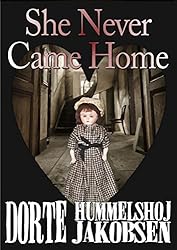
She Never Came Home by Dorte Hummelshoj Jakobsen

She Never Came Home is a perfect little ghost story for Halloween. Dorte Hummelshoj Jakobsen spins a suspenseful story of Alice and her husband Peter and their little dog, Foxy as they move into an old farmhouse deep in the Danish countryside. Just why is Foxy nervous about the cupboard under the sink, what is in the bedrooms upstairs that are excluded from their tenancy agreement, and why has the house been empty for over thirty years?

Both Peter and Alice are out of work, but Peter still has to work out his notice in Germany and leaves Alice alone in the house… Alice slowly discovers the horrible truth.

I really liked this short story, with its chilling atmosphere and shocking twist at the end. In just a few pages Dorte Hummelshoj Jakobsen has written such a compelling and entertaining tale.

This is my last entry in this year’s R.I.P. challenge and another one for the My Kind of Mystery challenge.