The Betrayal of Trust by Susan Hill

So far this year I’ve been reading from my own bookshelves – books I’ve owned before 1 January. I’ve had The Betrayal of Trust by Susan Hill, the 6th in the Simon Serrailler series, for nearly a year now. Like the earlier books, this one is  character-driven, concentrating on the people involved in the crime and Simon’s family, and also covering several ethical/moral/medical issues.

The crime element concerns a cold case, that of a teenager missing for 16 years. After flooding causes a landslip on the Moor her body comes to the surface together with that of an unknown female found in a shallow grave near by.The cold case is not a priority as the police force is struggling with staff shortages and cuts – Simon has to solve the cases mainly on his own, with the occasional help from DS Ben Vanek.

But the police investigations are not the main subject of this book. It focuses on the problems of ageing, hospice care, Motor Neurone Disease, assisted suicide, Parkinson’s Disease and Alzheimer’s Disease. A lot to cope with all at once and at times I found The Betrayal of Trust a deeply depressing book.

Having said that, as with Susan Hill’s other books, this is fluently written, looking at all sides of the issues, highlighting the dilemma facing those with terminal and debilitating illnesses, and those looking after dementia patients. The Serrailler family life has moved on from the last book, but Simon’s strained relationship with his father continues. He fails in love with a stunningly beautiful woman, which causes yet more complications – he just  doesn’t seem capable of having a happy relationship!

Although this is a quick read it’s also rather dark, with some dodgy and sinister characters and I was expecting it to be better than it is. It is a complex novel but the solution to the crime mystery soon becomes evident and is rather rushed at the end. There are several issues left unresolved and I hope they will be clarified in the next book in the series, A Question of Identity, which is next up for me to read.

Towards Zero by Agatha Christie

Towards Zero

Towards Zero, first published in 1944 (my copy is a 1972 impression), is an intricately plotted murder mystery featuring Superintendent Battle, the last of the five novels he appears in. Agatha Christie dedicated this book to Robert Graves, author of I Claudius, who was her neighbour in Devon during the Second World War and the two had become friends. She wrote:

‘Dear Robert, Since you are kind enough to say you like my stories, I venture to dedicate this book to you. All I ask is that you sternly restrain your critical faculties (doubtless sharpened by your recent excesses in that line!) when reading it. This is a story for your pleasure and not a candidate for Mr Graves’ literary pillory!”

It was received well at the time reviewed in the 6 August 1944 issue of The Observer:

 “The new Agatha Christie has a deliciously prolonged and elaborate build-up, urbane and cosy like a good cigar and red leather slippers. Poirot is absent physically, but his influence guides the sensitive inspector past the wiles of the carefully planted house party, and with its tortuous double bluff this might well have been a Poirot case. How gratifying to see Agatha Christie keeping the flag of the old classic who-dun-it so triumphantly flying!”

It begins with a prologue in which a group of lawyers discuss a recent case at the Old Bailey. Mr Treves, a retired lawyer puts forward the idea that murder is not the beginning of a detective story, but the end, that murder is the culmination of causes and events that bring together certain people, converging towards a certain place and time, towards the Zero Hour – ‘towards zero’. The idea presupposes that there is an inevitability – that once events have been set in motion then the outcome is determined.

And in line with this idea, an unnamed person is seen planning a murder:

The time, the place, the victim. … Yes everything planned – everyone’s reaction foretold and allowed for, the good and evil in everybody played upon and brought into harmony with one evil design.

But the story begins with Angus MacWhirter recovering in hospital after a failed attempt at suicide, assured by a nurse that the mere fact of his existence could be of great importance, perhaps even save someone’s life one day. It then moves on to Superintendent Battle whose daughter has confessed to pilfering at school, even though she hadn’t stolen anything. The relevance of this episode is made clear later in the book.

And it is only later in the book that the murder is carried out, giving plenty of time for all the characters to be introduced, defined and their thoughts and relationships explored – Nevile Strange, a sportsman, good looking, wealthy, married to his beautiful second wife, Kay, Audrey Strange, Nevile’s first wife, Thomas Royde, Audrey’s distant cousin returning from Malaya, who hopes to marry her, and Ted Latimer, Kay’s friend who all converge at Gull’s Point, a large country house on a cliff above the River Tern where Lady Tressilian and Mary Aldin, her cousin and companion live.

The murderer could be any of them and as solution after solution is proposed I was completely bamboozled. All the clues are there, but subtly hidden, buried in layer upon layer. As was Superintendent Battle for a while. I like Battle, described as

‘solid and durable, and in some way impressive. Superintendent Battle had never suggested brilliance; he was definitely not a brilliant man, but he had some other quality, difficult to define, that was nevertheless forceful.

And as he also knows Poirot, he is able to apply Poirot’s use of psychology to the case, keeping the suspect talking until the truth slips out.

Towards Zero has to be one of my favourite of Agatha Christie’s books despite a few reservations  – Angus MacWhirter’s role seems superfluous, other than introducing the idea of pre-destination, and Mr Treves’ story of a child killer wasn’t really explained. I was surprised by the ending – not the denouement of the murderer, but the unlikely romance between two of the characters in the very last chapter which seemed just too far removed from reality. But, disregarding these points I really enjoyed this book.
The Way Through The Woods by Colin Dexter: Mini Review

I really enjoyed reading Colin Dexter’s The Way Through The Woods, the tenth book in his Inspector Morse series. It’s nicely complicated and full of puzzles as Morse aided by Sergeant Lewis investigate the case of a beautiful young Swedish tourist who had disappeared on a hot summer’s day somewhere near Oxford twelve months earlier. After unsuccessfully searching the woods of the nearby Blenheim Estate the case was unsolved, and Karin Eriksson had been recorded as a missing person.
A year later Morse is on holiday at Lyme Regis when The Times published an article on the missing woman together with an anonymous poem that had been sent in that the police thought could help pinpoint the whereabouts of her body. This sets in motion more letters to The Times and ultimately to Morse being assigned to re-open the case.

I was completely engrossed in this book, trying to follow all the possible interpretations of the poem and the witness statements as Morse and Lewis go over the old evidence and turn up new information. This involves a trip to Wales for Morse and one to Sweden for Lewis, Wytham Woods is searched and a body is found – but whose is it? This book sees the first appearance of forensic pathologist, Dr Laura Hobson. But it’s not just the mystery, the crossword type clues, the characterisation and all the twist and turns that make this book so enjoyable, it’s the writing, the descriptions of the scenery and locations bringing them vividly to my mind.

This book has been sitting unread on my shelves for three years and is the last of my to-be-read books of 2014. An excellent book!

Cause of Death by Patricia Cornwell

Cause for Death is the seventh book in the Dr Kay Scarpetta murder mystery series. It’s a secondhand copy that had been on my TBR shelves for several years and I think I must have started to read it before as the opening chapter seemed very familiar.

It begins well enough when a reported is found dead in the Elizabeth River in Virginia on New Year’s Eve.

From the back cover:

New Year’s Eve and the final murder scene of Virginia’s bloodiest year takes Scarpetta thirty feet below the Elizabeth River’s icy surface. A diver, Ted Eddings, is dead, an investigative reporter who was a favourite at the Medical Examiner’s office. Was Eddings probing the frigid depths of the Inactive Shipyard for a story, or simply diving for sunken trinkets? And why did Scarpetta receive a phone call from someone reporting the death before the police were notified?

The case envelops Scarpetta, her niece Lucy, and police captain Pete Marino in a world where both cutting-edge technology and old-fashioned detective work are critical offensive weapons. Together they follow the trail of death to a well of violence as dark and forbidding as water that swirled over Ted Eddings.

However, although the murder investigation was interesting I wasn’t all interested in the terrorist/FBI/religious fanatics scenes that followed.  I don’t think I’ll bother reading any more of these books.

The Adventure of the Christmas Pudding by Agatha Christie

It seemed the right time of year to read The Adventure of the Christmas Pudding and a Selection of Entrées by Agatha Christie. It’s a collection of six short stories but only the first one, the title story, has any Christmas connection.
As Agatha Christie explained in her Foreword this story was an ‘indulgence‘, recalling the Christmases of her youth, spent at Abney Hall:

The Christmas fare was of gargantuan proportions. I was a skinny child, appearing delicate, but actually of robust health and perpetually hungry! The boys of the family and I used to vie with each other as to who could eat the most on Christmas Day. Oyster Soup and Turbot went down without undue zest, but then came Roast Turkey, Boiled Turkey and an enormous Sirloin of Beef. The boys and I had two helpings of all three! We then had Plum Pudding, Mince-Pies, Trifle and every kind of dessert. During the afternoon we ate chocolates solidly. We neither felt, nor were sick! How lovely to be eleven years old and greedy!

But I don’t think this story reflects her own Christmas experience apart from the setting, that is, for this is a collection of crime fiction! Poirot is invited to spend ‘a good old-fashioned Christmas in the English countryside’ in a 14th century English manor house, a prospect that fills him with apprehension, only agreeing to go when he hears there is oil-fired central heating in the house. There is of course a reason for inviting him – for a discreet investigation into the theft of a priceless ruby stolen from a Far Eastern prince. The Christmas Pudding in question is a ‘large football of a pudding, a piece of holly stuck in it and glorious flames of blue and red rising round it’. For a short story this is really complicated with several twists for Poirot to work through.

Four of the other stories feature Poirot, with the last one, Greenshaw’s Folly being a Miss Marple mystery, which I read last year in Miss Marple and Mystery.  Greenshaw’s Folly is a house, an architectural monstrosity, visited by Raymond West (Miss Marple’s nephew) and Horace Bindler, a literary critic. Later, Miss Greenshaw having drawn up a new will, is found murdered.

The remaining four stories concern the murder of a man found a Spanish chest (The Mystery of the Spanish Chest), a widow who is convinced her nephew had not killed her husband despite all the evidence against him (The Under Dog), a man who has inexplicable changed his eating habits is found dead (Four and Twenty Blackbirds), and a man who has the same dream night after night that he shoots himself is found dead (The Dream).

I enjoyed reading these stories. They are of varying length and are all cleverly done, if a little predictable.

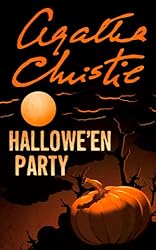
Hallowe'en Party by Agatha Christie

Hallowe’en Party begins with the party given by Mrs Drake for teenagers. One of the guests, Joyce Reynolds, a boastful thirteen-year old, who likes to draw attention to herself, announces that once she’d witnessed a murder. It seems nobody believed her and yet later on she is found dead, drowned in the tub used for the bobbing for apples game – someone had believed her and had killed her. Mrs Ariadne Oliver was at the party and she asks Poirot to help in finding the murderer.

This is one of Agatha Christie’s later books, first published in 1969, when she was approaching 80, and although I did like it for the most part, it is certainly not one of her best. It’s not terribly coherent and it lacks focus in parts as several characters, not sharply defined, are introduced along with a lot of detail and repetition. The plot, as usual in Agatha Christie’s murder mysteries is convoluted with lots of red herrings and loose ends. I thought the revelation of one of the character’s parenthood at the end was just too contrived to be believable. There are meandering and critical conversations about the ‘young people today’ and the state of the mental health service, with overcrowded mental homes, which so many of the characters thought must be the cause of the murder.

… so doctors say “Let him of her lead a normal life. Go back and live with his relatives, etc. And then the nasty bit of goods, or the poor afflicted fellow, whichever way you like to look at it, gets the urge again and another young woman goes out walking and is found in a gravel pit, or is silly enough to take lifts in a car. (page 37)

So it is down to Poirot to discover the real motive, but not before there is another murder. He investigates the possibility that Joyce was telling the truth and asks retired Superintendent Spence, living in the area with his sister, for details of any local deaths and disappearances over the past few years.

Even though I found this book less satisfying than many of Christie’s other books there are things in it that I liked. The relationship between Ariadne Oliver and Poirot for one – Poirot has to have a sip of brandy to fortify himself for the ‘ordeal’ of talking to her:

‘It’s a pity,’ he murmured to himself, ‘that she is so scatty. And yet she has originality of mind. It could be that I am going to enjoy what she is coming to tell me. It could be -‘ he reflected a minute ‘- that it may take a great deal of the evening and that it will all be excessively foolish. Eh bien, one must take one’s risks in life.’ (page 20)

And for another there is the description of a beautiful garden in a sunken quarry,  a well designed garden with the appearance of being perfectly natural. There are several pages lyrically describing this garden, which seemed to me to reflect Agatha Christie’s own interest in gardens, particularly the gardens at her house in Devon, Greenway. Seeing this garden sends Poirot into an almost mystical state of mind as he absorbed the atmosphere:

It had qualities  of magic, of enchantment, certainly of beauty, bashful beauty, yet wild. Here, if you were staging a scene in the theatre, you would have your nymphs, your fauns, you would have Greek beauty, you would have fear too. Yes, he thought, in this sunk garden there is fear. (page 93)

Overall, there are some vivid descriptions in this book – the Hallowe’en party and some of the descriptions of the teenagers ’60s style clothing for example as well as the beauty of the sunken garden, which for me compensated for its flaws. But if you haven’t read any of Agatha Christie’s books I wouldn’t recommend that you start with this one.