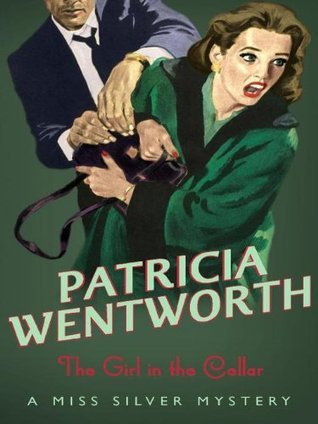
First Chapter, First Paragraph: The Girl in the Cellar

First chapterEvery Tuesday Diane at Bibliophile by the Sea hosts First Chapter First Paragraph Tuesday Intros to share the first paragraph sometimes two, of a book that she’s reading or planning to read soon.

I didn’t read any of my books for the 20 Books of Summer Challenge in July, so I’ve got some catching up to do. One of the shorter books on my list is The Girl in the Cellar by Patricia Wentworth, in which Miss Silver helps Anne, who has lost her memory, but who thinks she has witnessed a murder.

It begins:

She looked into the dead unbroken dark and had neither memory nor thought. She was not conscious of where she was, or of how she had come there. She was not conscious of anything except the darkness. She did not know if time had passed. There seemed to be no sense that it went by, but it must have done, because the moment when she knew nothing but darkness had changed into a moment in which she knew that her feet were on stone, and that she must not move from where she stood.

Blurb:

A young woman regains consciousness and finds herself on some cellar steps. At the bottom of the steps there is the corpse of a dead girl. She cannot remember who she is, what has happened or why she is there. Terrified and confused she manages to find a way out and as she flees she runs into Miss Silver, who offers to help her.

A letter in her bag is the only clue to her identity. But by investigating what has happened to her will she find herself in danger? Can she trust the letter writer? And who is the girl in the cellar?

This is a Miss Silver Mystery (there are 32 in the series), first published in 1961, the year that Patricia Wentworth died. She was born in India in 1878 and wrote dozens of best-selling mysteries being recognised as one of the ‘mistresses of classic crime.’She died in 1961 and was as popular in the 1940s as Agatha Christie and Dorothy L Sayers. Miss Silver, a contemporary of Miss Marple ‘was her finest creation‘.

What do you think? Would you keep reading? I think this opening paragraph sets the scene well, with the sense of danger and mystery to make me want to know more.

My Friday Post

Book Beginnings ButtonEvery Friday Book Beginnings on Friday is hosted by Gillion at Rose City Reader where you can share the first sentence (or so) of the book you are reading, along with your initial thoughts about the sentence, impressions of the book, or anything else the opener inspires.

This week’s book is Leaving Everything Most Loved by Jacqueline Winspear, the 10th Maisie Dobbs novel. It begins:

Prologue – London, July 1933

Edith Billings – Mrs Edith Billings, that is, proprietor of Billings’ Bakery – watched as the dark woman walked past the shop window, her black head with its oiled ebony hair appearing to bob up and down between the top shelf of cottage loaves and the middle shelf of fancy cakes as she made her way along with a confidence to her step.

Blurb:

London, 1933. Some two months after an Indian woman, Usha Pramal, is found murdered in a South London canal, her brother turns to Maisie Dobbs to find the truth about her death. Not only has Scotland Yard made no arrests, but evidence indicates they failed to conduct a full and thorough investigation. Before her death, Usha was staying at an ayah’s hostel, a refuge for Indian women whose British employers had turned them out. As Maisie learns, Usha was different from the hostel’s other lodgers. But with this discovery comes new danger – soon another Indian woman who was close to Usha is found murdered before she can speak out. As Maisie is pulled deeper into an unfamiliar yet alluring subculture, her investigation becomes clouded by the unfinished business of a previous case. And at the same time her lover, James Compton, gives her an ultimatum she cannot ignore …

Friday 56Also every Friday there is The Friday 56, hosted by Freda at Freda’s Voice.

These are the rules:

  1. Grab a book, any book.
  2. Turn to page 56, or 56% on your eReader.
  3. Find any sentence (or a few, just don’t spoil it) that grabs you.
  4. Post it.
  5. Add the URL to your post in the link on Freda’s most recent Friday 56 post.

Page 56:

Maisie felt her skin prickle when she read the more common name for the Camberwell Beauty: the Mourning Cloak. It was not a clue, not an element of great import of her investigation, but there was something in the picture before her that touched her heart. That something beautiful was so bold, yet at once so fragile.

I’ve read a few of the Maisie Dobbs books and like them. I’ve read just the first chapter of this book so far and it promises to be as good as the others. I don’t know the significance of the Camberwell Beauty butterfly but I know it under that name – not as the Mourning Cloak. It’s a rare butterfly here in the UK.

No Man’s Nightingale by Ruth Rendell

Last month I read books from my own shelves for the Mount TBR Reading Challenge (books owned before 1 January 2016) and the 20 Books of Summer Challenge, but then the urge to read other books took over, mainly because I’ve been adding books to my shelves. For the time being I won’t be reading for the Mount TBR Challenge as I have several books that I’ve acquired this year that I want to read first.

One of them is Ruth Rendell’s No Man’s Nightingale.

Blurb:

The woman vicar of St Peter’s Church may not be popular among the community of Kingsmarkham. But it still comes as a profound shock when she is found strangled in her vicarage.

Inspector Wexford is retired, but he retains a relish for solving mysteries especially when they are as close to home as this one is. So when he’s asked whether he will assist on the case, he readily agrees.

But why did the vicar die? And is anyone else in Kingsmarkham in danger? What Wexford doesn’t know is that the killer is far closer than he, or anyone else, thinks.

My thoughts:

I like Wexford, so I was predisposed to like this book (who in my mind looks like George Baker in the TV Wexford series) and I did enjoy it, although not as much as some of her other books.

Maxine Sams has several cleaning jobs, including cleaning for Reg and Dora Wexford – she talks all the time and regales Wexford with stories about her family, interrupting his reading of Gibbons’ Decline and Fall of the Roman Empire, which she thinks is a holiday guide to Rome. One of Maxine’s clients is the Reverend Sarah Hussain – and it is Maxine who finds her body, lying on the living room floor. She had been strangled.

Wexford, although enjoying his retirement, is pleased when Detective Superintendent Mike Burden asks if he would like to be involved as a consultant in the investigation into Sarah’s murder. It’s interesting to see how Wexford approaches this as he does not agree with Burden’s methods, thinking he has too many team meetings and ignores things Wexford would have concentrated on, nor can he express his opinions openly. And he isn’t sure just what he should or should not report back to Burden. As most of the book is written from Wexford’s point of view we can see how his mind works and the way he views his former colleagues and society in general and I was glad to see that as a retired person he is portrayed with an agile and observant mind.

There are plenty of red herrings and sub-plots that had me wondering as I read. At times it was rather confusing and I noticed a few continuity problems. Various issues are raised, not just the position of the elderly in society, but also questions of race and gender, religious intolerance, rape, single mothers and family relationships. I liked Wexford’s thoughts on The Decline and Fall of the Roman Empire, his musings on religion – he is a’committed atheist’ ( I don’t remember that from earlier books) and the self-doubt he reveals. I also liked the comic elements as Wexford tries to escape from Maxine’s non-stop chatter.

Overall I enjoyed the book, but think I prefer Ruth Rendell’s standalone books and those she wrote under the name of Barbara Vine.

Wycliffe and the Quiet Virgin by W J Burley

It’s that time of year again when I have less time for blogging – summer when the grass and the weeds grow in abundance. So what with that and a host of other things this post is shorter than I would like it to be.

I like W J Burley’s Wycliffe books. I’ve read several of them up to now and enjoyed each one. Set in Cornwall, they have a strong sense of place, and Wycliffe is a quiet, thoughtful detective.

In Wycliffe and the Quiet Virgin Chief Superintendent Wycliffe is staying with a Penzance lawyer, Ernest Bishop and his family for a few days over Christmas at the Bishops’ hill-top house. With his wife away in Kenya, Wycliffe is not looking forward to Christmas, and the welcome from the family is polite rather than welcoming. The situation only gets worse when a young girl goes missing after playing the part of the Virgin Mary in the local nativity play, and then her father also goes missing and her mother is found dead in their cottage. Wycliffe moves out of the Bishops’ house as it appears they may be suspects.

What follows is Wycliffe’s investigation which goes back to a crime committed five years earlier, involving many twists and turns. It was a quick and entertaining read with a lot of characters, but all are clearly distinguishable. The plot is complex and it was only as I was getting near the end that I began to have an inkling about the identity of the murderer.

W J Burley (1914 – 2002) lived near Newquay in Cornwall and was a teacher until he retired to concentrate on his writing. He wrote 22 Wycliffe novels. Wycliffe and the Quiet Virgin was the 13th, first published in 1986 and as such fits into Bev’s Vintage Mystery Cover Scavenger Hunt in the Silver Age (Vintage Mysteries first published any time from 1960 to 1989) in the category of ‘Spooky/House’ on its cover. It is also one of my 20 Books of Summer 2016.

Books Read in June

I read seven books in June, all of them ones that I’d included on my 20 Books of Summer Challenge, six of them books that qualify for the Mount TBR Reading Challenge (ie books I’ve owned prior to 1st January 2016). And I’ve managed to write about six of them – see the links to the books listed below.

  1. High Rising by Angela Thirkell (TBR) – an entertaining and witty social comedy, set in the 1930s.
  2. Talking to the Dead by Harry Bingham (TBR) – crime fiction introducing DC Fiona Griffiths, one of the most original fictional detectives I’ve come across.
  3. Asta’s Book by Barbara Vine (TBR) – a murder mystery, a missing child, a question of identity and overarching it all are the stories of two families ‘“ the Westerbys and the Ropers. A brilliant book.
  4. A Shilling for Candles by Josephine Tey (TBR) – Inspector Alan Grant investigates the apparent suicide of a young and beautiful film star, Christine Clay, who was found dead beneath the cliffs of the south coast.
  5. The Glass Room by Simon Mawer (TBR) – a gripping novel that had me on tenterhooks as well as being a beautifully written book, set in a Europe at war and its aftermath. I loved it.
  6. Heat Wave by Penelope Lively (TBR) – an in depth study of angst, frustration and conflict, set against the changing landscape of the countryside, the effect of the heat on the land, the crops and the people.
  7. Wycliffe and the Quiet Virgin by W J Burley – a search for a missing person turns into a murder case. (My post on this book to come later.)

During June I continued reading Andrew Marr’s A History of Modern Britain, which has reminded me of all the difficult times we have lived through in the years after the Second World War and continue to experience.

I’ve been reading some excellent fiction and my favourite book has to be Asta’s Book by Barbara Vine:

closely followed by The Glass Room by Simon Mawer:

Library Loot

badge-4Library Loot is a weekly event co-hosted by Claire from The Captive Reader and Linda from Silly Little Mischief that encourages bloggers to share the books they’ve checked out from the library. 

I’m trying to reduce my TBRs, but I can’t resist borrowing library books, especially when the mobile library van stops down the road, which it did last week. I was quite restrained though and only borrowed three books. They are all books in different series, that I’m reading totally out of order:

Library bks June 2016

  • The Prisoner of Heaven by Carlos Ruiz Zafon. This is part of a cycle of novels set in the literary universe of The Cemetery of Forgotten Books of which The Shadow of the Wind, which I read before I began this blog, and The Angel’s Game, which I have not read, are the first two instalments. I wondered whether it would matter that I haven’t read The Angel’s Game but a note at the beginning of The Prisoner of Heaven assures me that the cycle of books can be read in any order as each work presents an independent, self-contained tale, connected through characters and storylines, creating thematic and narrative links.

Blurb from Amazon:

It begins just before Christmas in Barcelona in 1957, one year after Daniel and Bea from THE SHADOW OF THE WIND have married. They now have a son, Julian, and are living with Daniel’s father at Sempere & Sons. Fermin still works with them and is busy preparing for his wedding to Bernarda in the New Year. However something appears to be bothering him.

Daniel is alone in the shop one morning when a mysterious figure with a pronounced limp enters. He spots one of their most precious volumes that is kept locked in a glass cabinet, a beautiful and unique illustrated edition of THE COUNT OF MONTE CRISTO. Despite the fact that the stranger seems to care little for books, he wants to buy this expensive edition. Then, to Daniel’s surprise, the man inscribes the book with the words ‘To Fermin Romero de Torres, who came back from the dead and who holds the key to the future’. This visit leads back to a story of imprisonment, betrayal and the return of a deadly rival …

From the back cover:

London, 1933. Two months after Usha Pramal, is found murdered in a South London canal, her brother turns to Maisie Dobbs to find the truth about her death, as Scotland Yard have failed to conduct a proper investigation.

Before her murder, Usha was staying at an ayah’s hostel, a refuge for Indian women whose British employers had turned them out. But nothing is as it seems and soon another Indian woman is killed before she can speak out. As Maisie is pulled deeper into an unfamiliar yet alluring subculture, her investigation becomes clouded by the unfinished business of a previous case. And at the same time her lover, James Compton, gives her an ultimatum she cannot ignore …

  • Pray for the Dying by Quintin Jardine, a Bob Skinner Mystery. There are 26 books in the series set in Edinburgh and previously I’ve read just one – Fallen Gods, the 13th book. Pray for the Dying is the 23rd. I’d been meaning to read more of these books before now as I did enjoy Fallen Gods, but quite simply other books got in the way, as they do …

Blurb:

‘After what happened, none of us can be sure we’re going to see tomorrow.’

The killing was an expert hit. Three shots through the head, as the lights dimmed at a celebrity concert in Glasgow. A most public crime, and Edinburgh Chief Constable Bob Skinner is right in the centre of the storm. The shooters were killed at the scene, but who sent them? The crisis finds Skinner taking a step that he had sworn he never would. Tasked with the investigation of the outrage, he finds himself uncovering some very murky deeds…The trail leads to London, and a confrontation that seems too much, even for him. Can the Chief solve the most challenging mystery of his career…or will failure end it?

And now I just need to find time to read them.