Notre-Dame de Paris by Victor Hugo

I have an old hardback copy of The Hunchback of Notre Dame (first published in 1831) in a very small font, too small for my eyes to cope with these days and a 49p e-book that I downloaded years ago when first got a Kindle. But I didn’t start reading it until a few months ago when FictionFan mentioned she was intending to read it and hold a Review-Along on her blog. I knew next to nothing about the book, not having seen any of the many films or TV versions, but I had read Victor Hugo’s Les Misérables back in 2008 and enjoyed it very much. So, I had high expectations that I would enjoy this one too.

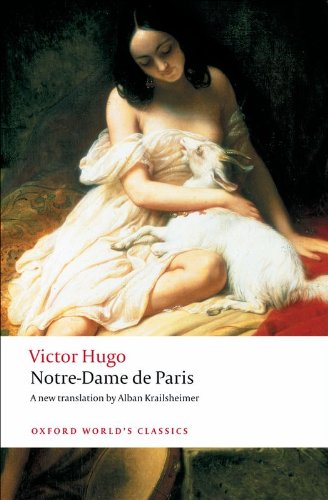
But when I began reading my e-bookI was so disappointed – I thought it was so boring and it was hard to read, the sentences stilted and stumbling and obtuse with no flow. I was tempted to abandon it, after all it is a long book, and there are plenty of other books I want to read. However, I persevered, thinking surely it would get better. It didn’t, so then I wondered if it was me or the translation and began to look for another edition and I ended up with the Oxford World Classics edition, translated and with an introduction by Alban Krailsheimer, Notre-Dame de Paris, which is so much better, so much easier to read!

Rating: 3 out of 5.

The English title is so misleading – this book is not just about the hunchback Quasimodo, the bell-ringer of Notre-Dame, it is historical fiction on a grand scale, with a large cast of characters. It revolves around four main characters – the beautiful gypsy dancer, Esmeralda who fell hopelessly in love with the handsome womaniser, Captain Phoebus de Châteaupers, who has no intentions of marrying her. She in turn is loved by Frollo, the Archdeacon of Notre-Dame and by Quasimodo, the deformed and deaf bell-ringer of the cathedral of Notre-Dame.

But that is not all – it is also the story of the cathedral itself, Notre-Dame de Paris, and Hugo describes it at great length, focusing on the Gothic architectural elements of its structure, particularly its use of the pointed arch and including its flying buttresses, clerestory windows, and stained glass. He was a great advocate for the preservation of its Gothic architecture and was also extremely upset about the changes to the cathedral, the repairs and additions that had been done over the years. And it is not just the cathedral, Hugo also devotes many pages to describing Paris, seeing it from a bird’s eye view and also to the invention of the printing press and its effect on culture, described by Hugo as ‘the greatest event in history’. These digressions were not what I expected to read – I just wanted to get on with the story. I was impatient with the digressions, but looking back at Les Mis, that is exactly what he had done in that book too, so I shouldn’t have been surprised.

The story of the main characters’ relationships is told in a complicated way, going forward and backward in time, filling in the background of the characters, whilst revolving around the events of 1482, during the reign of Louis XI (who makes an appearance in the book). And it is melodramatic, playing on all our emotions. Quasimodo was so named because he was found, abandoned on Quasimodo Sunday (that is the second Sunday after Easter) when he was four years old. He was ‘adopted’ by the sinister Archdeacon, Claude Frollo, and grew up in the cathedral, isolated by his deafness caused by all the years he’d spent ringing the bells, and feared because of his hideous appearance.

This book has everything! It is by turns a farcical comedy, a tale of obsessions and unrequited passions, of love and lust, of a terrible miscarriage of justice, of outsiders, of violent mobs, of cruelty, arrogant men, silly women, of monsters, of alchemy, of intolerance, of prejudice, jealousy, fury, torture, corruption and above all of tragedy. And it has a cast of colourful and distinct characters, that I either despised, loved or hated, including Esmeralda’s little goat Djali, who could dance and do tricks and spells (I loved Djali). It is difficult for me to love the book and equally as hard to dislike it as a whole, set firmly in its medieval time frame, against the dramatic backdrop of the cathedral (even though I grew impatient with all the architectural details). But I was convinced by the end of the book that Hugo had successfully brought the place and the people of 1482 dramatically to life for me.

My apologies to FictionFan for being nearly a week late to her Review-Along and thanks for nudging me into reading Notre-Dame de Paris at long last. I am glad I read it even if I can’t give it more than 3 stars – I  liked it, a good, enjoyable book.

Heart of Darkness by Joseph Conrad

Rating: 3 out of 5.

Heart of Darkness, a novella by Joseph Conrad, was originally a three-part series in Blackwood’s Magazine in 1899. Although a gripping story, this was not an enjoyable book for me. But then, I suppose, it is not meant to be. Conrad was writing about the inhumanity of the way the native population in Africa was treated; the greed and cruelty of the Europeans to gain property, business, trade and profit, draining Africa of its natural resources. It paints an appalling picture.

It is a story within a story and has an inner core of mystery. It relates the story told by Charlie Marlow to his friends on a cruising yawl on the Thames as the day ended and dusk fell. He began by saying ‘this also … has been one of the dark places of the earth.‘ He was referring to the Roman invasion of the British Isles centuries earlier, feeling the utter savagery that closed around them as they set out to conquer the land.

Then he went on to tell them about another ‘dark place‘ where he worked as the skipper of a river steamboat, travelling up and down an unnamed mighty African river (assumed to be the Congo) between the stations of an ivory trading business. He hears about the mysterious Mr Kurtz, the ivory trading company’s agent in the interior. He was said to have supernatural powers. What happened to Kurtz, or rather, what Kurtz did, and what he became, were the questions I pondered as I read on. Marlow set out to find Kurtz, which took him deep into the jungle, and also deeper into the heart of the ‘Dark Continent’ and into the darkness of the human soul. Nothing is what it seems, and the mystery surrounding Kurtz has a feverish and nightmare atmosphere. The ambiguity and the vagueness left me feeling puzzled as well as horrified at what was implied. I think it is all the more horrific for not being crystal clear.

It is an horrific tale that I think shows the darkest depths of human behaviour. In doing so Conrad highlights the prejudices and the cruelty and shows how it was at that time – the graphic reality of what happened. It is a powerful criticism of colonialism at its worst, and full of imagery, casting a spotlight on the barbarity of the so-called civilised Westerners. These few words, uttered by Kurtz concisely summarise the whole story: ‘The horror! The horror!’

Book Beginnings & The Friday 56: A Room with a View by E M Forster

Every Friday Book Beginnings on Friday is hosted by Gillion at Rose City Reader where you can share the first sentence (or so) of the book you are reading. You can also share from a book you want to highlight just because it caught your fancy.

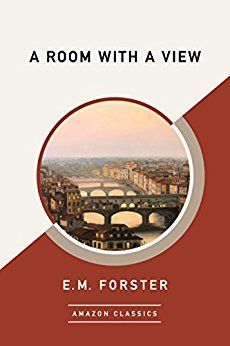
This week I’ve started to look at A Room with a View as this is the book I’ll be reading next for the Classics Club Spin. It was first published in 1908, set in Italy and England about a young woman, Florence and was E M Forster’s third book.

The Book Begins in Florence:

‘The Signora had no business to do it, said Miss Bartlett, ‘no business at all. She promised us south rooms with a view close together, instead of which here are north rooms, looking onto a courtyard, and a long way apart. Oh, Lucy!’

Also every Friday there is The Friday 56, hosted by Freda at Freda’s Voice, where you grab a book and turn to page 56 (or 56% of an eBook), find one or more interesting sentences (no spoilers), and post them.

Page 56:

The well-known world had broken up, and there emerged Florence, a magic city where people thought and did the most extraordinary things. Murder, accusations of murder, a lady clinging to one man and being rude to another – were these the daily incidents of her streets?

Synopsis from Goodreads:

Set in freewheeling Florence, Italy, and sober Surrey, England, E. M. Forster’s beloved third novel follows young Lucy Honeychurch’s journey to self-discovery at a transitional moment in British society. As Lucy is exposed to opportunities previously not afforded to women, her mind – and heart – must open. Before long, she’s in love with an “unsuitable” man and is faced with an impossible choice: follow her heart or be pressured into propriety.

A challenge to persistent Victorian ideals as well as a moving love story, A Room with a View has been celebrated for both its prescient view of women’s independence and its reminder to live an honest, authentic life.

I think I’m going to enjoy this book.

The Classics Club Spin Result

The spin number in The Classics Club Spin is number …

which for me is A Room with a View by E M Forster. The rules of the Spin are that this is the book for me to read by 30th April, 2022.

This has been on my Classics Club List for ages, so it’s time I read it – I think I saw the film years ago.

Set in freewheeling Florence, Italy, and sober Surrey, England, E. M. Forster’s beloved third novel follows young Lucy Honeychurch’s journey to self-discovery at a transitional moment in British society. As Lucy is exposed to opportunities previously not afforded to women, her mind – and heart – must open. Before long, she’s in love with an “unsuitable” man and is faced with an impossible choice: follow her heart or be pressured into propriety.

A challenge to persistent Victorian ideals as well as a moving love story, A Room with a View has been celebrated for both its prescient view of women’s independence and its reminder to live an honest, authentic life. (Goodreads)

Did you take part in the Classics Spin? What will you be reading?

John Le Carré’s Books

I have been having a sort out of both my physical and e-books and realised I have several books by John Le Carré, that I’d like to read sometime this year. I have three ‘real’ books by him and nine e-books. I’ve only read two (three now April 2022) of them!

Books shown in bold are the ones I’ve read and those in italics are the ones I own that I have yet to read. There are nine books in the Smiley series, in which the character George Smiley appears (in four out of the nine, Smiley is only a minor character). Within that series is the The Karla Trilogy (Books 5, 6 & 7).

Smiley
   1. Call for the Dead (1961) read
   2. A Murder of Quality (1962) – TBR (ebook)
   3. The Spy Who Came in from the Cold (1963) read
   4. The Looking Glass War (1965)
   5. Tinker, Tailor, Soldier, Spy (1974) read
   6. The Honourable Schoolboy (1977) read (paperback)
   7. Smiley’s People (1979) TBR (ebook)
   8. The Secret Pilgrim (1990)
   9. A Legacy of Spies (2017)

Standalone novels:

  1. A Small Town in Germany (1968)
  2. The Naive and Sentimental Lover (1971)
  3. The Little Drummer Girl (1983) – TBR (ebook)
  4. A Perfect Spy (1986) – TBR (ebook)
  5. The Russia House (1989)
  6. The Night Manager (1993) – TBR (ebook)
  7. Our Game (1995)
  8. The Tailor of Panama (1996)
  9. Single and Single (1999)
  10. The Constant Gardener (2000)- TBR (paperback)
  11. Absolute Friends (2003)
  12. The Mission Song (2006)
  13. A Most Wanted Man (2008)
  14. Our Kind of Traitor (2010) – TBR (ebook)
  15. A Delicate Truth (2013)
  16. Agent Running in the Field (2019)
  17. Silverview (2021)

As I’ve read Tinker, Tailor, Soldier Spy, the next one I’ll read is The Honourable Schoolboy.

Summary

In this classic masterwork, le Carré expands upon his extraordinary vision of a secret world as George Smiley goes on the attack.

In the wake of a demoralizing infiltration by a Soviet double agent, Smiley has been made ringmaster of the Circus (aka the British Secret Service). Determined to restore the organization’s health and reputation, and bent on revenge, Smiley thrusts his own handpicked operative into action. Jerry Westerby, “The Honourable Schoolboy,” is dispatched to the Far East. A burial ground of French, British, and American colonial cultures, the region is a fabled testing ground of patriotic allegiances and a new showdown is about to begin.

And after that as I did enjoy watching the TV adaptation of The Night Manager a while back, I might read that later on.

David Copperfield by Charles Dickens

4*

All I knew about David Copperfield: The Personal History, Adventures, Experience and Observation of David Copperfield the Younger of Blunderstone Rookery (Which He Never Meant to Publish on Any Account) by Charles Dickens is that it is said to be his most autobiographical novel. I think I must have watched a TV serialisation years ago but I remember very little about it. It was first published as a serial in 1849 and 1850, and then as a book in 1850.

It’s a long novel with a multitude of characters, including David’s cruel stepfather, Mr Murdstone, the family housekeeper Peggotty, his school friends Steerforth, who he mistakenly idolises and, my favourite character, Tommy Traddles, who has a heart of gold, and a remarkable upstanding head of hair. Then there’s another favourite character, David’s great aunt Betsey Trotwood, who wages war against marriage and donkeys and her companion, the simple-minded Mr Dick; Mr Micawber, always in debt and in and out of the debtor’s prison, and the odious and nauseating Uriah Heep are both memorable characters.

I was totally immersed in their world, enjoying the sights, sounds and smells of Victorian England, the living conditions of the poor contrasting with the decadent wealth of the rich, and the dramatic intensity of episodes such as the terrible storm at sea off Yarmouth. There’s drama, comedy and tragedy, melodrama and pathos as the story follows David’s life from his birth to his adulthood, covering his childhood, early schooldays, his time as a young boy working in a factory, then as a student in Canterbury where he lodged with the lawyer Mr Wickfield and his daughter, Agnes.

Betsey later established him in London where he worked in the Doctor’s Commons, under the tutelage of Mr Spenlow, whose daughter, the beautiful, frivolous and to my eyes, the utterly pathetic Dora totally captivated him. The sections of the book involving Dora are rather too sentimental for my liking. Then there’s Pegotty’s family – her brother Daniel, a fisherman, their nephew Ham and niece, Little Em’ly who is David’s childhood friend and sweetheart. They live in a converted boat on the beach at Yarmouth. And not forgetting Barkis, who marries Pegotty, after telling David to tell her, ‘Barkis is willing‘. Their sections of the book are the ones I enjoyed the most. I could go on and on, not forgetting David himself as describes the misfortunes and obstacles he met and the friends he makes.

I enjoyed reading David Copperfield, which was Dickens’ own personal favourite of all his novels, but it is not mine – it’s a bit too long for me. I think my favourite is Bleak House, which I read after seeing the TV adaptation in 2005 with Anna Maxwell Martin, Gillian Anderson, Denis Lawson, and Charles Dance. Maybe I’ll read it again to see what I think of it now. These days I prefer shorter books and Bleak House, like David Copperfield is long with many characters and sub-plots.