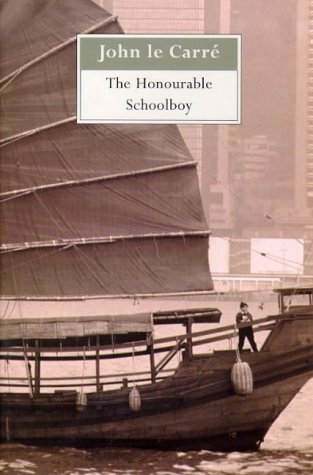
The Honourable Schoolboy by John Le Carré

Rating: 5 out of 5.

I read Tinker, Tailor, Soldier, Sailor, the first book in John le Carré’s Karla trilogy, a long time ago and I remember enjoying it very much. The story continues in the second book, The Honourable Schoolboy, which I think is brilliant. First published in 1977, it won the Gold Dagger award for the best crime novel of the year and the James Tait Black Memorial Prize.

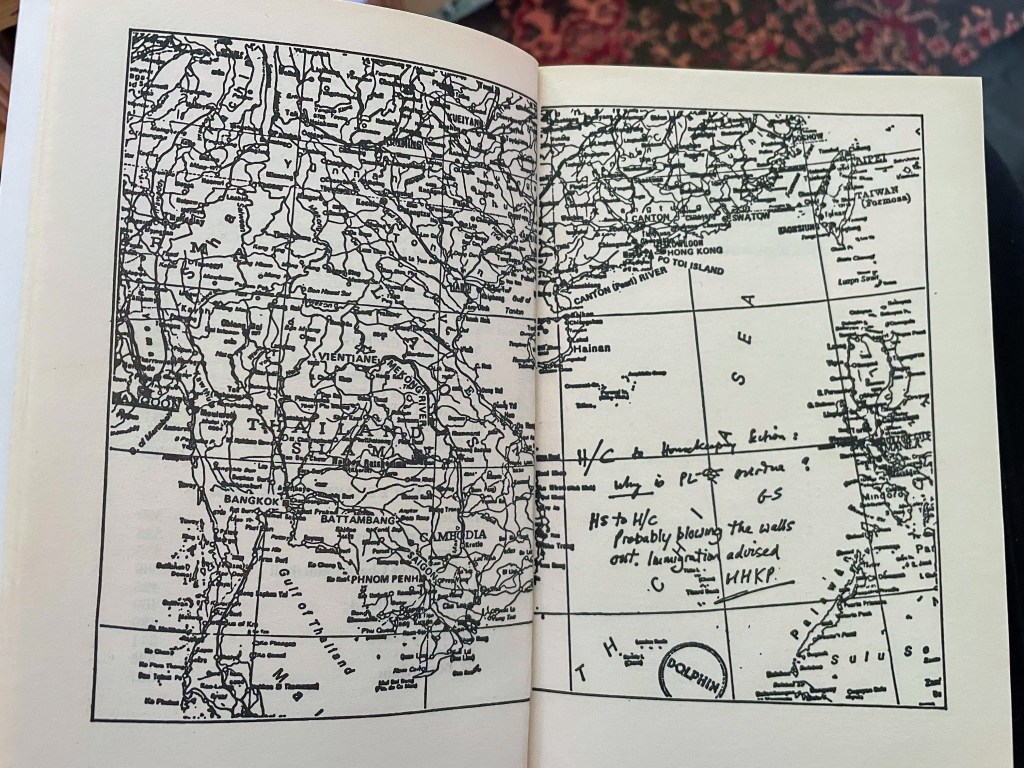
It’s wide ranging, set in 1974 in London, Hong Kong, Thailand, Vietnam, Phnom Pen (Cambodia), Vientiane (the capital and largest city of the Lao People’s Democratic Republic) Laos. My paperback copy has a map which is on such a small scale and is so detailed that it’s hardly legible. But, at least I could just about make out the main locations!

To say this has a complicated plot is a huge understatement. The amount of detail is staggering and for a while I was rather confused about what was happening. It certainly isn’t a book to read when you’re tired – you need to read it with a clear mind and be prepared to let yourself get fully immersed in the story. Tinker, Tailor, Soldier, Spy ends as George Smiley unmasks the identity of the ‘mole’, recruited by Karla, his Russian counterpart, as a spy within the British Secret Service. So, if you haven’t read Tinker, Tailor, Soldier, Spy you may want to read it before reading The Honourable Schoolboy because le Carré reveals the identity of that ‘mole’ in the first paragraph.

He then goes on to tell what happened afterwards as Smiley set about dealing with the consequences of that mole’s betrayal. He is appointed as a caretaker chief of the British Secret Service, known as ‘the Circus’, the name derived from the address of that organisation’s secret headquarters, Cambridge Circle. Smiley has Karla’s photo on his wall, determined to chase him down in revenge. Safe houses were closed and spies were recalled from abroad. In his search for Karla, Smiley sends Jerry Westerby, the eponymous Honourable Schoolboy to Hong King, undercover as a reporter, where he discovers a money laundering operation run by Moscow Intelligence and also an opium smuggling operation.

There are many characters and the action moves rapidly between Smiley in London and Westerby as he travels all over the various locations in the Far East. Le Carré’s style is clear and straight forward, the spy jargon, with the defined interwoven into the narrative, moving rapidly from one set of characters, all fully developed, to the next. Smiley, although the controlling character, is not present in much of the book. He is an enigmatic character, a lonely man, a ‘round little man in a raincoat’, as he walks alone in the evenings around the byways of London, immersed in his thoughts crammed with images, always ending in front of his own house where his estranged wife Ann lives.

From a slow start the pace steadily rose until the finale. It was gripped, eager to know how it would end. It was so much better than I thought when I began it and it’s definitely a book I’d like to re-read as I’m sure that I missed a lot in this first reading. But not right now as I’m keen to get on with the next book in the trilogy, Smiley’s People.

Cécile is Dead by Georges Simenon

Cécile is Dead by Georges Simenon, translated by Anthea Bell, an Inspector Maigret novel.

Synopsis (Amazon)

Poor Cécile! And yet she was still young. Maigret had seen her papers: barely twenty-eight years old. But it would be difficult to look more like an old maid, to move less gracefully, in spite of the care she took to be friendly and pleasant. Those black dresses that she must make for herself from bad paper patterns, that ridiculous green hat!

In the dreary suburbs of Paris, the merciless greed of a seemingly respectable woman is unearthed by her long suffering niece, and Maigret discovers the far-reaching consequences of their actions.

This novel has been published in a previous translation as Maigret and the Spinster.


My thoughts:

This is one of the best Maigret books I’ve read – and it is complicated, remarkably so in a novella of just 151 pages. At first it seems quite straight forward. Cécile has been wanting to see Detective Chief Inspector Maigret for months, sitting patiently in the ‘Aquarium’, as the waiting room at the Police Judiciaire in Paris, is known. She was convinced that someone had been breaking into her aunt’s apartment. But no one takes her seriously and Maigret is always busy, until one day he decides to see her. But she had left the waiting room, so he goes to the apartment where she lives with her elderly aunt, Juliette Boynet, the owner of the apartment building. She wasn’t there, but her aunt was – lying dead on the floor, strangled. Cécile was missing and the title tells you why – she was indeed dead.

And from then on, the mystery became more complex, with several suspects with a variety of motives. Juliette was very wealthy, but also miserly. She had a large family, mostly estranged from her and at odds with each other. They all turn up for her funeral, arguing about who should take precedence in the funeral cortège, and about who should inherit her money and property.

Maigret has to sort it out in his own way – musing over the details and feeling bad that he hadn’t spoken to Cécile earlier, thinking her worry over an intruder who just moved things around the apartment without taking anything was trivial. We see more of how he thinks and works when later in the investigation he is accompanied by an American, a Mr Spencer Oates from the Institute of Criminology of Philadelphia, who had asked if he could study Maigret’s methods.

This is the second time I’ve read Cécile is Dead. I first read it in 2018, but didn’t write about it at that time. Reading it for the second time, I realised I had forgotten all the details – it was like reading a new book. I thoroughly enjoyed it. It is either the 20th or the 22nd Maigret novel – Amazon records it as the 20th, whereas Goodreads has it as the 22nd! Whichever it is, it is a good read.

  • ASIN ‏ : ‎ B00SSKM6OC
  • Publisher ‏ : ‎ Penguin (4 Jun. 2015)
  • Print length ‏ : ‎ 151 pages
  • Source: I bought the e-book
  • My Rating: 4*

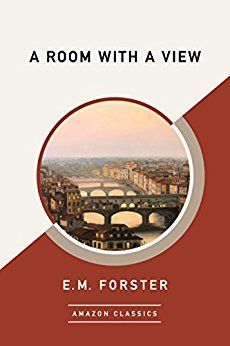
A Room with a View by E M Forster

A Room with a View by E M Forster is an early twentieth century comedy of manners, satirising the manners and social conventions of Vistorian/Edwardian society. It is Forster’s third novel, first published in 1908, a short novel of 161 pages and is light reading with some humorous dialogue.

Rating: 4 out of 5.

Lucy has her rigid, middle-class life mapped out for her, until she visits Florence with her uptight cousin Charlotte, and finds her neatly ordered existence thrown off balance. Her eyes are opened by the unconventional characters she meets at the Pension Bertolini: flamboyant romantic novelist Eleanor Lavish, the Cockney Signora, curious Mr Emerson and, most of all, his passionate son George.

Lucy finds herself torn between the intensity of life in Italy and the repressed morals of Edwardian England, personified in her terminally dull fiancé Cecil Vyse. Will she ever learn to follow her own heart? (Goodreads)

My thoughts:

I enjoyed Forster’s A Passage to India years ago and was looking forward to reading A Room with a View. Overall I enjoyed it, although I was rather underwhelmed by it and even in parts bored, especially near the end of the book, where there are some philosophical paragraphs that left me thinking I didn’t really understand them. It is about a young woman, Lucy Honeychurch, and her journey to self-discovery as she breaks out of the restrained culture of Edwardian England. It’s also a romance. The writing is ambiguous at times, so that you have to read between the lines in places.

It begins in Florence where Lucy is staying at the Pensione Bertolini, with her older cousin and chaperone Charlotte Bartlett. At dinner, they were complaining that their rooms didn’t have views over the River Arno as they had been promised.They were rather taken aback by two other guests, a Mr Emerson and his son George who offered to swap rooms with them. The Emersons are not bound by the conventions of the day and Charlotte considers they are ill-bred. But Lucy is attracted by the Emersons’ free thinking ideas. They spend time in Florence visiting various locations including the Santa Croce church, the Piazza Della Signoria and the San Miniato church, with its beautiful facade, and take a trip into the hills. Lucy finds herself in a little open terrace, covered in violets:

From her feet the ground sloped sharply into view, and violets ran down in rivulets and streams and cataracts, irrigating the hillside with blue, eddying round the tree stems collecting into pools in the hollows, covering the grass with spots of azure foam.

And it is there on that terrace that she comes across George and she is shocked and delighted, I think, when he kisses her. Charlotte witnesses the scene and urges/persuades Lucy to move to Rome where she meets Cecil Vyse, a most boring and priggish young man, whom she knew in England. The second half of the book takes place in England at Lucy’s home at Windy Corner where we meet the rest of her family and Lucy has to decide between the insufferable Cecil and the unconventional George. Will she give into convention or will she choose George, despite opposition from her family?

E M Forster from Goodreads:

Edward Morgan Forster, generally published as E.M. Forster, was an novelist, essayist, and short story writer. He is known best for his ironic and well-plotted novels examining class difference and hypocrisy in early 20th-century British society. His humanistic impulse toward understanding and sympathy may be aptly summed up in the epigraph to his 1910 novel Howards End: “Only connect”.

He had five novels published in his lifetime, achieving his greatest success with A Passage to India (1924) which takes as its subject the relationship between East and West, seen through the lens of India in the later days of the British Raj.

Forster’s views as a secular humanist are at the heart of his work, which often depicts the pursuit of personal connections in spite of the restrictions of contemporary society. He is noted for his use of symbolism as a technique in his novels, and he has been criticised for his attachment to mysticism. His other works include Where Angels Fear to Tread (1905), The Longest Journey (1907), A Room with a View (1908) and Maurice (1971), his posthumously published novel which tells of the coming of age of an explicitly gay male character.

A Room with a View was my Classics Club Spin book to read between 20th March and the 30th April. It is on my Classics Club list and it counts toward the Back to the Classics Challenge (as a 20th century classic).

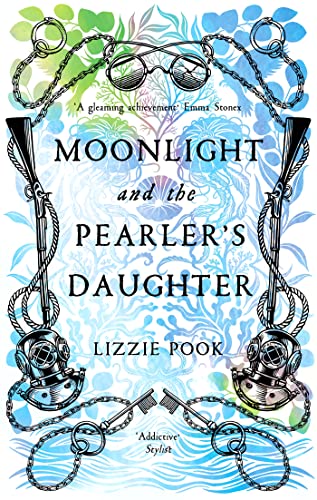
Moonlight and the Pearler’s Daughter by Lizzie Pook

Mantle| 3 March 2022| 304 pages| e-book| Review copy| 3*

1886, BANNIN BAY, AUSTRALIA.

The Brightwell family has sailed from England to make their new home in Western Australia. Ten-year-old Eliza knows little of what awaits them on these shores beyond shining pearls and shells like soup plates – the things her father has promised will make their fortune.

~~~

Ten years later and Charles Brightwell, now the bay’s most prolific pearler, goes missing from his ship while out at sea. Whispers from the townsfolk suggest mutiny and murder, but headstrong Eliza, convinced there is more to the story, refuses to believe her father is dead, and it falls to her to ask the questions no one else dares consider.

But in a town teeming with corruption, prejudice and blackmail, Eliza soon learns that the truth can cost more than pearls, and she must decide just how much she is willing to pay – and how far she is willing to go – to find it . . .

My thoughts:

I knew about diving for pearls, but I knew nothing about pearlers – the pearl divers/the people who trade in pearls – so I thought Moonlight and the Pearler’s Daughter would be a good way to find out more about it. And it is – I learned a lot. It has a great sense of both time and place. Although Bannin Bay is a fictional town in Western Australia its geography is modelled on parts of the north-west Kimberley coast. Lizzie Pook’s research, which she details in her Historical and Cultural Note at the end of the book, is fascinating. Her descriptive writing is very good and I felt that I was transported back to 19th century Australia experiencing the sights and smells of the coastal town and witnessing the appalling abuse and violence dealt out to the aboriginals who were forced to become pearl divers.

And I was also convinced by the main characters, Eliza in particular who comes across as a determined young woman, not cowed into conforming with the behaviour expected of women in the local community. She does everything she can to find out what happened to Charles, her father when he doesn’t return with his ship, the White Starling. It seems he just disappeared and no one can tell her what happened to him. She finds his diary and realises that there must be a reason why he didn’t take it with him as he always did. It contains detailed information about shell-beds, stars, storms, sharks and life at sea, but she also finds a sheet of paper between its pages with a cryptic clue she is convinced will help her find him. The police assume he went overboard and arrest one of the aboriginal divers for his murder. But Eliza is convinced that he is not dead and helped by Axel Kramer, a German and a newcomer to Bannin Bay, she sets sail on his lugger, Moonlight to search for him.

The book starts slowly, building up a picture of the town, its inhabitants, and landscape, and builds to a crescendo as Eliza’s search takes a dramatic turn when the Moonlight is caught up in a terrible storm putting their lives in danger. I enjoyed the book, just as much for its historical detail and vivid descriptions of the landscape and wildlife, as for the mystery of Charles’ disappearance.


Heart of Darkness by Joseph Conrad

Rating: 3 out of 5.

Heart of Darkness, a novella by Joseph Conrad, was originally a three-part series in Blackwood’s Magazine in 1899. Although a gripping story, this was not an enjoyable book for me. But then, I suppose, it is not meant to be. Conrad was writing about the inhumanity of the way the native population in Africa was treated; the greed and cruelty of the Europeans to gain property, business, trade and profit, draining Africa of its natural resources. It paints an appalling picture.

It is a story within a story and has an inner core of mystery. It relates the story told by Charlie Marlow to his friends on a cruising yawl on the Thames as the day ended and dusk fell. He began by saying ‘this also … has been one of the dark places of the earth.‘ He was referring to the Roman invasion of the British Isles centuries earlier, feeling the utter savagery that closed around them as they set out to conquer the land.

Then he went on to tell them about another ‘dark place‘ where he worked as the skipper of a river steamboat, travelling up and down an unnamed mighty African river (assumed to be the Congo) between the stations of an ivory trading business. He hears about the mysterious Mr Kurtz, the ivory trading company’s agent in the interior. He was said to have supernatural powers. What happened to Kurtz, or rather, what Kurtz did, and what he became, were the questions I pondered as I read on. Marlow set out to find Kurtz, which took him deep into the jungle, and also deeper into the heart of the ‘Dark Continent’ and into the darkness of the human soul. Nothing is what it seems, and the mystery surrounding Kurtz has a feverish and nightmare atmosphere. The ambiguity and the vagueness left me feeling puzzled as well as horrified at what was implied. I think it is all the more horrific for not being crystal clear.

It is an horrific tale that I think shows the darkest depths of human behaviour. In doing so Conrad highlights the prejudices and the cruelty and shows how it was at that time – the graphic reality of what happened. It is a powerful criticism of colonialism at its worst, and full of imagery, casting a spotlight on the barbarity of the so-called civilised Westerners. These few words, uttered by Kurtz concisely summarise the whole story: ‘The horror! The horror!’

The Red Monarch by Bella Ellis

Hodder and Stoughton| 18 November 2021| 326 pages| e-book| Review copy| 3*

Blurb

The Brontë sisters’ first poetry collection has just been published, potentially marking an end to their careers as amateur detectors, when Anne receives a letter from her former pupil Lydia Robinson.

Lydia has eloped with a young actor, Harry Roxby, and following her disinheritance, the couple been living in poverty in London. Harry has become embroiled with a criminal gang and is in terrible danger after allegedly losing something very valuable that he was meant to deliver to their leader. The desperate and heavily pregnant Lydia has a week to return what her husband supposedly stole, or he will be killed. She knows there are few people who she can turn to in this time of need, but the sisters agree to help Lydia, beginning a race against time to save Harry’s life.

In doing so, our intrepid sisters come face to face with a terrifying adversary whom even the toughest of the slum-dwellers are afraid of . . . The Red Monarch.


The Red Monarch is the third Brontë Mystery book in which the main characters are the three Brontë sisters, Charlotte, Emily and Anne and their brother Branwell. I’ve read the first two and enjoyed them. But when I came across the first book I wasn’t at all sure I wanted to read it, as I’m never very keen on books that use real people as fictional characters. So, I was delighted to find that I thoroughly enjoyed the books even though, of course, the stories about the Brontës being ‘detectors’, or amateur sleuths, are pure imagination. The setting in the Yorkshire Moors is superb, the characters came across as ‘real’ and the books are well plotted.

And so, I was looking forward to reading The Red Monarch and it began well in Haworth in August 1852 as Charlotte is trying to write Villette. She is in despair after the deaths of her siblings – Emily and Branwell in 1848, and Anne in 1849. Instead of writing she reads a little notebook containing Emily’s poems and one particular poem brought back to her the dreadful events that had taken place and the terrors and cruelties they had seen, on their excursion to London. It had all taken place just after the Brontë sisters’ first poetry collection had been published – in 1846.

It was at this point, right at the beginning of the story about their time in London, that I thought I was reading a completely different type of mystery from the earlier books – not only is in not set in Yorkshire this book is a gothic melodrama. In a terrifying attack on Lydia and her husband Harry, a gang of thieves and murderers, led by Noose, had burst into Harry and Lydia’s bedroom. They had seized Harry and threatened to kill him unless Lydia brought them the jewel that Harry had been ordered to collect. Lydia, who was pregnant, had seven days to save their lives. But it is the Red Monarch, who was in control of the gang, and who held them all under his control – a most villainous and fearsome gangster. In desperation Lydia wrote to Anne for help.

The story is melodramatic, sensational and fast-paced. It is told through each of the sisters’ eyes, each one clearly distinctive, whilst Emily (once more) is the standout character. They are all independent women, strong-willed and determined and as Victorian women, vastly underestimated by the men. But, I had a hard time accepting the Brontë sisters in this story. Whereas in the two previous books I could believe that the Brontë family were just as Bella Ellis has described them, in this book I couldn’t.

The descriptions of mid 19th century London are vivid, clearly depicting the filthy living conditions of the poor, the sights and foul smells. The details of the Brontës’ search for Harry and the missing jewel test their strength, courage and skill in detection.

There are a few other real people who play a minor role, notably Charles Dickens, who is dismissive when Charlotte, somewhat in awe of him, asks for his advice as a writer, telling her to abandon any ideas of being a novelist and to marry, or teach. His companion, Mrs Catherine Crowe, another real author who wrote supernatural tales, was much more approachable and friendly, contacting her spirit friends to help with Charlotte’s search as well as giving her useful advice as a writer. Another character, with a larger role, is Louis Parensell, who develops a passion for Emily. He was not a real person, but Virginia Moore, a Brontë biographer, misread the handwritten title of Emily’s poem ‘Love’s Farewell’ as ‘Louis Parensell’, and developed the theory that Louis was Emily’s secret lover.

As the novel reached its dramatic climax, Emily in particular is in danger of losing her life as she dared to challenge the Red Monarch. I was most interested in the identity of The Red Monarch – was he in fact a real person, or totally fictitious? There various references to him throughout the novel, what was the origin of his name, and what was the meaning of his insignia? It seemed to be two capital Rs back to back topped with a crown and contained within a five-pointed star of pentagram. Anne had first discovered them and she felt sure they carried a secret meaning to those in know. When the identity of the Red Monarch is finally revealed I was surprised – but it is appropriate in that the real person has been described as a maniacal, controlling man.

I enjoyed this book, but I think the two previous books are much better and seem more authentic, aided by being set in the Brontës’ Yorkshire. They were out of place in London. It all seems to me to be over dramatic and unbelievable. The fictional element far outweighs the historical.

~~~

‘Bella Ellis’ is the Brontë-inspired pen name for the author Rowan Coleman, who has been a Brontë devotee for most of her life. As well as writing the Brontë Mysteries she is the .author of sixteen novels including the Richard and Judy pick The Memory Book and the Zoe Ball bookclub choice, The Summer of Impossible Things.

My thanks to Hodder Stoughton for a review copy via NetGalley