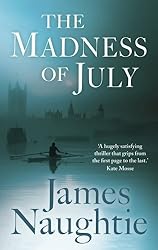
The Madness of July by James Naughtie

When I began reading The Madness of July I was immediately drawn into the story. I used many markers as I read it because it has such a complicated plot. It’s a political thriller set in London in the mid 1970s one sweltering July as Will Flemyng the foreign office minister and former spy finds himself drawn back into the world of espionage, a world of deception, manipulation and diplomacy. It’s the Cold War period and Will discovers politics can be just as dangerous as espionage.

I really wasn’t sure what was going on at first, not sure what was relevant for me to remember and understand, not even sure who was who as the narrative switched between London, New York, Washington and the Highlands of Scotland. So there were times when I had to backtrack when I came across a character or an event, that turned out to be important to the story, which I hadn’t realised earlier on. The characters know what has gone before, know each other, know what they are talking about – but we don’t.

In a different book this would be a major drawback – in this book it is necessary. It’s as though we’re peering through the fog, until gradually the fog lifts and things become clearer. Or it’s like beginning a cryptic crossword where you have all the clues and no idea about the answers. Anyway, I loved it. If the content isn’t too clear at first the writing is, Naughtie uses beautiful imagery and the characters are vividly drawn, in particular the part set in Scotland at Altnabuie, the Flemyngs Highland estate:

At Altnabuie, they woke to a trembling dawn. Flemyng had raised his bedroom window before turning in, and when he opened his eyes, very early, he could smell the highlands. There was a edge to the warmth and the damp, and the tang of tree and field lured him on. He looked towards the loch and saw swirls of mist rising up in thin pillars, like the guilty secrets of hidden smokers, leaving a thin topping of white cotton on the water that crept over the surface and was beginning to disperse here and there with the coming of a soft breeze. It would be gone within the hour. The herons were on their favourite stone, prim and still like a pair of disapproving clerks. The crows cawed in the woods beyond, and behind him, on the eastern side of the house where the sun was already giving life to the place, he could hear the cockerel at work. Everything was crisp and clean, the stifling urban fog a world away. (page 173)

The events that July take place over just 6 days. An American, Joe Manson dies, apparently of an overdose and is found in a store cupboard (it was a large one full of boxes and all sorts of spare objects) in the House of Commons – except that as the House is technically a royal palace deaths are not allowed and bodies have to be discreetly removed and ‘expire’ elsewhere. And thus begins a political crisis – who was Manson, how did he die, what did he know, what had he said – and to whom? And there is a letter on House of Commons notepaper that Will found on the photocopier – an anonymous letter that is puzzling him, a letter from someone who is desperate and who feels he/she is being driven insane.

A secondary plot, but to my mind just as interesting, maybe even more so, concerns Will and his family. He has two brothers, an older on, Mungo who lives at Altnabuie, and a younger one, Abel, who goes by the name of Grauber, their mother’s maiden name, and lives in New York. Mungo has been researching their family history and has discovered a secret about their mother that he finds disconcerting, even frightening.

And the madness? At one point Flemyng, talking about politics says that the rules of the game mean that you have to behave irrationally. A point is reached where you invited destruction, he’d said, as if it were inevitable. ‘Maybe madness isn’t an aberration, but the natural end to our game.’ Everyone aspired to it in politics, even if they didn’t recognise it for what it was. (page 110)

Madness has been haunting Flemyng: Because in these corridors – balance and rational though we believe ourselves to be – there’s madness on the loose. (page 326)

If you like a quick easy read, then The Madness of July is not the book for you. It, however, like me, you like a book that makes you think, that keeps you on your toes as you read, that both puzzles and entertains you, then you’ll probably enjoy it as much as I did.

James Naughtie (pronounced Nochtee, or ‘“ /ˈnɔːxti/ as it is given in Wikipedia, which doesn’t mean anything to me) is a British radio and news presenter for the BBC. From 1994 until 2015 he was one of the main presenters of Radio 4’s Today programme. He is now a ‘Special Correspondent’ with ‘responsibility for charting the course of the constitutional changes at the heart of the UK political debate’, as well as the BBC News’s Books Editor, contributing a book review to the Saturday morning editions of Today. The Madness of July is his first novel. He has also written books on politics and music. He was born in Aberdeenshire and lives in Edinburgh and London.

His second novel, Paris Spring, also featuring Will Flemyng, is due to be published in April this year.

…………………….

Reading Challenge: Read Scotland 2016 and What’s in  Name? 2016 – in the category of a book with a month of the year in the title.
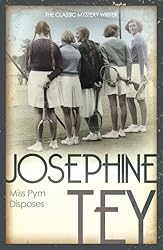
Miss Pym Disposes by Josephine Tey

Josephine Tey was a pseudonym for Elizabeth Mackintosh(1896 ‘“ 1952). She was a Scottish author who wrote mainly mystery novels (see the list at the end of this post). I read The Daughter of Time some years ago and thought it was an excellent book, a mix of historical research and detective work. Inspector Alan Grant is in hospital and to keep his mind occupied he decides to discover whether Richard III really did murder his nephews ‘“ the Princes in the Tower. I’ve also read The Franchise Affair, which I thought was also an excellent book.

I bought Miss Pym Disposes at the local village hall when I went to vote  in the European Election in June 2014. There was a table full of books for sale ‘“ nothing to do with the election, but a bonus for me! Based on the other two books I’d read by Tey I thought it would be a good buy. And it was. It is set in the 1940s and was first published in 1946.

I knew from the synopsis that Miss Pym was pleased and flattered to be invited to Leys Physical Training College to give a lecture on psychology. But then there was a’nasty accident‘.

So I was wondering about that ‘nasty accident’ as I began reading the book – who has the accident and is it really an accident, and if so who was responsible for the accident? It all seemed to be plain sailing until something happened that nobody expected and it was that that triggered the ‘accident’. It was intriguing and very cleverly written.

There is a long build up to the accident.  Miss Pym had been a French teacher at a girls’ High School until she inherited some money, left teaching and wrote a best-selling psychology book. She was invited to Leys by her old school friend, Henrietta Hodge, the college Principal and stayed on there for a few days, that extended into two weeks as she got to know and like the students and the staff. However, she realises that all is not as perfect at the college as she had thought, alerted to that fact that when one of the students, Teresa Desterro, tells her that everyone is just a little bit insane in this last week of term – ‘It is not a normal life they lead. You cannot expect them to be normal.‘ Miss Pym observes how strenuous their studies are and the stress and anxiety the senior students go through in their final exams and learn where Henrietta has found jobs for them, or if she has found jobs for them.

This is not a conventional crime fiction novel. It’s a psychological study focussing on the characters, their motivation and analysis of facial characteristics. It looks at the consequences of what people do and say and, as Miss Pym discovers who she thinks is responsible, it also looks at how much a person should intervene, or as one of the characters tells her, ‘Do the obvious right thing, and let God dispose.’ Miss Pym agonises over her decision, was she really going to condemn someone to death?

I thoroughly enjoyed this book, such a delight to read, a book that is beautifully written. I thought the slow build up to the ‘accident’ was perfect and I kept changing my mind about who would be involved – and it has such a good twist at the end.

It is the ideal book for these challenges: Bev’s Mount TBR Reading Challenge, her Vintage Mystery Cover Scavenger Hunt in the category ‘More Than Two people’, and Peggy Ann’s Read Scotland Challenge.

Josephine Tey’s books:

Alan Grant
The Man in the Queue (1929) aka Killer in the Crowd
A Shilling for Candles (1936) (the basis of Hitchcock’s 1937 movie Young and Innocent)
The Franchise Affair (1948) (my review)
To Love and Be Wise (1950)
The Daughter of Time (1951)
The Singing Sands (1952)

Novels
Kif: an Unvarnished History (1929) (writing as Gordon Daviot)
The Expensive Halo (1931)
Miss Pym Disposes (1946)
Brat Farrar (1949) aka Come and Kill Me
The Privateer (1952)
Non-Fiction

Claverhouse (1937) (writing as Gordon Daviot) A biography of John Graham of Claverhouse, 1st Viscount Dundee (1648 – 1689), known as “Bonnie Dundee” after leading the Jacobites to victory at the Battle of Killiecrankie in 1689, in which he lost his life.

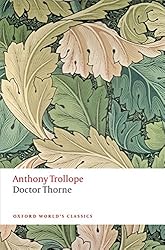
Doctor Thorne by Anthony Trollope

I’ve recently read Anthony Trollope’s Doctor Thorne, which I’d meant to read about a year ago after I finished Barchester Towers! I enjoyed it, although I think it’s a bit too drawn out – I could see where the plot was going very early in the book. The conclusion is predictable.

But that didn’t matter as it’s a book about mid nineteenth-century prosperous country life and the traditional attitudes towards the accepted codes of conduct, of the importance of birth, of wealth and above all about money, class and power. It’s about human relationships and the strength of the novel is in the portraits of its characters and their responses to matters of principle in the face of upper class idiocy and snobbishness. Trollope uses gentle satire in this novel, emphasising the absurdities of the class divisions in society and poking fun at the professions, with the names of doctors, such as Dr Fillgrave, whose name wouldn’t inspire me with confidence, parliamentary agents such as Mr Nearthewind and Mr Closerstil and lawyers called Messrs Slow and Bideawhile.

Doctor Thorne is the third in Trollope’s Barchester Towers books – the first one not set in Barchester, but in Greshambury in East Barsetshire, where the Gresham family and Doctor Thorne and his niece Mary live. As the novel opens nothing is going well for the Gresham family, they are in financial difficulties, the estate is mortgaged and they are heavily in debt. It is imperative that Frank, the son and heir to Greshambury Park and its estate, should marry money – indeed, his mother, Lady Arabella, the sister of the Earl de Courcy insists ‘He must marry money‘, a refrain that is repeated throughout the novel. But Frank has fallen in love with Mary, who has neither money or rank, and is illegitimate and as the story proceeds she is increasingly ostracised by the Gresham family, egged on by their rich relations the De Courcys.

Although the book is called Doctor Thorne, the main character to my mind is Mary Thorne, who shows great strength of character throughout. Mary had been adopted by Doctor Thorne, after her father, his brother had been murdered by her mother’s brother. Her mother had left England for America, where she had married and had a family. The brother, meanwhile had done well for himself after he left prison and made a fortune. Mary knows nothing of her background.

I particularly liked Miss Dunstable, the daughter of ‘the ointment of Lebanon man‘, who had inherited £200,000 when he had died recently. The Gresham family, or rather Lady Arabella, instruct Frank that he is to ask her to marry him – her wealth over-riding the fact that her father was a tradesman.

My only criticism of this book is that the discussions about whether Frank and Mary should or should not be allowed to marry are too drawn out and slowed down the plot too much for my liking. Apart from that I thought it was good, Trollope’s authorial comments were interesting, the dialogue was realistic and lively and the main characters came over as real people. An entertaining novel and now I’m keen to read the next Barchester Towers book, Framley Parsonage; Doctor Thorne also appears in this book!

In his Autobiography Trollope wrote that he had been trying to think up a new plot and he asked his brother to sketch one for him, which he did! He thought it was a good plot and the book was, he believed, the most popular book he had written. He was surprised by its success.

After I finished reading Doctor Thorne I realised that it was a perfect choice for the What’s in a Name? Challenge in the category of a book with a profession in the title. It’s a book I’ve had since before 1 January 2016 and fits into the Mount TRB Reading Challenge too and it’s also a book I identified for the Classics Club Challenge.

I wanted to read Doctor Thorne before the three-part adaptation of the book that starts tonight on ITV at 9 pm, so that my reaction to it wouldn’t be influenced. Now that I have read it I’m not at all sure I’ll watch the adaptation. If there are too many changes I know it will irritate me.

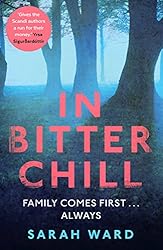
In Bitter Chill by Sarah Ward

I’ve made a great start to 2016 with the first book I’ve read this year. In Bitter Chill by Sarah Ward is her debut novel and it is excellent. I’ve been enjoying her book blog, Crimepieces, for a while now, so when I saw that she had published a book, I knew I had to read it. It will certainly be on my list of favourite books at the end of the year.

This is just the sort of book I love – excellent storytelling, moving smoothly between the past and the present as the secrets from the past gradually emerge, great characterisation and a superb location in the Derbyshire Peak District that Sarah Ward obviously knows very well. It is also a complex and puzzling mystery that kept me glued to the book.

In January 1978 two eight-year old girls, Rachel Jones and Sophie Jenkins were walking to school together when a strange woman offered them a lift in her car. Rachel is later found in Truscott Woods but Sophie was never found.  Move forward 30 years when Sophie’s mother commits suicide. Troubled by Yvonne Jenkin’s suicide, the police reopen the case – Superintendent Llewellyn who was on the original team asks DI Francis Sadler and his team, DC Connie Childs and DS Damian Palmer to see if there was anything that had been missed in 1978.

Rachel has very little memory of the kidnapping as she was drugged and she has nothing to add to the statement she made as a child. But prompted by Yvonne’s suicide she tries to remember what had happened and as she is a genealogist her research into her own family history proves to be invaluable. The questions are which child was the target, why was Rachel the only one to escape and what is the significance of her missing socks? The tension and mystery ramp up with a modern day murder, when Mrs Lander, one of the teachers at the girls’ school is found dead in the woods where Rachel was discovered 30 years earlier.

As I read I jotted down a few points that I thought were relevant. These were socks, illegitimacy, missing fathers and was Mrs Lander’s murder connected to the kidnapping and Yvonne’s suicide? It was only near the end of the book that I worked out why these points were relevant.

Connie was my favourite police officer and I liked the relationship between her and Sadler and the competition between her Sergeant Damian Palmer. I also liked the fact that although there are violent deaths in this book they are not described graphically. The weather gets colder and colder as the chilling events unfold and the devastating family secrets are revealed.

This is a powerful and well written crime fiction novel, one that I enjoyed immensely. I’m glad that there is to be a sequel, A Fragile Spring, which will be published later this year. I’m definitely looking forward to reading it.

Reading Challenges in 2016

I’ve been thinking about reading challenges. Each year I see other bloggers setting out their reading challenges and I get keen to join a lot of them.

But what is a ‘challenge’? Dictionary definitions include –

a difficult or demanding task, esp. one seen as a test of one’s abilities or character.

or – an invitation or summons to a trial or contest of any kind; a defiance.

So, I don’t need reading challenges –  reading books is not a difficult or demanding task, and I don’t want to treat my reading as a contest either with others or with myself, by reading either more books or different types of books. I already read as many books as my time allows and I love variety in my reading.

So why do I join reading challenges? It’s because I love reading and I also love making lists and ticking off the books I’ve read. I love looking through my books and seeing which ones will qualify for each challenge. I also like seeing what others are reading, books I may not have heard about. I like the camaraderie, of finding others who love the same type of books as me, of exchanging comments or recommendations.

But each year I find it can become a bind, reading to a set list and I want to branch out and read something different, books not on the lists, books that suddenly seem more enticing.

The ‘challenge’ I enjoyed the most last year was Reading Bingo 2015, that I did at the end of November. It involved looking back at the books I read during the year and fitting them into the relevant squares on the card. In other words read what you want first and then see if they meet the categories on the card.

This is why I’m cutting down on the number of challenges I join.

These are the challenges I’ll be taking part in, by reading and then slotting the books into the various categories:

  • Mount TBR hosted by Bev at My Reader’s Block –  this helps me remember to read books that I already own, which for this challenge are books I’ve owned before 1 January 2016.
  • Read Scotland hosted by Peggy Ann at Peggy Ann’s Post – I’ve taken part in this for the last two years and have found that without trying I naturally read books by Scottish authors/books set in Scotland. So for this challenge I’ll see at the end of the year how many I’ve read.
  • What’s In a Name? hosted by Charlie at The Worm Hole – I’ve done this challenge ever since it started and it would be a shame to stop now. It only involves reading 6 books and I’m going to treat it in the same way as Read Scotland by seeing at the end of the year if the books I’ve read slot into the categories.

I’ll also be taking part in Heavenali’s Virginia Woolf read-a-long, reading what I can when I can.

And because I do like making lists I’ll be doing various projects of my own reading and listing books in a variety of genres, such as historical fiction and non-fiction, as my mood and interests lead me, but not linking up to any challenges.

2015 Challenges Wrap Up

In 2015 I took part in several challenges. I completed half of them and made good inroads into the rest.

  1. Agatha Christie Reading Challenge‘“ ongoing – I read 6 books by Agatha Christie. I’ve nearly completed this challenge with just 3 of her full length novels to read. I still have a long way to go to read all her short stories!
  2. Mount TBR Challenge 2015 – I was aiming to reach the summit of Mt Ararat (48 books) and made it to the foothills by reading 39 of my TBR books (that is books I owned before 1 January 2015)
  3. Color Coded Challenge 2015 – completed by reading nine books in different colour categories, either named in the title or being the dominant colour for the cover of the book.
  4. What’s in a Name 2015 – completed. This involved reading books from six categories.
  5. Victorian Bingo Challenge 2015 Completed, by reading five books in the following categories:
    1. Book published in the 1840s, ‘“ The Old Curiosity Shop by Charles Dickens
    2. Male author – Anthony Trollope: An Autobiography
    3. Female author  ‘“ Adam Bede by George Eliot
    4. Book with a name as the title – Barchester Towers by Anthony Trollope
    5. Book published in serial (monthly) format – The Dead Secret by Wilkie Collins

    Victorian Bingo card

  6. Read Scotland 2015 – completed. My target was the first level to read 1-4 books and I reached the Hebridean Level by reading 9 books.
  7. TBR Pile Challenge 2015 – partly completed by reading 8 books out of the 14 I listed.
  8. Historical Fiction Reading Challenge 2015 – My target was 25 books and I read 17 books.
  9. Nonfiction Reading Challenge 2015 – completed. I was aiming for the Seeker Level (16 – 20 books) and I read 19!
  10. 10 Books of Summer Challenge 2015 – not completed, but I read 7 out of the 10 books I listed.