A Game of Thrones by George R R Martin

‘When you play the game of thrones, you win or you die. There is no middle ground.’
22740513

When we began watching the HBO TV series, A Game of Thrones, I was hooked and once we finished watching I immediately wanted to read the series, A Song of Fire and Ice. I’d just read The Sunne in Splendour by Sharon Penman, about the Wars of the Roses and had noticed the similarities between that and A Game of Thrones, the battles between the Houses of York and Lancaster paralleled by those between the Houses of Stark and Lancaster for example.

I don’t often read a book after seeing an adaptation, but in this case it proved ideal – the actors and scenery were perfect for my reading of the book, although there are some differences (the ages of the Stark children for example). I loved both the book and the TV series.

Blurb:

Summers span decades. Winter can last a lifetime. And the struggle for the Iron Throne has begun.

As Warden of the north, Lord Eddard Stark counts it a curse when King Robert bestows on him the office of the Hand. His honour weighs him down at court where a true man does what he will, not what he must ‘¦ and a dead enemy is a thing of beauty.

The old gods have no power in the south, Stark’s family is split and there is treachery at court. Worse, the vengeance-mad heir of the deposed Dragon King has grown to maturity in exile in the Free Cities. He claims the Iron Throne.

I was completely immersed in this world inhabited by numerous characters and set in different locations (Seven Kingdoms), all portrayed in meticulous detail and expertly constructed so that all the fantastic creations are credible, and complete with back stories and histories. Beginning with a Prologue the book is then narrated through different characters’ points of view – each chapter is headed by that character’s name making the plotlines easy to follow:

  • Lord Eddard “Ned” Stark, Warden of the North and Lord of Winterfell, Hand of the King.
  • Lady Catelyn Stark, of House Tully, wife of Eddard Stark.
  • Sansa Stark, elder daughter of Eddard and Catelyn Stark.
  • Arya Stark, younger daughter of Eddard and Catelyn Stark.
  • Bran Stark, second-youngest son of Eddard and Catelyn Stark.
  • Jon Snow, illegitimate son of Eddard Stark, mother unknown.
  • Tyrion Lannister, son of Lord Tywin Lannister, called the Imp, a dwarf, brother of the twins, the beautiful and ruthless Queen Cersei and Ser Jaime, called the Kingslayer,
  • Daenerys Targaryen, Stormborn, the Princess of Dragonstone, sister of Prince Viserys, the last of the Targaryens.

Other characters include:

  • King Robert of the House Baratheon, Lord of the Seven Kingdoms, Eddard Stark’s oldest friend, married to Queen Cersei, his son Joffrey, spoiled and wilful with an unchecked temper, heir to the Iron Throne.
  • Robb Stark, oldest true born son of Eddard Stark. He remained at Winterfell when Eddard became the Hand of the King.
  • Tywin Lannister, Lord of Casterly Rock, Warden of the West, Shield of Lannisport.
  • Khal Drogo – a powerful warlord of the Dothraki people on the continent of Essos, a very tall man with hair black as midnight braided and hung with bells.

Locations:
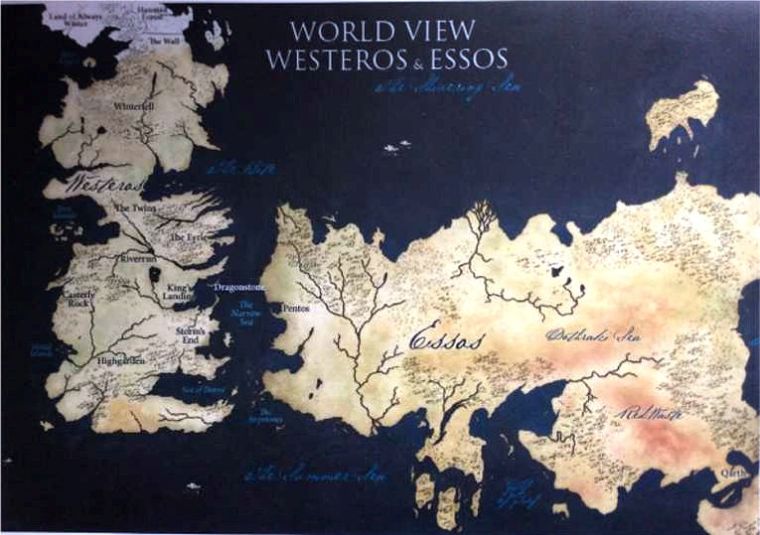
GOT Map1

  • Winterfell: the ancestral castle of House Stark.
  • The Wall: built of stone, ice and magic, on the northern border of the Seven Kingdoms, guarded by the Night’s Watch to protect the Kingdoms from the dangers behind the huge wall from ‘the Others’ and the Wildings.
  • Beyond the Wall: the first book begins Beyond the Wall with members of the Night’s Watch on the track of a band of Wildling raiders.
  • King’s Landing: a walled city, the capital of the continent of Westeros and of the Seven Kingdoms.
  • Essos: across the Narrow Sea from Westeros, includes the grassland known as the Dothraki Sea.

This article in The Telegraph lists the locations used in the TV series.

This is no fairy tale – it’s set in a grim and violent world full of tragedy, betrayals and battles; a tale of good versus evil in which family, duty, and honour are in conflict, the multiple viewpoints giving a rounded view of the conflicts the characters face. It’s a love story too. There are knights, soldiers and sorcerers, priests, direwolves, giants, assassins and bastards.  It’s complex and multifaceted, and it’s full of stories and legends – here for example Maester Luwin tells young Bran Stark about the children of the forest:

“They were people of the Dawn Age, the very first before kings and kingdoms,” he said. “In those days there were no castles or holdfasts, no cities, not so much as a market town to be found between here and the sea of Dorne. There were no men at all. Only the children of the forest dwelt in the lands we now call the Seven Kingdoms.

‘They were a people dark and beautiful, small of stature, no taller than children even when grown to manhood. They lived in the depths of the wood, in caves and crannogs and secret tree towns. Slight as they were, the children were quick and graceful. Male and female hunted together, with weirwood bows and flying snares. Their gods were the gods of the forest, stream and stone, the old gods whose names are secret. Their wisemen were called greenseers and carved strange faces in the weirwoods to keep watch on the woods. (page 713)

I shall be reading the next book in the series soon, A Clash of Kings. The other books are A Storm of SwordsA Feast for Crows, and A Dance with Dragons.

I read the Kindle Edition:

  • File Size: 8515 KB
  • Print Length: 819 pages
  • Page Numbers Source ISBN: 0007448031
  • Publisher: Harper Voyager (23 Dec. 2010)

Reading Challenges: Mount TBR Reading Challenge  – a book I’ve had since October 2015, and the What’s In a Name Challenge – in the category of a book with a piece of furniture in the title.

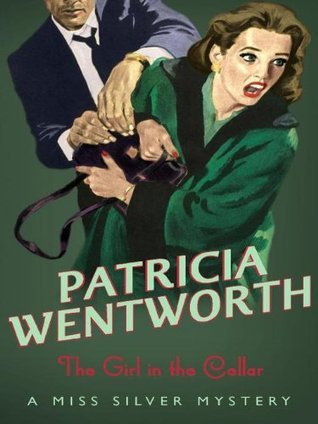
The Girl in the Cellar by Patricia Wentworth

I’m falling behind with reading for my 20 Books of Summer Challenge as I didn’t read any of them in July. I decided to read one of the shorter books to get back into the swing of the challenge and chose The Girl in the Cellar, a Miss Silver Mystery first published in 1961, by Patricia Wentworth (1878 – 1961). I wrote about the opening paragraph in this First Chapter, First Paragraph post.

It begins well as the main character finds herself in the dark in a cellar, not knowing who she is or how she got there. She is standing on the cellar steps and there is a dead girl lying at the bottom of the steps. She doesn’t recognise the dead girl either. She finds a bag beside her on the steps, which she doesn’t think is hers, but takes it with her as she escapes from the house and finds herself standing at the end of a road. She gets on a bus where she meets Miss Silver, who seeing how confused and frightened she is, takes her for a cup of tea and offers to help her. A letter in the handbag is addressed to Mrs James Fancourt and it seems that her name is Anne and she is to stay with her husband’s two aunts.

I think the opening of the book is the best part, setting up a scene of suspense and mystery. For most of the book Anne is suffering from amnesia but there is so much repetition of what little facts Anne knows that it became tedious reading, because it’s not just Anne who goes over and over what has happened but other characters too. I think the repetition lessened the sense of suspense, and overall, I thought the book was odd and not very convincing. There are too many coincidences, improbabilities, and loose ends.

This is the last of the Miss Silver Mysteries, published in the year Patricia Wentworth died. The first in the series was published in 1928. Miss Maud Silver is a retired governess who became a private investigator. She likes to help young lovers in distress – in The Girl on the Cellar, a ‘damsel in distress’ and she loves to knit and is a very sympathetic listener. I’ve only previously read one of the Miss Silver books, The Brading Collection, which is a much more convincing book.

As well as the 20 Books of Summer Challenge, this book qualifies for  Bev’s Vintage Mystery Cover Scavenger Hunt in the category, ‘Damsel in Distress’.

The Man Who Would Be King by Rudyard Kipling

For me the book chosen for the current Classics Club Spin is The Man Who Would Be King by Rudyard Kipling. It’s a novella, just 60 pages, which first appeared in The Phantom Rickshaw and other Eerie Tales, published in 1888.

Set in India and narrated by a journalist this is a story of two ruffianly-looking adventurers, wanderers and vagabonds, Daniel Dravot and Peachey Carnehan, who announce that they are off to Kafiristan in the mountains of Afghanistan to make themselves Kings. They tell the journalist that when they have got their kingdom ‘in going order’ they will let him know and that he can then come and help them govern it.

But some two years later, on a hot summer’s night, what was left of Carnehan crept into the journalist’s office,

He was bent into a circle, his head was sunk between his shoulders, and he moved his feet one over the other like a bear. I could hardly see whether he walked or crawled- this rag-wrapped, whining cripple who addressed me by name, crying that he was come back. (page 24)

And he had a sorry tale to tell.

I was a bit disappointed with it, mainly because for a novella it took such a long time to set the scene and the opening section was confusing, with references I didn’t understand. After the slow beginning the story picks up when it gets to relating what happened to Dravot and Carnehan. The Kipling Society website (where you can read the story, which is also free on Amazon) has some notes that helped me understand more – Masonic, Biblical and other references and details about the places and people mentioned.

The Kipling Society also gives details of the background to the story and some critical responses to it. Overall the responses are good – that it is a memorable, fantastic tale, some believing it to be a masterpiece, but Kingley Amis stated it was a ‘grossly overrated long tale‘. I was also interested that Edmund Wilson is quoted as stating that the story is “…surely a parable of what might happen to the English if they should forfeit their moral authority.”[Edmund Wilson ‘The Kipling that Nobody Read’, in Kipling’s Mind and Art ed. Andrew Rutherford, Oliver & Boyd, 1964.]

There was a film adaptation in 1975, starring Sean Connery as Dravot and Michael Caine as Carnehan with Christopher Plummer as Kipling, which according to some is much better than the story itself.

Rudyard Kipling was born in Bombay in 1865 and lived there until he was five when he was taken to live in England, returning to India in 1882, where he worked as a journalist. As well as short stories he also wrote poems, including If, and novels, and was awarded the Nobel Prize in Literature in 1907.

My copy is an e-book, which I’ve had for several years, so it counts towards my Mount TBR Reading Challenge.

The Spy Who Came in from the Cold by John le Carré

I’ve recently read John le Carré’s biography by Adam Sisman and inevitably it made me want to read le Carré’s books. I decided to start with his third novel, The Spy Who Came in from the Cold, first published in 1963.

Blurb:

a gripping story of love and betrayal at the height of the Cold War. This Penguin Modern Classics edition includes an afterword by the author and an introduction by William Boyd, author of Any Human Heart.

Alex Leamas is tired. It’s the 1960s, he’s been out in the cold for years, spying in the shadow of the Berlin Wall for his British masters. He has seen too many good agents murdered for their troubles. Now Control wants to bring him in at last – but only after one final assignment. He must travel deep into the heart of Communist Germany and betray his country, a job that he will do with his usual cynical professionalism. But when George Smiley tries to help a young woman Leamas has befriended, Leamas’s mission may prove to be the worst thing he could ever have done. In le Carré’s breakthrough work of 1963, the spy story is reborn as a gritty and terrible tale of men who are caught up in politics beyond their imagining.

My view:

This is a dark, tense book and quite short, just 252 pages. It’s complicated and although the language le Carré uses is clear and straight forward at times I wasn’t sure just what was going on, what lay behind the scenes – just what was Leamas up to, amidst the various deceptions and subterfuges? George Smiley does appear briefly in the book, but is there throughout in that he is masterminding Leamas’ mission.

Back from Berlin where he had seen his last agent killed whilst trying to cross the Berlin Wall, Leamas is apparently no longer useful. He goes to seed whilst working out his contact in the Banking Section, transforming into a drunken wreck no longer of use to the Secret Services, left without any money or a job until he finds work as a helper in a library for Psychical Research. Here he meets Liz Gold, who then unwittingly gets drawn into Smiley’s plan.

The atmosphere throughout is of secrecy, manipulation, of human frailty and its duplicitous nature. As the German, Fiedler says for a secret agent:

… deception is first a matter of self-defence. He must protect himself not only from without, but also from within, and against the most natural of impulses; though he earns a fortune, his role may forbid him the use of a razor, though he  be erudite, it can befall him to mumble nothing but banalities; though he be an affectionate husband and father, he must under all circumstances withhold himself from those in whom he should naturally confide. (page 143)

By the end of the book Leamas is in despair as his mission seems to have failed. Liz can’t work out which side he is on and he says:

What do you think spies are: priests, saints, martyrs? They’re a squalid procession of vain fools, traitors too, yes; pansies, sadists and drunkards, people who play cowboys and Indians to brighten their rotten lives. (page 243)

I hate it; I hate it all; I’m tired. But it’s the world, it’s mankind that’s gone mad. We’re a tiny price to pay … but everywhere’s the same, people cheated and misled, whole lives thrown away, people shot and in prison, whole groups and classes of men, written off for nothing. (pages 244-5)

But then again did his mission fail? This is one of those books that I find so hard to write about without giving away too much of the plot – the introduction by William Boyd begins with this statement, ‘New readers are advised that this Introduction makes details of the plot explicit.‘ And indeed it does. I was glad I read it after reading the book, though, as it also gives an interpretation that I found helpful – in particular just what Boyd thought was meant by ‘coming in from the cold‘.

This fulfils the “Broken Object” category on the Silver Vintage Scavenger Hunt card.

A Shilling for Candles by Josephine Tey

A Shilling for Candles, is the fourth book by Josephine Tey that I’ve read. It was first published in 1936 and is the second book in her Inspector Grant series. I enjoyed it but I have to admit that I don’t think it’s as good as the other books by her that I’ve read, namely:

  • The Daughter of Time, first published in 1951, a fascinating novel in which Inspector Alan Grant is in hospital and to keep his mind occupied he decides to discover whether Richard III really did murder his nephews – the Princes in the Tower;
  • Miss Pym Disposes, first published in 1946, a psychological study of characters and motives, in which Miss Pym investigates the death of a student at a physical training college; and
  • The Franchise Affair, first published in 1948, set in a post Second World War England reflecting the social attitudes of its time and based on a real case from the 18th century of a girl who went missing and later claimed she had been kidnapped.

Inspector Alan Grant investigates the apparent suicide of a young and beautiful film star, Christine Clay, who was found dead beneath the cliffs of the south coast. But he soon discovers that was in fact murder as a coat button was found twisted in her hair and he suspects a young man, Robin Tisdall who had been staying with Christine in a remote cottage near the beach, especially when it is revealed that she has named him as a beneficiary in her will. Tisdall has lost his coat and so the search is on to find it to prove either his innocence or guilt.
But it is not so straight forward and Grant has other suspects – Christine’s aristocratic and wealthy husband, an American songwriter, and her estranged brother to whom she had left the gift of ‘ a shilling for candles’. Then there are her friends, including the actress Marta Hart, a leading lady, Judy Sellers, who played dumb blondes and Lydia Keats, an astrologer who casts horoscopes for the movie stars.

Other characters include my favourite in the book, Erica Burgoyne, the Chief Constable’s 17 year old daughter, a quirky character who proves to be most resourceful.

I enjoyed it but thought that overall it was a bit messy, a bit all over the place, as Grant dashed about the south coast and London. It’s definitely a book of its time with several casual anti-Semitic references and Tey has used a lot of slang and idioms that aren’t so recognisable today. There are red herrings and plenty of twists and turns, all of which meant that although at first I identified the culprit, by the end I had no idea who it was. What I thought was more interesting is the way she wrote about the destructive nature of celebrity and the lengths to which the stars went to keep some privacy in their lives – not so different from today.

This book fits into several of the challenges I’m doing this year – the 20 Books of Summer, Mount TBR Reading Challenge, the Vintage Mystery Scavenger Hunt (in the category of a cover showing a body of water) and the Read Scotland Challenge, because Josephine Tey, whose real name was Elizabeth Mackintosh (1896 – 1952). She was a Scottish author who wrote mainly mystery novels.

Josephine Tey’s books:

Alan Grant
The Man in the Queue (1929) aka Killer in the Crowd
A Shilling for Candles (1936) (the basis of Hitchcock’s 1937 movie Young and Innocent)
The Franchise Affair (1948) 
To Love and Be Wise (1950)
The Daughter of Time (1951)
The Singing Sands (1952)

Novels
Kif: an Unvarnished History (1929) (writing as Gordon Daviot)
The Expensive Halo (1931)
Miss Pym Disposes (1946)
Brat Farrar (1949) aka Come and Kill Me
The Privateer (1952)
Non-Fiction

Claverhouse (1937) (writing as Gordon Daviot) A biography of John Graham of Claverhouse, 1st Viscount Dundee (1648 ‘“ 1689), known as ‘Bonnie Dundee’after leading the Jacobites to victory at the Battle of Killiecrankie in 1689, in which he lost his life.

  • Paperback: 256 pages
  • Publisher: Arrow; First Thus edition (3 Feb. 2011)
  • Language: English
  • ISBN-10: 0099556685
  • ISBN-13: 978-0099556688
  • Source: I bought my copy

The Voyage Out by Virginia Woolf

The idea for March and April in HeavenAli’s Virginia Woolf Read-a-long was to read one or more of: The Voyage Out, Night and Day (Virginia Woolf’s first and second novels) or Between the Acts which was her final novel. This was just the reminder I needed to get The Voyage Out down from my bookshelves where it’s been sitting unread for years.

This post is far too long, but one reason for writing this blog is to record what I think of a book and what I want to remember about it – this post only touches on that even at this length! There is so much more to be said about it.

I’ve not written much about the plot. This is the Synopsis from the back cover of my copy (published by Penguin in 1992):

The Voyage Out opens with a party of English people aboard the Euphrosyne, bound for South America. Among them is Rachel Vinrace, a young girl, innocent and wholly ignorant of the world of politics and society, books, sex, love and marriage. She is a free spirit half-caught, momentarily and passionately, by Terence Hewet, an aspiring writer met in Santa Marina. But their engagement is to end abruptly, and tragically.

Background to the novel:

In 1913 Virginia Woolf (1882 – 1941) had been suffering ill health for some time – depression,  nervous breakdowns and anorexia – when her half-brother George Duckworth published The Voyage Out in 1915. She had started writing it years earlier and had revised it several times before finalising it in 1912 and 1913.

I don’t like to read the introduction of a book first as often it gives away elements of the plot that I’d rather not know in advance, but I think that this paragraph does help to explain much that I wondered about as I read the book. But if you don’t want to know just skip this next paragraph.

In the introduction to the book, Jane Wheare wrote:

A knowledge of Woolf’s life will certainly deepen our response to all her work. Amongst many other details from the young Virginia Woolf’s experience that appear in fictional form in The Voyage Out one can single out her bouts of mental illness, on which she drew for the description of Rachel’s  fever; the voyage which she made to Spain and Portugal with her brother Adrian in the spring of 1905, her sister Vanessa’s illness and her brother Thoby’s death from typhoid in 1906; and her interest on feminism. (page xiii)

My thoughts:

I finished reading it a short time ago, but have found it difficult to write about it. It is an intriguing book, beginning in a leisurely fashion as Mr and Mrs Ambrose (Rachel’s aunt and uncle) stroll down the Strand to the Embankment on their way to board the ship, Euphrosyne  and yet there is tension in the air and Mrs Ambrose has tears rolling down her face. This tension and sense of underlying trouble and anxiety continues throughout the book.

It begins mid-stream, as it were, with little background at first about the characters or about why the people are on board the Euphrosyne. It is only when the ship arrives at Santa Marina (a fictional place) that Woolf explains why they are going there; and their relationships are slowly revealed through their conversations and actions. The Dalloways make a brief appearance in the book when they spend a short time aboard the ship, leaving before the ship reaches Santa Marina.

I was surprised at just how naive Rachel is for a young woman of 24, even though she had been brought up by her two aunts. Helen Ambrose is shocked, writing about her niece in a letter to a friend, criticising the current methods of education:

This girl, though twenty-four, had never heard that men desired women, and until I explained it did not know how children were born. (page 59)

In some ways this is a coming-of -age novel and Rachel’s actions and reactions are the focus of the book. In it Woolf explores the nature of Rachel’s mind, her obsessions and beliefs and through it her own thoughts about depression, suicide, death and the meaning of life. It’s a huge subject, at times celebrating the wonder and beauty of life and at other times plunging down into the hopelessness and despair that some of the characters experience.

I knew from the book’s description that it ends in tragedy and I wondered as I read what form it would take. But even so, I was taken aback at the desperate sadness of it – it was draining!

Some quotations:

On religion: Mrs Dalloway is talking to Helen Ambrose – “I always think religion’s like collecting beetles,” she said, summing up the discussion as she went up the stairs with Helen. “One person has a passion for black beetles; another hasn’t; it’s no good arguing about it.” (Page 33)

On politics: Mr Dalloway (a politician) talking about a suffragette sitting outside the house (House of Commons): “My good creature, you’re only in the way where you are. You’re hindering me, and you’re doing no good to yourself.” And later in the conversation he says: “Nobody can condemn the utter folly and futility of such behaviour more than I do: and as for the whole agitation, well! may I be in my grave before a woman has a right to vote in England! That’s all I say.” (page 24)

Mr Ambrose replies: “I don’t care a fig one way or t’other. If any creature is so deluded as to think that a vote does him or her any good, let him have it. He’ll soon learn better.”

On women:  St. John Hirst speaking, “Just consider: it’s the beginning of the twentieth century, and until a few years ago no woman had ever come out by herself and said things at all.” …

It’s the man’s view that’s represented, you see. Think of a railway train: fifteen carriages for men who want to smoke. Doesn’t it make your blood boil? If I were a woman I’d blow someone’s brains out. Don’t you laugh at us a great deal? Don’t you think it’s all humbug? (page 139)

There is much more I could quote on women’s suffrage in this book.

On England in June – an example of Woolf’s descriptive writing: The thought of England was delightful, for they would see the old things freshly; it would be England in June, and there would be June nights in the country; and the nightingales singing in the lanes, into which they would steal when the room grew hot; and there would be English meadows gleaming with water and set with stolid cows, and clouds dipping low and trailing across the green hills.

and comparing it with South America:

… “Lord, how good it is to think of lanes, muddy lanes, with brambles and nettle, you know, and real grass fields, and farmyards with pigs and cows, and men walking beside carts with pitchforks – there’s nothing to compare with that here – look at the stony red earth, and the bright blue sea, and the glaring white houses – how tired one gets of it! And the air without a stain or a wrinkle. I’d give anything for a sea mist.” (pages 138-9)

A note about the cover

I think the cover is striking. It’s from a painting by Roger Fry – Roquebrune and Monte Carlo from Palm Beach, in the City of Glasgow Art Gallery.

Roger Eliot Fry (14 December 1866 ‘“ 9 September 1934) was an English painter and critic, and a member of the Bloomsbury Group. Establishing his reputation as a scholar of the Old Masters, he became an advocate of more recent developments in French painting, to which he gave the name Post-Impressionism. He was the first figure to raise public awareness of modern art in Britain, and emphasised the formal properties of paintings over the “associated ideas” conjured in the viewer by their representational content. He was described by the art historian Kenneth Clark as “incomparably the greatest influence on taste since Ruskin … In so far as taste can be changed by one man, it was changed by Roger Fry”.[1] The taste Fry influenced was primarily that of theAnglophone world, and his success lay largely in alerting an educated public to a compelling version of recent artistic developments of the Parisian avant-garde. (from wikipedia)

Fry, who for a while had an affair with Vanessa Bell, Virginia’s sister, was a friend of Virginia’s. She wrote three books subtitled ‘A Biography‘ – her biography of Roger Fry is one of them, first published in 1940.

For more information on Roger Fry see Art UK.

Needless to say – I enjoyed this book and it has encouraged me to read more of Virginia Woolf’s books (I’ve already read Mrs Dalloway, To the Lighthouse and Flush, all before I began my blog, and Death of a Moth and Other Essays – see also this post.)