The Key in the Lock by Beth Underdown

Penguin UK| 13 January 2022| 283 pages| e-book| Review copy/4*

Rating: 5 out of 5.

Synopsis:

I still dream, every night, of Polneath on fire. Smoke unravelling from an upper window, and the terrace bathed in a hectic orange light…. Now I see that the decision I made at Polneath was the only decision of my life. Everything marred in that one dark minute.

By day, Ivy Boscawen mourns the loss of her son Tim in the Great War. But by night she mourns another boy – one whose death decades ago haunts her still.

For Ivy is sure that there is more to what happened all those years ago: the fire at the Great House, and the terrible events that came after. A truth she must uncover, if she is ever to be free.


From the award-winning author of The Witchfinder’s Sister comes a captivating story of burning secrets and buried shame, and of the loyalty and love that rises from the ashes.

My thoughts:

The Key in the Lock is Beth Underdown’s second book. I read her first book The Witchfinder’s Sister (my review) and enjoyed it immensely, so I had high expectations that I’d enjoy this book too – and it fully met my expectations. It is historical fiction set between two periods 1888 and 1918 in Cornwall.

It captures both time periods, reflecting the society both before and after the First World War showing the changes that the war had made. I loved the slow pace of this book as the secrets surrounding the death of William, the seven year old son of Edward Tremain in 1888 in a fire at Polneath, and that of Ivy’s son, Tim, on the battlefields of France are gradually revealed.

Both stories are shrouded in mystery as the circumstances of how William and Tim died are by no means clear. Ivy is devastated by Tim’s death and is determined to discover what actually happened to him, the letter informing them of his death was not phrased in the normal form of words. She wondered why.

It brought back painful memories of little William’s death. The fire at Polneath had started at night when everyone had gone to bed. William had been in the maid’s room, not his own bedroom when he had died. The postmortem revealed that he had died from asphyxiation by inhaling the smoke. Found under the bed, with paint from the door under William’s fingernails and bruised hands, it appeared that he must have been locked in and yet when he was found the door was standing open. The conclusion was that at some point the door had been locked – and later unlocked by a person or persons unknown.

The events surrounding each death are gradually revealed and there are plenty of secrets that come to light. It is described as a ‘gothic’ novel, but apart from the setting in an old isolated house, that had once been an ancient manor house, I didn’t find it gothic at all. It is a complicated story and at times I had to go back to make sure I’d got the facts right. I really liked Ivy and I liked the way her character is shown to develop with the passage of time. I loved the details about the attitudes to the First World War and the change from the earlier period. This is a novel full of grief and the circumstances surrounding both deaths provide an element of mystery. I loved the way the two time periods were interlocked as the novel progressed. I was fully engaged in it and I’ll be looking out for Beth Underdown’s next book.

A Tapping At My Door by David Jackson

Zaffre/ 2016/ e-book/ Print length: 315 pages/ My own copy/ 4*

It’s that time of year ago when I’ve been reading and not reviewing – spending more time gardening as the grass grows so quickly and the weeds multiply. And I want to do some more family history . As it’s too hot to do much gardening today I’ve got some time to write a short review.

A Tapping At My Door is a crime thriller, the first in David Jackson’s DS Nathan Cody crime thriller series. I bought it not long after it had been published in 2016, but I’ve only just got round to reading it. I wrote about the opening in this post. Even though this book is more scary and, in parts more gruesome, than I like to read, I did finish it, and enjoyed it for the characters and the plot.

I liked Nathan immediately. He works in the Major Investigation Team in Liverpool, but was previously an undercover officer. It’s obvious that something had gone wrong whilst he was working undercover, which had affected him very badly. He can’t sleep, has a quick temper and flares up very easily, especially with the local reporter and he acts recklessly with little regard for his safety.

The mystery begins as Terri Latham is disturbed late one night by a ‘tapping, scratching, scrabbling noise at her back door’. When she goes outside to investigate she sees a large black bird trapped at her window and she is then struck with something hard and heavy, rammed into her skull. What follows is not a quick death and when the police find her, it is with the dead bird’s wings unfurled and spread across her where her eyes had been, and her cheeks. There is a note attached to the bird’s leg, with the message: ‘Nevermore‘, a reference to Edgar Allan Poe’s poem, The Raven.

There are more bodies, each accompanied by a dead bird and a cyptic note, and it is soon obvious that the murderer is targeting the police. This book is full of tension, it’s very creepy and in places it is utterly gross. Although, I’m giving it 4 stars I am not at all sure I’ll read any more of the books in this series, but if you have a stronger stomach than me you’ll probably love them.

I have a backlog of reviews to write, so this is the first of several short reviews so that I can catch up!

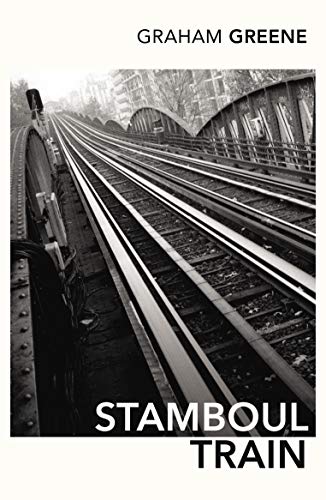
Stamboul Train by Graham Greene

Vintage Digital/ 2010/ e-book/ Print length: 216 pages/ My own copy/ 4*

Stamboul Train was first published in the UK in 1932 and was renamed Orient Express when it was published in the USA. My copy is an e-book, with an Introduction by Christopher Hitchins.

I read it in February and didn’t find time to write about it then, so this is just a mini review that really only skates over the surface of the novel. I enjoyed it, set in the early 1930s, about a three day journey on the luxurious Orient Express travelling from Ostend to Constantinople (Instanbul or Stamboul), via Cologne, Vienna and Belgrade.

Greene weaves a web of subterfuge, murder and politics around his characters, including Carleton Myatt, a Jewish businessman, who trades in currants; Coral Musker, a dancer, a chorus girl on her way to join the Dunn’s Babies dance troupe in Constantinople; a journalist, Mabel Warren, a lesbian who drinks too much; Dr Czinner, a Yugoslavian on his own mission of revolution (as Hutchins describes it), a dissident communist leader, travelling under the name of schoolteacher Richard John – Mabel has recognised him as Dr Czinner and is after a scoop from him for her newspaper; and Josef Grünlich, a murdurous burglar. .

It’s a dismal book in some respects. Written in 1931, it reflects the anti-Semitism of the period, although I think Greene’s description of Myatt’s generosity towards Coral in giving her his berth in a first-class sleeping compartment shows some sympathy towards Jews. Having said that, I also think the characters as a whole are stereotypical, but the tension that he builds around them is palpable.

Greene’s storytelling saved the book for me, with descriptions of the train itself and the glimpses of the countryside as the train speeds along – as well as Myatt’s dramatic car journey through the snow-laden countryside to and from the railway station at Subotica on the Yugoslavian border. Written just as the Nazi party was preparing to take power in Germany there is a sense of unease throughout the novel.

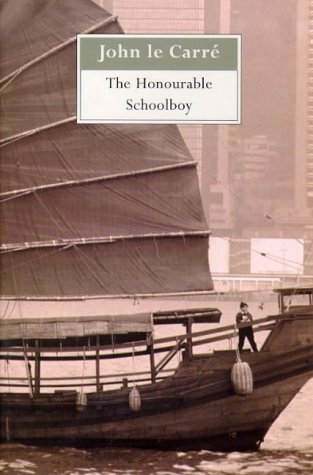
The Honourable Schoolboy by John Le Carré

Rating: 5 out of 5.

I read Tinker, Tailor, Soldier, Sailor, the first book in John le Carré’s Karla trilogy, a long time ago and I remember enjoying it very much. The story continues in the second book, The Honourable Schoolboy, which I think is brilliant. First published in 1977, it won the Gold Dagger award for the best crime novel of the year and the James Tait Black Memorial Prize.

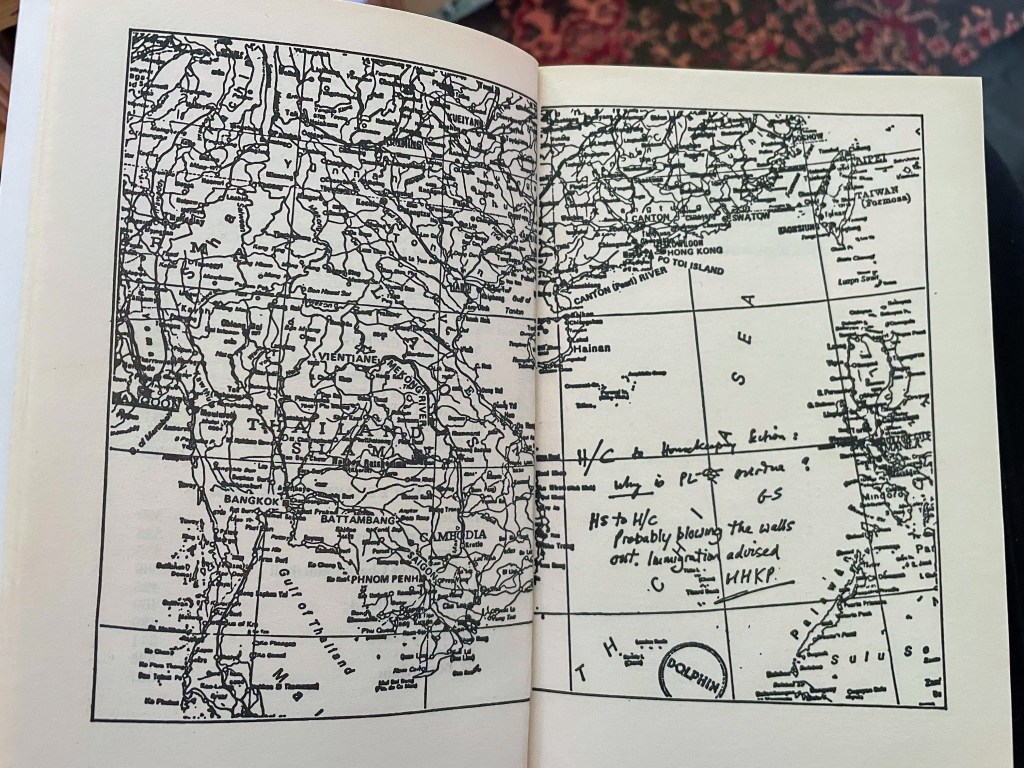
It’s wide ranging, set in 1974 in London, Hong Kong, Thailand, Vietnam, Phnom Pen (Cambodia), Vientiane (the capital and largest city of the Lao People’s Democratic Republic) Laos. My paperback copy has a map which is on such a small scale and is so detailed that it’s hardly legible. But, at least I could just about make out the main locations!

To say this has a complicated plot is a huge understatement. The amount of detail is staggering and for a while I was rather confused about what was happening. It certainly isn’t a book to read when you’re tired – you need to read it with a clear mind and be prepared to let yourself get fully immersed in the story. Tinker, Tailor, Soldier, Spy ends as George Smiley unmasks the identity of the ‘mole’, recruited by Karla, his Russian counterpart, as a spy within the British Secret Service. So, if you haven’t read Tinker, Tailor, Soldier, Spy you may want to read it before reading The Honourable Schoolboy because le Carré reveals the identity of that ‘mole’ in the first paragraph.

He then goes on to tell what happened afterwards as Smiley set about dealing with the consequences of that mole’s betrayal. He is appointed as a caretaker chief of the British Secret Service, known as ‘the Circus’, the name derived from the address of that organisation’s secret headquarters, Cambridge Circle. Smiley has Karla’s photo on his wall, determined to chase him down in revenge. Safe houses were closed and spies were recalled from abroad. In his search for Karla, Smiley sends Jerry Westerby, the eponymous Honourable Schoolboy to Hong King, undercover as a reporter, where he discovers a money laundering operation run by Moscow Intelligence and also an opium smuggling operation.

There are many characters and the action moves rapidly between Smiley in London and Westerby as he travels all over the various locations in the Far East. Le Carré’s style is clear and straight forward, the spy jargon, with the defined interwoven into the narrative, moving rapidly from one set of characters, all fully developed, to the next. Smiley, although the controlling character, is not present in much of the book. He is an enigmatic character, a lonely man, a ‘round little man in a raincoat’, as he walks alone in the evenings around the byways of London, immersed in his thoughts crammed with images, always ending in front of his own house where his estranged wife Ann lives.

From a slow start the pace steadily rose until the finale. It was gripped, eager to know how it would end. It was so much better than I thought when I began it and it’s definitely a book I’d like to re-read as I’m sure that I missed a lot in this first reading. But not right now as I’m keen to get on with the next book in the trilogy, Smiley’s People.

Cécile is Dead by Georges Simenon

Cécile is Dead by Georges Simenon, translated by Anthea Bell, an Inspector Maigret novel.

Synopsis (Amazon)

Poor Cécile! And yet she was still young. Maigret had seen her papers: barely twenty-eight years old. But it would be difficult to look more like an old maid, to move less gracefully, in spite of the care she took to be friendly and pleasant. Those black dresses that she must make for herself from bad paper patterns, that ridiculous green hat!

In the dreary suburbs of Paris, the merciless greed of a seemingly respectable woman is unearthed by her long suffering niece, and Maigret discovers the far-reaching consequences of their actions.

This novel has been published in a previous translation as Maigret and the Spinster.


My thoughts:

This is one of the best Maigret books I’ve read – and it is complicated, remarkably so in a novella of just 151 pages. At first it seems quite straight forward. Cécile has been wanting to see Detective Chief Inspector Maigret for months, sitting patiently in the ‘Aquarium’, as the waiting room at the Police Judiciaire in Paris, is known. She was convinced that someone had been breaking into her aunt’s apartment. But no one takes her seriously and Maigret is always busy, until one day he decides to see her. But she had left the waiting room, so he goes to the apartment where she lives with her elderly aunt, Juliette Boynet, the owner of the apartment building. She wasn’t there, but her aunt was – lying dead on the floor, strangled. Cécile was missing and the title tells you why – she was indeed dead.

And from then on, the mystery became more complex, with several suspects with a variety of motives. Juliette was very wealthy, but also miserly. She had a large family, mostly estranged from her and at odds with each other. They all turn up for her funeral, arguing about who should take precedence in the funeral cortège, and about who should inherit her money and property.

Maigret has to sort it out in his own way – musing over the details and feeling bad that he hadn’t spoken to Cécile earlier, thinking her worry over an intruder who just moved things around the apartment without taking anything was trivial. We see more of how he thinks and works when later in the investigation he is accompanied by an American, a Mr Spencer Oates from the Institute of Criminology of Philadelphia, who had asked if he could study Maigret’s methods.

This is the second time I’ve read Cécile is Dead. I first read it in 2018, but didn’t write about it at that time. Reading it for the second time, I realised I had forgotten all the details – it was like reading a new book. I thoroughly enjoyed it. It is either the 20th or the 22nd Maigret novel – Amazon records it as the 20th, whereas Goodreads has it as the 22nd! Whichever it is, it is a good read.

  • ASIN ‏ : ‎ B00SSKM6OC
  • Publisher ‏ : ‎ Penguin (4 Jun. 2015)
  • Print length ‏ : ‎ 151 pages
  • Source: I bought the e-book
  • My Rating: 4*

A Room with a View by E M Forster

A Room with a View by E M Forster is an early twentieth century comedy of manners, satirising the manners and social conventions of Vistorian/Edwardian society. It is Forster’s third novel, first published in 1908, a short novel of 161 pages and is light reading with some humorous dialogue.

Rating: 4 out of 5.

Lucy has her rigid, middle-class life mapped out for her, until she visits Florence with her uptight cousin Charlotte, and finds her neatly ordered existence thrown off balance. Her eyes are opened by the unconventional characters she meets at the Pension Bertolini: flamboyant romantic novelist Eleanor Lavish, the Cockney Signora, curious Mr Emerson and, most of all, his passionate son George.

Lucy finds herself torn between the intensity of life in Italy and the repressed morals of Edwardian England, personified in her terminally dull fiancé Cecil Vyse. Will she ever learn to follow her own heart? (Goodreads)

My thoughts:

I enjoyed Forster’s A Passage to India years ago and was looking forward to reading A Room with a View. Overall I enjoyed it, although I was rather underwhelmed by it and even in parts bored, especially near the end of the book, where there are some philosophical paragraphs that left me thinking I didn’t really understand them. It is about a young woman, Lucy Honeychurch, and her journey to self-discovery as she breaks out of the restrained culture of Edwardian England. It’s also a romance. The writing is ambiguous at times, so that you have to read between the lines in places.

It begins in Florence where Lucy is staying at the Pensione Bertolini, with her older cousin and chaperone Charlotte Bartlett. At dinner, they were complaining that their rooms didn’t have views over the River Arno as they had been promised.They were rather taken aback by two other guests, a Mr Emerson and his son George who offered to swap rooms with them. The Emersons are not bound by the conventions of the day and Charlotte considers they are ill-bred. But Lucy is attracted by the Emersons’ free thinking ideas. They spend time in Florence visiting various locations including the Santa Croce church, the Piazza Della Signoria and the San Miniato church, with its beautiful facade, and take a trip into the hills. Lucy finds herself in a little open terrace, covered in violets:

From her feet the ground sloped sharply into view, and violets ran down in rivulets and streams and cataracts, irrigating the hillside with blue, eddying round the tree stems collecting into pools in the hollows, covering the grass with spots of azure foam.

And it is there on that terrace that she comes across George and she is shocked and delighted, I think, when he kisses her. Charlotte witnesses the scene and urges/persuades Lucy to move to Rome where she meets Cecil Vyse, a most boring and priggish young man, whom she knew in England. The second half of the book takes place in England at Lucy’s home at Windy Corner where we meet the rest of her family and Lucy has to decide between the insufferable Cecil and the unconventional George. Will she give into convention or will she choose George, despite opposition from her family?

E M Forster from Goodreads:

Edward Morgan Forster, generally published as E.M. Forster, was an novelist, essayist, and short story writer. He is known best for his ironic and well-plotted novels examining class difference and hypocrisy in early 20th-century British society. His humanistic impulse toward understanding and sympathy may be aptly summed up in the epigraph to his 1910 novel Howards End: “Only connect”.

He had five novels published in his lifetime, achieving his greatest success with A Passage to India (1924) which takes as its subject the relationship between East and West, seen through the lens of India in the later days of the British Raj.

Forster’s views as a secular humanist are at the heart of his work, which often depicts the pursuit of personal connections in spite of the restrictions of contemporary society. He is noted for his use of symbolism as a technique in his novels, and he has been criticised for his attachment to mysticism. His other works include Where Angels Fear to Tread (1905), The Longest Journey (1907), A Room with a View (1908) and Maurice (1971), his posthumously published novel which tells of the coming of age of an explicitly gay male character.

A Room with a View was my Classics Club Spin book to read between 20th March and the 30th April. It is on my Classics Club list and it counts toward the Back to the Classics Challenge (as a 20th century classic).