What’s in a Name 2025

I’ve been taking part in Andrea’s What’s in a Name Challenge for years and although I didn’t complete it last year I’ve decided to have a go again this year

It is hosted by Andrea at Carolina Book Nook. The challenge runs from 1st January to 31st December 2025. You can sign up at any time but can only count books you read between those dates. Read a book in any format (hard copy, ebook, audio) with a title that fits into each category.

In 2025, choose 6 books that have titles that contain:

  • Cardinal direction – Titles for this category need to include at least one cardinal direction (North, East, South, West) in the title
  • Wanderlust – Titles for this category need to include words or phrases related to wanderlust: wander, journey, trip, travel, explore, trek, tour, adventure, etc. Or the implication of traveling or exploring.
  • First & last name – Titles for this category need to include both a first name (given name) and last name (surname). The names don’t matter, as long as it’s the first and last of a real person or fictional character.
  • Alliteration – Titles for this category need to include at least two main words that begin with the same letter in the title.
  • Deity – Titles for this category need to include words associated with a deity of some sort. This can be the words “deity,” “god,” “goddess,” or a specific name of a deity. In your comment, please include the culture or religion of the deity (even if the deity isn’t being directly referenced.)
  • Crime – Titles for this category need to include the word “crime,” a specific type of crime, a specific type of criminal, or the name of an infamous criminal.

I’ve got a few choices for each category so I reckon I should be able to complete the challenge this year.

What’s in a Name 2024

The What’s In A Name Challenge is being hosted again for 2024 by Andrea at Carolina Book Nook. The challenge runs from 1st January to 31st December 2024. You can sign up at any time but can only count books you read between those dates. Read a book in any format (hard copy, ebook, audio) with a title that fits into each category.

The categories with my provisional choices are:

Double Letters        The Secret Lives of Bees by Sue Monk Kidd

An NFL Team         Giant’s Bread by Agatha Christie

A natural disaster The Year of the Flood by Margaret Atwood

A virtue                     Brave New World by Aldous Huxley

A shape                    Square Haunting: Five Women, Freedom and London Between the Wars by Francesca Ward

Footwear                   The Boy with No Shoes by William Horwood

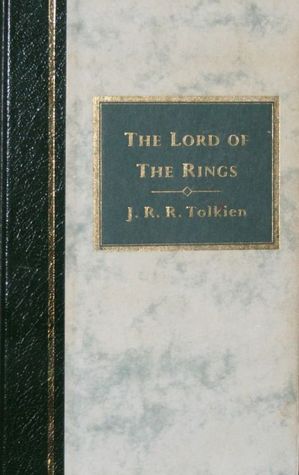
The Lord of the Rings by J R R Tolkien

Last year I began re-reading The Fellowship of the Ring by J R R Tolkien and when I finished it I had to carry on with the other two books of the The Lord of the Rings trilogy. They were first published between 1954 and 1955. I first came across it at the library when I was a teenager. I loved it so much that I decided I needed to buy my own copy for myself and have since read the trilogy several times. The three books are The Fellowship of the Ring, The Two Towers and The Return of the King. Imagine my delight when I went to college and found that so many of the students on my course also loved the trilogy and I read it all again and could talk about it with the others.

What follows is not a review. It is some of my thoughts on reading this epic fantasy story about the quest undertaken by Frodo and the Fellowship of the Ring to destroy the One Ring of Power in the Mountain of Fire, Mount Doom in Mordor and thus prevent the Dark Lord, Sauron from conquering Middle-earth.

Re-reading The Lord of the Rings, I was delighted to find that it had lost none of the magic I found the first time. It is one of my all time favourite books and this time round I was struck by Tolkien’s world building and his powers of description of the characters and the locations, but most of all by Tolkien’s storytelling – superb. I read it slowly, taking my time over it, just a small section each day – letting the story soak into my mind.

The members of the Fellowship are Gandalf the Grey, a wizard; the hobbits Frodo, Merry, Pippin, and Sam; Gimli the Dwarf; Legolas the Elf; Boromir of Gondor; and a tall, mysterious stranger called Strider (later revealed as Aragorn, the heir of Isildur, an ancient King of Arnor and Gondor). And there’s a whole host of other characters.

Alongside my reading I also watched Peter Jackson’s three films, adaptations of the trilogy. When I watched these when they first came out I wasn’t surprised that they didn’t live up to my visualisation of the characters, except that Ian McKellen was just perfect as Gandalf, or of the locations, beautiful as the locations in the films are, Lothlorien is nowhere nearly as magical as I had imagined from reading the book. But the main difference I noticed this time is that the book is very descriptive, going into great detail about the routes of the journeys, of the places and of the characters, it is very long – The Fellowship of the Ring alone took me a month to read. Whereas the films are very much action movies with long and violent battle scenes, against the backdrop of the locations and the running time of each one is approximately three hours – with the extended versions being even longer.

So, inevitably there are changes from the books rearranging the sequence of events in places and cutting scenes – most notably for me the hobbits’ meeting with Tom Bombadil, one of my favourite episodes. Tom is a nature spirit and like the wizards he appears like a man. I loved that episode – when Tom rescued Merry and Pippin from Old Man Willow, the malevolent tree in the Old Forest that had grabbed them and enclosed them within the folds of his trunk. He lives in the Old Forest, near the Barrow-downs, with his wife Goldberry, ‘Daughter of the River’. Goldberry says he ‘He is the master of wood, water, and hill.‘ He has lived in Middle Earth from its earliest days and when Frodo asks him who he is he says

Eldest, that’s what I am. … Tom was here before the river and the trees; Tom remembers the first raindrop and the first acorn. He made paths before the Big People, and saw the little People arriving. He was here before the Kings and the graves and the Barrow-wights. When the Elves passed westward, Tom was here already, before the seas were bent. He knew the dark under the stars when it was fearless – before the Dark Lord came from Outside. (page 171)

Other characters and episodes that stand out for me are:

Frodo and Sam, two hobbits. I prefer to think of them both as they are in the books, rather than in the films, because the actors are totally different from how I first visualised the characters. Frodo was adopted by Bilbo Baggins, a distant relative and lived with him at Bag End as his heir and so he inherited Bag End and the One Ring. He and Bilbo shared the same birthday and the same party to celebrate Bilbo’s 111th birthday and Frodo’s coming of age birthday at the age of 33. On his 50th birthday Frodo left Bag End with Sam, his gardener, beginning his quest to destroy the One Ring. So, the depiction of the hobbits by the actors wasn’t right at all, they are far too young, and I had to remember that the films and the books are two separate creations (but it still rankles).

My favourite characters, in no particular order, are Gandalf the Grey, later known as Gandalf the White, especially his battle with the Balrog at the Bridge of Khazad-dûm, Strider/Aragorn, Gollum, all the Elves and the Ents.

This post is left over from last year when I stopped writing it just before I went into hospital and I have now finished it. I had intended it to be more detailed but it was not to be …
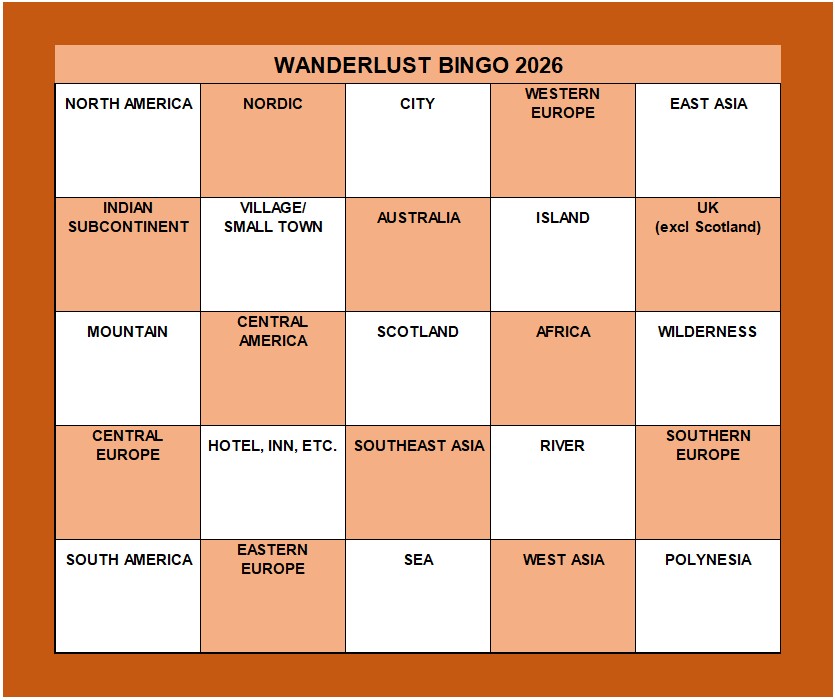
Wanderlust Bingo Challenge

I have completed reading the books for this challenge, although there are four that I haven’t reviewed. It has taken me two years and I’ve read 25 books, some of which I wouldn’t have thought of reading if it hadn’t been for this challenge. I travelled round the world and ventured into Outer Space in Ray Bradbury’s Leviathan ’99 and into the realms of fantasy in J R R Tolkien’s The Lord of the Ring Trilogy.

I enjoyed all of them, especially the 5 star books marked with an asterisk *.

Here’s the final list with links to my reviews (where they exist):

North America (USAInland by Téa Obreht

Small Town ( CanadaA Town Called Solace by Mary Lawson*

Island (CreteGreece) The Island by Victoria Hislop

Train (travelling from Ostend to Constantinople, via Cologne, Vienna and Belgrade) Stamboul Train by Graham Greene

Far East (Hong Kong, CambodiaThe Honourable Schoolboy by John le Carré*

Indian Sub-Continent (India) Last Man in Tower by Aravind Adiga*

Village (IrelandThe Wonder by Emma Donoghue *

Oceania (AustraliaA Room Made of Leaves by Kate Grenville

Forest (GermanyWhite Rose, Black Forest by Eoin Dempsey

Space (The Universe) Leviathan ’99

Mountain (Spain and other countries ) The Moon Sister by Lucinda Riley

South America (based on Peru) Bel Canto by Ann Patchett*

Free Square (Middle Earth) The Fellowship of the Ring by J R R Tolkien*

River (Rio Negro in BrazilState of Wonder by Ann Patchett*

Polar Regions (The South Pole, Antarctica)– Ice Bound by Jerri Nielsen* (nonfiction)

Desert (Saudi Arabia) The Night of the Mi’raj by Zoë Ferraris

Walk (Malaya) A Town Like Alice by Nevil Shute

Southeast Asia (Vietnam) The Quiet American by Graham Greene

Africa (Belgian Congo) Heart of Darkness by Joseph Conrad

Beach (England) The Night Hawks by Elly Griffiths

Road (ScotlandCoffin Road by Peter May*

Europe (Belgium) Ashes by Christopher de Vinck

Sea (in the Gulf Stream off the coast of Cuba) The Old Man and the Sea by Ernest Hemingway

Middle East (present-day Iraq, Kuwait, and parts of Iran, Syria, and Turkey) Murder in Mesopotamia by Agatha Christie

City (FranceThe Paris Library by Janet Skeslien Charles

~~~

My thanks to FictionFan who devised this challenge – I’m looking to seeing what she comes up with next.

Two Short Reviews: Coffin Road by Peter May and The Wonder by Emma Donoghue

Two more short reviews as I try to catch up on the books I’ve been reading. Both are excellent books, each one with a great sense of location and descriptive writing bringing the scenes and characters vividly to life.

First, Coffin Road by Peter May, is a standalone novel, set on the Isle of Harris in the Outer Hebrides. I read it because I loved his Lewis trilogy. There are 3 strands to the story. There’s a mystery surrounding a man, washed up during a storm on a deserted beach on the Isle of Harris. He is wearing a life jacket, is battered and bruised – and has no idea who he is or where he is. The only clue to why he is living on Harris is a folded map of a path named the Coffin Road and following the route marked on the map he finds some hidden beehives that are familiar to him. In the second strand DS George Gunn investigates the murder of a bludgeoned corpse discovered on a remote rock twenty miles to west of the Outer Hebrides. And thirdly, a teenage girl in Edinburgh is desperate to discover the truth about her scientist father’s suicide.

It is fast-paced, almost impossible to put down, and full of intrigue and mystery. Each strand of the story kept me guessing, wondering what the connections between them were. It’s tense with the sense that time is running out for all the characters and I wasn’t sure whether any of them were reliable narrators or were who they appeared to be.

In addition the bees have a major role in the story. All the facts about the bees slot seamlessly into the story and I learned quite a lot about bees that I didn’t know before, especially their role in climate change.

The Wonder is a very strange story. It’s uncomfortable reading, but I felt I just had to read it. And although it moves at a slow pace I read it quickly in large chunks. It is tense, full of atmosphere and just like Coffin Road, I found it almost impossible to put it down, such is the power of Emma Donoghue’s storytelling.

The plot is simple: it is set in a small village in the Irish Midlands in the 1850s. Eleven-year-old Anna O’Donnell stops eating, but remains miraculously alive and well. A nurse, Lib Wright, trained in the Crimea by Florence Nightingale, and a nun, Sister Michael are hired by a committee of influential locals to spend two weeks observing her to make sure she is not being fed secretly.

Lib observes Anna in scrupulous detail, noting Anna’s symptoms. At first she seems a healthy little girl but as the two weeks go by she develops worrying symptoms – downy cheeks, scaly skin, blue fingertips, and swollen lower limbs and hands. Lib begins to realise that it is not just a question of how Anna is managing to exist without food, but also why. What is motivating Anna to persist in saying she is not hungry and doesn’t need to eat? The answer seems to lie in her religious beliefs, and maybe religious hysteria is playing a part as well as the clash between medical science and faith. But is there more to it? Lib wonders about the family’s relationships and the effect of Anna’s brother’s death just a few months before Anna stopped eating.

As Donoghue explains in her author’s note The Wonder is an invented story, inspired by almost fifty cases of so-called Fasting Girls in the British Isles, Western Europe and North America between the 16th and 20th centuries. A film of the book is available on Netflix, but I don’t think I could bear to watch it.

The Island by Victoria Hislop: A Short Post

I have been struggling to write posts recently. I haven’t been able to settle down to writing after finishing a book, either because I’m too eager to read the next book, or like Heavenali I’ve been so distracted and mithered by other things going on in my life, mostly minor that shouldn’t really bother me, but do, that I am finding it hard to concentrate on writing.

So, that is why I haven’t written about a number of books I read earlier this year. Some of them are books that qualify for the Wanderlust Bingo CardThe Island by Victoria Hislop, The Fellowship of the Ring by J R R Tolkien, The Night of the Mi’raj by Zoë Ferraris and Coffin Road by Peter May. These aren’t the only books I’ve read that need to write about, but it’s a start.

The first one I’m writing about is The Island by Victoria Hislop, her debut novel and one of my TBRs. It’s been on my bookshelves for years and I did start reading it soon after buying it, but I didn’t get very far and put it back on my bookshelves. Since then I’ve read three other books by Victoria Hislop and enjoyed them so I decided to try it again, especially as it fills the Island Square (set in Greece) on the Wanderlust Bingo card. I began reading it in August, when I took it away with me, visiting family, but didn’t find much time to read it and had to set it to one side. After I returned home I went on to read other books until October when I picked it up once more.

It is historical fiction set in Plaka on the island of Crete and in Spinalonga, a tiny, deserted island just off the coast of Plaka. I wasn’t very sure I would like it when I read the first chapter about Alexis Fielding longing to find out about her mother’s past. Sofia had never told her anything about it and all that Alexis knew was that Sofia had grown up in Plaka, a small Cretan village before moving to London. She gave Alexis a letter to take to an old friend, Fotini, promising that through her she will learn more. And once Fotini entered the story I was hooked as she told what had happened to Sophia’s grandmother, Eleni and her daughters, Anna and Maria after Eleni caught leprosy and was sent to live on Spinalonga.

Beginning before the Second World War the story moved between Plaka and Spinalonga and I loved all the details of Elena’s life on Spinalonga, but then when the narrative moved on to describing her daughters’ lives I began to lose interest. Instead of a fascinating historical novel about leprosy it changed into a historical romance, which I didn’t enjoy as much as the earlier part of the book. Overall, I think it’s too long and drawn out, and the ending is a bit too neat. So I’m giving this book 4*, combining 5* for Eleni’s story and 2-5* for both the beginning and the ending.

I’m hoping to write similar short posts for the other three books.