BooksPlease is 10 today!

I started BooksPlease as a way of keeping a record of what I’ve read and now it has become a part of my life. I love writing about books and reading what others have read. It amazes me to realise that I’m part of a blogging community of like-minded people who all love to read and talk about books.
Thanks to everyone who visits and especially to those who make comments – it wouldn’t be the same without you.
Here are just some of the books I’ve loved over the last 10 years, listed in the order I read them:
 in 2007
I read Here Lies Arthur by Philip Reeve, an adventure story, set in Britain in AD 500. I have always been fascinated by the legend of King Arthur and this book tells his story, casting a new and original slant on the ‘facts’. Very little historical evidence has survived to give concrete information about life in Britain from the fifth to the sixth centuries. The picture Reeve paints is of a turbulent and harsh world, with Arthur as a war-leader in a land where opposing war-bands fight for supremacy. Arthur is not the romantic hero of legend but a dangerous, quick-tempered man, ‘solid, big-boned with a thick neck and a fleshy face. ‘¦ A bear of a man.’
in 2008: Cider with Rosie by Laurie Lee, a delicious book, full of wonderful word pictures of life in a remote Cotswold village at the beginning of the twentieth century. Laurie Lee was also a poet and this book reads like a prose poem throughout. The village is Slad in Gloucestershire, the home of Laurie Lee, a beautiful place, but no longer as it was in his childhood.
in 2009:
 Fire in the Blood by Irene Némirovsky. Although only a short book (153 pages) it is an intense story of life and death, love and burning passion. it’s set in a small village based on Issy-l’Eveque between the two world wars. The narrator is Silvio looking back on his life and gradually secrets that have long been hidden rise to the surface, disrupting the lives of the small community. The people are insular, concerned only with their own lives, distrusting their neighbours. All Silvio wants now is a quiet life, but he cannot avoid being drawn into helping Colette, his cousin Helene’ s daughter, when her husband Jean is found drowned in the mill stream.
in 2010:
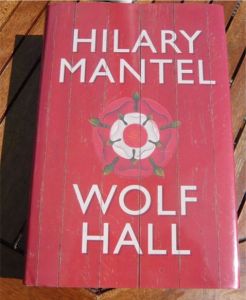 Wolf Hall by Hilary Mantel, one of the best books I read that year, if not the
best one. It is satisfying in depth and breadth, with a host of characters and detail.
It is, of course the story of Thomas Cromwell, the son of a blacksmith, and his political rise, set against the background of Henry VIII’s England and his struggle with the Pope over his desire to marry Anne Boleyn. It’s a brutal time. What I found most enjoyable was the way this book transported me back to that time, with Mantel’s descriptions of the pageantry, the people, the places and the beliefs and attitudes of the protagonists.
In 2011:
 The Murder of Roger Ackroyd by Agatha Christie. This is Agatha Christie’s
6th book, published in 1926. Set in the village of King’s Abbot, the story begins with the death of Mrs Ferrars, a wealthy widow and the local doctor, Dr Sheppard suspects it is suicide. The following evening Roger Ackroyd, a wealthy widower who it was rumoured would marry Mrs Ferrars, is found murdered in his study. Poirot has retired to King’s Abbot, to grow vegetable marrows, not very successfully. He’s missing Captain Hastings who is living in the Argentine, so when he is asked to investigate the murder he enlists Dr Sheppard, who lives next door with his sister Caroline, to help him and it is Dr Sheppard who narrates the story.
In 2012:
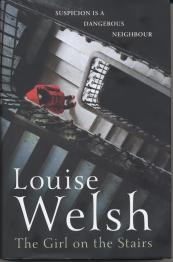 The Girl on the Stairs by Louise Welsh, a dark, psychological thriller, full of atmosphere and claustrophobic tension. Jane moves to an apartment in Berlin to join her partner, Petra. Everything is new to her, she only speaks a little German, she doesn’t know the area and has no friends there. And she’s pregnant. She meets some of the other residents of the apartment building, their neighbour Dr Mann and his daughter Anna ‘“ the girl on the stairs. She hears them arguing and fears Dr Mann is abusing Anna. Jane’s suspicions about her neighbours grow, and her sense of isolation mounts when Petra has to go to Vienna for a week.
In 2013:
 The Glass Room by Ann Cleeves, the fifth book in her Vera Stanhope series. It has everything I like in a crime fiction novel – setting, characters and a cleverly constructed plot. I didn’t guess who the murderer was but realised afterwards that all the clues had been there, skilfully woven into the narrative, hidden among the dead-ends and red herrings, so that I’d read on without realising their significance.
Set in the Northumberland countryside in an isolated country house, a number of aspiring authors are gathered at the Writers’ House, to work on their novels. One of the visiting tutors, Professor Tony Ferdinand, is found dead in the conservatory, stabbed with a kitchen knife.
In 2014:

Sisters of Sinai: How Two Lady Adventurers Found the Hidden Gospels by Janet Soskice . This is biography so well written that it almost reads like a novel. In fact, if this was a novel I would think it was a most unlikely story of twin sisters in the latter half of the nineteenth century, travelling to St Catherine’s Monastery at Mount Sinai where they discover one of the earliest copies of the Gospels written in ancient Syriac. It’s an excellent biography of two Scottish sisters ‘“ twins, Agnes and Margaret Smith born in 1843 in Irvine, a town south-west of Glasgow. Their father died when the twins were 23, leaving his fortune to them they decided to have a trip down the Nile. And that was just the beginning; their lives were transformed.
In 2015:
 Even Dogs in the Wild by Ian Rankin. Rebus is on his second retirement ‘“ well
almost. It seems they can’t do without him and when someone takes a potshot at retired gangster, Big Ger Cafferty DI Siobhan Clarke suggests they ask him to act in a ‘˜consultative capacity’ albeit not as a cop and with no warrant card or real powers and with no pay. Cafferty refuses to let the police in to talk to him ‘“ he’ll only speak to Rebus.
There are various strands to this complicated murder mystery with so many twists and turns that my mind was in a whirl as I tried to sort out all the characters. Rankin successfully combines all the elements of the crime mystery with the personal lives of the main characters and at the same time highlighting various current political and social issues.
In 2016:
 Bones and Silence by Reginald Hill, the 11th book in his Dalziel and Pascoe series. When Detective Superintendent Andy Dalziel witnesses a bizarre murder across the street from his own back garden, he is quite sure who the culprit is. But does he? I liked all the complications of plot and sub-plots in this book and the interplay of the characters. It’s full of interesting characters and humour, but it is the plot that takes precedence. It is so tricky, with numerous red herrings and plot twists. My image of Dalziel comes from Warren Clark’s portrayal of him in the TV series because I watched the programmes before I read any of Hill’s books. To me Warren Clarke is Dalziel, just as David Suchet is Poirot. Dalziel is a larger than life character, speaks his mind and is never politically correct.
 Every Friday Book Beginnings on Friday is hosted by Gillion at


 It begins with a Prologue:
 BooksPlease