Teaser Tuesdays is a weekly bookish meme, hosted by MizB of Should Be Reading. You grab your current read and pick two or three sentences from somewhere on a random page, taking care not to include spoilers and share the title and author, too, so that other TT participants can add the book to their TBR Lists if they like your teasers!
Today my teaser sentences are from page 37 of Ian Rankin’s Doors Open:
‘Look’, Mike argued, ‘I agree it’s a nice thought – I like the idea of planning some sort of … heist.’ Gissing, listening intently, had folded his arms again.
‘It’s been preying on my mind, too,’ he said eventually.
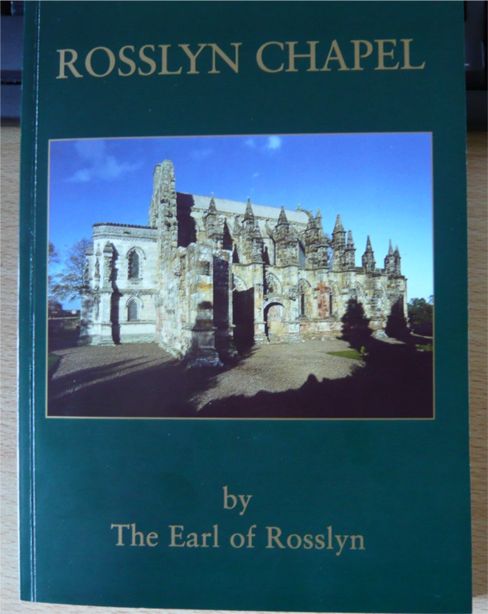
Last week whilst staying with our son in Scotland we visited Rosslyn Chapel. The chapel was founded in 1446 and is still used today as a place of worship. I first came across Rosslyn Chapel through reading Dan Brown’s The Da Vinci Code and was fascinated by it then. I never thought I’d actually visit it as we live so far away, but when I discovered through reading Ian Rankin’s The Falls that it is just a few miles south of Edinburgh and only a short distance from where our son is living we decided to go. It’s well worth a visit on its own merits (forget about Dan Brown’s book) if you get the chance. It’s simply the most stunning building, packed with stone carvings. It was a cold windy day, but there were quite few other people there too, and I imagine it would be packed during the summer months.
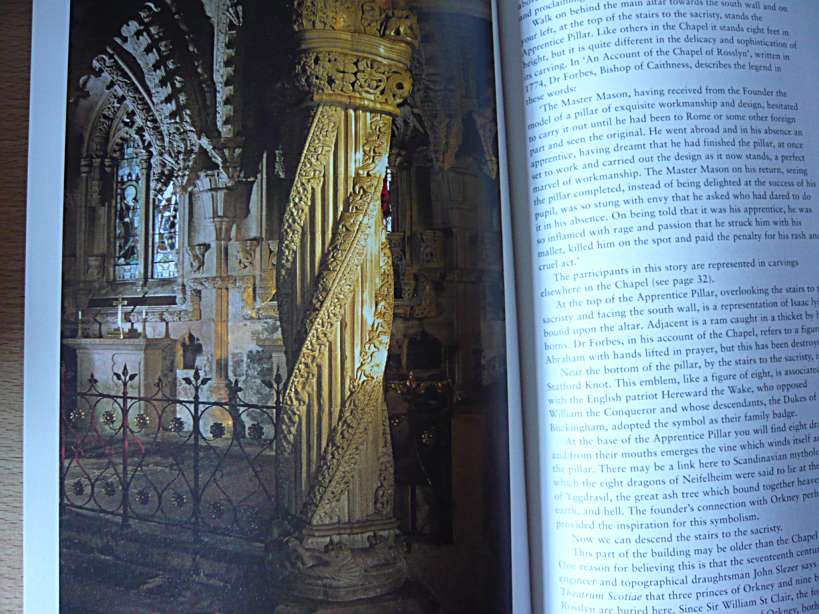
I was surprised at how big the Chapel is, from outside it seems quite small but inside it is magnificent – the ceiling seems enormous, covered in stone carvings. After reading The Falls I wanted to see the Mason’s Pillar, the Apprentice Pillar and the carvings of maize over one of the windows (these were all clues to the cryptic questions in The Falls). The Pillars are eight feet high and are splendidly and elaborately carved. The legend goes that the Mason decided to go abroad to study the design for a pillar he’d been instructed to build and whilst he was away the Apprentice created the pillar having had a dream about how it should look. On the Master Mason’s return he was so enraged and jealous that he killed the Apprentice striking him with his mallet.
The roof of the Chapel is covered with a steel canopy whilst the conservation of the building is taking place – the masonry was saturated with water and pollutants and the canopy enabled the stonework to dry out before the repairs could be done. Photos are not allowed inside but here are a few photos of the exterior:
Rosslyn Chapel Exterior
And I did take a photo just before I went into the Chapel – for more photos see the Rosslyn Chapel website.
Of course, I was interested in all the mystery surrounding the carvings and their meanings and whether there really was a link with the Knights Templar. The guide book indicates that there were in fact connections – the carvings of the five-pointed star, the dove in flight carrying an olive branch, the floriated cross and the artichoke are all said to have Templar associations.
For me, though, it was the two pillars and the Biblical scenes that are the most striking, the crucifixion scenes and the images of death, particularly the series of figures each accompanied by a skeleton – known as the ‘dance of death’. The barrel-vaulted roof and stained glass windows are beautiful. I’ll have to go back for another visit one day, once I’ve read the guide book in more detail – one visit is just not enough.
Today’s MUSING MONDAYS post is about recording your reading
Do you keep track of what and/or how many books you read? How long have you been doing this? What’s your favorite tracking method, and why? If you don’t keep track, why not? (question courtesy of MizB)
I first started to keep track of which books I’ve read when I was about 10, when I simply listed them in an exercise book, but that didn’t last very long! For the last ten years I’ve attempted to keep a record but it was very spasmodic until 2006. I would intend to keep the list up to date but often went for months just reading books without keeping track of what I’d read. Then I realised that I’d be in the library, looking at a book and thinking I’ve read that – or have I? So I decided it was time to be more organised and I started a list in Word.
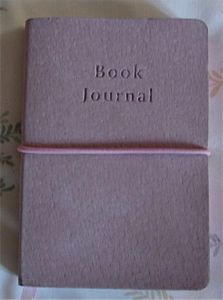
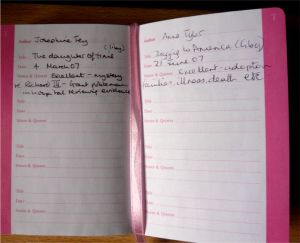
I still record books in that way but I also have a Book Journal in which I note down the author, title, date and a very brief note of what I thought about each book that I’ve read since 2006. The benefit of this is that I can take it with me to check which books I’ve already read and to look up authors I’ve enjoyed. It also has a section to record “Books I Want to Read” – very useful!
I also list the books on this blog – see the tab at the top – “Books Read”. I’ve listed there the books I’ve read since 2007. Just recently I’ve added a section on the sidebar of the books I’ve read each month, but I’m not sure I’ll carry on with that – it’s just an experiment to see how I like it.
I suppose LibraryThing is also a place where I record what I’ve read. In that catalogue I’ve tagged the books I haven’t read “TBR” and rated some of the fiction that I have read.
It really is so easy to become (just a bit) obsessed by books!
How about, ‘What’s the worst ‘best’ book you’ve ever read – the one everyone says is so great, but you can’t figure out why?’
This question is practically impossible for me to answer. If I don’t like a book I stop reading it because life’s too short and there are too many good books to read to bother with one that’s not.
But it’s impossible for everyone to agree about books (or anything else for that matter) and there have been a few books that I’ve not been too keen on and noticed that other people have rated them highly. For example – The Bell Jar by Sylvia Plath. I was disappointed with this one, about a depressive/suicidal teenager, but I finished reading it so it’s not that bad. No doubt it’s a good portrait of mental illness but I found it a bit confusing and disjointed and in parts rather dull. Maybe I was expecting too much from it and maybe I should have read it when I was a teenager.
It’s been a while since I did a Tuesday Thingers post. Actually I hadn’t realised that it had started again, but it has thanks to Wendi, who’s taken over asking the questions. It’s a good way to learn more about LibraryThing. This week’s question is all about the memes on LibraryThing, which I have looked at before, but there are new ones since I last looked. These memes are specific to your own books on LT.
Question: Do you visit the memes section often? Have you visited recently? Have you discovered anything that surprises you when you visit the memes for your library?
I don’t visit the memes section often and when I looked this morning there weren’t any real surprises. Apart from the “Male or Female? What gender are your authors?” I have 111 authors whose gender is “not set”. Oops, I don’t think rugby players like Martin Johnson, Lawrence Dallaglio and Bill Beaumont would be too happy with that!
In the “You and None Other” meme which means me and only one other person in LT (confuses me this section but that’s what it means) there are several books. I’m particularly interested in this one – Bradshaws ancient rock paintings of North-West Australia by Grahame L Walsh. This is a book that I inherited from my sister and although it is beautiful it is not really of much interest to me and I would like to sell it. Anyone interested please contact me for more details.
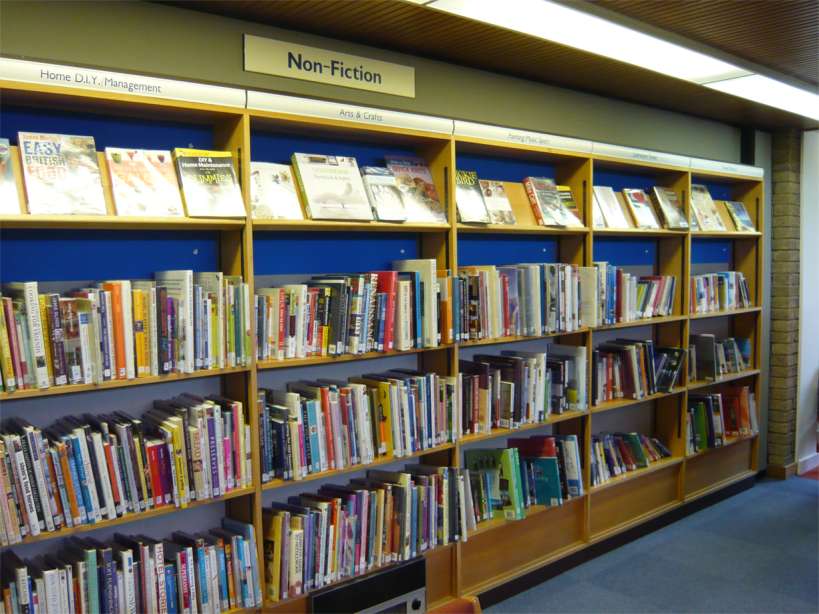
I don’t need to borrow any more books, but I had to go to the library to return The Gargoyle (see here) and of course then I couldn’t leave without at least looking at the books. This week I concentrated on non-fiction as I already have a few novels on the go. I read non-fiction much more slowly than fiction, so I don’t read many.
The photo below shows part of my local library’s non-fiction section. It’s not large but it has a good selection of books and I always find something of interest there.
Non Fiction Books
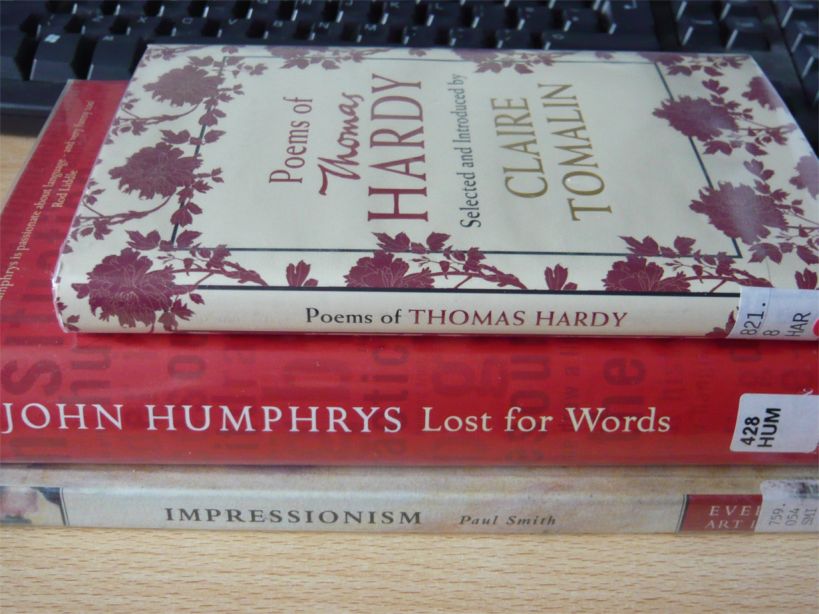
I came home with three books (I was very restrained remembering all my unread books):
I don’t read much poetry but The Poems of Thomas Hardy, selected and introduced by Claire Tomalin caught my attention as I’ve read several of Hardy’s novels, but none of his poetry. Hardy wrote over a thousand poems and this selection traces his experiences of life and love. This reminded me that over a year ago I started to read her biography of Hardy, which I’d put down for a while to read more of Hardy’s own works before finishing it. Time to get back to it soon.
Impressionism by Paul Smith. I’ve become very interested in the Impressionists since taking a short course recently. The course concentrated on the sites they painted rather than their lives. To supplement that I’m already reading Sue Roe’s The Private Lives of the Impressionists. This book looks at the social, political and intellectual contexts in which Impressionism came about. Plus it has many colour illustrations of their paintings.
Lost For Words by John Humphrys. I like John Humphry’s style – this book is about the “mangling and manipulation of the English Language”. He thinks language should be “simple, clear and honest” and provides examples of cliches, meaningless jargon and evasive language (which I detest).
 Teaser Tuesdays is a weekly bookish meme, hosted by MizB of Should Be Reading. You grab your current read and pick two or three sentences from somewhere on a random page, taking care not to include spoilers and share the title and author, too, so that other TT participants can add the book to their TBR Lists if they like your teasers!
 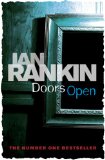 Today my teaser sentences are from page 37 of Ian Rankin’s Doors Open: