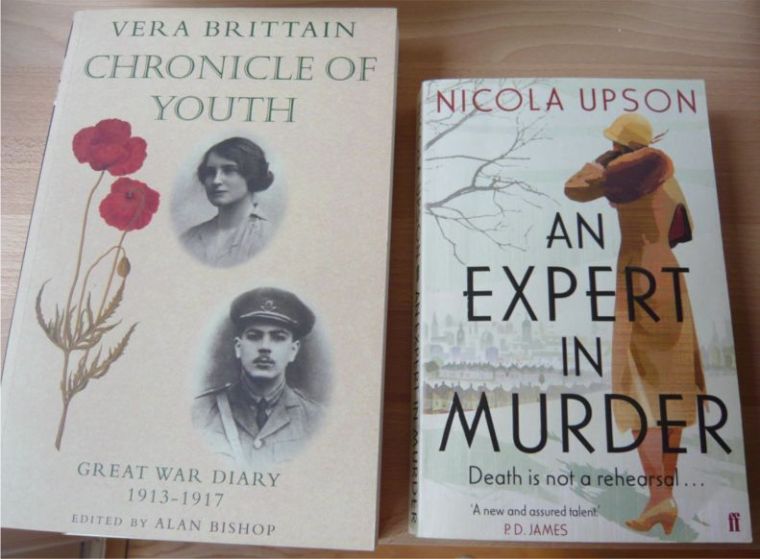
I bought a book …

… not so unusual! But I had decided I wouldn’t buy any more until I’d read at least 6 of my to-be-read books and so far I’ve only read 3.

I gave  in and bought first one book and then another because we went to Much Wenlock in Shropshire on our way to Stratford-upon-Avon and found two good bookshops on the High Street. The  first one I saw on the High Street was Wenlock Books, selling new and secondhand books in a lovely old timber-framed building:

The secondhand books are upstairs:

where I bought Vera Brittain’s Chronicle of Youth Great War Diary 1913 – 1917. It looks unread and as good as new. I’ve borrowed her diary Testament of Youth from a friend, so I’ll read that first.

We walked across the road to the Copper Kettle for a cup of tea and then saw another bookshop further down the High Street – Much More Books, selling secondhand books:

where I bought An Expert in Murder by Nicola Upson.

I’m following Fleur’s method of not buying books except for exceptional bargains, which I think these two books were:


Gently Does It by Alan Hunter: Book Review

When I saw that Gently Does It by Alan Hunter was available as an e-book I bought it because I’d enjoyed watching the TV version with Martin Shaw as Chief Inspector George Gently. First published in 1955, this is the first in the Chief Inspector Gently series, set in Norfolk (unlike the TV version, set in Northumbria).

Product Description from Amazon

The last thing you need when you’re on holiday is to become involved in a murder. For most people, that would easily qualify as the holiday from hell. For George Gently, it is a case of business as usual. The Chief Inspector’s quiet Easter break in Norchester is rudely interrupted when a local timber merchant is found dead. His son, with whom he had been seen arguing, immediately becomes the prime suspect, although Gently is far from convinced of his guilt. 

Norchester City Police gratefully accept Gently’s offer to help investigate the murder, but he soon clashes with Inspector Hansom, the officer in charge of the case. Hansom’s idea of conclusive evidence appals Gently almost as much as Gently’s thorough, detailed, methodical style of investigation exasperates Hansom, who considers the murder to be a straightforward affair.

Locking horns with the local law is a distraction Gently can do without when he’s on the trail of a killer.

My thoughts

I really enjoyed Gently Does It. I liked the portrayal of George Gently, a patient, thoughtful policeman, never hurried or distracted, quiet and persistent. He eats a lot of peppermint creams and doesn’t follow normal police procedures, as he admits:

I oughtn’t to tell you this ‘“ I oughtn’t even to tell myself. But I’m a very bad detective, and I’m always doing what they tell you not to in police college. (page 36)

but he does get results. He takes his time and despite disagreeing with Inspector Hansom, from the local police force, he gradually works his way through the various suspects, all of whom have secrets that he winkles out.

About the Author (copied from the e-book version)

Alan Hunter was born in Hoveton, Norfolk in 1922. He left school at the age of fourteen to work on his father’s farm, spending his spare time sailing on the Norfolk Broads and writing nature notes for the Eastern Evening News. He also wrote poetry, some of which was published while he was in the RAF during the Second World War. By 1950, he was running his own book shop in Norwich and in 1955, the first of what would become a series of forty-six George Gently novels was published. He died in 2005, aged eighty-two.

There are more Gently books that I’m aiming to read. I love the titles and they’re all available as e-books!

Crime Fiction Alphabet: S is for …

… The Stabbing in the Stables by Simon Brett, the seventh book in the Fethering Mysteries series.

Description from Fantastic Fiction:

Fethering’s favorite sleuths are at it again as Jude and Carole Seddon find themselves in the midst of some horseplay, after stumbling upon the body of ex-equestrian Walter Fleet at Long Bamber Stables.

The police attribute the stabbing death to the mysterious “Horse Ripper,” who’s been mutilating mares across West Sussex-and who Walter obviously caught in the act. But considering Walter’s track record out of the saddle, Jude and Carole find that there are plenty of suspects- including Walter’s put-upon wife and more than a few jealous husbands who wanted Walter put out to pasture.

Jude and Carole are amateur detectives, who live next door to each other in the village of Fethering. Jude (who won’t give her last name) is a healer and takes on a new patient a horse and his owner Sonia Dalrymple, kept in stable owned by Lucinda and Walter Fleet. Carole,  retired from the Home Office, divorced and shy, is very different from Jude, but they work well together.

They make enquiries and discover that Walter was not a popular man, not even his wife mourns his death. The Stables, however, is a source of rivalry and secrets, and suspicion lands on Donal, a drunken ex-jockey and horse healer. Jude and Carole don’t believe he is the murderer even when the police arrest him. Sonia, tense and  verging on hysteria is obviously hiding something and Imogen, a teenager helping out at the Stables, behaves very oddly.

It’s an easy read, a ‘cozy mystery’, enjoyable and not too taxing on the brain, as I did work it out before the denouement.

A Crime Fiction Alphabet post for the letter S.

First Lines

Currently I’m reading The Weather in the Streets by Rosamond Lehmann, but I’m getting increasingly tired of it. It maybe very well written, chronicling (in detail) the tension and despair in Olivia Curtis’s life as she has an affair with a married man in the 1930s, and no doubt it captures the spirit of the times of the interwar years but I just want to shake her. I’m probably in the wrong frame of mind to read it right now with its stream of consciousness style of writing and the small font that is blurring in front of my eyes as I read.

So this morning instead of struggling on with it I opened Once a Biker by Peter Turnbull, a Hennessey and Yellich mystery and began reading. It was a relief – the font size is much bigger, the writing is straightforward and the action is quick-moving.

I’ll write more about both books when I’ve finished them, but for now here are the opening lines of Once a Biker:

Monday, 17th June, 09.05 hours – 23.42 hours in which a realization comes to a dying man.

She had found the hospice had a wholly unexpected air of happiness about it. The peace of the institution she could understand, and indeed expected, as with the atmosphere of resignation, but the happiness of those awaiting death was something that came as a surprise. (page 1)

and of The Weather in the Streets:

Turning over in bed, she was aware of a summons: Rouse yourself. Float up, up from the submerging element … But it’s still night, surely … She opened one eye. Everything was in darkness; a dun glimmer mourned in the crack between the curtains. Fog stung faintly in nose, eyelids. So what was it: the fog had come down again: it might be morning. But I hadn’t been called yet. What was it woke me? Listen: yes the telephone, ringing downstairs in Etty’s sitting room; ringing goodness knows how long, nobody to answer it. (page 1)

Both books invite me to carry on reading. They are very different genres, but I’m keener to find out who killed Terry North, whose body has been found buried in a wood, twenty years after he disappeared, than I am to find out how Olivia’s affair progresses. I suspect it’s doomed.

A Book Beginnings post hosted by Katy at A Few More Pages.

Cold is the Grave by Peter Robinson: Book Review

There’s quite a lot to think about reading Cold is the Grave by Peter Robinson. First of all are the crimes, the characters, how they interact and so on and then there are  a number of issues raised – including the difficulties of family relationships, the problems arising when professional  and personal lives overlap, and the effects of guilt.

Description from the back cover:

Detective Inspector Banks’s relationship with Chief Constable Riddle has always been strained. So Banks is more than a little surprised when Riddle summons him late one night and begs for his help.

For Riddle, Banks’s new case is terrifyingly close to home. Six months ago his sixteen-year old daughter ran away to London, where she has fallen into a turbulent world of drugs and pornography. With his reputation threatened, Riddle wants Banks to use his unorthodox methods to find her without fuss. But before he knows it, Banks is investigating murder …

My thoughts:

This is the 11th book in the Inspector Banks series and refers back to incidents in previous books. It’s not too difficult to follow if you haven’t read all the others (as I haven’t) but I think it would help and I wish that I had. It’s also a bit too long for my liking – maybe reading older crime fiction has  made me prefer a tighter and shorter book. However, this is still a good read.

Banks quickly finds Emily, living with Barry Clough a dubious character, old enough to be her father and wealthy from the proceeds of bootlegged computer games and software. Sickened by her life with Clough, she returns home with Banks and then one month later she is found dead, murdered by a mixture of cocaine and strychnine. Banks finds it difficult to stand back and be objective. It becomes personal to him and Detective Superintendent Gristhorpe has to warn Banks,

… don’t let anger and a desire for revenge cloud your judgement. Look clearly at the evidence, the facts before you make any moves. Don’t go off half-cocked the way you’ve done in the past. (page 192)

He and his team, including Detective Sergeant Annie Cabot, are also investigating the death of Charlie Courage, a small-time crook. Their investigations take them from their base in Eastvale, Yorkshire down to London, Stony Stratford, and Leicestershire, with links to crime in Northumbria. At first this seems to be unrelated to Emily’s death but Banks begins to suspect that the two cases maybe linked.

More complications follow with blackmail, another death and suicide, but eventually Banks and Annie work their way through the maze of events. Banks, though, has more victims of crime to add to those that bother his sleep with feelings of guilt, thinking that he should have dug deeper, and that he could have prevented the murders. He knew there was ‘something desperately out of kilter with the Riddle family’, and realises that Emily’s death was

… murder from a distance, perhaps even death by proxy, which made it all the more bloody to solve. (page 271)

This is a detailed and comprehensive police procedural as well as a thoughtful look at the problems of modern life. One to ponder.


The Long Song by Andrea Levy: Book Review

I thoroughly enjoyed The Long Song by Andrea Levy. I think it may even be the best book I’ve read so far this year.

It’s brutal, savage, and unrelenting in depicting the lives of the slaves in Jamaica just as slavery was coming to an end and both the slaves and their former owners were adjusting to their freedom. The narrator is July, at the beginning a spirited young woman, born in a sugar-cane field, telling her story at her son’s suggestion. She begins by telling of her conception, but then says:

Reader, my son tells me that this is too indelicate a commencement of any tale. Please pardon me, but your storyteller is a woman possessed of a forthright tongue and little ink. Waxing upon the nature of trees when all know they are green and lush upon this island, or birds which are plainly plentiful and raucous, or taking good words to whine upon the cruelly hot sun, is neither prudent nor my fancy. Let me confess this without delay so you might consider whether my tale is one in which you can find an interest. If not, then be on your way, for there are plenty books to satisfy if words flowing free as the droppings from the backside of a mule is your desire. (page8)

It is a tale I found full of interest and one that is beautifully written too. I didn’t want to stop reading it, my only criticism being that I thought towards the end it was too condensed. There was a gap of thirty years, largely unexplained, but too much detail would have taken attention away from the main events of the story.

July lives with Kitty her mother until Caroline Mortimer, the sister of the plantation owner arrives and takes her to live in the big house as her servant and rename her ‘Marguerite’. Caroline is a frivolous, self-obsessed, ignorant woman and soon becomes dependent on July whilst still treating her as less than nothing – a slave. The end of slavery is violent and bloody but July lives on through it with Caroline, eventually helping her to run the plantation even though she is now ‘free’.

The story takes a tragic turn with the introduction of Robert Goodwin, a young Englishman, leading inevitably to heartbreak for July. There are several sub-plots that waylaid me, but I read it quickly eager to find out what happened. It’s shocking, breath-taking and completely absorbing.