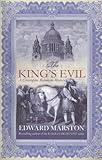
The King's Evil by Edward Marston

I’m still reading from my own unread books and turned to The King’s Evil for some historical crime fiction. It’s the first in Edward Marston’s Restoration series, featuring Christopher Redmayne, an architect and Jonathan Bale, a parish constable.

The King’s Evil is set in London in September 1666, just as the Great Fire of London has begun, eventually devastating a large part of the old medieval City of London. I liked Marston’s description of the fire, conjuring up the sights and sounds, the fear and panic it caused and the efforts to stop its spread – although I’m sure they didn’t use ‘dynamite’ to blow up houses to create a fire break. Anyway this anachronism didn’t spoil my enjoyment of this book.

Redmayne, a Royalist – a supporter of the Court and King Charles II – has designed a new house for Sir Ambrose Northcott and Bale is a Puritan who views Charles with great disapproval and is wondering if the fire is a consequence of the corruption in society as a result of the Restoration of the Crown:

England was once more ruled by a Stuart king. A monarchy which Jonathan had been pleased to see ended was now emphatically restored. As a result, London was indeed a wicked city and nobody was better placed to see the extent of its depravity than someone who patrolled the streets in the office of constable. Jonathan was a God-fearing man who always sought guidance from above and he was bound to wonder if the conflagration really was a sign of divine anger. There were Biblical precedents of cities being punished for their corruption. (page 26)

The two men are brought together with the discovery of Sir Ambrose’s dead body in the cellars of his partly built new house. It’s a good story with some interesting characters, including Jesus-Died-To-Save-Me Thorpe and Redmayne’s older brother Henry, elegant, fashionable and a dissipated rake, who had introduced Christopher to Sir Ambrose. But it’s the setting in time and place that interested me most – the period when Christopher Wren was the leading architect in rebuilding London – the bustle and energy of the times and the lingering conflict between Royalists and Parliamentarians.

The mystery of who killed Sir Ambrose moves along swiftly, with a few surprises along the way, as you would expect, but nothing too surprising. Redmayne travels to Sir Ambrose’s country house, Priestfield Place in Shipbourne, Kent and crosses the Chanel to Paris following the trail of the killer. It’s the ending of the book that let it down somewhat for me – it’s all a bit rushed and abrupt, but overall I enjoyed it and will read more in the series.

Edward Marston, who also writes under the name of Keith Miles, is a prolific author. He is a former chairman of the Crime Writers’ Association. He has several series of books, listed on his website and also on Fantastic Fiction.

The King’s Evil fits into several challenges I’m doing – The Mount TBR Reading Challenge, TBR Triple Dog Dare,the Historical Fiction Challenge, My Kind of Mystery Challenge and What’s in a Name (royalty category).
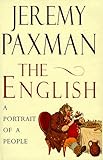
The English by Jeremy Paxman

The English: a Portrait of a People by Jeremy Paxman (an English journalist, broadcaster and author) is a very interesting book, described as:

A book on what constitutes Englishness, and what are considered the essential characteristics and values. Using literary sources and interviews, Jeremy Paxman attempts to define how “Englishness” has changed over this century, and what it is now both in our own and outsider’s views.

It is full of historical information, but is a bit rambling, but even so it is very entertaining. He begins with ‘Being English used to be so easy‘ and goes on to say ‘It’s all so much more complicated now.’ And then proceeds to prove his point.

This makes it difficult to write about it, but easy to read. I like Paxman’s style of writing, I could almost hear him speaking as I read. He’s a person who has grown on me over the years and  lately I’ve enjoyed his TV documentaries too. It’s always been entertaining to watch his interviews, even if I didn’t agree with his views – or his aggressive approach. It’s toned down in this book, but every now and then his acerbic nature comes across.

The easiest way to describe the book is to look at the chapter headings. There are chapters on ‘Funny Foreigners’, ‘The English Empire’, and ‘There Always Was An England’ – in which he concludes ‘the chasm between the imaginative England and the real England won’t do any longer because it fails to reflect the lives of the majority.‘ Other chapters are about the ‘Ideal Englishman’, the ‘True Born Englishman and Other Lies’ and so on. But it’s the index that shows the full breadth of the topics he covers, from the ‘Abbey National Bank’ to ‘Zadok the Priest (Handel)’.

He writes about food, sport, football hooligans, language, individualism, education, religion, ‘John Bull’, cities and the countryside – the English idyllic village, class structure and social tone, attitudes to women, business and trade to name but a few topics. It’s well researched and very readable, with a bibliography listing all the books he mentions plus others that presumably he has used.

It was published in 1998, so things have moved on a lot since then, but I still think it’s a valid book. I’ve had it for about four years and was prompted to read it now by all the discussion about Scottish Independence, if only to see if he could clarify what it means to be ‘English’. He points out the thoughtless way people have of muddling up ‘England’ with ‘Britain’, as if the Scots and Welsh do not exist (it annoys me too).

But I don’t really feel any clearer about what is is to be ‘English’. It seems there really is no such thing as ‘the English’ – we’re a mixture of all sorts, or as Paxman puts it, The English are a mongrel race‘. (page 59) It’s hard to do justice to this book in one short post and there is so much more that I could write about – but it would be far better to read the book itself.

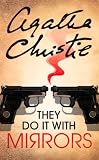
They Do It With Mirrors by Agatha Christie

I’m slowly reading my way through Agatha Christie’s books, not in chronological order, but just as I come across them and this month I’ve read They Do It With Mirrors which was first published in 1952.

I don’t think it’s one of her best, but I did like it. It begins with Miss Marple reminiscing with an old friend, Mrs Ruth Van Rydock, an American. Miss Marple has known her and her sister, Carrie Louise since they had been together at a pensionnat in Florence. Ruth is worried about Carrie Louise, who is now living in a country house in the south of England with her husband, Lewis Serrocold, which he has turned into a home for delinquent boys. She can’t put her finger on what is wrong, she just felt the atmosphere wasn’t right, whether it was the boys’ home – ‘those dreadful young delinquents‘ or something else and she asks Miss Marple to visit Carrie Louise to see if her fears are justified.
Miss Marple finds an unhappy household, including Mildred, Carrie Louise’s widowed daughter, Stephen and Alex, her stepsons, and Gina, her adopted daughter’s daughter, married to an American, Wally Hudd. Lewis Serrocold is Carrie’s third husband, described by Ruth as a

‘crank’, a ‘man with ideals’, ‘bitten by the bug of wanting to improve everybody’s lives for them. And, really you know, nobody can do that but yourself.’

All is not well with the boys either – one of them, Edgar Lawson is suffering from delusions, saying his father is Churchill and then that he is Montgomery. He loses control and Lewis takes him into his office, but their raised voices are heard by the others, culminating in the sound of gunshots. But it is not Lewis or Edgar who is killed, but one of the trustees of the home, Christian Gulbrandsen, the brother of Carrie Louise’s first husband who was alone in his study. So Ruth’s fears materialise when Christian is found shot dead and it seems that someone is trying to poison Carrie Louise.

As I expected from the title not everything is as it appears.  The layout of the house is of importance and there is a plan showing how the rooms are connected, but even so I was still in the dark. I hadn’t worked out who the murderer is and had even ruled out the person in question quite early on in the book. Miss Marple, however, was not deceived and had sorted out the reality from the illusion and seen through the misdirection.

… all the things that seemed to be true were only illusions. Illusions created for a definite purpose – in the same way that conjurers create illusions to deceive an audience.

There are a number of points that struck me as interesting as I read the book, not essential to the plot, but maybe revealing Agatha Christie’s opinions and her views of post-war society. There is the subject of self-help and the issue of expecting things to be granted as a right, focussing on providing education for the juvenile delinquents by men crazy with enthusiasm like Lewis Serrocold:

One of those men of enormous will power who like living on a banana and a piece of toast and put all their energies into a Cause.


She makes the point that just because a person comes from a deprived background doesn’t mean they’re going to turn into criminals and it is the honest ones who could do with a start in life – ‘But there, honesty has to be its own reward – millionaires don’t leave trust funds to help the worthwhile.’

There are comments on the oddness of the English, being prouder of defeats and retreats than of their victories, using Dunkirk as an example and the Charge of the Light Brigade. At the same time as I was reading this I was also reading Jeremy Paxman’s The English: a Portrait of a People, in which he also comments on this trait – turning the consequence of catastrophe into a ‘victorious retreat’.

On a more personal level there are her views on the vulnerability of women:

Women have a much worse time of it in the world than men do. They’re more vulnerable. They have children and they mind – terribly – about their children. As soon as they lose their looks, the men they love don’t love them any more. They’re betrayed and deserted and pushed aside.


I can’t help thinking that really was Agatha Christie speaking from experience.

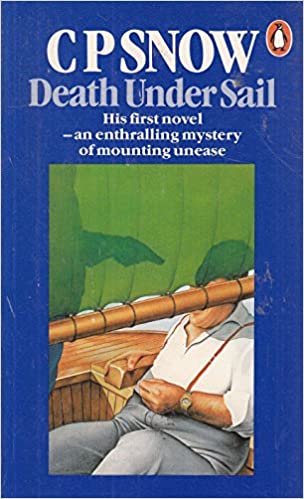
Death Under Sail by C P Snow

I didn’t know that C P Snow had written crime fiction. I’d read some of his books many years ago – the Strangers and Brothers series, in which he had coined the phrase ‘the corridors of power‘. I won Death Under Sail, Snow’s very first novel, in one of Bev’s Mount TBR Checkpoints at My Reader’s Block last year! It was first published in 1932, when Snow was 26 and a research scientist at Cambridge.

This is a classic mystery, a type of ‘country house’ mystery, but set on a wherry (a sailing boat) on the Norfolk Broads, where Roger Mills, a Harley Street specialist, is taking a group of six friends on a sailing holiday. When they find him at the tiller with a smile on his face and a gunshot through his heart, all six fall under suspicion.

The book is narrated by Ian Capel, who is older than the other friends and has joined the party a week later than the others. They are all old friends, with the exception of Tonia, Philip’s new girl friend, who all get on very well together; Avril and Christopher are engaged and William is a young doctor, a colleague of Roger’s. Ian describes them as ‘some of the pleasantest people whom I had ever known‘ – but are they, because one of them must be the murderer?

Ian asks his old friend Finbow, a civil servant home on leave from Hong Kong, to help them discover who did it. Meanwhile the police are also investigating the murder in the form of Detective Sergeant Aloysius Birrell. Finbow and Birrell provide an interesting contrast in the way they work – Finbow looks at the crime from a psychological and philosophical point of view, ruling out suspect after suspect, whereas Birrell looks for facts and evidence – even down to diving into the river himself to look for the missing gun and Roger’s log book. It’s ingenious!

C P Snow (1905 – 1980) was an English novelist and physicist. He was knighted in 1957 and made a life peer in 1964. His last novel, A Coat of Varnish is also crime fiction.

Mini Book Reviews

I’ve got a bit behind with writing about the books I’ve read recently, so to catch up I thought I just write some quick reviews. These books are all from my TBRs, two of them good/ excellent books and the third a bit of a disappointment:

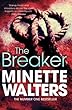
First the good – The Breaker by Minette Walters

From the back cover:

Twelve hours after a woman’s broken body is washed up on a deserted shore, her traumatized three-year-old daughter is discovered twenty miles away wandering the streets of Poole …

But why was Kate killed and her daughter, a witness, allowed to live? And why weren’t they together? More curiously, why had Kate willingly boarded a boat when she had a terror of drowning at sea?

Police suspicion centres on both a young actor, whose sailing boat is moored just yards from where the toddler is found, and the murdered woman’s husband. Was he really in Liverpool the night she died? And why does their daughter scream in terror every time he tries to pick her up … ?

This kept me guessing all the way through and I kept changing my mind about who the murderer was, so I liked this book. It moves between the third person narrative and copies of reports and faxes etc that form part of the police investigation. There are lots of clues, twist and turns and plenty of red herrings. A satisfying book. I’d like to read more of Minette Walters’s books.

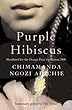
Then the excellent – Purple Hibiscus by Chimamanda Ngozi Adichie.

From the back cover:

Fifteen-year-old Kambili lives in fear of her father, a charismatic yet violent Catholic patriarch who, although generous and well-respected in the community, is repressive and fanatically religious at home. Escape and the discovery of a new way of life come when Nigeria is shaken by a military coup, forcing Kambili and her brother to live in their aunt’s home, a noisy place full of laughter. The visit will lift the silence from her world and, in time, unlock a terrible, bruising secret at the heart of her family life.
This is a fabulous book, one of the best I’ve read this year and it’s even more amazing that this was Adichie’s first book. I read her second book Half of a Yellow Sun a few years ago and was completely taken with that book too. It’s beautifully written – Kambili’s father and aunt are such rounded characters, in other hands they could have just been caricatures. At times I struggled to read the physical abuse scenes, they were so vivid.

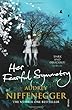
And finally, the disappointment – Her Fearful Symmetry by Audrey Niffenegger. 

From the back cover:

When Elspeth Noblin dies, she leaves her beautiful flat overlooking Highgate Cemetery to her twin nieces, Julia and Valentina Poole, on the condition that their mother is never allowed to cross the threshold.  But until the solicitor’s letter falls through the door of their suburban American home, neither Julia or Valentina knew their aunt existed. The twins hope that in London their own, separate lives can finally begin but they have no idea that they have been summoned into a tangle of fraying lives, from the obsessive-compulsive crossword setter who lives above them to their aunt’s mysterious and elusive lover who lives below them and works in the cemetery itself.

As the twins unravel the secrets of their aunt, who doesn’t seem quite ready to leave her flat, even after death, Niffenegger weaves together a delicious and deadly ghost story about love, loss and identity.

I’d found The Time Traveler’s Wife disappointing and irritating and at first I thought Her Fearful Symmetry was going to be better. It started off well and I liked all the information about Highgate Cemetery, but actually overall this book was disappointing too. I thought it was all rather predictable – I easily guessed the secrets and whilst the ghost elements are interesting at first I found it all became a bit dull and unconvincing. However, the chapters on Martin, the obsessive-compulsive are much more interesting and brought the book a bit more to life. The decision Valentina made was so ridiculous I just couldn’t suspend my disbelief.

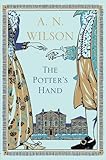
Book Beginnings: The Potter's Hand by A N Wilson

Whilst I’ve been reading from my own book shelves this year so far, I’ve accumulated a pile of library books that are tempting me away from them. One of these books is The Potter’s Hand by A N Wilson.

It begins:

The unoiled hinge joined its melancholy whine to the opium-dosed whimper of the patient who st gagged in his chair, and to the swift rasping of the saw. The door creaked ajar in the very moment that the doctor sawed off the leg of Sukey’s pa.

Such a dramatic opening that immediately grabbed my attention, conjuring up such a vivid picture complete with sound effects! The year is 1768. Sukey (Susannah), who later became the mother of Charles Darwin, was the daughter of Josiah Wedgwood,  an English potter and founder of the Wedgwood company.

The Potter’s Hand is a novel about Josiah Wedgwood and his family. Wilson explains in an Afterword that the broad outlines of the story and most of the details are true, but he has altered dates and rearranged historical events and nearly all the letters are invented. It is ‘meant to be read as fiction, even thought it is intended in part, as an act of homage to one of the great men of our history.’

I’ve read the first two chapters and think I’ll have to read on soon, after I’ve finished Death Under Sail by C P Snow, a crime fiction novel, if not sooner.

Every Friday Gilion at Rose City Reader hosts Book Beginnings on Friday, where you can share the first sentence (or so) of the book you are reading, along with your initial thoughts about the sentence, impressions of the book, or anything else the opener inspires.