Book Beginnings: An Astronaut’s Guide to Life on Earth

Book Beginnings ButtonEvery Friday Book Beginnings on Friday is hosted by Gillion at Rose City Reader where you can share the first sentence (or so) of the book you are reading, along with your initial thoughts about the sentence, impressions of the book, or anything else the opener inspires.

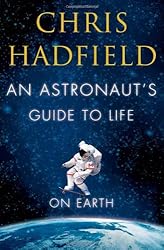
This morning I have started to read An Astronaut’s Guide to Life on Earth by Chris Hadfield.

It begins with an Introduction: Mission Impossible

The windows of a spaceship casually frame miracles. Every 92 seconds, another sunrise: a layer cake that starts with orange, then a thick wedge of blue, then the richest, darkest icing decorated with stars.

Moving on to the first chapter:The Trip Takes a Lifetime

One morning a strange thought  occurs to me shortly after waking: the socks I am about to put on are the ones I’ll wear to leave Earth. That prospect feels real yet surreal, the way a particularly vivid dream does. The feeling intensifies at breakfast, when reporters jostle each other to get a good photo, as though I’m a condemned man and this is my last meal.

I first heard of this book when Chris Hadfield appeared on Sunday Brunch and then Jackie of Farm Lane Books Blog wrote about his book, which reminded me I wanted to read it.

What an amazing  experience to be looking down on Earth, seeing its entirety and beauty from a totally different perspective!

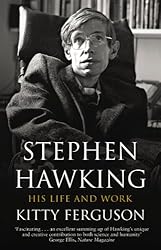
Stephen Hawking: His Life and Work by Kitty Ferguson

Blurb:

Stephen Hawking is one of the most remarkable figures of our time, a Cambridge genius who has earned international celebrity as a brilliant theoretical physicist and become an inspiration and revelation to those who have witnessed his courageous triumph over disability. This is Hawking’s life story by Kitty Ferguson, who has had special help from Hawking himself and his close associates and who has a gift for translating the language of theoretical physics for non-scientists.

Twenty years ago, Kitty Ferguson’s Stephen Hawking: Quest for a Theory of Everything became a Sunday Times bestseller and took the world by storm. She now returns to the subject to transform that short book into a hugely expanded, carefully researched, up-to-the-minute biography.

Recently I watched The Theory of Everything, with Eddie Redmayne playing the part of Stephen Hawking. I think it’s a brilliant film and it made me want to know more about Stephen Hawking. Stephen Hawking: His Life and Work by Kitty Ferguson, subtitled The Story and Science of One of the Most Extraordinary, Celebrated and Courageous Figures of Our Time, has certainly expanded my knowledge, even if some of the science is beyond me.

At first I read the scientific explanations carefully and felt I understood them until about half way into the book, when I struggled and ended up skim reading passages. I could cope on an elementary level with quantum mechanics, the uncertainty principle is not new to me, nor the theory of black holes, and singularity. I learnt about the ‘event horizon’, which is the ‘radius-of-no-return where velocity becomes greater than the speed of light’, and about Hawking Radiation, the radiation produced by a black hole. But when I got up to ‘brane’ theory and p-branes, I was lost – it’s too mathematical for my pea-brain! But I still think I learned a lot. It helps that there is not only an index, but also a glossary that explains many of the scientific terms (not p-branes, unfortunately).

The book moves between biography and Hawking’s work, painting a picture of a warm, likeable, humorous, and courageous man with an exuberance for life. There’s a lot about his health, his career, his trips abroad and his relationships with colleagues. But not much about his marriages or divorces; I expect that was Hawking’s preference. I hadn’t known that he liked Marilyn Monroe, having a life-size picture of her on the door of his office, or that he has co-written children’s books with his daughter Lucy. They look very good!

Details from Fantastic Fiction:
1. George’s Secret Key to the Universe (2007)
2. George’s Cosmic Treasure Hunt (2009)
3. George and the Big Bang (2011)
4. George and the Unbreakable Code (2014)
5. George and the Blue Planets (2016)


I was fascinated, as I was when watching the film, with how he lives with Amyotrophic Lateral Sclerosis (ALS) a form of motor neurone disease and the remarkable fact that he has lived so long with this condition and yet can say, ‘ Although I cannot move, and I have to speak through a computer, in my mind I am free.‘ (page 434)

Kitty Ferguson writes:

Hawking’s life and his science continue to be full of paradoxes. Things are often not what they seem. Pieces that fit together refuse to do so. Beginnings may be endings; cruel circumstances can lead to happiness, although fame and success may not; two brilliant and highly successful scientific theories taken together yield nonsense; empty space isn’t empty; black holes aren’t black; the effort to unite everything in a simple explanation reveals, instead a fragmented picture; and a man whose appearance inspires shock and pity takes us joyfully to where the boundaries of time and space ought to be – and are not. (page 17)

  • Paperback: 528 pages
  • Publisher: Bantam (5 July 2012)
  • Language: English
  • ISBN-10: 0857500740
  • ISBN-13: 978-0857500748
  • Source: library book

I have an e-book of Jane Hawking’s book, Travelling to Infinity; My Life with Stephen, which I’ll be reading sometime soon.

First Chapter, First Paragraph: Go Set a Watchman

Every Tuesday Diane at Bibliophile by the Sea hosts First Chapter, First Paragraph Tuesday Intros, where you can share the first paragraph, or a few, of a book you are reading or thinking about reading soon.

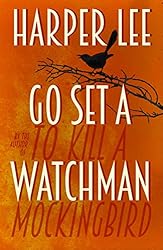
My choice this week is Go Set a Watchman by Harper Lee which is published today. It begins:

Since Atlanta, she had looked out the dining-car window with a delight almost physical. Over her breakfast coffee, she watched the last of Georgia’s hills recede and the red earth appear, and with it tin-roofed houses set in the middle of swept yards, and in the yards the inevitable verbena grew, surrounded by whitewashed tires. She grinned when she saw her first TV antenna atop an unpainted Negro house; as they multiplied her joy rose.

Jean Louise Finch always made this journey by air, but she decided to go by train from New York to Maycomb Junction on her fifth annual trip home. For one thing, she had the life scared out of her the last time she was on a plane: the pilot had elected to fly through a tornado. For another, flying home meant her father rising at three in the morning, driving a hundred miles to meet her in Mobile, and doing a full day’s work afterwards: he was seventy-two now and this was no longer fair.

I loved To Kill a Mockingbird when I read it a couple of years ago but I’m still not sure I want to read Go Set a Watchman, so I downloaded a sample on my Kindle to have a look at the beginning.

What do you think? Are you going to read it?

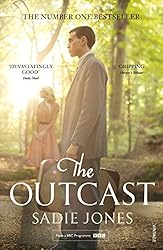
The Outcast by Sadie Jones

I noticed trailers for a new drama on BBC for The Outcast and wondered if it’s based on the book of the same name by Sadie Jones ‘“ a book that has sat on my shelves for a few years (well nearly 7 years) and I still haven’t read it. That’s what happens when you move house, box the books and then double shelve them, putting this one at the back! It was shortlisted for the Orange Broadband Prize for Fiction in 2008.

And it is the same book (although my copy being much older has a different cover) ‘“ the TV version begins tomorrow on BBC One at 9 pm. It’s been adapted by Sadie Jones, so I hope this means it’s faithful to the book. I’ve started to read it ‘“ won’t finish it by tomorrow night but will definitely finish it before the second episode is broadcast the following Sunday.

It’s set in the 1950s, when Lewis Aldridge aged nineteen, is released from jail, and returns to the village where he grew up: the village where, a decade earlier, tragedy tore his family apart, leaving him to a troubled adolescence with a father he barely knew.

Stacking the Shelves: 11 July 2015

STSmall

Stacking The Shelves is all about sharing the books you are adding to your shelves. This means you can include ‘˜real’ and ‘˜virtual’ books (ie physical and ebooks) you’ve bought, books you’ve borrowed from friends or the library, review books, and gifts.

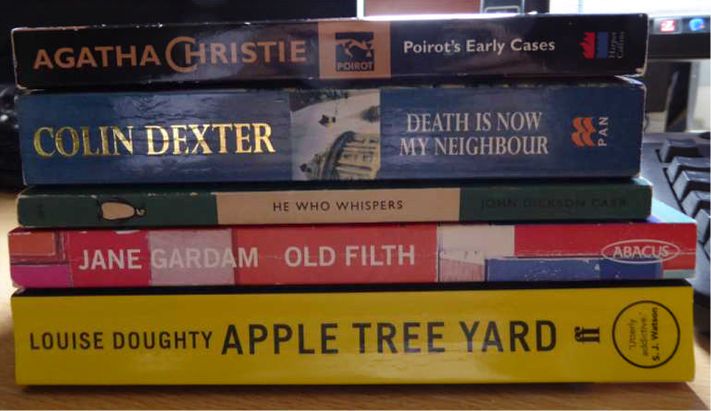
Another visit to Barter Books on Tuesday resulted in bringing these books home – a fair exchange for some computer books I thought. (If you can visit Alnwick it’s well worth looking in at Barter Books.)

Books July15From top to bottom they are:

  • Poirot’s Early Cases by Agatha Christie. I’ve been hoping this book would turn up at Barter Books – a collection of short stories, all first published in magazines between 1923 and 1935.
  • Death is Now My Neighbour by Colin Dexter – the 12th Inspector Morse mystery. I haven’t read many of the Morse books, although I’ve watched all the TV adaptations. A young woman is murdered – the trail leads Morse to Lonsdale college where there is a contest for the coveted position of Master.
  • He Who Whispers by John Dickson Carr. As I’ve been reading The Golden Age of Murder by Martin Edwards I looked for books by the authors he mentions in his book. He Who Whispers was the only book I found (I don’t think it’s mentioned in Edwards’ book). It’s a Doctor Gideon Fell murder mystery, first published in 1946. My copy is a green and white Penguin paperback.
  • Old Filth by Jane Gardam (Failed in London Try London). I first read this several years ago – a library book – but as I’ve been reading the next two in the trilogy I wanted to refresh my memory about this first one.
  • Apple Tree Yard by Louise Doughty, described as a psychological thriller. The quotes on the back cover convinced me to try this book – ‘Brilliant and bruising. Obsession, betrayal and blood letting …‘ Ian Rankin and this from Val McDermid, ‘ Realised I’d been holding my breath for the last forty pages. Gripping.’

Do let me know if you’ve read any of these and what you found to add to your shelves this week.

The Day of the Lie by William Brodrick

William Brodrick’s books are meaty, books that make me think. Nothing is straight forward, they’re layered books, delving into the past, uncovering secrets and revealing crimes. They are well researched, bringing the past to life.
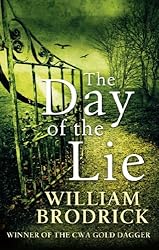
In The Day of the Lie (the 4th Father Anselm book) the past in question is post Second World War Poland, covering  the early 1950s, the early 1980s and the present day.

Blurb from the back cover of my paperback copy:

In present day Cambridge, Father Anselm receives a visit from an old friend with a dangerous story to tell – the story of a woman in Eastern Europe in the icy grip of the Cold War. She was brave, brilliant … and betrayed by someone close to her – someone still unknown. What became of this woman and the dark secret she kept?

No one can be trusted. Nothing is as it seems. Before more blood is spilt, Anselm must peel back years of history, decades of secrets and a half-century of lies in order to expose a secret so shocking that some would rather die than see it revealed.

Father Anselm’s old friend John has asked him to investigate who had betrayed  Roza Mojeska. She had been part of an underground resistance movement, had been arrested and tortured by the secret police, in particular by Otto Brack, in order to uncover the identity of the Shoemaker, the author of a dissident newspaper, Freedom and Independence.

Never explicitly graphic, Brodrick conveys the horror of the torture chamber and as Anselm’s Prior warns him he had to enter ‘the world of Otto Brack, this frightening man who learned how to bring about evil by exploiting someone who is good, laying – in part – the evil at their door.‘ (page 75-6) It’s a world where ‘twisted people lead twisted lives and the roads they build around them are never straight and true.’

My knowledge of the period is limited, so I found the historical setting quite difficult to follow, as the narrative switches between the time periods, but once I had sorted out the relationships between the characters (or I thought I had) it became clearer. But there is also the problem of working out who is ‘good’ and who is ‘bad’, just who is telling the truth, whose recollection of the past is ‘correct’? I thought I knew, but then there was a shift and I wasn’t sure right up to the end of the book.

Looking back on the book now (I finished reading it over a week ago) I can say I did enjoy it, but it was hard work in parts.

William Brodrick became a barrister, having been an Augustinian monk for six years (the other way round from his fictional character, Father Anselm). After 10 years at the Bar, his interest in writing led him to writing the Father Anselm books.

The Father Anselm books (with links to my posts) are:

  1. The Sixth Lamentation (2003)
  2. The Gardens of the Dead (2006)
  3. A Whispered Name (2008) – the best one in my opinion
  4. The Day of the Lie (2012)
  5. The Discourtesy of Death (2013)

And the latest book has just been published:
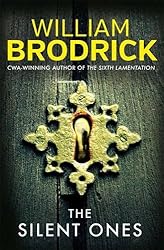
The Silent Ones by William Brodrick published 2 July 2015.

The Day of the Lie fits into the Mount TBR Challenge and is also a book I identified as one for the 10 Books of Summer Challenge.