My Week in Books: 13 April 2016

This Week in Books is a weekly round-up hosted by Lypsyy Lost & Found, about what I’ve been reading Now, Then & Next.
IMG_1384-0

A similar meme,  WWW Wednesday is run by Taking on a World of Words.

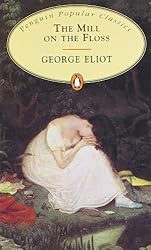
Now: Currently I’m reading three books, because I like to vary my reading. So, I have a classic, a crime fiction and a non-fiction book on the go:

Blurb:

George Eliot drew on her own anguished childhood when she depicted the stormy relationship between Maggie and Tom Tulliver. Maggie’s often tormented battle to do her duty and belong on the one hand, and to be  herself, wild and natural, on the other, propels her from one crisis to another. As the Tulliver fortunes decline and fall, the rift between Maggie and her family becomes almost irreconcilable. But Maggie’s biggest mistake of all is to fall in love with Stephen Guest who is engaged to another woman.

Both a sharp and observant picture of English rural life and a profoundly convincing analysis of a woman’s psychology, The Mill on the Floss is a novel that tackles the complexities of morality versus desire.
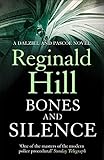
  • Bones and Silence by Reginald Hill – a Dalziel and Pascoe crime fiction novel. It’s book 11 in the series, which I’m reading totally out of order (there are over 20 in the series) and it is really good.

Blurb:

When Detective Superintendent Andy Dalziel witnesses a bizarre murder across the street from his own back garden, he is quite sure who the culprit is. After all, he’s got to believe what he sees with his own eyes. But what exactly does he see? And is he mistaken? Peter Pascoe thinks so.

Dalziel senses the doubters around him, which only strengthens his resolve. To make matters worse, he’s being pestered by an anonymous letter-writer, threatening suicide. Worse still, Pascoe seems intent on reminding him of the fact.

Meanwhile, the effervescent Eileen Chung is directing the Mystery Plays. And who does she have in mind for God? Daziel, of course. He shouldn’t have too much difficulty acting the part’¦
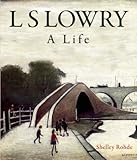
  • L S Lowry: A Life by Shelley Rohde. Lowry is one of my favourite artists, well known for his urban paintings of industrial towns but his work covers a wide range of themes and subjects, from landscapes and seascapes to portraits. This biography is based on collections of private papers held in The Lowry, Salford Quays.
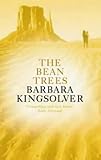
  • Then: I’ve recently finished The Bean Trees by Barbara Kingsolver, her first novel. I’ve read some of her other books –  loved The Poisonwood Bible which I’ve read a few times, and Homeland, a book of short stories, but wasn’t so taken with The Lacuna. I thoroughly enjoyed The Bean Trees – my review will follow shortly:

Blurb:

Plucky Taylor Greer grows up poor in rural Kentucky with two goals: to avoid pregnancy and to get away. She succeeds on both counts when she buys an old car and heads west. But midway across the country motherhood catches up with her when she becomes the guardian of an abandoned baby girl she calls Turtle. In Tuscon they encounter an extraordinary array of people, and with their help, Taylor builds herself and her sweet, stunned child a life.

Next: I really don’t know.

What about you? What are you reading this week?

Ninth Blog Birthday!

Nine todayI started blogging on 12 April 2007, after a hesitant start with one post in July 2006. Nine years! Each year, as the anniversary comes round, I think how amazing it is that I’m still writing my blog, but it still feels like yesterday that I began it.

Since then I’ve posted 2,235 posts – most of them are book reviews, which is no surprise to me as I began BooksPlease as a way of keeping track of what I’ve read. I also write about other things, such as art, pets, places I’ve visited, personal anecdotes or thoughts, cookery, walking, travels and holidays. But it still remains mostly a book blog.

I had no idea when I began just how big a community the book blogging world is, nor that I would make contact with so many people in so many parts of the world. I had never heard of ‘memes’, didn’t know about reading challenges, but over the years I’ve taken part in many, broadening my reading interests into many different genres, and I never thought that authors would want me to review their books, nor that I would enjoy it all so much.

It’s really the contact with people that makes book blogging so enjoyable – knowing that you’re part of a world-wide group of people who love books and reading. So, thank you to all of you who read and comment on my blog – I really do appreciate it!

Stacking the Shelves: 9 April 2016

STSmall

Stacking The Shelves is all about sharing the books you are adding to your shelves. This means you can include ‘˜real’ and ‘˜virtual’ books (ie physical and ebooks) you’ve bought, books you’ve borrowed from friends or the library, review books, and gifts.

I’ve borrowed three library books this week, books by authors whose books I’ve read in the past and enjoyed:

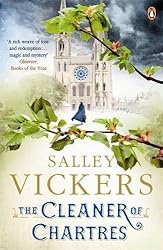
  • The Cleaner of Chartres by Salley Vickers – I borrowed this because I’ve some of Salley Vickers’ books and loved them, in particular Miss Garnet’s Angel and Mr Golightly’s Holiday and Where Three Roads Meet, so I’m hoping I’ll love this one too.

Blurb:

There is something special about the ancient cathedral of Chartres, with its mismatched spires, astonishing stained glass and strange labyrinth. And there is something special too about Agnès Morel, the mysterious woman who is to be found cleaning it each morning.

No one quite knows where she came from – not the diffident Abbé Paul, who discovered her one morning twenty years ago, sleeping in the north porch; nor lonely Professor Jones, whose chaotic existence she helps to organise; nor Philippe Nevers, whose neurotic sister and newborn child she cares for; nor even the irreverent young restorer, Alain Fleury, who works alongside her each day and whose attention she catches with her tawny eyes, her colourful clothes and elusive manner. And yet everyone she encounters would surely agree that she is subtly transforming their lives, even if they couldn’t quite say how.

But with a chance meeting in the cathedral one day, the spectre of Agnès’ past returns, provoking malicious rumours from the prejudiced Madame Beck and her gossipy companion Madame Picot. As the hearsay grows uglier, Agnès is forced to confront her history, and the mystery of her origins finally unfolds.

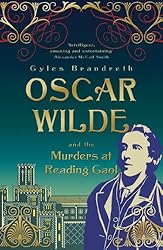
Blurb:

Reading Gaol’s most famous prisoner is pitted against a ruthless and fiendishly clever serial killer. ‘Intelligent, amusing and entertaining’ Alexander McCall Smith It is 1897, Dieppe. Oscar Wilde, poet, playwright, novelist, raconteur and ex-convict, has fled the country after his release from Reading Gaol. Tonight he is sharing a drink and the story of his cruel imprisonment with a mysterious stranger. He has endured a harsh regime: the treadmill, solitary confinement, censored letters, no writing materials. Yet even in the midst of such deprivation, Oscar’s astonishing detective powers remain undiminished – and when first a brutal warder and then the prison chaplain are found murdered, who else should the governor turn to for help other than Reading Gaol’s most celebrated inmate?
In this, the latest novel in his acclaimed Oscar Wilde murder mystery series, Gyles Brandreth takes us deep into the dark heart of Wilde’s cruel incarceration.

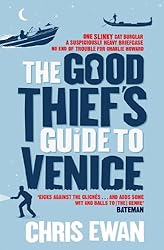
Blurb:

Charlie Howard ‘“ struggling crime-writer by day, talented thief by night ‘“’¯has gone straight. But holing himself up in a crumbling palazzo in Venice in an attempt to concentrate on his next novel hasn’t got rid of the itch in his fingers. And to make matters worse, a striking Italian beauty has just broken into his apartment and made off with his most prized possession, leaving a puzzling calling card in its place.

It looks as though kicking the habit of a lifetime will be much more of a challenge than Charlie thought.

Sneaking out into Venice’s maze of murky canals, Charlie’s attempts to tame a cat burglar embroil him in a plot that is far bigger and more explosive than he could ever have imagined.

We should treasure our libraries.

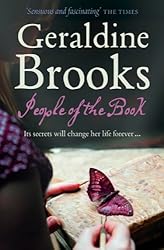
People of the Book by Geraldine Brooks

When I began reading People of the Book by Geraldine Brooks I wondered why I’d left it nearly eight years on my book shelves before I  got round to reading it. I loved it; it’s a real gem! It has joined the ranks of my favourite books and is definitely a book for keeping and (I hope) for re-reading.

How could I not love a book about books, in particular an ancient book, one that was thought to be lost or destroyed, a book that escaped burning by the Inquisition and the Nazis, a book that survived shelling during the Bosnian War in the 1990s, a book known as the priceless Sarajevo Haggadah – a medieval Jewish prayer book containing the illustrated traditional text of the Passover Haggadah which accompanies the Feast of Passover.

In Geraldine Brooks’ Afterword she explains that People of the Book is fiction, inspired by the true story of the Hebrew codex known as the Sarajevo Haggadah. Some of the facts are true to the haggadah’s known history but most of the plot and all of the characters are imaginary. She then goes on to define what is true and what is fictional, which I think is the best way of presenting historical fiction.

Australian Hanna Heath is a rare-book restorer and it’s not only the content of the haggadah that interests her, it is the hidden history of the book that captured her imagination and also mine. She finds tiny clues to its history as she restores the book – a fragment of an insect’s wing, wine stains, salt crystals and a tiny white hair – clues to unlock its mysteries. The story of the book is told in reverse chronological order beginning in 1996 and working back to 1480. Interwoven with each story is Hanna’s own story as she too discovers her roots. It’s a story too of love and war, of family relationships, of Anti-Semitism and of historical religious conflicts as the haggadah survived disaster after disaster. It’s also a novel about preserving the past, its culture and history for future generations. It has depth and breadth and is beautifully written. I was irresistibly engrossed in this book and full of wonder at its stories, reaching back in time from Sarajevo to Vienna, Venice, Tarragona to Seville in 1480 and also Hanna’s story from 1996 to 2002.

There are many descriptions of the haggadah throughout the book, all of which made me eager to know more about it. This is just one example from the chapter on wine stains set in Venice in 1609:

Aryeh released the catches, admiring the work of the silversmith. Each clasp, closed, was in the form of a pair of wings. As the delicate catch released – still smoothly after more than a century – the wings opened to reveal a rosette enfolded within. Aryeh saw at once that the book was a haggadah, but unlike any he had seen before. The gold leaf, the pigments … he stared at the illuminations, opening each page eagerly. He was delighted, yet a little disturbed, to see Jewish stories told in an art so like that of the Christians’ prayer books. (page 163)

And here, by way of contrast, is a description of Arnhem Land in the north east corner of Australia’s Northern Territory, where Hanna is working in the caves studying the Aboriginal rock art to document and preserve it before the uranium or bauxite companies blasted it into rubble:

I stepped out of the cave and blinked in the bright daylight. The sun was a big disc of brilliant madder, reddening the stripes of ore that ran through the sheer black-and-ocher rock face. Down below, the first shoots of new spear grass washed the plain in vivid green. Light silvered the sheets of water left behind by the previous night’s downpour. We’d moved into Gunumeleng – one of six seasons the Aborigines identified in a year that whites simply divided into Wet and Dry. Gunumeleng brought the first storms. In another month, the entire plain would be flooded. The so-called road, which was actually virtually a marginal dirt track, would be impassable. (pages 339-340)

I just had to know more about the Sarajevo Haggadah and found these illustrations (see Wikimedia Commons for more illustrations and these sites for more information –  WikipediaThe Times of Israel and About Haggadah:

Copies of Sarajevo Haggadah in parliament building – from Wikimedia Commons

The Sarejevo Haggadah, 15th century Spain – from Wikimedia Commons
Reading challenges: Mount TBR Reading Challenge 2016

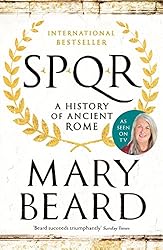
SPQR: A History of Ancient Rome by Mary Beard

Mary Beard is a Professor of Classics at Newnham College, Cambridge and is the Classics editor of the TLS. She is a fellow of the British Academy and a member of the American Academy of Arts and Sciences. And she writes a blog – A Don’s Life, which appears in The Times. I’ve enjoyed watching her TV programmes and so it doesn’t surprise me at all  that SPQR is just as entertaining and informative as the programmes – and very readable, even for someone, like me, who only has a smattering of knowledge about Roman history.

I took my time reading SPQR; some of it covered familiar ground and some was new to me. It’s a fascinating account of how Rome grew and sustained its position for so long, covering the period from the fourth century BCE when Rome was expanding from a small village, up to the moment in 212 CE when the emperor Caracalla made every free inhabitant of the Roman Empire a full Roman citizen.

The title, SPQR, is taken from the Roman catchphrase, Senatus Populusque Romanus meaning the Senate and People of Rome and it is on these two elements – the Senate and the People that Mary Beard concentrates, focussing on the city of Rome, on Roman Italy and also looking at Rome from the outside, from the point of view of those living in the wider territories of the Roman empire.

The book is not strictly chronological and begins with an event I know a bit about through reading Robert Harris’ Lustrum. It’s the Catiline conspiracy in 63 BC, which concerned a plot, or so it was rumoured to overthrow the Roman Empire and Cicero’s part in uncovering the plot and saving the state. Mary Beard begins with this event, because:

it is only in the first century BCE that we can start to explore Rome, close up and in vivid detail through contemporary eyes. An extraordinary wealth of words survives from this period: from private letters to public speeches, from philosophy to poetry – epic and erotic, scholarly and straight from the street.’ (location 143)

She highlights the effect Cicero had, not just on the politics of his own time but also on the language of modern politics. And it is from Cicero’s speeches, essays, letters, jokes and poetry and other Roman writers that we see the Roman world not just in 63 BCE but throughout the city’s history.

For the earlier period however, there are no contemporary accounts and so the early years of the city and of the earliest Romans has to be reconstructed  from individual pieces of evidence from fragments of pottery or letters inscribed on stone.

There are also, of course the myths and stories as well and Beard refers to these, such as the story of Romulus and Remus, who are said to have founded the city, told by Livy and several other Roman writers. Tradition has it that Romulus and his tiny community fought against their neighbours, the Sabines, and erected a temple on the site of the battle, which later became the Forum, but there is no archaeological evidence to identify the remains of this temple. Archaeology, in fact, only sketches what Rome in the earliest period was like and it is very different from the myths. Later Roman writers and modern historians alike have debated intensely the stories of Romulus and Remus, raising the questions of what it was to be Roman. And Beard states:

There is often a fuzzy boundary between myth and history … and … Rome is one of those cultures where the boundary is particularly blurred. … For a start there was almost certainly no such thing as a founding moment of the city of Rome. … Although Romans usually assumed that he [Romulus] had lent his name to his newly established city, we are now fairly confident that the opposite was the case: ‘Romulus’ was an imaginative construction out of ‘Roma’. ‘Romulus was the archetypal ‘Mr Rome.’ (locations 844 – 850)

From that point Beard goes on to discuss the basics of Roman culture, including the nature of Roman marriage, Roman slaves, the Republican system, the principle of freedom, or ‘libertas’, the changing definition of what it meant to be ‘Roman’, Roman domination of the Mediterranean, dictatorship, civil war, taxation, the modern Western system of timekeeping, the emperors and their imperial successes and military victories and the army – and so much more!

SPQR is an immense  achievement, covering 1,000 years of the history of Ancient Rome, and not only the history but also explaining Roman values, what they thought about themselves, and the way of life of both the People and the Senate.

  • Format: Kindle Edition
  • File Size: 22379 KB
  • Print Length: 608 pages
  • Publisher: Profile Books; Main edition (20 Oct. 2015)
  • Source: I bought it

Reading Challenges: Mount TBR 2016 – an e-book I’ve owned since November 2015

Reading Challenges 2106: Quarterly Update

Writing my last post on the Mount TBR Reading Challenge: Check Point made me think it would be a good time to see where I’m up to with the other reading challenges I’m doing. They are:

Mount TBR 2016Mount TBR 2016 – target: to read as many of my own books as I can. There are eight levels and I’m aiming first of all for Mt Ararat, which is 48 books. Progress – I’ve read 15 books, taking me on to the second level, Mont Blanc (24 books) so well on track to meet my target and hopefully go beyond it – maybe even to Mt Kilimanjaro (60 books).

Read Scotland 2016Read Scotland 2016 – target: to read and review Scottish books ‘“ any genre, any form ‘“ written by a Scottish author (by birth or immigration) or about or set in Scotland. There are 5 levels, the last being 21+ books.  I didn’t set myself a specific target and so far I’ve read 5 books, completing the first level.

Whats in a name16What’s in a Name? 2016 Challenge – target: to read books with titles that match six  different categories. Progress: two categories completed

  • A country
  • An item of clothing
  • An item of furniture
  • A profession: Doctor Thorne by Anthony Trollope
  • A month of the year: The Madness of July by James Naughtie
  • A title with the word ‘˜tree’ in it

Vintage coversVintage Mystery Cover Scavenger Hunt – I’m taking part in both the Golden and the Silver Age Vintage Mystery Scavenger Hunts. The aim: to find as many objects on the Scavenger Hunt list as possible on the covers of the mystery books you read. The minimum number of items to complete the challenge is six items from the covers of books read from a single Vintage Mystery Era. The Golden Age Vintage Mysteries must have been first published before 1960 and the Silver Age any time from 1960 to 1989 (inclusive).

My Progress: Five books read from the Golden Age and one from the Silver Age.

agatha_christie_rcAgatha Christie Reading Challenge: an ongoing challenge – to read Agatha Christie’s books. I have read all 66 of her books, but still have three to review and many of her short stories to read. And there are also the books she wrote under the pen name, Mary Westmacott.

Virginia WoolfI haven’t even started on Heavenali’s Virginia Woolf read-a-long but I would like to read some of Virginia Woolf’s short stories/essays and The Voyage Out, her first novel.