I saw this tag on FictionFan’s book blog and fancied doing it too.
What is the 100th book on your TBR list? (In the unlikely event that you don’t have 100 books on your TBR, what book’s been on there longest?)
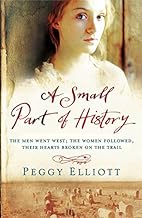 I am not very organised in keeping check of how many TBRs I have. I have books listed on both Goodreads and on LibraryThing and neither are complete. But as I began my LibraryThing catalogue first (in 2007, by which time some of my books were TBRs of quite long-standing) I’m using that for my answer – the 100th book I added to my LT catalogue is A Small Part of History by Peggy Elliott, a novel about the Oregon trail in America in the mid 19th century.
Open your current book to page 100 (or randomly, if you don’t have page numbers on your e-reader) and quote a few sentences that you like.
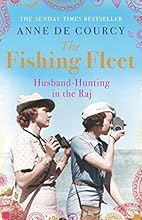 I’m currently reading The Fishing Fleet: Husband-Hunting in the Raj by Anne de Courcy:
‘From now on for the following year life became a glamorous fairy-tale,’ wrote Betsy Anderson, who had been brought out to India, aged seventeen, in the Fishing Fleet of 1923 by her mother after years at an English boarding school, followed by presentation at court and a London Season. They stayed with friends in bombay, in a house that reminded Betsy of Rome, with its black and white marble floors, high ceilings and windows with long venetian blinds.
This book is about the eligible young women, known as the ‘Fishing Fleet’ who travelled to India in search of a husband. For some they experienced both glamour and excitement before being whisked off to remote outposts where life was a far cry from the social whirl of their first arrival. It’s interesting but a bit disjointed and repetitive.
When you are 100, what author(s) do you know you will still be re-reading regularly? (This should be an easy one for those of you who are already over 100’¦)
Well, if I get there I hope I’ll still be reading. But maybe I won’t be able to tell the difference between reading and re-reading as there are books I read years ago that seem like new books to me now.
Link to your 100th post (if you’re a new blogger then link to your tenth post, or any one you like). Do you still agree with what you said back then?
My 100th post was on the TV dramatisation of Cranford by Elizabeth Gaskell in which I wrote about the forthcoming dramatisation, based on three of Elizabeth Gaskell’s works, Cranford, My Lady Ludlow and Mr Harrison’s Confessions. Before the broadcast I re-read Cranford, which I’d first read at school, and then when I watched the series I wished I hadn’t bothered as it was so different from Cranford. It bothered me so much I wrote another post after watching two of the episodes about what I didn’t like about it. I’m still sceptical about TV/film adaptations of books and prefer to keep my own images of the characters and locations rather than someone else’s versions.
Name a book you love that has less than 100 pages. Why do you love it?
 A Month in the Country by J L Carr – As an old man Tom Birkin is looking back to the summer of 1920 when he was asked to uncover a huge medieval wall-painting in the village church of Oxgodby in Yorkshire. It is a beautifully written little book of just 85 pages, set in the aftermath of World War I and it is the writing that I loved the most, the way Carr took me back in time to that glorious summer in Oxgodby.
If someone gave you £100, what would be the five books you would rush to buy?
You would think this would be an easy question but it isn’t because there are so many books I want to read At the moment here are five from my wishlist (blurbs from Amazon):
 Girl in a Green Gown: The History and Mystery of the Arnolfini Portrait by Carola Hicks
 – ‘Is the painting the celebration of marriage or pregnancy, a memorial to a wife who died in childbirth, a fashion statement or a status symbol? Using her acclaimed forensic skills as an art historian, Carola Hicks set out to decode the mystery.’

 Painting as a Pastime by Winston S Churchill – ‘The perfect antidote to his ‘Black Dog’, a depression that blighted his working life, Churchill took to painting with gusto. Picking up a paintbrush for the first time at the age of forty, Winston Churchill found in painting a passion that was to remain his constant companion. This glorious essay exudes his compulsion for a hobby that allowed him peace during his dark days, and richly rewarded a nation with a treasure trove of work.’
 The Last Englishman by J L Carr – because I enjoyed A Month in the Country so much I want to know more about the author. ‘Byron Roger’s acclaimed biography reveals an elusive, quixotic and civic-minded individual with an unswerving sympathy for the underdog, who led his schoolchildren through the streets to hymn the beauty of the cherry trees and paved his garden path with the printing plates for his hand-drawn maps, and whose fiction is quite remarkably autobiographical.’

 Daisy in Chains by Sharon Bolton – I love her books and have heard (from FictionFan herself!) that this one is brilliant – ‘Sharon Bolton at her twisty, twisted best.‘ ‘Hamish Wolfe is charming, magnetic and very persuasive. Famed for his good looks, he receives adoring letters every day from his countless admirers. He’s also a convicted murderer, facing life in prison. Maggie Rosie is a successful lawyer and true-crime author. Reclusive and enigmatic, she only takes on cases she can win.
Hamish is convinced that Maggie can change his fate. Maggie is determined not to get involved. She thinks she’s immune to the charms of such a man. But maybe not this time . . .’

The Grapes of Wrath by John Steinbeck – ‘Set against the background of dust bowl Oklahoma and Californian migrant life, it tells of the Joad family, who, like thousands of others, are forced to travel West in search of the promised land. Their story is one of false hopes, thwarted desires and broken dreams, yet out of their suffering Steinbeck created a drama that is intensely human yet majestic in its scale and moral vision; an eloquent tribute to the endurance and dignity of the human spirit.’
What book do you expect to be reading 100 days from now?
I don’t know. Every time I plan what I’ll read next it never happens and I read whatever appeals at the time.
Looking at The Guardian’s list of ‘The 100 greatest novels of all time’, how many have you read? Of the ones you haven’t, which ones would you most like to read? And which will you never read?
I’ve read 41 of these. Several are on my TBR list – The Count of Monte Cristo, The Scarlet Letter, The Marquez books and Tinker Tailor, Soldier, Spy. And I’m now adding The Big Sleep to my TBRs. I’ve had a go at reading Ulysses, but gave up- I’ll never read it.
Free Question ‘“ Create a 100 themed question of your own choice and answer it.
My question is: Which 21st-century novel do you think will still be read in 100 years’ time?
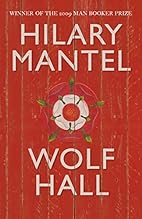 Of course I have no idea of the answer. But I ‘d like to think it could be Wolf Hall by Hilary Mantel. It’s the story of Thomas Cromwell, the son of a blacksmith, and his political rise, set against the background of Henry VIII’s England
When I read it six years ago I thought it was one of the best books I’ve read that year, if not the best one. And it still stands out as one of my all time favourite books. It is satisfying in depth and breadth, with a host of characters and detail. I loved the way transported me back to that time, with Mantel’s descriptions of the pageantry, the people, the places and the beliefs and attitudes of the protagonists. It was as though I was there in the thick of it all. Since then Mantel has written Bring Up the Bodies, also a great book and is writing a third book to complete the story of Thomas Cromwell’s life.
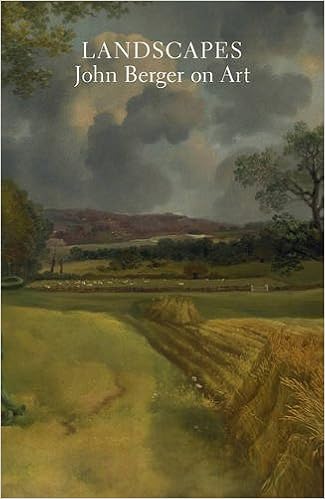 Landscapes : John Berger on Art, edited by Tom Overton is a collection of essays by art critic, novelist, poet, and artist John Berger written over the past 60 plus years. However both the title and the cover art – a painting of a landscape – led me to think it would discuss landscapes. But I should have taken more note of this sentence in the blurb-‘Landscapes offers a tour of the history of art, but not as you know it.‘ It is definitely not art as I know it but it is a “landscape” of Berger’s thoughts on his life, on people and ideas that have influenced him, artists and authors that he liked and disliked, with very little in it about landscapes. There are essays on his life, people, ideology, philosophy and on art history and theory about the nature and meaning of art.