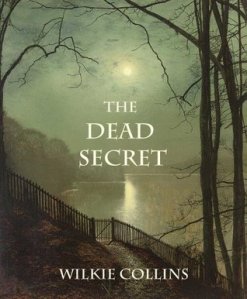
The Dead Secret by Wilkie Collins

I can imagine how intriguing Wilkie Collins’ novel The Dead Secret must have been when it was first serialised in weekly episodes in Household Words in 1857, every episode ending leaving the reader eager to know what happens next. It’s a sensation novel* (see my note below) , with many twists and turns, giving hints to the secret (which I did guess fairly early in the book) gradually and surely building up the suspense and with a final twist at the end (which I hadn’t forseen).  I’m reading Anthony Trollope’s Autobiography and this is what he had to say about his friend, Wilkie Collins:

 When I sit down to write a novel I do not all know, and I do not very much care, how it is to end. Wilkie Collins seems so to construct his that he not only, before writing, plans everything on, down to the minutest detail, from the beginning to the end; but then plots it all back again, to see that there is no piece of necessary dove-tailing, which does not dove-tail with absolutely accuracy. The construction is most minute and most wonderful.

And the plotting is like this in The Dead Secret – detailed and dove-tailed right from the powerful beginning at Porthgenna Tower in Cornwall in the 1820s, at the bedside of a dying woman, Mrs Treverton as she commands her maid, Sarah Leeson, to give her husband a letter confessing a great secret, to its end when all is revealed.

I think that to the modern reader the impact of this book is not the revelation of the secret but the manner of its style of delivery – the initial questions about the secret, what is in the letter, why has Sarah’s hair turned prematurely white, why she visits an an old grave set apart from others in the graveyard, why she talks to herself and why she disappears from Cornwall soon afterwards, having hidden the letter.

Fifteen years later, Rosamund, Mrs Treverton’s daughter returns to Porthgenna Tower to live in her old home. By an accident of circumstances, before Rosamund and her husband reach Cornwall, she gives birth a month earlier than expected and Sarah under an assumed name, is appointed to nurse Rosamund and the baby. Overcome by emotion Sarah cannot stop herself from warning Rosamund not to go into the Myrtle Room, which of course arouses Rosamund’s curiosity.

Trollope, however, says he ‘can never lose the taste of the construction’, feeling that Collins ‘books are ‘all plot’. I think this is a harsh judgement. In The Dead Secret, I think that on the whole the characters do come across as real people – I particularly like Rosamund and Sarah’s Uncle Joseph, both are sympathetically drawn – and there are other characters that add colour and interest. The settings and details of Victorian life are clearly described.  It also examines several social and moral issues of period, such as the role of women and respectability.

I don’t think The Dead Secret is in quite the same league as The Moonstone or The Woman in White, but it has all the elements of a good mystery story, drawing out the secret in tense anticipation of its revelation and making me as eager as Rosamund to know the secret and then almost as paranoid as Sarah that it should remain a secret!

*Sensation Novels*

I wrote about sensation novels,  in an earlier post and have reproduced the information here for ease of reference. It is a novel  with Gothic elements  ‘“ murder, mystery, horror and suspense ‘“ within a domestic setting. They have complicated plots, are set in modern times, and are reliant on coincidences, with plots hinging on murder, madness and bigamy. They exploited the fear that respectable Victorian families had of hidden, dark secrets and explored the woman’s role in the family. There is a pre-occupation with the law ‘“ wills, inheritance, divorce and women’s rights over property and child custody. They are emotional dramas about obsessive and disturbed mental states, with villains hiding behind respectable fronts, and bold assertive women, as well as passive, powerless and compliant women.

Reading Challenges: Mount TBR Challenge 2015, My Kind of Mystery Challenge, Victorian Bingo Challenge 2015 
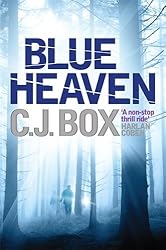
Blue Heaven by C J Box

There are lots of things I like about reading e-books, but I’ve found that my Kindle has become a Black Hole – it sucks in books and once they are in there they may never see the light of day again. I don’t even know how many books are lost in there. It’s so easy to download books and just forget they are there. With print books they’re always around sitting on the shelves and even if they are in boxes they take up space and are visible. Not so on an e-reader, the books are invisible.

So it was with Blue Heaven by C J Box – it has sat in my Kindle for nearly three years an unread and indeed a forgotten book. And here is where my liking for reading challenges came into its own, because I was looking for a book with ‘blue’ in its title for Bev’s Color Coded Challenge and up popped Blue Heaven.

I loved it and will certainly look out for more books by C J Box.

The action takes place over four days in North Idaho one spring. It’s a story about two children, Annie and William who decide to go fishing without telling their mother, Monica, and witness a murder in the woods. One of the killers sees them and they run for their lives.

It’s set in a farming community which is changing as people move into the area – specifically retired police officers, about 200 hundred of them, which is where the book title comes from, as according to Fiona Pritzle, the mail lady and local gossip, ‘They call North Idaho ‘Blue Heaven at the LAPD ‘. So when Monica reports her children missing it’s natural for the ex-policemen to volunteer to search for them and as the local sheriff is new to the job, they soon take over the investigation.

Annie and William meanwhile have discovered that not everyone is who they seem to be and it’s not safe even to call home. Until they met Jess Rawlins, an old rancher, a lonely divorcee who is in financial difficulty and struggling to keep his ranch going.

This is really a straightforward story of kids on the run but just to complicate things a little there is a newcomer, Eduardo Villatoro, another retired police officer from California, who arrives in town trying to trace the money stolen from a Santa Anita racetrack several years earlier when a young guard was killed.

It all melds together in a fast paced chase to save Annie and William, the tension maintained until the end. There are several things that kept me gripped as I read Blue Heaven. It’s one of those books that I find myself thinking about when I’m not reading it and keen to get back to it. First of all it’s written in a style that appeals to me – straightforward storytelling, with good descriptions of locality and characters, secondly characters that are both likeable and downright nasty, but not caricatures, and finally the ending was what I hoped, and also dreaded it would be.

  • Format: Kindle Edition
  • File Size: 731 KB
  • Print Length: 353 pages
  • Page Numbers Source ISBN: 0312365705
  • Publisher: Corvus (1 July 2010)
  • Source: I bought it

Challenges: Color Coded Challenge, Mount TBR Challenge and My Kind of Mystery Challenge.

Testament of a Witch by Douglas Watt

Testament of a Witch by Douglas Watt is the second book of his that I’ve read. The first one Death of a Chief I read 5 years ago! Both books are set in late 17th century Scotland (1686 and 1687) and feature a Gaelic speaking, Edinburgh lawyer John MacKenzie and his clerk Davie Scougall. I like the way Douglas Watt incorporates the historical background into the narrative without detracting from the story.

In Testament of a Witch MacKenzie investigates the death of Grissell Hay, Lady Lammersheugh accused of witchcraft in a village overwhelmed by superstition, resentment and puritanical religion. Then the same accusations are made against the Euphame, Grissell’s daughter.  I wasn’t too keen on the horrifying and explicit descriptions of how the witch hunter identified and dealt with women accused of being witches, which involved torture and sleep deprivation, but apart from that I enjoyed this book.

I liked the interaction between Mackenzie, a Highlander and Scougall, a Lowland Scot. Scougall is convinced of the reality of witchcraft, whereas Mackenzie has ‘grave doubts about the crime of witchcraft‘, believing ‘it is nothing more than superstition‘. The religious fervour and political unrest are clearly demonstrated in this book, setting the frenzied persecution of those suspected of witchcraft in context. Watts’ Historical Note on The Scottish Witch-hunt at the end of the book gives the background, when Scottish society was in a state of flux.

Change caused anxiety and fear, unleashing frenzies of witch-hunting . … It has been estimated that the Scottish witch-hunt was ten times more deadly than the English one in terms of executions per head of population. Probably more than a thousand men and women were executed for witchcraft in Scotland during the sixteenth and seventeenth centuries.

The witch-hunt could not have occurred without a widespread belief in magic, charming and divination, and the acceptance of Satan as a real presence in the life of the people.

Witch-hunting declined when the revolutionary zeal of the Scottish Reformation ran out of steam in the late seventeenth century. Scotland began to turn its back on persecution and look towards the more tolerant and commercial age of the Enlightenment.

Testament of a Witch is well-researched and although it gets off to a slow start and I didn’t enjoy it quite as much as Death of a Chief, I was immersed into the fascinating and terifying world of the witch-hunt in 17th century Scotland as I was reading. It’s a book that qualifies both for the Read Scotland 2014 Challenge and this year’s R.I.P. Challenge, as well as the Historical Fiction Challenge and the My Kind of Mystery Challenge.

Douglas Watt is a Scottish historian, poet and novelist, who lives in Linlithgow. He has a PhD in Scottish History from Edinburgh University and is the author of The Price of Scotland, a history of Scotland’s Darien Disaster, which won the Hume Brown Senior Prize in Scottish History in 2008. 

Two R.I.P. IX Books

So far I’ve read five books that fit into the R.I.P. Challenge categories of Mystery, Suspense, Thriller, Dark Fantasy, Gothic, Horror, or Supernatural. As I’m behind with writing about these books here are just a few notes on two of them:

Wycliffe and the House of Fear by W J Burley. Like the other Wycliffe books this is set in Cornwall. Detective Superintendent Wycliffe is on holiday recuperating from an illness when he meets the intriguing Kemp family and visits Kellycoryk, their decaying ancestral home.  The Kemps’ behaviour is odd to say the least and when Roger Kemp’s second wife, Bridget disappears people remember  that his first wife had also disappeared in what had been assumed was a boating accident. Wycliffe is inevitably drawn into the investigation.

I have yet to read a Wycliffe book and be disappointed and this one is no exception. It’s a complex story with sinister undercurrents and good depiction of a dysfunctional family. It kept me guessing almost to the end. This fits into the ‘Mystery’ category.

The next one I read is the short story (just 27 pages), The Yellow Wallpaper by Charlotte Perkins Gilman, which is definitely a suspense story of a young woman slowly but surely losing her mind – or is it a case of a woman suffering from post-natal depression most cruelly treated by her doctor husband? Her husband believes she has just a ‘slight hysterical tendency‘ and prescribes rest and sleep, scoffing at what he considers are her fantasies.
The un-named woman has just had a baby, which she is unable to bear to be near her. She spends most of her time in an attic bedroom, with barred windows and a bed fixed to the floor. The walls are covered in a hideous yellow wallpaper which has been torn off in places. It’s not a beautiful yellow like buttercups but it makes her think of old, foul bad yellow things – and it smells.  The pattern is tortuous and she sees a woman trapped behind the wallpaper as though behind bars, crawling and shaking the pattern attempting to escape. Definitely a creepy and disturbing story!

It reminded me of Marghanita Laski’s The Victorian Chaise-Longue with a similar sense of claustrophobia and helplessness. But The Yellow Wallpaper is much more horrific and by the end I began to question just what was real and what was imagination – it’s psychologically scary!

These two are both books from my to-be-read piles.

The Three Graces by Jane Wallman-Girdlestone

I’ve read a couple of novels this year that deal with mental illness – The Bell Jar by Sylvia Plath, which I found a bit confusing and disjointed and The Grass is Singing by Doris Lessing. My reaction to both books was that they are bleak and depressing, showing the breakdown of a personality and I struggled to read them. (See my thoughts on Doris Lessing’s book in this post.)

So, I was a bit hesitant about reading The Three Graces when I realised that it was a novel dealing with the subject of schizophrenia. I needn’t have been concerned as it is by no means a depressing novel. This is Jane Wallman-Girdlestone’s description of her book (taken from her website):

… Grace Hunter, the newly appointed Team Rector for the town, turns out to be nothing like people expect.  Nobody suspects that she has a guilty secret.  No one guesses that the local funeral director is the answer to the Rector’s prayers.  No one in their right mind would have thought that workaholic Grace was tormented by imaginary friends who dominated everything she did. 

My view:

Grace Hunter is trying to adjust to her new appointment as Team Rector, but her confusion grows as she begins to have hallucinations. It’s a remarkable book because although told in the third person at times I wasn’t sure that the people she sees were just in Grace’s head. I think it’s a very clever portrayal as the reader sees things through Grace’s eyes and mind whilst she is carrying on with everyday living and her job as Rector. Grace’s behaviour becomes reckless, at times divorced from reality. It clearly demonstrates how difficult/impossible it is for her to distinguish between what is real and what is not.

The Three Graces follows Grace’s life and to a lesser extent that of her family – husband Tom, Josh and Ros her step-children and her father-in-law, Charlie. They are all having to adjust to Tom and Grace’s marriage and the move to St Anthony’s, their third in five years. And they’re all feeling very unsettled. The dominant character in the novel is Grace; it all revolves around her and as her confusion grows it affects them all. It is an engrossing book, the writing is clear and concise, and the characters are clearly defined. It’s a well-structured novel, the tension and emotional atmosphere gradually rising and Grace’s feelings of despair and confusion and are all very evident. The book is certainly an enlightening read for me.

About the author (From Amazon):

Jane Wallman-Girdlestone was born and grew up in Tooting, South London. She began writing about her life experiences at eight. Jane taught briefly before working in theatre as a writer and director. She later worked as a Vicar and chaplain for some years before lecturing in Theology and Spirituality. Jane works with people who are on retreat offering creative and spiritual mentoring and as a counsellor.

Jane lives in the Highlands of Scotland in the UK, where she writes and paints. She is married and has three Newfoundland dogs and a cat.

The Three Graces is the second book in the Brayston series. Sausages and Trash is the first and the third, with the working title Sleight of Hand, will be published on Kindle in December. This will feature some of the characters from the first two books and I’ll be looking out for it.

NB:  The Three Graces is temporarily unavailable on Kindle.

I Murdered My Library by Linda Grant

Following on from yesterday’s post on books I’ve read recently and not reviewed, I have three more I have not written about and here is one of them:

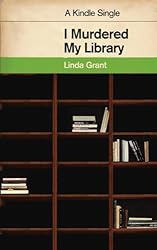
I Murdered My Library by Linda Grant. This is an essay of just 28 pages in which Linda Grant tells about moving house and downsizing her considerable book collection to fit into a small flat. She had had books everywhere:

Books multiplied, books swarmed; they were a papery population explosion. When they had exhausted the shelves, they started to take over the stairs. You cannot have a taste for minimalist decor if you seriously read books.

Well, I know all about that and all about trying to find more space for books or to reduce my book collection, so I really liked this little e-book. Linda Grant can read my mind – and those of many other book-lovers, I’m sure – as she went through her books deciding which ones could go. It could be me saying this too:

I am kidding myself if I think that I am going to reread a fraction of the books I have brought with me or a fraction of those I have never got round to reading.

In my youth, I imagined old age and retirement as the time when one sat back, relaxed and read. There would be all the time in the world for reading. Sixty was so far away, and 80 stretching out into a future not imaginable, that you might as well be talking about living forever. Now time gobbles up my life.

I have tried, but I’ve never managed to be as ruthless as she was, never seen empty bookshelves and I doubt I ever will, because there have been so many books I’ve given away only to realise later that I want to re-read/read them, or to look up a reference. So it’s made me think twice, or even ten times before I actually part with a book. And indeed as Linda Grant looks at her shelves of the books she has kept she mourns the ones she killed off!