A Darker Domain by Val McDermid

A Darker Domain (Karen Pirie, #2)

This is the second book in Val McDermid’s Kate Pirie series, a series that really should be read in order as A Darker Domain reveals one of the outcomes of the first book, The Distant Echo.

Description from Amazon:

Twenty-five years ago, the daughter of the richest man in Scotland and her baby son were kidnapped and held to ransom. But Catriona Grant ended up dead and little Adam’s fate has remained a mystery ever since. When a new clue is discovered in a deserted Tuscan villa – along with grisly evidence of a recent murder – cold case expert DI Karen Pirie is assigned to follow the trail.

She’s already working a case from the same year. During the Miners’ Strike of 1984, pit worker Mick Prentice vanished. He was presumed to have broken ranks and fled south with other ‘scabs’… but Karen finds that the reported events of that night don’t add up. Where did he really go? And is there a link to the Grant mystery?

The truth is stranger – and far darker – than fiction.

My thoughts:

The first thing that struck me when I began reading this book is that is not divided into chapters. Instead the text is divided by date and place, which initially is a bit confusing, moving between the two cases Karen is investigating. However, I soon got the hang of it.

I like the mix of fact and fiction in A Darker Domain, using the Miners’ Strike as the backdrop to the mystery of Mick Prentice’s disappearance. It is intricately plotted, with a large cast of characters and it’s deceptively easy to read – it’s easy to pass over significant facts that you realise later are of importance.

I like Karen Pirie, who had been a Detective Constable in the second part of the first book, The Distant Echo. Now she is a Detective Inspector in charge of the Cold Case Review Team in Fife. She describes herself as

a wee fat woman crammed into a Marks and Spencer suit, mid-brown hair needing a visit to he hairdresser, might be pretty if you could see the definition of her bones under the flesh. (page 6)

In the tradition of fictional detectives she’s an independent character, who takes little notice of her ineffectual boss, who she nicknames the ‘Macaroon’, undermining his authority. But she is hard-working and tenacious.

I like the contrasts Val McDermid portrays, such as the ‘darker domain‘ of the miners’ lives, the rich landowner wanting to find his grandson, and the beautiful setting in Tuscany where the members of a troupe of puppeteers, are squatting in a ruined villa.

I also like the mix of the two cases, which, as this is crime fiction, I fully expected would at some point interlink. The question is how do they interlink? Val McDermid has a neat way of leading you along the wrong lines with her twists and turns, culminating in the final paragraph. But the ending seemed rushed, tacked on, almost as an afterthought, which left me bemused and feeling rather flat. So, not as good as The Distant Echo but still an entertaining book.

  • Paperback: 400 pages
  • Publisher: HarperCollins; First Thus edition (2 April 2009)
  • Language: English
  • ISBN-10: 0007243316
  • ISBN-13: 978-0007243310
  • Source: a library book
  • My rating: 3.5* (rounded up to 4* on Goodreads)

Reading Challenges: my 4th book for R.I.P. XII

I hope to read the next book in the series, The Skeleton Road, before the end of the year.

After the Fire by Henning Mankell

Publication: Random House UK, Vintage Publishing, Harvill Secker, 5 October 2017

Source: review copy via NetGalley

My rating: 5*

Description:

Fredrik Welin is a seventy-year-old retired doctor. Years ago he retreated to the Swedish archipelago, where he lives alone on an island. He swims in the sea every day, cutting a hole in the ice if necessary. He lives a quiet life. Until he wakes up one night to find his house on fire.

Fredrik escapes just in time, wearing two left-footed wellies, as neighbouring islanders arrive to help douse the flames. All that remains in the morning is a stinking ruin and evidence of arson. The house that has been in his family for generations and all his worldly belongings are gone. He cannot think who would do such a thing, or why. Without a suspect, the police begin to think he started the fire himself.

Tackling love, loss and loneliness, After the Fire is Henning Mankell’s compelling last novel.

My thoughts:

After the Fire by Henning Mankell, translated by Marlaine Delargy, is not standard crime fiction and although there are crimes committed they are not the main focus of the book.  Living alone on an isolated island in the Swedish archipelago, Fredrik, a retired doctor, is devastated by the fire which destroyed the house he had inherited from his grandparents. He has nothing left apart from a boathouse, where he had set up an improvised surgery, a caravan (belonging to his daughter, Louise), and a boat. Suspected by the police of starting the fire, he tries to discover the culprit.

But the main emphasis of the book is on his reflections on life, death, ageing, and loneliness.  I found it absolutely fascinating as Fredrik looks back over his life.  His relationship with his daughter, Louise, who he hadn’t known about until she was an adult, is difficult – he knows almost nothing about her. However this changes when she comes to the island to decide what to do next and he gets more involved in her life.

Told in the first person by Fredrik it goes into detail about his fears of dying and the difficulties of understanding other people and both beginning and maintaining relationships. He has no real friends and only knows a handful of people living on the islands.  There is Jansson, a hypochondriac, the former postman, a snooper who read all the postcards he delivered, Oslovski, who he describes as a strange woman his contact with her is only to the extent of checking her blood pressure from time to time and parking his car outside her house on the mainland. Then there is Lisa, a journalist who writes for the local paper, a new acquaintance who interviews him about the fire and Nordin who owns the chandlery.

It’s beautifully written and I was entranced. I found it all very real, the people, the places and the mystery. It is both a character study  and a meditation on the complexities of life and death. Once I began reading I just didn’t want it to end.

The Betrayals by Fiona Neill

Publication date: August 217, Penguin – Michael Joseph

Source: Review copy via NetGalley

My rating: 4*

Blurb (Amazon)

None of them would forget that week on the wild Norfolk coast.

Best friends Rosie and Lisa’s families had always been inseparable.

But that summer, Lisa had an affair with Rosie’s husband Nick.

And now, after years of silence, she sends Rosie a letter begging for help. A letter which exposes dark secrets.

Daughter Daisy’s fragile hold on reality begins to unravel.

Teenage son Max blames himself for everything that happened that long hot summer.

And Nick must confront his own version of events.

There are four sides to this story. Who will you believe?

My thoughts:

An excellent book about families, relationships, and the consequences of an affair! It looks at what happens when an affair becomes known, a marriage is over and the families’ friendship is destroyed.

It grabbed my attention right from the start with Daisy’s opening words:

Three is a good and safe number. I close my eyes and whisper the words three times so no one can hear. The sound like a sweet sigh. If Mum notices she might worry and the days of worry are over. I say this three times too, just to make triple sure, remembering how the words have to be spoken on the out breath.

Whatever Daisy says her days of worry are not over and her OCD goes into overdrive when she opens Lisa’s letter to Rosie. The novel is narrated in the present tense, often a bit of a stumbling block for me, but not so in this book, told from four different viewpoints – those of Daisy, her mother Rosie, father Nick and brother Max. Each one casts a different light on events and shows how easy it can be to interpret what happens in differing and often mistaken ways.

As I read the book I often couldn’t decide whose version to believe, especially when they were so contradictory. It explores the reliability of memory, the nature of mental illness and the devastation of friendships and family relationships through deceit and betrayal. What stood out for me was the portrayal of what it’s like to struggle with OCD and cancer. The book as a whole is an in-depth study of character and the terrible effects of suppressed memories and secrets. I loved it.

My thanks to the publishers and NetGalley for a review copy.

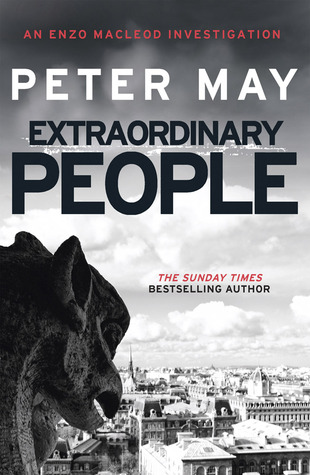
Extraordinary People by Peter May

Extraordinary People (The Enzo Files, #1)

I loved Peter May’s Lewis trilogy and I also enjoyed his standalone book, Entry Island, so I decided to read Extraordinary People, the first in his Enzo Files series when I saw a copy in a secondhand bookshop (along with the second in the series, The Critic). They are both TBR books.

Set in France the action moves between various locations, but is mainly in Paris, as Enzo Macleod tries to solve a cold case mystery, that of the disappearance and presumed death of Jacques Gaillard, an eminent professor, 10 years earlier. Enzo is trained as forensic scientist, who is now a professor of  biology at a university in Toulouse. He has taken a bet that he can solve seven of the most notorious murders, using modern technology. Journalist Roger Raffin had originally researched the Gaillard case and shares his information with Enzo and accompanies him on the search.

It helps that a metal trunk had been found in the catacombs under the Place d’Italie, containing a skull and a number of apparently unconnected items. Enzo succeeds in establishing that it is Gaillard’s skull and using the items in the trunk as clues begins the search for the rest of his skeleton. This takes the form of internet searches, DNA investigations and leaps of intuition, ending up in a dramatic scene back in the Paris catacombs. Enzo’s own life is in danger and that of his elder daughter, Kirsty.

There is quite a lot about Enzo and his family background. He is of Scottish/Italian parents, with a complicated personal life. He has two daughters, by different mothers. Kirsty refuses to have anything to do with him, whereas Sophie who dotes on him, lives with him, whilst Enzo can’t stand her boyfriend.

I had a couple of small issues with this book. It takes the form of a puzzle and a chase to find the culprit, much in the same vein as Dan Brown’s books. I did find it rather implausible that the murderer would have left such specific clues and although Enzo does raise the question of why anyone would do that, it’s never properly answered (to my mind at least).

I also questioned why the French police ordered him to leave the investigation solely to them without using his obvious skills and knowledge (there is a reason for that, which I quickly surmised).

Another little niggle is the way May interspersed the text with French words for some items, but not others – the word séjour is used a lot but other rooms such as ‘bedroom’, ‘hall’ are in English – a minor quibble I know, but each time I read it I wondered why.

But, having said all that I did like the book, it’s very readable and I learned a lot about Paris and its catacombs.

  • My copy: published in GB in 2014 by Quercus Editions Ltd, 420 pages
  • Source: I bought a secondhand paperback copy
  • My rating: 3* (it would have been 4*, but for the leaps of intuition and other small issues I had with this book)

Reading Challenges: my 3rd book for the RIP 2017 challenge and my 20th book for Bev’s Mount TBR 2017.

The Taxidermist’s Daughter by Kate Mosse

The Taxidermist's Daughter

Publication date: September 2015, Orion Books

Source: my own copy

Rating: 3*

The Taxidermist’s Daughter is a difficult book to review without giving away too much detail particularly about the element that almost made me stop reading and because of that I was in two minds what rating to give it. The main thing that I didn’t like is all the detail about taxidermy – and there is a lot of detail. I found its gruesome application in this book absolutely sickening. But I still read on, such is the strength of Kate Mosse’s ghoulish storytelling.

Blurb (from the back cover):

1912. A Sussex churchyard. Villagers gather on the night when the ghosts of those who will not survive the coming year are thought to walk. And in the shadows, a woman lies dead.

As the flood waters rise, Connie Gifford is marooned in a decaying house with her increasingly tormented father. He drinks to escape the past, but an accident has robbed her of her most significant childhood memories. Until the disturbance at the church awakens fragments of those vanished years . . .

Connie Gifford is the taxidermist’s daughter and she has grown up learning the art of taxidermy, taking over from her father who is a hopeless drunk. Her mother had died giving birth to her and there had been an accident when she was twelve (ten years earlier), which had almost completely wiped the first twelve years of her life from her mind.

The book began well, full of atmosphere, set in the Fishbourne Marshes and the tidal estuary in West Sussex (where Kate Mosse grew up), with Gothic overtones and hints of dark and terrible secrets and revenge. There is the mystery of the dead woman who has been garroted – who was she? What, or who haunts Connie’s father? What had happened to Connie when she was twelve, and who was the girl Connie vaguely remembers – older than her, with a love of life and a yellow ribbon in her hair? She experiences strange episodes where she feels herself falling out of time, spinning and flying through the air – episodes full of menace and threat.

But it dragged in the middle, with too many indistinct male characters and even though there is a map showing the layout of Fishbourne in 1912 I had difficulty in following the location of the action, nor could I work out how quickly they seemed to be able to travel between the various houses and Chichester.

It ends dramatically in death and destruction, with all the strands of the story coming together, one dark and stormy night. The waters rise, as the banks of the rivers, streams, the mill pond and the sluice gates break, flooding the whole area. Connie’s memories too come flooding back as the wind and rain join the thundering torrent of the flood water.

After a while though too much was foreshadowed and the story became rather predictable, which lessened the tension. Its gruesomeness however will stay with me for quite a while.

Reading Challenges: Mount TBR 2017 and R.I.P. 2017

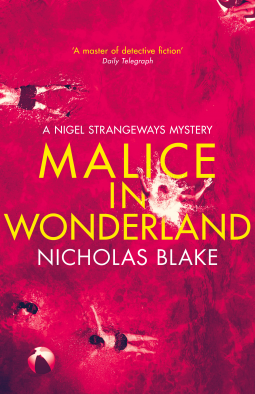
Malice in Wonderland by Nicholas Blake

A Golden Age Mystery

Published: 2017, Ipso Books. First published in 1940, Collins UK (The Crime Club)

Source: Review copy via NetGalley

My rating: 4*

I really enjoyed Malice in Wonderland by Nicholas Blake*. It’s a Golden Age mystery first published in the UK in 1940; in the US as The Summer Camp Mystery, later in 1971 as Malice with Murder; and in 1987, as Murder with Malice.

There are several allusions to Lewis Carroll’s Alice’s Adventures in Wonderland. The train to Wonderland plunges into a tunnel, just as Alice enters Wonderland through a rabbit hole. But in this case Wonderland is a holiday camp, set on a cliff top overlooking the sea. And all is not well in Wonderland as there is a prankster in the camp , the self-styled ‘Mad Hatter’, who is playing nasty and cruel practical jokes on the holiday makers. Swimmers are ducked in the sea and held down, tennis balls are coated in treacle, left with a note that refers to a part of dormouse’s story in Alice in Wonderland. Then the jokes get more dangerous. The camp’s owners are concerned not just for the guests but also for their business as they fear a rival firm with a grudge against the company is trying to ruin them.

There are hundreds of visitors at Wonderland, but the action revolves around a few characters including Paul Perry, a young man who calls himself a scientist, but who is there taking notes for the Mass Observation project, Mr and Mrs Thistlethwaite and their teenage daughter, Sally, Albert Morley, a timid little man, brothers Mortimer and Teddy Wise, the camp’s managers, their secretary Esmeralda Jones and Nigel Strangeways, a private detective.

Like other Golden Age mysteries, Malice in Wonderland presents a puzzle, plenty of suspects, clues planted along the way and a detective who solves the puzzle. It also presents a picture of life just before the Second World War, the social attitudes and in particular the beginnings of the holiday camps. By the 1930s there were several camps, including Warners and Butlins, at seaside locations. Wonderland has dining-halls presenting food cooked by London chefs, a ballroom, bars, an indoor swimming-bath, a concert hall, a gymnasium and numerous playrooms, plus a programme of entertainment with professional hosts and hostesses. It’s described as ‘the biggest, brightest and most ambitious of all the holiday camps that had sprung up over England during the last year or two.’

I loved the setting, the interesting characters, and the fiendishly difficult mystery to solve (I only solved it just before the denouement). And it’s well written with humour and style.

*Nicholas Blake was the pseudonym of Poet Laureate Cecil Day-Lewis (1904 – 1972), one of the leading British poets of the 1930s. He published his first Nigel Strangeways detective novel, A Question of Proof in 1935. Malice in Wonderland is the 6th in the series.

My thanks to the publisher for a digital ARC via NetGalley.

Amazon UK