Crime Fiction Alphabet: U

This week’s letter in Kerrie’s Crime Fiction Alphabet is letter-u

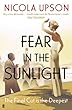
I’ve chosen Nicola Upson’s Fear in the Sunlight, the fourth novel featuring Josephine Tey, which I read on Kindle.

Summary from Fantastic Fiction:

Summer, 1936. The writer, Josephine Tey, joins her friends in the holiday village of Portmeirion to celebrate her fortieth birthday. Alfred Hitchcock and his wife, Alma Reville, are there to sign a deal to film Josephine’s novel, A Shilling for Candles, and Hitchcock has one or two tricks up his sleeve to keep the holiday party entertained – and expose their deepest fears. But things get out of hand when one of Hollywood’s leading actresses is brutally slashed to death in a cemetery near the village. The following day, as fear and suspicion take over in a setting where nothing – and no one – is quite what it seems, Chief Inspector Archie Penrose becomes increasingly unsatisfied with the way the investigation is ultimately resolved. Several years later, another horrific murder, again linked to a Hitchcock movie, drives Penrose back to the scene of the original crime to uncover the shocking truth.
My thoughts:

I have mixed thoughts about this book, good and not so good. Overall I enjoyed it but I found it confusing with so many characters, introduced very quickly in the novel, and it was difficult to distinguish who they all were, with the exception, of course, of Josephine Tey and Alfred Hitchcock. So, not well-defined characters.

However, the setting in Portmeirion is very well done and if you like lots of description that’s a bonus. I do like description, up to a point, but in this book I thought it intruded too much and held up the action. (Portmeirion is Sir Clough Williams-Ellis’s Italianate creation in the Welsh countryside. It’s also the setting for the 1960s TV series, The Prisoner, if you remember that as I do.) Set in the thirties it does give a good sense of the period between the two world wars with the shadow of the Great War still lingering and the threat of another war getting ever nearer. There is a general air of unhappiness, as Alma, Hitchcock’s wife says:

Perhaps it’s the times we have lived through, but we seem very good at destroying each other and not just through wars. We wear each other down all the time through little acts of jealousy or cruelty or greed. (location 1731)

And there are many such acts in Fear in the Sunlight as the murders pile up. I didn’t really have much idea what was going on until about halfway into the book when the writing became sharper, more focussed on the plot and characters.

I was interested in Nicola Upson’s inclusion of a discussion about writing, about mixing fact and fiction and also about the difference between a book and the film of the book. Here Josephine and Marta are talking about mixing fact and fiction, which is exactly what Nicola Upson does in her books:

‘Mix fact and fiction?’ Josephine asked, and Marta had to laugh at the disapproval in her voice. ‘How would that help restore the reputation of a much aligned man? No one would know what was true and what wasn’t.’

‘Exactly. That’s the fun of it. And a biography would only be your interpretation. At least calling it fiction is honest.’ (location 3548)

Josephine is at Portmeirion to discuss making a film of her book, A Shilling for Candles, with Alfred and Alma Hitchcock. She’s sceptical about the process of using her book as the basis for a film, but Alma tells her:

‘A film can’t just be a visual record of a book or it will never have a life of its own,’ she said.  … ‘It’s like any marriage, I suppose. The two things can coexist if they’re both good in their own right, and it doesn’t have to be one at the expense of the other.’ (locations 1612-1620)

I’ll try to remember that next time I get irritated at the way a film or TV drama alters a book.

I think that Alfred Hitchcock is really the main character and I don’t know enough about him to be able to distinguish fact from fiction in Fear in the Sunlight, nor do I know that much about the thirties either to judge whether that’s an accurate picture, but I have no doubt that Nicola Upson has done her research. Hitchcock seems to have been a complicated and difficult character, a practical joker and a manipulator:

An experiment in fear and guilt, he had called it, but an exercise in control would have been more accurate. Staging a joke, like making a film, was a way of holding on to power, and Hitchcock had discovered long ago that the manipulation involved in both helped him to forget his own anxieties and doubts. (location 1088)

As you would expect he is a master of suspense:

‘Fear of the dark is natural, we all have it, but fear in the sunlight, perhaps fear in this very restaurant, where it is so unexpected – that is interesting’. (location 3465)

  • Format: Kindle Edition (also available in paperback)
  • File Size: 821 KB
  • Print Length: 432 pages
  • Publisher: Faber and Faber Crime (3 April 2012)
  • Sold by: Amazon Media EU S.à r.l.
  • Language: English
  • ASIN: B007JVF6U2
  • Source: My own copy
  • My Rating 3/5

September’s Books

September was a good month for reading. In total I read 10 books:

I read 4 crime fiction, 4 non fiction, 1 ghost story and 1 science fiction. Two of the books were library books, 3 borrowed from a friend and 4 books were from my to-be-read books (books I’ve owned before January 2012).

It’s not been such a productive month for writing about the books I’ve read – more reading means less writing. So I’ve not previously written about the book I’ve chosen as my Pick of the Month. For more ‘Picks of the Month’ see Kerrie’s blog Mysteries in Paradise.

It is, by a short margin, The Sixth Lamentation by William Brodrick, the first Father Anselm novel.

Synopsis from Fantastic Fiction:

What should you do if the world has turned against you? When Father Anselm is asked this question by an old man at Larkwood Priory, his response, to claim sanctuary, is to have greater resonance than he could ever have imagined. For that evening the old man returns, demanding the protection of the church. His name is Eduard Schwermann and he is wanted by the police as a suspected war criminal.

With her life running out, Agnes Aubret feels it is time to unburden to her granddaughter Lucy the secrets she has been carrying for so long. Fifty years earlier, Agnes had been living in Occupied Paris, a member of a small group risking their lives to smuggle Jewish children to safety – until they were exposed by a young SS Officer: Eduard Schwermann.

As Anselm attempts to uncover Schwermann’s past, and as Lucy’s search into her grandmother’s history continues, their investigations dovetail to reveal a remarkable story.

It’s my Pick of the Month because it is historical fiction and it’s also a mystery. It looks back  to the Second World War in occupied France, telling a dramatic tale of love and betrayal, full of suspense, and interwoven stories.William Brodrick explains in his Author’s Note that the novel weaves fact and fiction, with accurate details of life in Paris during the Occupation and the subsequent war trials. He gathered facts for his novel from a variety of sources, although he has taken ‘small liberties’ with some of them.

William Brodrick has also drawn on his own personal experience. He was formerly in religious life but left before his final vows. He has degrees in philosophy and theology and after studying law he became a barrister, specialising in personal injury. The idea of smuggling Jewish children out of the Nazis’ hands was prompted by the war time experience of his own mother, Margaretha Duyker. She was part of a smuggling ring and took a child out of Amsterdam by train to Arnhem. She was caught by the Gestapo and imprisoned and eventually released. She died of motor neurone disease (the disease that Agnes is suffering from) in 1989.

I’ve read one other book by William Brodrick – The Gardens of the Dead, also a Father Anselm book. There are two more:

The Sixth Lamentation also fits into the R.I.P.VII Challenge.

Crime Fiction Alphabet: S is for …

Maigret and the Ghost by Georges Simenon, which is my choice to illustrate the letter S in Kerrie’s Crime Fiction Alphabet.

Simenon wrote many Maigret books spanning the years 1931 – 1972, 75 novels and twenty eight short stories to be precise.

Maigret and the Ghost was first published in 1964 as Maigret et le Fantome. Inspector Lognon, a plain-clothes detective is shot in the street and is close to death, fighting for his life. The last word he spoke was ‘ghost’. It is soon apparent that this grumpy detective, who suffers from an inferiority complex, believing that he never gets the credit he is due, was visiting the apartment of a beautiful young woman every night. Chief Superintendent Maigret finds it hard to believe he has transformed into some sort of Don Juan. The young woman has disappeared.

Maigret investigates in his usual seemingly casual manner, registering impressions, which he knew would sooner or later ‘coalesce and become meaningful.’ Lognon’s wife insists that he was convinced he was onto something big which would bring him the recognition he deserved. Maigret’s investigations lead him into the strange world of art dealer Norris Jonker and his glamorous and much younger wife, Mirella. His search for the culprit brings him into contact again with the English detective he had first met in My Friend Maigret, Mr Pyke, now Chief Inspector Pyke at Scotland Yard.

I really enjoyed this short, concise detective story. Simenon writes such taut prose, straight-forward and direct, with not one word wasted. He conveys the nature of each character with precision, the dialogue is so realistic and the setting in a rainy Paris is so atmospheric. It’s almost like viewing a painting. Because his books are short (in comparison to today’s chunksters) the tension is easily maintained throughout and it’s so well-paced that I just  had to read it straight through from start to finish.

Although short Simenon’s books don’t lack detail or complicated plots. One of the things I like about them are the glimpses into Maigret’s personal life. In this book Madame Maigret is thrilled because he invites her out to lunch:

They couldn’t help exchanging smiles. The contrast between lunching at home in the Boulevard Richard-Lenoir and in the intimate atmosphere of the little restaurant struck them both at the same time. Madame Maigret especially was tremendously thrilled by it. (page 37)

She was also thrilled because she had been to see Madame Lognon and on telling Maigret about the visit he commented:

‘I fancy what you have just told me alters the whole complexion of the case …’

She stared at him, torn between incredulity and delight. For the rest of her life, that lunch at Chez Maniere was to remain one of her happiest memories. (page 40)

Georges Simenon was definitely a master of the detective novel.

  • Paperback: 160 pages
  • Publisher: Penguin Classics; New Ed edition (4 Dec 2003)
  • Language: English
  • ISBN-10: 0141187271
  • ISBN-13: 978-0141187273
  • Source: library book
  • My Rating 4/5

I’ve read some of his other books –

Crime Fiction Alphabet: Letter R

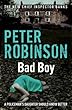
This week I’ve chosen Peter Robinson‘s Bad Boy to illustrate the letter R in Kerrie’s Crime Fiction Alphabet.

Bad Boy is Peter Robinson’s 19th book in his Inspector Banks series, but I don’t think you have to have read the previous 18 because it functions OK as a stand-alone, as quite a lot of the back-story is included.

Description from the back cover:

Banks isn’t back, and that’s the problem.

If DCI Alan Banks had been in his office when his old neighbour came calling, perhaps it would have turned out differently.

Perhaps an innocent man would still be alive.

And perhaps Banks’s daughter wouldn’t be on the run with a wanted man.

But Banks is on holiday, blissfully unaware of the terrible chain of events set in motion by the discovery of a loaded gun in a young woman’s bedroom, and his daughter’s involvement with the ultimate bad boy . . .

My thoughts:

There’s not much more for me to write about this book. I didn’t think it was as interesting as the earlier ones of his that I’ve read. For one thing there’s not much of a mystery for Banks to solve and for another I didn’t like the graphic descriptions of violence it contains. It’s a police procedural to a certain extent, except of course, that Banks doesn’t actually always follow the set procedures.

Banks does come back from his holiday, down to earth with a vengeance as he sets out to rescue Tracy, his daughter from the wanted man, Jaff, the ‘bad boy’.

DI Annie Cabot obligingly gives a definition of a ‘bad boy’:

A bad boy is unreliable, and sometimes he doesn’t show up at all, or if he does, he’s late and moody, he acts mean to you and he leaves early. He always has another fire in the iron, somewhere else to be. But always while you’re waiting for him you can’t really concentrate on anything else, and you have at least one eye on the door in case he’s the next one to walk in the room, even though you might be seeing someone else, and when you’re with him your heart starts to beat a little faster and your breath catches in your chest. (page 163)

As for Banks, there are some interesting insights into his personality. He realises that he is ‘a stranger‘ to happiness, and that he has a restless nature which precluded happiness. If he wasn’t restless he either felt a vague sadness which was occasionally punctured with anger or irritation. He also realises that he hadn’t been a good parent, but he had felt inadequate and awkward with Tracy as she was growing up, not knowing how to communicate with her.

But, Banks is on the side of law and order, despite not always sticking to procedure:

If there was one part of the job Banks hated more than any other, it was that feeling of impotence and ineffectiveness he often felt by having dedicating himself to upholding the law, following the rules. He cut corners from time to time, like everyone, had occasionally acted rashly and even, perhaps, illegally, but on the whole, he was on the side of the virtuous and the good. (page 322)

And are there hints at the end about Banks’s future? He says he is ‘getting a bit tired of it all, to be honest.’ Do I sense that Peter Robinson is getting a bit tired of Banks too?

  • Paperback: 448 pages
  • Publisher: Hodder Paperbacks; 1st edition (28 April 2011)
  • Language: English
  • ISBN-10: 0340836970
  • ISBN-13: 978-0340836972
  • Source: Library book
  • My Rating: 3/5

Dark Matter: a Ghost Story by Michelle Paver

Dark Matter

My first book for the R.I.P. VII Challenge is a chilling book, very chilling, both in the setting in the High Arctic and in atmosphere. I was glad I wasn’t reading Dark Matter by Michelle Paver in the dead of winter, snowbound and alone, because then it would have been terrifying. The isolation of the long, dark Arctic winter is oppressive and unrelenting.

It’s a ghost story in the form of a diary – that of Jack Miller who in 1937 was part of an expedition to the High Arctic to study its biology, geology and ice dynamics and to carry out a meteorological survey. Jack’s role is as radio operator, transmitting observations three times a day to the Government forecasting system.

From the start Jack is very reluctant to go, put off by the other members of the expedition, four ex-public schoolboys. But he’s stuck in a boring job, after giving up his plans to be a scientist and realises this is the only chance he’ll ever get to change his life. Right from the start things begin to go wrong, but Jack remains enthusiastic. Later when they meet Skipper Eriksson, the part owner and captain of the ship taking them to Gruhuken, a remote uninhabited bay where they’re setting up camp, Jack begins to feel increasingly uneasy. Eriksson is reluctant to take them to Gruhuken, but he doesn’t explain why merely saying he doesn’t think it’s ‘right’ for a camp.

Not long after they have set up camp Jack feels oppressed by the isolation brought on by the thought of the men who had been there before them:

Suddenly, I felt desolate. It’s hard to describe. An oppression. A wild plummeting of the spirits. The romance of trapping peeled away, and what remained was this. Squalor. Loneliness. It’s as if the desperation of those poor men had soaked into the very timber, like the smell of blubber on the Isbjørn. (page 65)

The trappers had left behind a ruined mine, a hut ‘crouched among the boulders  in a blizzard of bones‘ and in front of the hut a ‘bear post’ for luring bears to the trappers’ gun. It all makes Jack’s spirits sink. As the ship is leaving the camp, Jack sees a man standing in front of the cabin by the bear post and is relieved when he leaves. Now the members of the expedition are alone with the huskies and Jack’s unease grows. He is disturbed by the change in the weather, the increasingly shorter days and irritated by the other members, in particular by Algie and his insensitivity and cruelty towards the dogs.

Jack’s unease turns into dread as he realises that Gruhuken may be haunted, but his rational mind explains his feeling as an echo:

An echo from the past. … it’s called ‘place memory’, a well-known idea, been around since the Victorians. If something happens in a place – something intensely emotional or violent – it imprints itself on that place; maybe by altering the atmosphere, like radio waves, or by affecting matter, so that rocks, for example, become in some way charged with what occurred. Then if a receptive person comes along, the place plays back the event, or snatches of it. … What I saw was only an echo. (pages 111-2)

As the darkness descends, Jack is left alone at the camp and his nightmare really begins. The book is well-paced, the tension mounts, and paranoia sets in … or is it real, even the dogs are scared. It really is a page-turner and a good old-fashioned ghost story. The relationships between the characters are well drawn, and especially Jack’s relationship with Isaak, one of the huskies. I was most concerned about Isaak!

Jack describes ‘dark matter‘ of the title, as that part of the universe that cannot be seen or detected, but is there. He finds this idea

‘… unsettling. Or rather, not the idea itself, that’s merely an odd notion about outer space. What I don’t like is the feeling I sometimes get that other things might exist around us, of which we know nothing.’ (pages 94-5)

I don’t like that either. It’s scary.

  • Hardcover: 256 pages
  • Publisher: Orion; First Edition edition (21 Oct 2010)
  • Language: English
  • ISBN-10: 1409123782
  • ISBN-13: 978-1409123781
  • Source: I bought the book
  • My Rating: 4/5

Crime Fiction Alphabet: Letter P

It’s the letter P this week in Kerrie’s Crime Fiction Alphabet and I have another of Agatha Christie’s books to illustrate the letter.

If you haven’t read any of Agatha Christie’s books don’t begin with Postern of Fate. It’s the last novel she wrote, published in 1973, and it’s rambling and repetitive, with very little in the way of mystery. It’s the fourth of the Tommy and Tuppence Beresford mysteries and it begins with the ageing couple, now retired and living in a new home. I read it because I like Tommy and Tuppence and wanted to know what they were doing in this final book.

I liked the opening pages in which Tuppence is bemoaning the fact that they have so many books and there isn’t enough room to shelve them. They’d sorted out their books before they moved house, only bringing with them the ones they couldn’t bear to part with, but they had bought books from the previous owners of the house. Tuppence is sorting through them and in Robert Louis Stevenson’s The Black Arrow she sees that some of the letters are underlined in red ink, spelling out an intriguing message: ‘Mary Jordan did not die naturally. It was one of us. I think I know which one.’

Naturally the Beresfords have to find out more and after talking to some of the local people Tuppence discovers that Mary Jordan had lived in the house during the First World War and there are rumours that she was a German secret agent. It appeared she had died from accidental poisoning. But they aren’t satisfied and want to know more. Whilst Tuppence continues talking to the locals, Tommy goes to London and talks to Captain Pikeaway, ex-head of Special Branch and the enigmatic Mr Robinson (who appeared in Agatha Christie’s thriller Passenger to Frankfurt). They discover some facts, and have lots of meandering discussions, but the denouement is very vague (at least I found it so).

Its interest for me lies in what the book reveals about Agatha Christie. Clearly she is remembering her own childhood when Tuppence is reminiscing about the books she had read as a child, listing them and exclaiming how much she liked them – books such as The New Treasure Seekers, lots of Stanley Weyman books (he wrote historical romances), The Prisoner of Zenda, Treasure Island and Kidnapped.

Throughout her life she was an avid reader and her books include many references to a variety of sources from Shakespeare to T S Eliot. The title of this book derives from a poem Gates of Damascus by John Elroy Flecker, quoted as an epigraph and by Tommy as he worries about keeping Tuppence out of danger:

Four great gates has the city of Damascus …

Postern of Fate, the Desert Gate, Disaster’s Cavern, Fort of Fear …

Pass not beneath, O Caravan, or pass not singing.

Have you heard

That silence where the birds are dead, yet something pipeth like a bird?

I think when Tommy and Tuppence are complaining about the difficulties of getting tradesmen to complete work on their new house Agatha Christie was writing from experience:

Electricians arriving in a kindly tangle of optimism and efficiency had stated work. “Coming along fine now, not much more to do,” they said. “We’ll be back this afternoon.” But they hadn’t been back that afternoon. Tommy was not precisely surprised. He was used, now, to that general pattern of labour in the building trade, electrical trade, gas employees and others. They came, they showed efficiency, they made optimistic remarks, they went away to fetch something. They didn’t come back. One rang up numbers on the telephone but they always seemed to be the wrong numbers. If they were the right numbers, the right man was not working at this particular branch of the trade, whatever it was. (pages 35-36)

Then there are her misgivings about the state of the country:

England was in a funny state, a different state from what it had been. Or was it really always in the same state? Always underneath the smooth surface there was some black mud. There wasn’t clear water down to the pebbles, down to the shells, lying on the bottom of the sea. There was something moving, something sluggish somewhere, something that had to be found, suppressed. (page 138)

But there is rather too much of this sort of digression in Postern of Fate and Agatha Christie comes across as disillusioned with modern life. Here, for example, she has Colonel Pikeaway complaining about the worship of money:

…big fortunes made out of drugs, drug pushers, drugs being sent all over the world, being marketed, a worship of money. Money not just for buying yourself a big house and two Rolls Royces, but money for making more money and doing down, doing away with the old beliefs. Beliefs in honesty, in fair trading. (page 249)

Although there are things I like in this book and I am glad I’ve read it, I think it must be my least favourite of Agatha Christie’s books that I’ve read.