Falling Angels by Tracy Chevalier

I really enjoyed reading Falling Angels by Tracy Chevalier. It’s been sitting unread for several years on the to-be read shelves and I’ve been meaning to read it for ages after reading her earlier book, Girl with a Pearl Earring. I should have got round to it sooner.

It begins:

I woke this morning with a stranger in my bed. The head of blond hair beside me was decidedly not my husband’s. I did not know whether to be shocked or amused.

Well, I thought, here’s a novel way to begin the new century.

It is 1901, the day after Queen Victoria’s death and the ‘I’ in this opening is Kitty Coleman, one of several narrators in this novel set in Edwardian England.

Synopsis from Tracy Chevalier’s website:

Two families visit neighboring graves in a fashionable London cemetery. One is decorated with a sentimental angel, the other an elaborate urn. The Waterhouses revere the late Queen and cling to Victorian traditions; the Colemans look forward to a more modern society. To their mutual distaste, the families are inextricably linked when their daughters become friends behind the tombstones. And worse, befriend the gravedigger’s son.

As the girls grow up and the new century finds its feet, as cars replace horses and electricity outshines gas lighting, Britain emerges from the shadows of oppressive Victorian values to a golden Edwardian summer. It is then that the beautiful, frustrated Mrs Coleman makes a bid for greater personal freedom, with disastrous consequences, and the lives of the Colemans and the Waterhouses are changed forever.

A poignant tale of two families brought reluctantly together, Falling Angels is an intimate story of childhood friendships, sexual awakening and human frailty. Yet its epic sweep takes in the changing of a nation, the fight for women’s suffrage and the questioning of steadfast beliefs.

My view:

This book covers the years from 1901 – 1908 when the world was on the cusp of change just before the outbreak of the First World War, and I found myself wondering what my grandmothers, who would have been much the same age as Kitty Coleman and Gertrude Waterhouse, had thought about it all. What would they have thought about the suffragettes for example? I suspect it would have been similar to one of the characters, Jenny Whitby, the Colemans’ maid servant, as they too were domestic servants. Jenny is horrified when she listens to the suffragettes, whilst she served them with scones at Kitty Coleman’s ‘At Home’:

What I heard made me want to spit. They talked about helping women but it turns out they are choosy about who exactly gets the help. They ain’t fighting for my vote – only for women who own property or went to university. (pages 227 – 228)

Maybe my great aunt who never married and became a matron at a public school would have had more sympathy and agreed with the suffragettes that all women would not get the vote all at once and they had to start somewhere. These are the early years of the suffragette movement culminating in the book in June 1908 with the Women’s March in Hyde Park to demand Votes for Women.

The change between Victorian and Edwardian England was a gradual one, as attitudes to life and death were transformed and the middle-class Colemans and the Waterhouses reflect these changing attitudes with the Colemans looking forward to the modern era, whilst the Waterhouses still value the Victorian traditions. I was interested in the discussion about cremation/burial, with Kitty favouring cremation  in opposition to her mother-in-law as they visited the columbarium (a place for keeping cinerary remains, ie ashes) that had recently been opened at the cemetery. Their discussion with Mr Jackson, the superintendent of the cemetery was a theological one in which he ends the discussion of how God could reunite the body and soul if the body has been burnt by saying:

Surely there is no difference between the decomposed remains of a buried body and the ashes of a burned one. … I would simply say that God is capable of all things, and nothing we do with our remains will stop Him if he wishes to reunite our souls with our bodies. (pages 37 – 38)

I liked the multiple first person narrator structure of the book, giving an all round view of events and the characters’ views and thoughts. It was easy to distinguish between them all, the two daughters, Maude Coleman and Lavinia Waterhouse in particular are very well depicted. The setting too is so well described that I could imagine myself wandering round the cemetery with all its gothic symbology, and see the suffragettes’ march with their banners ‘Deeds not Words’ and hear their cries of ‘Votes for Women’.

It’s an easy to read book that still manages to contain depth both of characterisation and of themes – family relationships, in particular that of mother and daughter, attitudes towards death and mourning, the change in social codes, the perils of being an unmarried mother and the beginnings of the women’s movement. I was fascinated by it!

This page on Tracy Chevalier’s website lists her books – I have one more of hers – The Lady and the Unicorn, I mustn’t wait too long before I read it!

Although I didn’t read this to take part in any challenges I realise that it fits in with several I’ve signed up to do – the Mount TBR Challenge, the Historical Fiction Reading Challenge and the What’s in a Name Challenge (in the category of book with the word ‘down’ or an equivalent in the title).

Barnaby Rudge by Charles Dickens

I knew absolutely nothing about Barnaby Rudge: a Tale of the Riots of ‘Eighty before I started to read it. It’s not a book that I’ve seen dramatised. But whilst reading (very slowly) Claire Tomalin’s biography, Charles Dickens A Life I came across the following information. In May 1836, the year that Dickens, then 24, married Catherine Hogarth on 2 April, he agreed he would write a three volume novel, called Gabriel Vardon by November. But by November he was trying to withdraw from the agreement, due to his commitments in writing Pickwick and Sketches by  Boz. He began writing Gabriel Vardon in 1839 and it was only in February 1841 that its serialisation began. By then he had renamed it as Barnaby Rudge.

It’s a murder mystery as well as a historical novel, mainly concerning the events surrounding the Gordon Riots of 1780. The Riots began in protest to the Catholic Relief Act of 1778, which granted Roman Catholics exemption from taking the religious oath when joining the British Armed Forces and granted them a few liberties, previously denied to them. Led by Lord George Gordon the protests quickly turned violent, Parliament was invaded and Newgate prison was burned to the ground. I was rather surprised that Tomalin gave away most of the plot in describing Barnaby Rudge and gave away the identity of the murderer. I don’t intend to do the same as it spoilt the mystery for me.

Barnaby Rudge begins in 1775, five years before the riots as a group of customers in the Maypole Inn in the village of Chigwell, on the borders of Epping Forest and about 112 miles from London, recollect the murder of Reuben Haredale, the owner of The Warren, 22 years earlier to the day. His steward, a Mr Rudge was found months later, stabbed to death.The murderer had never been discovered. Reuben’s brother Geoffrey had lived at The Warren with his niece, Emma ever since.

From then on the book becomes much more complicated with many characters and sub-plots. There is the love story of Emma, a Catholic and Edward Chester, the son of Sir John Chester, a Protestant and opponent of her uncle, who is dead against their marriage. Also crossed in love are Joe Willet, whose father John Willet is the landlord of the Maypole and the captivating Dolly Varden whose father Gabriel Vardon is a locksmith. Barnaby Rudge is a simple young man, living with his mother. His pet raven, Grip goes everywhere with him. He’s a most amazing bird who can mimic voices and seems to have more wits about him than Barnaby. Grip is based on Dickens’s own ravens, one of whom was also called Grip. (Edgar Allen Poe was inspired by Dickens’s portrait to write his poem The Raven).

It’s a long book and in parts loses its impetus, but picks up when Dickens jumps five years forward into the Riots and I was taken aback by his vivid and dramatic descriptions of the violence and horror:

If Bedlam gates had been flung wide open, there would not have issued forth such maniacs as the frenzy of that night had made. … There were men who cast their lighted torches in the air, and suffered them to fall upon their hands and faces, blistering the skin with deep unseemly burns. There were men who rushed up to the fire, and paddled in it with their hands as if in water; and others who were restrained by force from plunging in, to gratify their deadly longing. On the skull of one drunken lad – not twenty, by his looks – who lay upon the ground with a bottle to his mouth, the lead from the roof came streaming down in a shower of liquid fire, white hot; melting his head like wax.

And then there is the attack on Newgate prison, the release of the prisoners and finally the scene as the mob set fire to the prison, scenes that rival the storming of the Bastille in A Tale of Two Cities.

By the end of the novel the murderer is revealed and all the plot strands are completed. There are a number of themes running through the novel – the relationship between fathers and sons, the position of authority, justice and the question of punishment for crime, and religious conflict. Dickens paints a picture of London, the dirt and poverty, the terrible condition of the roads, the perils of footpads and highwaymen which is in contrast to the countryside that still at that period surrounded London making it a cleaner, purer place to live in. There are detailed descriptions of the old inn, the Maypole and Vardon’s house and shop with their individual irregularities and strangeness.

And alongside all this are the characters, the restless innocent that is Barnaby, his over-protective and distracted mother, the melodramatic servant Miggs, the pure evil of Hugh, an idle servant at the Maypole who becomes one of the leaders of the riots, and Mr Dennis, the hangman to name but a few.

It wasn’t such a success as some of Dickens’s other novels but I think that that is not a fair reflection of its qualities. It’s almost a book of two parts and the dramatic second half, to my mind, more than makes up for the slow beginning which I had to read slowly and carefully. The portrayal of Barnaby Rudge is also masterly – a sympathetic but totally unsentimental characterisation of his ‘madness’ and his underlying common sense.

Barnaby Rudge was number 6 in the Classics Club Spin, which is the reason I’ve been reading it this June, rather than later.  I’ve had the book on my Kindle since March 2013, so not as long as some of my to-be-read books, so it also counts towards the Mount TBR Reading Challenge and the Historical Fiction Challenge too. There are numerous editions of Barnaby Rudge and each one gives different page numbers, depending, I suppose on the format and font size. The Kindle edition estimates its length at 845 pages, so it also counts towards the Tea and Books Challenge.

Kissing the Gunner's Daughter by Ruth Rendell

I’ve read only a few of Ruth Rendell’s Detective Chief Inspector Wexford books, although I must have watched all the TV dramatisations, with George Baker playing the part of Wexford. The books are set in Kingsmarkham, a fictional English town. The first of these, From Doon with Death, is also her first novel and was published in 1964. The full list of her books is on Fantastic Fiction.

Kissing the Gunner's Daughter

Kissing the Gunner’s Daughter (first published in 1992) is the fifteenth book in the series. It begins with the shooting of Sergeant Martin of Kingsmarkham CID whilst he was standing in a queue at the local bank. This seemed to trigger a chain of more murders as a few months later Wexford and Burden are faced with solving the brutal murders of author Davina Flory, her husband and daughter, shot dead at Tancred House. Only Daisy, her granddaughter survived, and wounded in the shoulder she had crawled to the phone to call for help. Her account of what happened is understandably confused. They had all been eating their dinner when they heard noises of someone upstairs. She only saw one of the intruders:

‘He came in …’ Her voice went dead, automatic machine tones. ‘Davina was still sitting there. She never got up, she just sat there but with her head turned towards the door. He shot her in the head, I think. He shot my mother. I don’t know what I did. It was so terrible, it was like nothing you could imagine, madness, horror, it wasn’t real, only it was – oh, I don’t know … I tried to get on to the floor. I heard the other one getting a car started outside. The one in there, the one with the gun, he shot me and I don’t know, I don’t remember … (page 70)

I had my suspicions quite early on in the book about the murder, but it was only intuition – I couldn’t put my finger on the reason for my thoughts. As I read on I thought I was wrong, as Ruth Rendell added more and more detail, and I was lost in all the red herrings she introduced. But then I began to suspect that I might have been right after all.This is an excellent book, both for the mystery element and for the characterisation, even the lesser characters stand out as real people.

I like Wexford, a detective with a happy marriage, although his relationship with his daughters, especially the younger daughter, Sheila is not so good. He hates her fiancé, author Augustine Casey, and this forms an interesting sub plot in which Rendell expresses her views on literary scene poseurs and post-modernist literature. Casey is an ‘extreme post-modernist‘ who ‘had already written at least one work of fiction without characters.‘ (page 97) Dora says that Casey is a very clever man, perhaps a genius and Wexford responds:

God help us if you’re going to call everyone who was shortlisted for the Booker prize a genius. (page 95)

I did not want to put this book down and just wish that it hadn’t sat unread on my bookshelves for about 20 years (including being hidden away for a few years due to being double shelved). But then I wouldn’t have had the pleasure of reading it now – I think it’s much better than some of Ruth Rendell/Barbara Vine’s later books.

A note on the title:

Kissing the Gunner’s Daughter’ is a phrase derived from a tradition in the Royal Navy, as Wexford explains:

It means being flogged. When they were going to flog a man in the Royal Navy they first tied him to a cannon on deck. Kissing the gunner’s daughter was therefore a dangerous enterprise. (page 340)

A dangerous enterprise indeed not only for the victims but also for the culprits, one of whom took enormous risks. (And my intuition proved partly right in the end.)

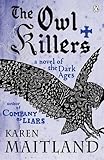
The Owl Killers by Karen Maitland

I can’t remember how I first came across Karen Maitland‘s books, but after I’d read Company of Liars I was hooked and bought The Owl Killers, a tale of witchcraft and pagan superstition set in 1321.

Karen Maitland has written four medieval thrillers, Company of Liars, The Owl Killers, The Gallows Curse, and Falcons of Fire and Ice, with The Vanishing Witch to be published later this year. She also writes joint medieval crime novels with a group of historical authors known as the Medieval Murderers.

I was going to summarise the novel but I think this description on Fantastic Fiction does it very well:

‘The Owl Killers’ is a novel of an embattled village and a group of courageous women who are set on a collision course – in an unforgettable storm of secrets, lust, and rage.

England, 1321. The tiny village of Ulewic teeters between survival and destruction, faith and doubt, God and demons. For shadowing the villagers’ lives are men cloaked in masks and secrecy, ruling with violence, intimidation, and terrifying fiery rites: the Owl Masters.

But another force is touching Ulewic – a newly formed community built and served only by women. Called a beguinage, it is a safe harbor of service and faith in defiance of the all-powerful Church.

Behind the walls of this sanctuary, women have gathered from all walks of life: a skilled physician, a towering former prostitute, a cook, a local convert. But life in Ulewic is growing more dangerous with each passing day. The women are the subject of rumors, envy, scorn, and fury, until the daughter of Ulewic’s most powerful man is cast out of her home and accepted into the beguinage – and battle lines are drawn.

Into this drama are swept innocents and conspirators: a parish priest trying to save himself from his own sins.a village teenager, pregnant and terrified,a woman once on the verge of sainthood, now cast out of the Church … With Ulewic ravaged by flood and disease, and with villagers driven by fear, a secret inside the beguinage will draw the desperate and the depraved – until masks are dropped, faith is tested – and every lie is exposed.’

My View:

The Owl KillersA long, historical novel well founded in its time and place; the historical detail is easily absorbed within the story, without feeling intrusive. There is a glossary of medieval terms and words at the end of the book which also helps to flesh out the detail. The story does indeed come alive through the descriptions of the physical and emotional lives of the characters in the small isolated community where the villagers have interbred – a sign of their belonging is their webbed fingers. Superstition, fear and belief in the supernatural rule their lives.

The novel is told through five narrators, which means there is a rounded picture of events, portraying the characters through their own eyes and also showing how they appear to others. I thought that was particularly well done, illustrating the tensions and misunderstandings between the characters.

The suspense builds as the tension increases, and I began to wonder if all the narrators were to be trusted. Fear of the ‘outsider’ is prevalent, the struggle for power dominates and the outsider is seen as the cause for events, such as floods, famine and disease, outside the villagers’ control. Religious and pagan beliefs clash, and the equality between men and women is challenged.

I found The Owl Killers a compelling story, at the same time down to earth and grounded in reality, yet mystical and mysterious and tragic as it explores the struggle to survive and the battleground between the old pagan beliefs and Christianity.

A Time of Gifts by Patrick Leigh Fermor

I read A Time of Gifts by Patrick Leigh Fermor a few weeks ago and have been mulling it over ever since. It began so well and I thought it was one of those books I was going to love. And then there are later passages which are so tedious and hard work to read, so full of dry facts and arcane words that I began to wonder why I was reading any further. But I did and then the writing swept me away and I became engrossed in the book again.

My reaction, I think, is to the two sides of this book, in which Patrick Leigh Fermor describes his travels on foot in 1933 from the Hook of Holland through Germany, to Austria, Slovakia and Hungary, on his way to Constantinople. (He continued his journey in Between the Woods and the Water, which describes his experiences up to the Iron Gates border between Rumania and Bulgaria.) The two sides are because he wrote this book in later life so his direct experiences and reactions are intermingled with the results of his later research and with the benefit of hindsight. I prefer the immediacy of his earlier writings taken from the diaries he kept along the way, bringing the countryside to life and recounting his encounters with the local people.

There are passages like the one below where he linked his journey to painting:

When no buildings were in sight, I was back in the Dark Ages. But the moment a farmhouse, or a village impinged, I was in the world of Peter Brueghel. The white flakes falling beside the Waal – or the Rhine or the Neckar or the Danube – and the zigzag gables and the muffled roofs, were all his. The icicles, too, and the trampled snow, the logs piled on the sledges and the peasants stooped double under loads of faggots. … When the wintry light crept dimly from slits close to the horizon or an orange sun was setting through the branches of a frozen osier-bed, the identity was complete.

In the end I scan read page after page of detailed descriptions of churches, of sociological, political or historical people and places.  I was too impatient to read all those details and I was reading the book too quickly. It’s a book to take your time with, to read a section, put the book down and come back to it later – and I didn’t do that, I swallowed it down with the result that parts were indigestible.

In a way his journey was a gilded experience as he had introductions to people in different places – people who gave him a bed for the night, or longer stays. There were also people who didn’t know him who welcomed him into their homes as a guest – as the title says it was a time of gifts. It was the period when Hitler came to power in Germany:

Appalling things had happened since Hitler had come into power ten months earlier: but the range of horror was not yet fully unfolded. In the country the prevailing mood was a bewildered acquiescence. Occasionally it rose to fanaticism.

But whereas not everyone liked the English there were some who did:

I answered many earnest questions about England: how lucky and enviable I was, they said, to belong to that fortunate kingdom where all was so just and sensible. The allied occupation of the Rhineland had come to an end less than ten years before, and the British, she said, had left an excellent impression.

Overall, I did enjoy this book. There are many passages so vividly described that I can remember them now weeks later – the vision of this young man, nearly nineteen years old striding through the German countryside reciting Shakespeare, in a loud voice and accompanied with gestures, sword thrusts, a staggering gait and with his arms upflung, looking as though he was drunk, or a lunatic. Then there was the time in Vienna when the money he was expecting hadn’t arrived and Konrad, a Don Quixote type character, took him round to a block of flats and encouraged him to knock on doors asking if the occupants wanted to pay him for a sketch of themselves.

In fact even with the dull passages, I liked this book well enough to buy the second book by Fermor Leigh, Between the Woods and the Water and I see that a third book is to be published later this year – The Broken Road, completing the account of his journey to Constantinople.

Following his walk across Europe, Patrick Leigh Fermor (1915-2011) lived and travelled in the Balkans and Greek Archipelago. He joined the Irish Guards and during the occupation of Crete led the party that captured the German commander. He was awarded the DSO and OBE.

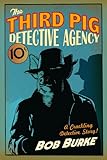
The Third Pig Detective Agency by Bob Burke

Reading The Third Pig Detective Agency by Bob Burke was a complete change of genre for me. It’s funny, a bit silly, a pastiche of American gumshoe crime fiction, and a fantasy  – indeed it’s a fairytale detective story. I did enjoy recognising all the fairy tale characters Bob Burke throws into the mix.

The Third Pig is Harry Pigg, who in his own words:

was the pig that built the house out of bricks while my idiot brothers took the easy route and went for cowboy builders and cheap materials.

Following his success at defeating the Big Bad Wolf, Harry became a detective, finding the two missing kids Hansel and Gretel and then identifying them as the murderers of the little old lady who lived in the gingerbread house.

But work for Harry had almost dried up, so when ‘an oriental gentleman the size and shape of a zeppelin‘, or in other words, Aladdin, the richest man in Grimmtown, accompanied by a sturdy white goat, none other than the eldest of the Gruff Brothers, demands his services, Harry can’t turn him down. Aladdin’s lamp had been stolen, an old battered lamp that he had kept under close guard, protected by hi-tech security and surveillance systems and Harry has to get it back for him. And so Harry sets out in pursuit of the lamp, aided or hindered by numerous characters, finding himself in all sorts of tricky and dangerous situations.

It’s a case of spot the characters from fairy tales and nursery rhymes and it’s most entertaining. Boy Blue, that lazy former shepherd tells Harry the lamp is rumoured to be a magic lamp, but Harry hates magic:

As a working detective it’s bad enough running the risk of being beaten up or thrown into a river with concrete boots on, without having to live with the possibility of being changed into a dung beetle or having a plague of boils inflicted on you. If you think humans were disgusting covered in boils, imagine how I might look.

And Harry just couldn’t have survived without the help of his Apprentice Gumshoe, Jack Horner, who rescues him several times.

There is no doubt that I’ll be reading more of Bob Burke’s books. the next one is The Ho Ho Ho Mystery which starts where The Third Pig Detective Agency ended when a very large lady dressed in black boots, bright red trousers and a hooded jacket came to see Harry and announced:

I need you to find my husband. He’s been kidnapped and it’s only two days to 25th December. If he’s not found soon we may have to cancel Christmas.

Carl’s Once Upon a Time VII challenge is coming to an end soon (21 June) and this is the fourth book I’ve finished. I may make five (my target for the challenge).