The Big Four by Agatha Christie

I’ve read a lot of Agatha Christie’s books, most of which I’ve really enjoyed, but I’m not too keen on her books that involve spies and gangs of international criminals who are seeking world domination. And The Big Four, first published in 1927, is one of those books.

Basically it’s a collection of short stories (derived from a series of stories that first appeared in The Sketch, a weekly magazine) in which Hercule Poirot and Captain Hastings lock forces with a vast organisation of crime led by four individuals, in the course of which they uncover the identity of the ‘Big Four’. The aim of the Four is ‘to destroy the existing social order, and to replace it with an anarchy in which they would reign as dictators.’  They are a Chinese man, Li Chang Yen, an American multi-millionaire, a French woman and ‘the Destroyer’, an Englishman. Poirot is convinced that they are behind everything:

The world-wide unrest, the labour troubles that beset every nation, and the revolutions that break out in some. There are people, not scaremongers, who know what they are talking about, and they say that there is a force behind the scenes which aims at nothing less than the destruction of civilisation. (page 25)

In the course of their investigations Poirot and Hastings find themselves in many dangerous  situations, all melodramatic and a little far-fetched, from which they miraculously escape certain death. The Big Four is action packed, with Poirot uncharacteristically chasing off after the criminals, still using his ‘little grey cells’ of course, whilst Hastings is knocked out and kidnapped, and Li Chang Yen threatens to abduct and torture Hasting’s wife, whom he had left behind in their ranch in the Argentine.

This is not one of my favourite Agatha Christie books. But perhaps it is not so surprising that The Big Four is far from her best. It was in  December 1926 that Agatha Christie disappeared after her husband, Archie Christie had told her he wanted a divorce and in 1927 she was still recovering from this. It was her brother-in-law’s suggestion that the last Poirot short stories she had published could be re-written to ‘have the appearance of a book‘ as a ‘stop-gap‘ – and the result was The Big Four, which, I think, suffers from being a loosely connected collection of episodes. Agatha explained in her Autobiography that Campbell Christie had helped her with linking the short stories as she was ‘unable to tackle anything of the kind.‘ (Autobiography page 365)
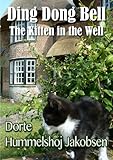
Knavesborough Stories by Dorte Hummelshoj Jakobsen

Recently Dorte Hummelshoj Jakobsen kindly made two of her short stories available to me (e-books) for review. They are both about the Gershwin family in Knavesborough, a fictional village in Yorkshire, namely Ding Dong Bell, the Kitten in the Well and Green Acres. I often find short stories lack the necessary depth to be convincing – either weak plots and/or characterisation, but these short stories are both convincing and satisfying. Maybe it helps that they are continuations of other stories, or in the case of Ding Dong Bell, the Kitten in the Well, a prequel.

Ding Dong Bell, the Kitten in the Well goes back in time to Rhapsody Gershwin’s childhood in the early 1990s. Rhapsody is the vicar’s daughter first featured in The Cosy Knave. In this short story Rhapsody and her sisters are worried about the disappearance of the black kitten they have called Black Pete. The last time they had seen him was when they had played in old Ursula Abbot’s garden and they wondered if he had he got locked in her cottage. Ursula had died but as she was nearly ninety it wasn’t entirely an unexpected death … but she had been in good health. Is Ursula’s death connected to Black Pete’s disappearance?Rhapsody helps to solve the mystery.
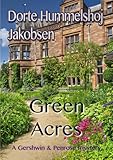
Green Acres* takes us to the latest in the Gershwin and Penrose Mysteries series. Green Acres, once a country mansion, has been converted into a home for the elderly. Rhapsody visits Rowan Dougal, a farmer who has broken his hip and is currently living at Green Acres. Lavinia Banbury staying in the room next to Rowan dies in her sleep. Nothing unusual in an old people’s home, but is her death really a natural one?

Green Acres* was originally published in the anthology The Red Shoes. This is a new and longer version.

I like these stories. They’re humorous crime fiction, with colourful characters all with quirky names. There’s no blood and gore and each story has an unexpected twist at the end. In other words, they are cosy crimes (if any crime could really be considered as ‘cosy’, that is).

Dorte Hummelshoj Jakobsen is Danish. After many years as a teacher she is now concentrating on a writing career, publishing in both Danish and English. As well as writing her cosy mysteries she has also written a full length psychological murder mystery novel, Anna Marklin’s Family Chronicles, which I thoroughly enjoyed too – see my post here.

Black Dogs by Ian McEwan

Black Dogs 001Black Dogs is one of Ian McEwan’s earlier books (his fifth), first published in 1992. The narrator is Jeremy who lost his parents in a road accident when he was eight and from then on he is fascinated by other people’s parents, particularly his in-laws, Bernard and June Tremaine. When he first met them they were living apart, barely on speaking terms. Starting from a shared belief in communism, they had separated when June turned to God after an encounter with evil in the form of two black dogs. What actually happened doesn’t become clear until the end of the book.

Jeremy is writing a memoir about their lives. The book shifts in time and perspective as he talks to Bernard and June separately. So it moves from Wiltshire, where he visits June in 1987 where she is living in a nursing home, to Berlin with Bernard, when the Wall came down in 1989. Then it moves back in time to 1981 at Majdanek where Jeremy met Jenny, Bernard and June’s daughter, during a visit to the death camp near Lublin in Poland; then to the present day (1989) at the family house at St Maurice de Navacelles in Languedoc in southern France; and finally to 1946 with Bernard and June, newly married on their honeymoon in St Maurice de Navacelles, where June had her encounter with the black dogs.

In 174 short pages the characters come alive, their ideas and meditations are revealed, and the places they inhabit are easily visualised. Black Dogs is a book that gets inside its characters’ minds. It centres around love, loss and longing. The incidents Jeremy describes are open to interpretation – June and Bernard are the extremities, neither seeming to be on the same wave length; Bernard a rationalist and a scientist, June a mystic and believer, seeing the same events through different perspectives. Jeremy is impatient with the difficulty of communication, seeing

an image of parallel mirrors in place of lovers on a bed, throwing back in infinite regression likenesses paling into untruth. (page 90)

The question of the black dogs hangs over the narrative – were they symbolic of evil, or an expression of Churchill’s term for depression, or real creatures? Their impact was immense however you look at it. Black Dogs is a book I really enjoyed reading and thinking about after I finished it. 

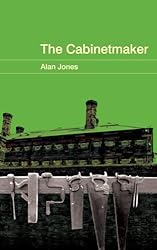
The Cabinetmaker by Alan Jones

When Alan Jones emailed me about reading his book The Cabinetmaker he described it as a gritty crime novel based in Glasgow that tells the story of a local cabinetmaker, Francis Hare, father of a murdered son, and John McDaid, a young detective on the investigation.

He went on to say that it contained some strong language, some sleazy police and a smattering of Glasgow slang, which did make me unsure I wanted to read it. But he also said that it combined Glasgow gang culture, sloppy policing and amateur football with fine furniture making and taking that into account I thought that it probably wouldn’t be your normal run-of-the mill crime fiction.

And I was right – it is different and I did like it, despite some of the language (which actually is no worse than in some other books) and there are no truly gruesome descriptions to put me off. In parts I thought it lost focus somewhat, the crime and justice aspects becoming a bit lost in a wealth of detail about football and furniture making, but apart from that it is a intricately plotted book which had me totally gripped. By the end of the book I realised that there is a purpose to those chapters beyond Alan Jones’s obvious love of football and furniture making. Within them lie the clues to what was really going on in Francis and John’s lives.

The Cabinetmaker follows John McDaid’s life from his first day as a detective up to his retirement in 2008, focussing on one crime – the killing of Patrick Hare, a student by a gang of thugs in Glasglow’s west end. The killers were tried but walked free.  From that point onward the story is of John and Francis and their search for justice.  Patrick’s death was a turning point in their lives and although they become friends through a shared interest in football and cabinet making, under pinning everything is their desire for justice.

There are many characters, including police and villains and at times some of them did begin to blur in my mind, with the exception of Francis, John and Sarah, Patrick’s girl friend, who all stand out as vivid and believable people. There are many twists and turns in the story, before the full truth is revealed. It’s a novel of loss and retribution.

Alan Jones (his pen name) is Scottish, living on the Clyde coast. I see from this interview on Omnimystery News that he is writing another book – I’ll be looking out for it.

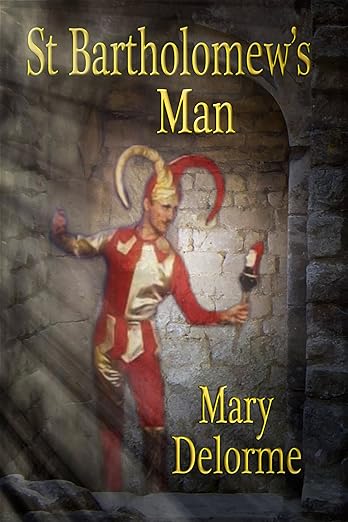
St Bartholomew's Man by Mary Delorme

I was intrigued when I was asked if I would like to read Mary Delorme’s book St Bartholomew’s Man, about Rahere, a man who was a court jester to Henry I and who was also instrumental in the foundation of St Bartholomew’s Hospital in 1123. I was intrigued because it seemed an odd combination, that a jester and the founder of St Bartholomew’s should be one and the same person. And I wondered how that had come about.

It is historical fiction but as Mary Delorme clarifies in her Author’s Note it is based on fact with this proviso:

Almost nine hundred years lie between Rahere and myself; enough to blur historical facts, and leave room for doubt. Rahere is often described as a man of lowly origins, and a jester – something I find difficult to accept, bearing his mind his outstanding achievements and experiences. I therefore began my novel assuming that he was more highly born; not of the highest, but still an educated man. (Loc 26)

It seems to me that she has thoroughly researched her material, and managed to incorporate it seamlessly into her book. St Bartholomew’s Man follows the life of Rahere, from his childhood growing up as an orphan in a monastery, where he was one of the singing children, and he helped the monks in their healing work.

It is a book that left me knowing a lot more about the late 11th and early 12th centuries. It tells of the lives of ordinary people, of the monastic life and above all of the dangers and turbulence of life, moving through the oppressive reign of the irreligious William II (William Rufus), the more settled and peaceful reign of Henry I, followed by the violent conflict that ensued with the reign of Stephen and Matilda. I liked the historical setting and the detail both about healing and building methods. The plot kept me interested to read on to find out whether Rahere succeeded, despite all the suffering he endured and the challenges he had to overcome, in fulfilling his vow to build a hospital to care for the poor in London. The characterisation is good and I felt all the main characters came over as real people, who grew and developed throughout the book.

I enjoyed reading this book, which made me want to find out more about Rahere and St Bartholomew’s. St Bartholomew’s Hospital website outlines the history of the Hospital and St Bartholomew the Great’s website gives some information about the founding of the Priory church and Prior Rahere. Rahere’s tomb is in the church.

Then there is Rudyard Kipling’s poem Rahere, based on the legend that Rahere founded St Bartholomew’s Hospital after suffering a bout of depression and seeing a family of lepers in a London street. I also see that Rosemary Sutcliff’s children’s book The Witch’s Brat is set in the reign of Henry I and features Rahere – I’m hoping to read that one too.

My thanks to Jon Delorme for providing a copy of St Bartholomew’s Man for review, a book that entertained me and led me on to other sources of history and literature. I really want to know more about the 12th century. My knowledge is limited to schoolgirl history and Ken Follett’s The Pillars of the Earth!

The Potter's Hand by A N Wilson

Now that the TBR Triple Dog Dare has finished I am free to read anything I want. I have bought/borrowed a few books since the beginning of the year and I immediately turned to The Potter’s Hand by A N Wilson, a library book I borrowed in March and fortunately I’ve been able to renew it. I had actually read the first couple of chapters, because I just couldn’t stop myself once I’d glanced at the dramatic opening paragraph, which I wrote about in a Book Beginnings post in March, but I resisted reading any more until April!

The novel begins in 1768 and roughly follows the fortunes of the Wedgwood family until 1805, 10 years after the death of Josiah Wedgwood, an English potter and the founder of the Wedgwood company. I say roughly because the narrative moves back and forth in time and place. It is a most remarkable book, which kept me wanting to read it each time I had to stop reading – it’s a long book which took me several days to read.

As Wilson explains in an Afterword the broad outlines of the story and most of the details are true, but he has altered dates and rearranged historical events and nearly all the letters are invented. It is ‘meant to be read as fiction, even thought it is intended in part, as an act of homage to one of the great men of our history.’

For me it really did convey what it must have been like to live in that period – whilst the the American War of Independence, the French Revolution, were taking place. It was a time of great change (what time isn’t?) both social and political change as the industrial revolution got under way in England. It’s full of ideas about colonialism, the abolition of slavery, working conditions, and women’s rights. It brought about small changes as well as big ones – for example, before Josiah’s time many families ate off pewter plates or wooden platters, but with his production of creamware ‘there was hardly a respectable household in the kingdom which did not eat its dinner off well-glazed delicate plates.’

Wedgwood’s fame was international and resulted in an order to supply Catherine the Great, the Empress of Russia with an enormous dinner service – the Frog Service, decorated with illustrations of grand houses, scenes of country estates, parks and gardens and numerous other British landscapes. And his great creation towards the end of his life was the Portland Vase, a copy of the original cameo glass Roman vase. But Wedgwood was not only a master craftsman, he was also involved with his friends – philosophers, scientist and inventors – in the development of the canals and roads improving transportation as his factory grew and prospered .

It’s big on character (lots of them), the main ones being Josiah Wedgwood himself, ‘Owd Wooden Leg‘, his daughter Sukey, his nephew Tom Byerley, his childhood friend Caleb Bowers and Blue Squirrel, an American Cherokee Tom fell in love with in America. But there are plenty more who come in and out of the narrative along the way, both fictional and historical, including Voltaire, George Stubbs (who painted the Wedgwood family portrait) and Samuel Taylor Coleridge. I was particularly interested in Dr Erasmus Darwin, Charles Darwin’s grandfather, with his stammer and familiar way with his lady patients (if Wilson’s depiction is true to life) and his ideas on creation and evolution.

Overall it is the story of a remarkable family, their lives, loves, work, illnesses, depressions, addictions and deaths. I found it fascinating throughout, whether it was set in America during the fight for independence, or in England in Wedgwood’s factories, or his grand new house Etruria Hall, or travelling through England on the new canals.